



Audience’s software lets PCs process your voice without special chips

Previously, Audience’s sound processing tricks have required a dedicated chip, limiting where you would see it; you’re more likely to get clever noise cancelling in your phone than in a PC. That’s changing shortly thanks to S1.0, the company’s first software-only approach to voice processing. The code primarily gives x86-based PCs better-than-usual noise reduction; people shouldn’t hear echoes or typing sounds while you’re in the middle of a chat. Audience’s technology also brings 360-degree voice boosting, so you can hold conference calls without making everyone huddle around the computer. There aren’t any confirmed customers for S1.0 just yet, but the company vows that “major PC OEMs” are testing it as you read this.
Don’t worry, phone fans, you’re covered as well. Audience is simultaneously unveiling two mobile audio chips, the eS804 and eS854. Both have improved noise cancelling and VoiceQ listening, so you’re both more likely to get your message across and less likely to accidentally wake up your phone. If your device has the eS854, you’ll also getting a new Smart Audio Codec that should handle all varieties of sound processing, not just speech. Manufacturers will have to wait until the first quarter of 2015 to get sample units, which suggests that you’ll see (or rather, hear) these eS800 chips in phones around the middle of next year.

Filed under: Peripherals, Software, Mobile
Source: Audience
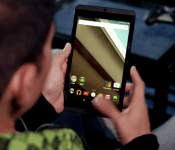
NVIDIA gives a sneak peek of Android Lollipop on the NVIDIA SHIELD Tablet
 With Android Lollipop officially released, the race is on to see which devices are going to be the quickest to be updated to the hugely overhauled operating system. Nexus devices are obviously a given to be one of the first, and Motorola devices are sure to be a close second, but who will follow after that? Well, if the latest sneak peek from NVIDIA is anything to go by, then Android Lollipop on the NVIDIA SHIELD Tablet appears to be a lock for sometime in November which would see it beat plenty of major Android players. Check out NVIDIA’s video which details some of the UI changes in Lollipop and NVIDIA’s own apps:
The speed of NVIDIA’s software update is presumably hugely helped by the fact the version on the SHIELD Tablet is incredibly close to stock Android, and it looks to take full advantage of the SHIELD Tablet’s Tegra K1 processor to make those new animations silky smooth. The SHIELD Tablet remains one of the most powerful Android tablets you can get at the moment – the Nexus 9 of course being the other tablet possessing a Tegra K1 – and is sure to benefit hugely from Lollipop’s improvements. As per the video, NVIDIA says the Android Lollipop on the NVIDIA SHIELD Tablet should be available sometime in November.
What do you think about Android Lollipop on the NVIDIA SHIELD Tablet being released in November? Let us know your thoughts.
Source: YouTube
//<![CDATA[
ord = window.ord || Math.floor(Math.random()*1E16);
document.write('‘);
//]]>
The post NVIDIA gives a sneak peek of Android Lollipop on the NVIDIA SHIELD Tablet appeared first on AndroidSPIN.

SoundCloud inks its first major label deal, eyes streaming service in 2015

After rumors swirled for months regarding SoundCloud’s pending licensing deals with major labels, Warner Music Group is the first to sign on. As part of the agreement, the German audio-streaming site will shell out funds each time one of the labels’ songs are spun. What’s more, it seems the crux of the deal was that SoundCloud would guarantee it’d be launching its own subscription service — which is said to happen during the first half of 2015.
The label will get a kickback when parts of its catalog are used in mashups too, but it doesn’t have to open its entire library for access. Warner also nabs a small stake in the site, a stipulation that was reported to be somewhere between 3 and 5 percent back in the summer. Right now, SoundCloud and its apps are free, but pack in ads to bring in revenue from its 175 million monthly users. Artists who upload their work in bulk have to fork over a monthly fee, but that’s for sharing only, as musicians don’t see any money in return. Lastly, it seems that talks with both Universal Music and Sony are on-going, per the Wall Street Journal report.
Filed under: Internet, Software
Source: Wall Street Journal

‘Destiny’ and the 9.5 million ‘registered users’ number

Activision is the most profitable game publisher in existence. The company’s behind the Call of Duty franchise, the Skylanders franchise and many more. You know World of Warcraft? Activision owns the company that makes it, Blizzard Entertainment. The company’s latest big release is Destiny — a $500 million bet that Activision’s making on the studio that previously created the Halo franchise (Bungie Studios). The game launched on September 9th across four platforms: Xbox 360, PlayStation 3, Xbox One and PlayStation 4. Activision CEO Eric Hirshberg says the game was “profitable from day one,” but the company’s yet to release up-to-date sales numbers. Instead, it’s offering a “registered user” statistic: 9.5 million. But what does that actually mean? That’s a good question. Hirshberg offered the following clarification during a quarterly financial call this evening:
“To date we have over 9.5 million registered users — of course there’s a relationship to sell through, it’s not exact. Because some people have more than one identity, but obviously that’s directional.”
Okay, what?
There are two ways to interpret Hirshberg’s explanation, and those interpretations hang on one particular bit of language in the statement. “Some people have more than one identity” is the problematic bit — is Hirshberg referencing folks who have more than one Xbox Live/Sony Entertainment Network login? Or is he referencing how many player characters have been created within Destiny?
These two interpretations come with starkly different outcomes. Should he mean the former, the correlation between 9.5 million “registered users” and sales of the game aren’t completely divorced. After all, there are only so many folks who purchase the same game on multiple platforms. We can pretty safely assume the actual unit sales of Destiny wouldn’t be very different from the “registered users” number if this is what Hirshberg is referencing.
But if he means the latter, that 9.5 million number could shrink pretty dramatically in terms of unit sales. Each copy of Destiny enables three character creation slots. It doesn’t cost anything extra to create extra characters (other than time, of course), and part of the appeal of Destiny is trying out different character builds. It also doesn’t help that there’s a relatively low level cap in the game thus far, meaning multiple characters is the way that many are extending their gameplay experience.
Thus, if “registered users” means “all created characters,” the correlation between that 9.5 million number and actual copies of the game sold to human beings is pretty weak. To the extent that the number could be divided by a factor of three, in fact. That’s a huge difference!
We’ve asked Activision for clarification and will update this should we hear more. That said, Activision not outright stating Destiny sales (for the second month in a row) says a lot unto itself.

‘Call of Duty: Advanced Warfare’ is having a rocky launch on Xbox One and PlayStation 4

Call of Duty continues to be a pretty big deal. Despite annualized releases and the occasional stinker (we’re looking at you, Modern Warfare 3!), people still love to wage virtual war on Activision’s battlefields. Hey, we hear this year’s game is pretty good! And when you’ve got a new Xbox One or PlayStation 4 this holiday, there’s a strong possibility you’ll want to check out this year’s entry, Call of Duty: Advanced Warfare — statistically speaking, anyway. Should you be one of those folks: beware! Both Xbox One and PlayStation 4 versions of CoD are having issues. The kind of issues that make the game outright unplayable.
Somewhere in Los Angeles, Kevin Spacey is shedding a single tear and he doesn’t know why.

So, what’s going on with Call of Duty? It’s down to platform. First up:
PlayStation 4
If you pre-loaded the game on PlayStation 4, Sony suggests deleting the file (nearly 40GBs) and pulling down the whole shebang once more. More specifically, it looks like Advanced Warfare issues on PS4 are strictly limited to folks who pre-loaded the game before launch (today). If you took advantage of said functionality, that may be why you’re experiencing issues starting the game.
Here’s what Sony suggest you do, in full:
- “Restore PS4 licences. [Settings] > [PSN] > [Restore License].
If this doesn’t solve the issue continue to [following steps]:
- Go to Library, highlight Call of Duty: Advanced Warfare and press Options.
- Delete Game Content.
- While still in the Library highlight Call of Duty: AW and press X to re-download the content.
Please ensure you download all available updates for Call of Duty: Advanced Warfare and your system is running the latest system software.”
Activision has yet to acknowledge the issues publicly, and we’ve not heard back from reps.
Xbox One
We’ve got firsthand experience with this one, and the issue is a little more prevalent than PlayStation’s equivalent. If you buy Call of Duty: Advanced Warfare on disc, beware not to allow the game’s update to download when you first insert the disc into your Xbox One. We said yes, and the game was unable to install from the disc. It ends up looping between “Installing” and “Queued,” occasionally spinning up the disc, then quitting, then spinning again, then quitting again, ad infinitum. In the business, we call that “pretty whack.” If you end up in this situation, we’ve got a tested solution — and it works, at least on my Xbox One — care of Crave Online:
- Remove the Call of Duty: Advanced Warfare from the Xbox One disc tray.
- Navigate to My Games & Apps, then select the Call of Duty: Advanced Warfare and hit the Xbox One gamepad’s Menu button.
- Select “Uninstall game” and hit A
- Re-insert your Call of Duty: Advanced Warfare game disc
- When asked whether you want to install the game’s update, select “Update later”
- The game will install like normal! Hooray!
Again, Activision has yet to acknowledge the issues publicly. We’ve asked. The company has forum threads set up to address issues with digital versions of the game, and an overall setup/installation page (which warns against playing the game before it completely installs, despite current-gen consoles allowing you to start before installation is finished). There’s even a page dedicated to Xbox One installation issues, but nothing regarding the installing/queued loop that some folks are experiencing with disc versions of the game on Xbox One.
We’ll update this piece as we hear more, but for now: Beware!

Football training could soon get a boost from virtual reality

So far, the gaming and entertainment industries have welcomed the modern VR craze with open arms. In sports, however, that adoption hasn’t been particularly prominent. Here’s where EON Sports VR hopes to come in, starting with football, one of the most popular sports in the US. With a newly launched Kickstarter, and backed by legendary NFL coach Mike Ditka, the Kansas City, Missouri-based startup wants to integrate virtual reality into football training. Using a smartphone-powered VR headset (similar to the Gear VR), known as the Dive Sport, the goal is to build different coaching experiences for players that are “as fun as video games,” yet as “serious as training camp.”
Just as well, EON Sports VR has its Sidekiq software to go with the novel hardware, a football simulator that teams can use to create plays and scenarios in virtual reality — in fact, the software is already being used by coaches across the country, only without the headset.
Training drills will obviously be one of the most common uses for the Dive Sport, and there are a lot of people who know the sport very well involved with the project. Among them is Ditka, best known for turning the Chicago Bears into one of the most feared teams in the NFL during the ’80s. “EON Sports is revolutionizing football in the way you study the game, the way you understand your opponent and the way you prepare,” says Ditka. “And you will have a visual of it, which is much better than film [in] doing in certain situations. It’s revolutionary and unbelievable.”
Brendan Reilly, CEO of EON Sports VR, told me that, if successfully funded, “there are a lot of social aspects we’d like to integrate in the mobile version that go beyond just this Kickstarter.”
“It’s pretty unbelievable how everything has come into place so far. [The] first domino to fall was the fact that rendering complex interactive environments can now be done on your smartphone. Second was in getting such an positive response from the coaching community and having guys like Mike Ditka, Terry Shea and Steve Clarkson, among others, not only want to work with us, but [also] provide us with a wealth of knowledge at how this technology can help football players,” he added.
“Our goal of $50,000 is the minimum amount needed to make this happen,” Reilly says, “but we have much higher aspirations than just that.”
Filed under: Misc, Peripherals, Software
Source: EON Sports VR (Kickstarter)
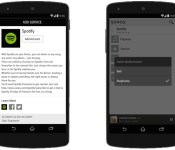
Sonos’ multi-account beta lets you keep playlists to yourself

Sonos’ whole-home audio gear is tailor-made for families, but you’ve had to use a single account for each music service — not so hot if you’d rather not share your Spotify rap playlists with the kids. You won’t have to squabble over whose account gets priority for much longer, though. A new Sonos controller app beta lets you switch accounts on the spot, so you won’t have to sign in every time you want to hear your carefully curated tunes. The upgrade also provides a few additional perks, depending on the platform you use; Android users can finally control a Sonos setup from the lock screen, while Playbar owners should get better sound staging and balancing. You can try the beta today if you’re using Android, a Mac or a PC, and the finished software should reach everyone before the end of the year.
Filed under: Home Entertainment, Software, HD, Mobile
Source: Sonos

Touching virtual reality with Nimble VR’s Sense camera

Every time I use virtual reality headsets, I find new limitations. Now that I’m finally “inside” a virtual world, I want to explore. I want to touch things and feel them respond. I want to speak and have my voice heard inside the virtual world. I want to see my hands represented virtually, and I want to be able to use them as I do in real life. I very much doubt I’m alone in this — the latest Oculus Rift dev kit has a dedicated USB port on top of the headset explicitly for peripherals that intend to solve these issues. I spent an hour last week with one such device: the Nimble Sense camera from Nimble VR.
The Nimble Sense camera is a skeletal-tracking camera/laser combination from PMD — it both picks up and tracks human skeletal movement, as well as creating a point cloud of the world around you. It’s not quite pass through vision (seeing “through” the VR headset into reality), but it enables a blurry version of your own body and the world around you. Enough so that you could, say, drink from a cup.
http://www.engadget.com/embed-5min/?sid=577&playList=518495711&responsive=false
You know Microsoft’s Kinect? It’s kind of like Kinect, except much smaller. The device attaches directly to the top of the latest Oculus Rift dev kit (DK2) via a 3D-printed mount. It points down at an angle, intentionally aimed at your hands while you look straight ahead.
I was shown several demos and able to try out several myself. In one, three enemies approach and I’m able to raise my hand to aim; when I open my hand, lightning fires out. It’s crude, but the tech demo shows how games are able to use Nimble Sense’s data to bring my arms into the game without perceptible lag. In another, Nimble VR co-founder Robert Wang picks up individual dice cubes on a table. He spins them around before placing each in a cup, then picks up the cup and spills them back onto a table in front of him.
This of course begets a new issue: feedback. If you pick up virtual dice with your virtual hand, you don’t feel the dice. Your brain approximates that action using spatial perception, but you’re still broken from any intended immersion in the process. Wang and his team aren’t against some form of glove that would approximate feedback, but he (rightly) points out that a glove is yet another peripheral to put on. As if putting on a virtual reality headset wasn’t enough?
If you think this sounds like Leap Motion, that’s because it’s very similar to Leap Motion. Nimble actually created a video explicitly showing the difference, right here:
Convinced? Don’t get too excited just yet — Nimble VR’s Sense camera is still a prototype, and the only way to reserve one is chipping in $99 on Kickstarter. The group’s already surpassed their goal, so you don’t have to worry about whether the crowdfunding round will succeed, and Nimble VR has seed funding to (hopefully) ensure the product arrives as promised in June 2015.
Filed under: Cameras, Gaming, Peripherals, Software

Skype’s Translator preview goes live for Windows 8.1 users

We first heard about Skype’s Translator feature back in May, and that it should arrive before the end of the year. Well, in keeping with that timeline, the video-chatting outfit opened up a preview for Windows 8.1 devices. As its moniker suggests, the new feature converts speech in real-time, to keep the lines of communication open without the need for a third person to do the translating. It also shows an on-screen transcript during calls and can sort IM translation in 45 languages. If you’re wielding a computer or tablet that’s running the aforementioned OS, head over to the source link to opt in to the preview ahead of the new tool’s official arrival.
Filed under: Internet, Software, Microsoft
Source: Skype
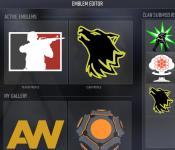
Call of Duty: Advanced Warfare Companion App Available
Today is zero day for the next Call of Duty from Activision, Call of Duty: Advanced Warfare. The latest installment in the franchise pulls out some futuristic combat that certainly looks to be exciting. Along with a new triple-A title comes the official companion app. Similar to those that we have seen with Battlefield, Titanfall, Call of Duty Ghosts and other high-profile games.

The companion app is just that, a companion. It lets you create and manage your clans and clan emblems. There is a mini game of sorts that will let you pit your clan against similar sizeed and skilled clans for for positions on the in-app Clan War map and earn some loot while on the go.
The app is free and does require you to have login details accompanied by having actually purchased the new console title. It would appear that there are plenty of the usual first day launch issues with the app, like not being able to sign in. More than likely the servers are being hammered and things will slow up soon. If not, then you can expect an update to the app pretty soon.
//<![CDATA[
ord = window.ord || Math.floor(Math.random()*1E16);
document.write('‘);
//]]>
The post Call of Duty: Advanced Warfare Companion App Available appeared first on AndroidSPIN.
 AIVAnet