


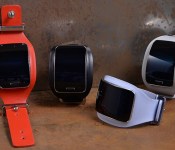
Samsung’s Gear S hits the runway with Diesel Black Gold for New York Fashion Week

When we saw Samsung’s Gear S curved smartwatch last week, we said its design, “feels functional, but also like an afterthought.” The 2-inch behemoth certainly doesn’t blend into outfits as much as it becomes the centerpiece, for better or worse. Diesel Black Gold — the even more expensive, “premium” line of the Diesel clothing brand — is apparently down with that, and is working with Samsung on a variety of “unique” bands (seen above). That’s pretty much all the news there is about these so far — no pricing or release dates were given — but check out this amazing sentence from the announcement, describing the bands:
“Elements of the SS 15 collection, inspired by highly stylized New Wave rock stars and tough rockabilly heroines, have been used to give a sharp attitude to the device, characterized by signature leather and metal details.”
Delightful! The Stray Cats and Siouxsie and the Banshees clearly influenced the above design. And yes, they are just a series of colored bands for holding the Gear S. If that weren’t enough, the debut of said bands is being captured in 360-degree film and released for Samsung’s virtual reality headset, Gear VR, when it launches later this fall with the Note 4 smartphone. That is some serious crossbranding, y’all. Crossbanding? Sorry, we’ll see ourselves out.
Filed under: Wearables, Mobile, Samsung
Source: Samsung
.CPlase_panel display:none;
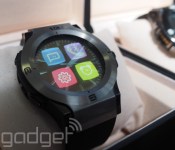
An analog timepiece beats in the heart of this awkward smartwatch

Think you know what to expect in the emerging category of wrist-worn computing? Think again — the thick, heavy device pictured above is the Halo: a smartwatch that almost has more in common with a traditional timepiece than it does with a smartphone. Lonshine technologies bills the Halo as “the world’s first smart analogue watch,” meaning that it still relies on the ticking of mechanical quartz movement to keep time. This is a smartwatch that has a real watch face and real hands nestled underneath a transparent touchscreen.
If you’re wondering “why” (so were we), the answer is simple: battery life. The Moto 360 may be an attractive, functional wearable, but when its battery runs down it loses the ability to tell time. The Halo doesn’t — its mechanical movement runs on a standard watch battery, and lasts up to three years. Its higher functions are completely separate, almost an afterthought to the device’s primary function as a timepiece. Unfortunately, that disharmony shows.

The Halo is a heavy, thick watch that comes in two variants — an extra thick model (the Halo-2) that features extra batteries in the wrist-band and room for a sim-card as well as a slightly slimmer (but still notably large) Bluetooth model. Both watches run a heavily stripped down version of Android and can be used to make and accept calls and text messages (as as Google Hangouts) and display weather data. The experience is responsive, and overlays the traditional watch nicely, but it’s extremely limited. This is a last generation smartwatch embedded within last century’s timepiece.
For its faults, the Halo is actually a very novel idea — by retaining classic watch mechanics, it ensures the wearer will always have at least basic functionality from the wearable, giving it a form of battery life that no other smart wearable on the market can manage. Lonshine technologies says it’s looking for partners in the US to help market and distribute the watch, but couldn’t say when it will launch. When it does arrive, however, it should be somewhere in the $300 price range.
Filed under: Wearables, Wireless
.CPlase_panel display:none;
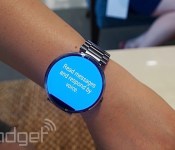
Verizon will sell the Moto 360 with a metal band on November 11th

If you refuse to wear a Moto 360 smartwatch until it’s equipped with a metal wristband, you now have a firmer date than “fall” to mark on your calendar. Verizon says that it will ship this slightly ritzier version of Motorola’s wearable in both black and silver on November 11th for the expected $300. It’s not certain that Verizon will be the first out of the gate with the extra-shiny 360, but its timing should serve as a good yardstick even if you don’t plan to buy your watch at Big Red. And don’t forget: if two months is simply too long to wait, you can always buy the leather edition now and upgrade to metal later for $80.
Filed under: Wearables, Google, Verizon, Lenovo
Via: 9to5Google, BGR
Source: Verizon
.CPlase_panel display:none;
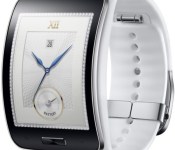
Samsung posts infographic of the Samsung Gear family
 Samsung looks like they are in a very ‘infographic’ mood. After posting an infographic of the Galaxy Note series over the years, Samsung has come out with another infographic of the Samsung Gear family, showing its full range of wearable devices, from the aging – but still supported – Galaxy Gear, the Gear 2, Gear 2 Neo, Gear Fit, Gear Live, right through to the brand-new Gear S announced just before IFA 2014. Check out the infographic below; be sure to click the thumbnail to view the full sized image:

It’s clear that Samsung is fully committed to the wearable craze, particularly with their efforts to update their seemingly abandoned Galaxy Gear with Tizen, their operating system baby. In fact, apart from the Gear Live smartwatch which runs Android Wear, all of Samsung’s Gear devices run on Tizen; it’s no wonder that Google has been annoyed at Samsung for investing far more effort into creating Tizen wearables rather than Android Wear wearables. Only time will tell whether Samsung has the better strategy or not, but with the influx of Android Wear smartwatches released at IFA 2014, it’s hard to imagine even Samsung triumphing in this space.
What do you think about this infographic of the Samsung Gear family? What are your thoughts on Samsung’s wearables? Let us know your opinion in the comments below.
Source: Samsung Tomorrow
//<![CDATA[
ord = window.ord || Math.floor(Math.random()*1E16);
document.write('‘);
//]]>
The post Samsung posts infographic of the Samsung Gear family appeared first on AndroidSPIN.
.CPlase_panel display:none;
Here’s what it’s like to use a watch as a phone

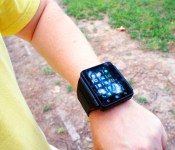
No one wants the smartwatch category to succeed more than I do. As a kid, I dreamed of enjoying TV on my watch, or video calling “HQ” (or more likely, my mum), just like Penny in Inspector Gadget. Most smartwatches offer a taste of this experience, but not the whole enchilada. Enter Neptune Pine. It’s a smartwatch by the loosest definition: it’s a small Android phone in a wrist-strap. Whatever you want to call it, it’ll do both of the above things, and more. It’s also a genuine Kickstarter success story — like, one, where the product came out and everything! It might not be the first smartwatch/phone mash-up, and it’s (definitely) not the last. But, it’s one of the more ambitious takes on the idea I’ve seen. I spent seven days with it (and no other phone) to see how my dream stands up to the reality — and whether a watch could ever replace your trusty mobile. The galleries tell much of the story, so be sure to jump in when you see them.

I’m not joking when I say it’s a small phone. It has a 2.4-inch (320 x 240) display, has a micro-SIM slot, runs Android (JellyBean), comes with 512MB of RAM (plus 16- or 32GB of storage) has front and rear cameras and, well, pretty much everything you’d expect from a phone (GPS, apps, headphone jack etcetera). It’s a chunky device — pretty much what you’d expect a wrist-phone to look like. It’s also undoubtedly bigger than any watch I have ever used. By some margin. Dive in to the gallery to see for yourself.

If the form factor isn’t an issue for you (the strap comes with two choices: like it, or lump it), there’s the software to consider. Most smartwatches come with a custom user interface (until Android Wear showed up). Neptune’s plumped for stock Android, just as you already know it. While the screen size is uncommon these days, the resolution isn’t wacky (HTC’s Wildfire, for example, was/is 320 x 240), so theoretically most apps should work. How well is something of a case by case journey of discovery. But, if you’re wondering what Facebooking, tweeting or dialling a number from your wrist would be like, you’ll see in the gallery below. In short, with a bit of work, the Pine can feel just like your a regular Android. But, not without some important caveats. This raises the question: If a proprietary interface can’t win people over, and stock Android has challenges, where to do watch-phones go from here?
Let’s tackle the (other) elephant in the room. The biggest barrier for wearables is how they look and feel — a nut that’s yet to be cracked, despite best efforts. This shouldn’t be a surprise though, given that, well, you’re wearing these things. The Neptune Pine is big, chunky, and a bit uncomfortable if worn for long periods. It also has no style customization options (at time of writing), and, well, it’s fairly ugly. Like babies, though, some parents (owners) will love it regardless — but it’s definitely high on the dorky scale. I’m okay with it, but others, many others, won’t be. Of course, that might not be a problem if the user experience is delightful. Sadly, that’s not quite how I’d describe it. The lack of Google services/Play store out of the box means it requires some noodling to get it just how you want it. For those mainstream consumers who could see past the exterior, the Play hurdle is likely enough to turn them off. Then there are the small idiosyncrasies, like having to take it out of the strap (which can be a clumsy task) if you want to take a picture — so no impulse snaps we’re afraid.
The minor gripes continue. The headphone experience is only worth thinking about if you’re using a Bluetooth set. I think it’s nice to have the option of a 3.5mm line out for a number of reasons, but practical headphone use isn’t one of them. Put on some headphones now, and tuck the cable under a watch — you’ll soon see what I mean. More pressing (no pun intended), are the issues with the display. The touch detection is frustrating. Typing is possible, but quite often it can feel like you’re drunk, as you mash the tiny keys and the wrong letters or options respond. It’s serviceable, but it’s not perfect — SwiftKey works, and improves the experience somewhat. But input is a fundamental that companies will need to figure out. It can also be a little uncomfortable holding your wrist in the right position for typing/watching video. This is exacerbated by the fact the Pine’s screen has fairly poor viewing angles. Worse, is that if worn on the left wrist (for most right-handers), it’s that angle you’ll be viewing from that suffers most. The last of the bad news is that the battery life is just okay enough to see you through a day. But it’s usually a close call. Displays, input and battery-life: none of them new challenges for smartwatches.

There are positives though. Using apps like Skype, maps, and fitness loggers is, dare I say it, an improvement on the experience you often get on a phone. Voice calls do work, and still feel kinda “fun” or futuristic. You’ll definitely want to have a hands-free ready, but it’s not a bad experience. It’s also a good general purpose media player. While you wouldn’t want to watch a film on a smartwatch, it can make a great mp3/music player, and there’s definitely a novelty factor to watching YouTube videos on one (that, plus Skype, satisfies my childhood dreams!).
The bottom line, though, is that Pine only proves what plenty already suspected — a watch can’t usurp your phone, at least not yet, not permanently. The Pine has enough going for it though that it deserves, and already looks to have, a dedicated fan-base. Android tweakers, tech-savvy folk who can tolerate low-level gripes for a device that does more things, hobby-hackers and lovers of geek-chic (I kinda warmed to the looks of it myself in the end) will get on well with Pine. There are other entrants into this market. Samsung’s new Gear S is definitely a more refined take on the idea (in design at least, but the UI is yet to be proven). Perhaps the hybrid watch/phone will mature into something more practical and public-ready. But that time isn’t now.
Filed under: Cellphones, Wearables, Mobile
Source: Neptune
.CPlase_panel display:none;

Fossil and Intel are teaming up to make Android Wear devices
 With the smartwatch space heating up, more and more high quality watchmakers are looking to make entry into this space. Fossil, maker of some truly breathtaking watches, is next on that list of interested parties and have just announced a partnership between Fossil and Intel to create Android Wear devices. In fact, Fossil is no stranger to the smartwatch industry; MetaWatch is a Fossil-branded offshoot, albeit one that hasn’t quite reaped the rewards it might have expected. Despite this, it looks like they’re willing to have another go, this time with a different operating system and Intel fanning wind into their sails.
However, it doesn’t look like Fossil and Intel’s ambitions end with wrist wearables. With quotes like this:
“Combining our fashion lifestyle brands with Intel’s expertise in technology, hardware and innovation will position us to be a leader in this segment.” – CEO of Fossil, Kosta Kartsotis
And this:
“The combination of Intel’s technology and Fossil Group’s ability to design innovative fashion accessories and to create, market and distribute globally is why we are confident about this initiative.” – VP and GM of Intel New Devices, Mike Bell
It looks like Fossil and Intel are leaving the door open for wearable technologies to be mixed into Fossil’s jewelry and accessories business too. That could be an important innovative differentiation in a market now crowded by wrist wearables, but we’ll see where this partnership goes.
What do you think about Fossil and Intel teaming up to make wearable technology? Let us know your thoughts in the comments below.
Source: Intel Newsroom via engadget
//<![CDATA[
ord = window.ord || Math.floor(Math.random()*1E16);
document.write('‘);
//]]>
The post Fossil and Intel are teaming up to make Android Wear devices appeared first on AndroidSPIN.
.CPlase_panel display:none;
Huawei will join the smartwatch party with Android Wear device of their own
 Although HTC may have pulled out of the smartwatch race, it looks as though Huawei will join the smartwatch party in the near future. In an interview at IFA 2014, Huawei CEO, Richard Yu, said that the company is readying a device for release next year and confirmed that it would be running the Android Wear operating system. Yu didn’t say much more than that on the device, but said it would be “innovative and beautiful”. He also mentioned it would be “more beautiful” that Samsung’s recently announced Gear S, however that being decidedly the black sheep of the smartwatches announced at IFA 2014, we would say that isn’t a terribly difficult feat.
Huawei’s previous wearable ventures only include the TalkBand B1, a device that is more closely reminiscent of a fitness device than full-blown smartwatch. We’d expect any future devices to resemble a more traditional watch form factor, but we’ve yet to see anybody focus on fitness with Android Wear. Also, we’d question Huawei’s plan to release next year when all the manufacturers will already have a foothold in this market, but it does give them a chance to correct any potential mistakes other smartwatches have. Whatever the case, we’ll likely be hearing more about the device the closer its release date comes.
What do you think of a Huawei Android Wear smartwatch? Let us know your thoughts in the comments.
Source: engadget
//<![CDATA[
ord = window.ord || Math.floor(Math.random()*1E16);
document.write('‘);
//]]>
The post Huawei will join the smartwatch party with Android Wear device of their own appeared first on AndroidSPIN.
.CPlase_panel display:none;
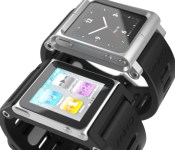
Yes, Apple’s smartwatch should run third-party apps

Tipsters have been seemingly eager to shed light on every single facet of Apple’s long-rumored smartwatch, but one obvious question hasn’t really received a clear answer: will it run third-party apps? If you ask 9to5Mac, the answer is “yes.” Its sources claim that the iOS-based wristwear will not only support third-party software, but already has a developer kit to make sure there are plenty of titles ready for the reported launch early next year. There isn’t much word about what these apps can do, although they’ll supposedly make good use of iOS 8 features like Handoff and widgets to quickly transfer info between the watch and its companion iPhone.
You may even get a peek at what these apps can do at Apple’s September 9th event. As with past iOS devices, a handful of developers have supposedly received early access to the programming kit so that they can show off their work at the media shindig. It’s not surprising that Apple would create a wearable app platform; Google, Pebble and Samsung already have their own. If true, though, the news might prove comforting to anyone worried that Apple is working on little more than an iPod nano on steroids.
Source: 9to5Mac
.CPlase_panel display:none;
HTC is rumoured to have abandoned their smartwatch aspirations for now
 While many manufacturers have made very impressive announcements of their Android Wear smartwatches, one manufacturer has been glaringly missing from that list. HTC is rumoured to have at least one, possibly two, smartwatches it was allegedly readying for a September release, making a showing at IFA 2014 almost inevitable. While IFA isn’t over yet, the window for big announcements has passed, and we’re searching for reasons why HTC might not have had anything to show. As it turns out, it may be because HTC is rumoured to have abandoned their smartwatch aspirations for now.
It might be easy to say HTC must have been scared off by its competitors’ offerings, but sources say that HTC is ditching its smartwatch program due to large costs and “a lack of wow factor”, something which many of the other Android Wear smartwatches have had bundles of. While we’re definitely disappointed that HTC is likely not entering the smartwatch game yet, the company would be much better served given the current market to postpone their release and revisit the idea when they have, for lack of a better analogy, the HTC One M7 of smartwatches.
What do you think about this rumour that HTC is killing its smartwatch plans? Let us know your opinion in the comments.
Source: Pocket-lint via engadget
//<![CDATA[
ord = window.ord || Math.floor(Math.random()*1E16);
document.write('‘);
//]]>
The post HTC is rumoured to have abandoned their smartwatch aspirations for now appeared first on AndroidSPIN.
.CPlase_panel display:none;

Behind the watch: the Moto 360 story

“It’s not a smartwatch,” said Iqbal Arshad, Motorola’s Senior VP of Global Product, to a roomful of journalists in Motorola’s Chicago headquarters. Instead he, and by extension the rest of Motorola, prefer to think of the Moto 360 as a reinvention of the humble wristwatch — more of a modern timepiece than a futuristic gadget. It’s with that philosophy in mind that Motorola made the 360 the way it is. That’s why its face is round. That’s why its leather strap is sourced from the Horween Leather Company, a premium tannery located in the Windy City. That’s why Motorola took care to encase the 360 in polished stainless steel. That’s why it’s providing a premium metal band option later this year. The Moto 360, as far as Motorola is concerned, is watch first, fancy mobile computer second.
That’s not to say Motorola didn’t consider the square shape. In a behind-the-scenes tour of Motorola’s spacious facilities, we were shown early prototypes of the 360 that were decidedly rectangular. Design director Dickon Isaacs explains that it was simply the only option for smartwatches at the time. However, when they tested the square mockups with plastic wrist trees — rough approximations of male and female wrists — they saw that the fit was clunky and awkward. “They just weren’t very wearable,” he said. Further, he said that when most people think of a watch, they think of a circle with straps attached. It’s what he calls a “stored shape” — a universally accepted idea of what something should look like.
So the team decided to go all-in on a round watch. But even that had its challenges. Beyond working with Google to come up with an Android Wear UI that’d play nice with a circular screen, they also wanted a round face that was wide enough to accommodate “glanceable information.” So instead of creating a round watch with a thick bezel, they opted for as much screen as possible — it’s why the 360’s glass goes almost edge-to-edge. Unfortunately, that meant they had to house the watch’s display drivers and ambient light sensor in a rather noticeable black slice at the bottom of the display. That was the price Moto was willing to pay to get more screen out of a round display.
The result is the watch that got arguably the most buzz when Android Wear was announced earlier this year. Sure, LG and Samsung came to market first with their square iterations, leaving Motorola to be third out of the gate. But seeing as LG is also now dabbling in the round watch territory (and Samsung too apparently), Moto’s instincts might not be off the mark. For more on how the Moto 360 came to be, take a look at the gallery above where we walk you through the early mockups, the 3D printers they used for the initial prototypes and more. As for our final thoughts on the 360? Well, that will have to wait for our full review. Stay tuned.
Filed under: Wearables, Mobile
.CPlase_panel display:none;
 AIVAnet