



Daily Roundup: Google’s robotic dog, one-way trips to Mars and more!

In today’s Daily Roundup, we marvel over the impressive stabilization abilities of the latest robot from Google-owned Boston Dynamics, get all the details on why people want to go on a one-way trip to Mars and review BlackBerry’s latest phone, straight out of 2011. All that and more past the break.
Google’s got a robot dog that stalks indoors, haunts dreams

Google-owned Boston Dynamics showed off its latest quadruped, “Spot.” This 160-pound robot is able to conquer a variety of challenging situations thanks to an array of sensors on its head that helps keep it balanced.
Here’s why people are volunteering for a one-way trip to Mars

A new documentary about the Mars One mission was just released by The Guardian. It interviews three Mars One finalists and asks why they’d want to leave our relatively safe and comforting home for a new life on a planet far, far away.
BlackBerry Classic review: A love letter to fans and few others

The BlackBerry Classic looks like a phone straight out of 2011, but it has a few modern touches to make it interesting. Is it enough to turn things around for the struggling company? Read our review and find out.
New video spec clears the way for 8K laptop screens

We’re finally starting to get comfortable with 4K displays, but the Video Electronics Standards Association (VESA) just unveiled Embedded DisplayPort 1.4a, a new format that lets all-in-ones and laptops use 8K screens. That’s a resolution of 7,680 x 4,320 pixels.
Neil Armstrong kept the original moon landing camera in his closet

After returning from the moon, Neil Armstrong stored numerous items from the Apollo 11 moon landing in a closet at home, including the 16mm Data Acquisition Camera used to record the iconic moment he reached the lunar surface. Some of these items will be on display at the Smithsonian National Air & Space Museum starting on June 8th.
Apple cracks down on accessory makers to discourage leaks

Sources for 9to5Mac claim that Apple is making key accessory manufacturers sign agreements that prevent them from making items for upcoming devices based on factory leaks. If the firms give in to the temptation and ship leak-based products, Apple warns of “penalties.”
Samsung swears its smart TVs aren’t eavesdropping on you

Samsung’s smart TV privacy policy recently left a number of people worried that the manufacturer was eavesdropping on private conversations. The company posted a response clarifying how its voice-recognition features work.

Samsung swears its smart TVs aren’t eavesdropping on you
Over the weekend, quite a few people panicked at the phrasing of Samsung’s smart TV privacy policy. Its warning that third parties would get your sensitive spoken info conjured up images of Orwellian telescreens spying on their viewers. The reaction was largely paranoia (this was just a description of standard cloud-based voice recognition), but the company isn’t leaving anything to chance — it posted a retort that denies any eavesdropping and clarifies what its screens are really doing. As Samsung explains, neither the TV’s mic nor the one in your remote are monitoring everything you say. The TV only listens for a predetermined set of commands, while the controller won’t handle more sophisticated requests (such as asking for movie advice) until you hit a button.
The explanation isn’t perfect (how long is that information stored, for example?), but it doesn’t leave much room for debate. However, it also suggests that smart TV makers haven’t finished tackling the privacy concerns that have plagued them since at least 2013. Unless every manufacturer both respects privacy and is clear about what’s happening, there may always be a nagging suspicion that these smart sets are too nosy.
Filed under: Home Entertainment, Internet, HD, Samsung
Via: TechCrunch
Source: Samsung Tomorrow

Samsung to begin producing and selling authentication chips for Samsung and third-party accessories

The Korean blog, DDaily, is reporting that an insider has given them some information detailing Samsung’s attempt to create an accessory ecosystem not unlike what we see with Apple’s.
These NFC-equipped “authentication chips” will allow Samsung to give both its blessing to particular accessories, as well as allow itself and third-parties to design smarter accessories that exhibit a greater connection to Samsung’s devices.
Samsung and other sources have indicated that, unlike in the past, these authentication chips will be manufactured and sold by Samsung directly. The hope is that these new lines of accessories will create an ecosystem that advances the appeal of the upcoming Samsung Galaxy S6.
DDaily’s source said, “The decision to mount authentication chips to accessories aims to differentiate the functions of original products.” They go on to say that consumers will see the first round of authentication chips being used in accessories like flip covers.
Samsung notes that this does not, in any way, prohibit third-parties from manufacturing accessories without the authentication chips; rather, it is merely an additional design element that could be included in those products. Plus it will give consumers the peace of mind in knowing that they are purchasing an accessory that comes with Samsung’s approval.
It’ll be interesting to see what kind of accessories debut with these new NFC-equipped authentication chips and what features they could bring to the table. Will Samsung be able to catch up to Apple’s established dominance in the accessory game or will it always be a step behind? Will third-parties look kindly to the authentication chips or will they see this as an additional financial burden before bringing products to the market? Give us your thoughts in the comments below!
Source: DDaily
Come comment on this article: Samsung to begin producing and selling authentication chips for Samsung and third-party accessories

Samsung claims that their SmartTVs do not monitor living room conversations

Several days ago, The Daily Beast reported that Samsung SmartTVs were pretty much spying on its customers thanks to language buried in the “privacy policy” that allowed for Samsung’s Internet-connected SmartTV to use its voice command feature to possibly capture words stated by people around it.
“Please be aware that if your spoken words include personal or other sensitive information, that information will be among the data captured and transmitted to a third party.” – Samsung Policy
To be fair, The Daily Beast did note that it looked as if Samsung was simply collecting voice commands to improve the TV’s performance. As the EFF stated, “that language could be interpreted pretty broadly.” Such as, who is this third party? Is the data encrypted?
Now, Samsung’s official blog has answered most of the questions asked and announced that they will be changing their privacy policy to correct the confusing language.
In the statement, Samsung claims that they do in fact encrypt data sent to 3rd parties and that the 3rd party in this case was Nuance Communications who converted the customers voice commands to text and to the extent necessary to provide the Voice Recognition features to you.
Basically, Samsung is making it clear that the voice commands and associated texts will only be used to improve voice commands in the future.
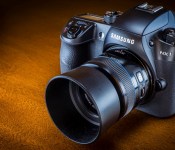
Samsung’s NX1 camera looks like a DSLR, but does it perform like one?

While companies like Sony and Fujifilm continue to stuff serious camera guts into smaller and smaller mirrorless bodies, Samsung’s aiming to ape both the function and the form of modern “prosumer” DSLR’s with its $1,500 NX1. With a rapid-fire 15 fps burst mode and 4K video support, the company’s flagship interchangeable lens camera certainly boasts some high-end specs. I spent a month with Samsung’s latest to see if it can match or even exceed the DSLRs it appears to emulate.
In terms of appearance and build quality, the NX1 most closely mimics the advanced consumer, or prosumer, models offered by Canon and Nikon — the 70Ds and D7100s of the world. Its magnesium body, robust grip and distinct viewfinder hump definitely suggest a traditional DSLR at first glance. Put the NX1’s viewfinder up to your eye, however, and you’ll spot a rather capable, 2,360-dot electronic viewfinder rather than the optical variety. Under most circumstances, the EVF’s frame rate is rock solid, though I did notice it stutter a bit while trying to lock focus in poor lighting conditions. Elsewhere on the body, you’ll find a fair number of controls, including a handy locking mode dial. The overall layout feels comfortable, though the movie record button seemed out of place to the right of the shutter/power toggle. And the ring of buttons atop the drive mode dial are a bit too tiny to easily find without looking.
The NX1 also boasts a 3-inch touchscreen on the back that responds well to swipes and gestures like two-finger zooming. It’s a flip-out deal, so low- and high-angle shooting should be a breeze, but it doesn’t flip to the side or forward for selfies like, say, Canon’s 70D. Colors are well-saturated on the Super AMOLED screen, though they don’t always reflect reality. On a cloudy, overcast day inside the Seattle Seahawks training facility, the artificial grass of the team’s practice field came across as vividly green on the display, but it was much more muted in person. Hopefully, though, if you’re investing this much in a camera system, you’re also examining your pics on a more accurate (possibly calibrated) external screen as much as possible.

Still-image quality is generally quite high and noise levels weren’t much of an issue up to about ISO 6400. When you get much higher, though, the noise tends to creep in a bit too much for my liking. I wouldn’t use the standard top-end ISO of 25,600 unless I had no other options; checking a box in the menu unlocks ISO 51,200, but it’s grainy (no surprise there). At more sane levels, there’s not much to complain about from a speed or quality standpoint. The fast burst mode and solid AF performance mean you won’t miss many shots because of your gear. Its hybrid autofocus system includes 205 phase-detection points and its max shutter speed of 1/8000 is plenty quick. The NX1’s auto white balance also performed well, though it tended to have a tougher time than, say, my Fujifilm X-E2 when it came to yellowish street lighting.
Samsung’s also touting the NX1’s video chops, which include up to 4K (4,096 x 2,160 or 3,840 x 2,160) recording at 30/25/24 fps. If all you need is ho-hum 1080p, you can choose up to 60 frames per second. The camera supports the newer, more efficient H.265 video codec and an included app will quickly convert that video to the older H.264 standard if your editing suite of choice doesn’t yet handle the new format. Overall, video quality is quite good, with sharp details in the feathers of a hungry hummingbird, though I did spot a vague hint of compression artifacts in particularly dark sections of the frame. I could see rolling-shutter effects if I panned around like a crazy person, but under normal filming circumstances, I don’t think it poses much of a problem.
The NX1 also features a deep set of wireless capabilities, including WiFi, NFC and Bluetooth. I was able to easily pair my iPad to the camera using the Samsung Camera Manager app. With the link established, I could remotely snap pics of hummingbirds in our backyard thanks to the app’s live viewfinder and onscreen controls.
 Samsung’s Camera Manager app for WiFi remote control.
My time with the NX1 was spent using Samsung’s 45mm f/1.8 lens. It’s a pretty standard optic, save for a trick 3D mode that activates an internal shutter, presenting the image sensor with two slightly offset perspectives in a single shot. The effect works in both stills and movie modes. I took a quick sample video in 3D mode and asked our own Jose Andrade to check out the results on his Panasonic 3D TV. The first clip (recorded at the highest setting) showed great picture quality, but playback was quite choppy on his set. A second clip, captured at a lower bit rate, played flawlessly, however. If you’re taking still images in 3D mode, the NX1 saves both a standard JPEG and MPO (Multi-Picture Object) formats for viewing.
Overall, Samsung’s made a pretty potent mirrorless shooter in the NX1. There’s not too much to complain about in either stills or movie mode, though editing video will require a middleman conversion until H.265 becomes more widely supported. The biggest question is whether Samsung’s lens offerings meet your needs — a solid camera body is nothing without good glass. If the performance and solid build have you curious, take a look at the lens lineup and see if the ranges and specs you need are there. At $1,500 for the body only, this is an investment, after all.
To view some full-resolution shots from the Samsung NX1, click here.
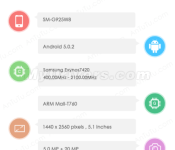
Hardware of the Samsung Galaxy S6 confirmed thanks to AnTuTu listing

The Samsung Galaxy S6 has just made an appearance on AnTuTu benchmarks, telling us everything we needed to know about the hardware of the handset.
The device shown in the listing has the model number SM-G925W8 which could be the Galaxy S6 Edge. Considering that both the Galaxy S6 and the Galaxy S6 Edge are expected to pack identical hardware, we can expect the same feature set to be available on the Galaxy S6 as well.
According to this new revelation, the Galaxy S6 Edge will pack a 5.1 inch 2560 x 1440 resolution display, 3GB of RAM, 32GB of internal storage (possibly expandable), a 20-megapixel camera, a 5-megapixel front facing camera and the Samsung Exynos 7420 chipset with the Mali-T760 GPU. Naturally, the device shown here is running Android 5.0.2 Lollipop by default.

Given the hardware on offer, the smartphone has managed to score 60,978 on AnTuTu, which is the highest ever score received by a smartphone. This is all thanks to the new Exynos 7420 chipset which is manufactured using the company’s 14nm process while its alternative, the Snapdragon 810 uses the 20nm process.
The Galaxy S6 could be shaping up to be quite the smartphone as we get closer to the launch. What do you think about the hardware of the Galaxy S6/S6 Edge? Let us know below.
Source: myDrivers
Via: Phone Arena
Come comment on this article: Hardware of the Samsung Galaxy S6 confirmed thanks to AnTuTu listing
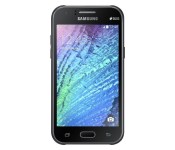
Galaxy J1 to launch in India tomorrow, $115 for entry-level specs

The Samsung Galaxy J1 has been leaked and talked about for many weeks now, but finally official evidence of its existence has surfaced, along with a launch date and price for the entry-level class creation: it will be released on February 11th on Amazon India, for the low price of Rs.7,199 (roughly $115US).
The Galaxy J1 comes with a 4.3 inch (800X480) screen, a 1.2GHz Dual-Core Cortex A7 CPU,Mali-400 graphics, 512MB of RAM, 4GB of storage, 5-megapixel rear camera and 2-megapixel front camera, and a 1,580 mAh battery. The phone supports microSD to augment the limited on-board storage, 802.11 b/g/n Wi-Fi, Bluetooth 4.0, FM Radio and Dual-SIM support. It is also running Android 4.4.4 and supports up to HSPA+ connectivity (sorry, no LTE here).
While the specs are not going to satiate those waiting for say, the Galaxy S6, they are still relatively decent for an entry-level phone. This is perhaps one of the cheapest products released by Samsung in recent memory, although the fact that competitors have products available at similar prices, but with souped-up specs, means South Korea’s darling is once again banking on its brand-name recognition and definitive TouchWiz software skin to justify the cost. In some regards, the device even competes with another recent release, Samsung’s own Z1 Tizen-based smartphone.

On the whole, it is curious to see the company make use of the J branding for such an underwhelming product given that the original Galaxy J was a product designed with Japanese consumers at heart and was essentially a slightly-modified Galaxy S4 with all the same top-notch specs to boot. That the J1 is the complete opposite and designed with a totally different market in mind is an interesting turn of events to say the least.
For all those interested, keep your eyes peeled for the various special offers Amazon India is going to be bundling with the device come tomorrow.

Samsung and Microsoft come to terms over billion dollar license fee dispute

Microsoft has long been the recipient of license fees for patents related to each and every Android device sold. Samsung has long been the number one seller of Android devices sold around the globe, but have been refusing to pay said licensing fees for a while now.
This dispute hit the courts last year, with Microsoft looking to sue for damages estimated to be in excess of $1 billion. As most major cases go, many months have passed with no results, and little progress, until today. The two companies have come to terms in a private arrangement.
While the exact terms have not been disclosed, and there is a good chance they never will be, both companies took to their own blogs to post the same message:
“Samsung and Microsoft are pleased to announce that they have ended their contract dispute in U.S. court as well as the ICC arbitration. Terms of the agreement are confidential.” – Samsung’s Jaewan Chi, Executive Vice President and Global Legal Affairs & Compliance Team and Microsoft’s David Howard, Corporate Vice President and Deputy General Counsel.
It would be great to see what the terms of this agreement are. More importantly, we are eager to see what impact this will have for all of the other Android device manufacturers out there still paying their dues.
What do you think, for how long should Microsoft be able to collect license fees for patents relating to Android technology?

Android patent lawsuit between Samsung and Microsoft settled

In what has to be one of the quickest resolutions to a patent lawsuit between tech giants in recent history, Microsoft and Samsung have announced a settlement over patent royalties for some code included in Samsung’s Android devices. The lawsuit stemmed from an agreement reached between the two companies in 2011 that flared up in August 2014 when Microsoft accused Samsung of breach of contract.
According to Microsoft’s original complaint, the company claimed Samsung had failed to make agreed upon royalty payments. Microsoft was asking that the contract be declared valid and that in addition to the payments owed, that Samsung also pay interest for late payments.
Neither side revealed any details of the settlement, instead issuing a joint statement that said, “Samsung and Microsoft are pleased to announce that they have ended their contract dispute.”
source: Re/code
Come comment on this article: Android patent lawsuit between Samsung and Microsoft settled

Android patent lawsuit between Samsung and Microsoft settled
In what has to be one of the quickest resolutions to a patent lawsuit between tech giants in recent history, Microsoft and Samsung have announced a settlement over patent royalties for some code included in Samsung’s Android devices. The lawsuit stemmed from an agreement reached between the two companies in 2011 that flared up in August 2014 when Microsoft accused Samsung of breach of contract.
According to Microsoft’s original complaint, the company claimed Samsung had failed to make agreed upon royalty payments. Microsoft was asking that the contract be declared valid and that in addition to the payments owed, that Samsung also pay interest for late payments.
Neither side revealed any details of the settlement, instead issuing a joint statement that said, “Samsung and Microsoft are pleased to announce that they have ended their contract dispute.”
source: Re/code
Come comment on this article: Android patent lawsuit between Samsung and Microsoft settled
 AIVAnet
