


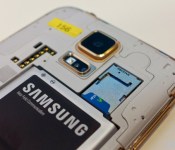
Another clue that the Galaxy S6 will feature a 2,600-mAh battery

Images that surfaced on Weibo suggest the upcoming Galaxy S6 will feature a 2,600-mAh non-removable battery.
Earlier this week, a report out of Korea claimed Samsung’s upcoming flagship would come with a built-in battery of 2,600-mAh, a step down from the 2,800-mAh unit on the Galaxy S5 and generally lower than the current “gold standard” for a high-end smartphone, which is around 3,000-mAh. Because the source of the report was rather obscure, and the automated translation of Korean sources always leaves room for interpretation, we decided to skip it.
But now we have another clue that the Galaxy S6 will indeed pack a 2,600-mAh battery, in the form of shots uploaded by a user of China’s Weibo social network. One of the albums uploaded by said user shows photos that appear to be taken inside a battery manufacture facility, and one of the images is tagged “Samsung Galaxy S6 battery.”

As Phone Arena points out, the code on the battery resembles codes of original Galaxy S5 replacement batteries, while the “925” bit could be a reference to the SM-925X code attached to the Galaxy S6 Edge.
Furthermore, other images uploaded by the same user show the logo of Samsung SDI (Samsung’s component-making unit), as well as that of ITM, a Korean supplier of batteries and related circuitry.
#gallery-1
margin: auto;
#gallery-1 .gallery-item
float: left;
margin-top: 10px;
text-align: center;
width: 50%;
#gallery-1 img
border: 2px solid #cfcfcf;
#gallery-1 .gallery-caption
margin-left: 0;
/* see gallery_shortcode() in wp-includes/media.php */


Why would Samsung reduce the battery size of the Galaxy S6? The answer may lie in the phone’s sealed construction and 6.9-millimeter profile. These design constraints probably forced Samsung to shave off the size, and implicitly the capacity, of the battery inside the S6.
A smaller battery does necessarily result in shorter battery life, as factors like screen technology, processor, software optimization, and the battery technology itself can greatly affect it. In theory, the 14nm Exynos processor expected to power the Galaxy S6 should consume less power than previous generations, partially offsetting the decreased battery capacity. Then again, the reverse applies for the Quad HD screen, because higher resolutions translate into higher consumption. So we’ll have to evaluate the entire package before we can issue a judgment on the Galaxy S6’s battery life. And that will only be possible after March 1, when Samsung will lift the veil of the S6 and S6 Edge at its MWC event.
Thoughts?

Samsung will broadcast public safety announcements over LTE this year

Samsung’s got strong LTE (and LTE-A, and… whatever’s next) bones and now it’s looking to shift the commercial tech into the emergency services. Public safety announcements has been a project of the 3GPP for a while. What’s that, you say? It’s a ragtag gang of superheroes telecoms groups and organizations that hammers out the crucially important (but typically very dry) standards and technical specifications — these have formed the basis for the likes of 3G and LTE in the past. Samsung’s public safety LTE (PS-LTE) is apparently geared for first responders and use during “emergency situations”. Importantly the option of a new kind of public safety announcement network will take the drag off existing networks, as well as offer the data heft of LTE network, hopefully ensuring communication remains possible in even the most dire situations.
The tech includes push to talk in addition to text broadcast and even multimedia broadcast delivery. The company’s put its focus on stability on the network, is is obviously the most important thing to take into account if there’s a natural disaster. The Korean government plans to launch the first PS-LTE network in the Gangwon province in late 2015, spreading to more of the country’s major cities next year.
Filed under: Internet, Mobile, Samsung
Source: Samsung

Android Zodiac: notable Android events
Android has come a long way since its release. From the HTC Dream to the Nexus 6, everything has changed. To come so far, significant things have happened that have changed the Android world. To highlight some of these events that have occurred, I have created an Android Zodiac! Yes, I’m aware this is not the same as the Chinese Zodiac, and this doesn’t really say anything about those born in those years. If you’re looking for something like that, check out our article called “What does your phone say about you“. Anyways, let’s dive in.

2007: Year of the Open Handset Alliance
2007 was a big year in not only the Android world, but the technology world as a whole. This was the year that the first iPhone was announced, and when Google and 47 other firms announced the Open Handset Alliance that would lead to Android. The reason for this was to unite companies to “enable everyone in our industry to innovate more rapidly and respond better to consumers’ demands” by having an open operating system, Android. The SDK is available to everyone, and the goal is to have one standard among mobile phones. If you’re interested, you can even look at the website that was released for this here. Definitely a blast from the past! Anyways, it would be the Open Handset Alliance that would help make Android the most popular OS on the market.

2008: Year of the HTC Dream
In 2008, the very first Android phone was released: the HTC Dream. Also known as the T-Mobile G1, this was the first phone to showcase Android. This smartphone not only had a sliding keyboard, but it had a home screen you could customize, complete with a wallpaper and widgets. There was also a new notification system that displays the icon for an app in the status bar whenever there’s a new notification, and you can slide down from the top to view more details about the notification. There was also integration with Google services allowing access to Gmail, YouTube, and more. On top of all of that, it was backed by the OHA, Google, and a promise to have updates brought to it that would bring new features and bug fixes. This device would change how software is designed and implemented for devices everywhere. Another interesting thing about this is HTC would later be the first for other landmarks in Android. But more on that later…
2009: Year of the Android Wars
2009 was the year that most of the manufacturers we know in Android phones today started to make Android phones. Samsung, Motorola, HTC, Sony, LG, and more all threw their hat into the Android phone ring. HTC released four other smartphones after the HTC Dream; Samsung released the first Galaxy phone, along with three other phones; Motorola released three phones along with their first DROID, Sony released the first Android Ericsson phone, and LG released a phone. Below is a collection of some of the phones along with a link to their specifications.
Note: I may have missed a few devices. Please let me know what I’ve missed!
 Samsung
 Motorola
 HTC
HTC
 Sony
Sony
 LG
LG
2010: Year of the Nexus
In 2010, Google released their first in-house designed smartphone: the Nexus One. Once again, HTC was the first with something in the Android space, as they manufactured the Nexus One. The Nexus One was a phone released with an unlocked bootloader for developers to create and test software on a version of Android that was untouched by manufacturers. It was also designed by Google to provide an example of what it believes other phones should look like in terms of hardware. The phone was sold online by Google, eventually being available through carriers. Little did we know, this would open a world of expectations from Android geeks everywhere as each year we now await eagerly to see what Google will release in the next Nexus. The Nexus One also was the first phone with Android 2.1 Eclair, which is another precedent set by this phone.

2011: Year of the Modern Phone
2011 saw the introduction of a lot of aspects in smartphones that consumers have come to expect of their smartphone. Displays started getting bigger, the bodies started getting thinner, and keyboards started disappearing. Screen resolutions started becoming important, and design started to focus more on looking futuristic. 2011 saw phones such as the Samsung Galaxy S II, the first Samsung Galaxy Note, the first Motorola DROID RAZR, and the Motorola DROID BIONIC. HTC and LG started to up their game too. Companies who were a part of the Android world started releasing more and more devices, and companies that weren’t involved before started to get involved. Users started to expect more out of their devices. A lot of the things you see in your current smartphone likely resembles most of the phones that came out in 2011.
 2012: Year of the Samsung

Let’s be honest, 2012 was all about Samsung. Not only did they have almost 50 different models and refine their Galaxy Note in the much more successful Galaxy Note II, but they released their most successful phone ever: the Samsung Galaxy S III. The S3 turned out to overtake the Apple iPhone 4S and iPhone 5 in sales in Q3 2012, selling over 18 million units in Q3 alone. The design was different, its speed and fluidity was unprecedented, and Samsung had added features to Android through its TouchWiz UI (user-interface) that helped make the OS (operating system) more friendly. Again, the Galaxy Note II also did well, selling over 3 million units in under two months of its release. The Note II had improved on the first generation in almost every way, and can certainly be accredited for the rise in popularity of the “phablet”. Samsung was on fire, and at that time it seemed no other manufacturer could touch them.

2013: Year of the User
2013 was a big year for Android. After Samsung’s huge success in 2012, all the other manufacturers took a step back and realized they needed to change things, and focus on the user. LG released their very different LG G2, where the power and volume buttons were on the back. Sony released the Xperia Z series, where durability became a focus. HTC released the gorgeous HTC One (M7). Google/LG released the Nexus 5, which improved on the widely accepted Nexus 4. Motorola released the Moto X, which focused on genuinely useful features and consumer design, and the Moto G, which brought great functionality and speed to budget phones. In 2013, we saw a huge focus on the end-user, finally bringing Android as an ecosystem to the big leagues.

2014: Year of the Chinese
After all-around positive reception to Android devices in 2013, most manufacturers pretty much just improved on their previous flagships in small ways (which is not a bad thing). However, with little to no innovation, this made way for a new player in the Android space: Chinese manufacturers. Xiaomi especially, but companies like Huawei, Vivo, Oppo, THL, and OnePlus entered the smartphone race with some serious gusto. While most of these companies had already existed, their entries in 2014 gained a lot of attention, and money. OnePlus in particular with their very controversial invitation-only system garnered many headlines. However, Xiaomi was the company that often made a couple of entries onto lists of top-selling smartphones, such as this one. Essentially, manufacturers based in China proved that they were starting to get serious about making Android smartphones.

2015: Year of the Software Design
I know I know: 2015 has just started. So you can take this as my prediction for the big thing in 2015. Some say that it will be all about wearables; others say it will be all about phone displays. In my opinion, wearables still have a ways to go before it becomes mainstream, and curved displays can only do so much at their current state, especially considering how expensive they are to manufacture. With innovation in the hardware space becoming infrequent (except for Project Ara, but that’s not ready yet), there is really only one place left to go: software. And while new features in software are introduced all the time, I think that Android Lollipop has shown us that Android can look good. Pretty soon, iOS will not be the only pretty operating system, as more and more manufacturers adopt Lollipop; with manufacturers having their own UI skin they slap on their phones, they’ll recreate Lollipop a bit, but users are going to want the design to still be there, so there is going to be a lot of creativity in the software. Hopefully.
That wraps up the Android Zodiac! Let me know what you think 2015 will bring. Perhaps in a year, we can dig this post back up and compare and add-on what really happened.
(function() var script = document.createElement(‘script’);script.src = ‘https://stacksocial.com/widget.js?publisher=androidguys&type=editorial_post_widget_preferences’;script.async = true;var entry = document.getElementsByTagName(‘script’)[0];entry.parentNode.insertBefore(script, entry);)();
http://www.androidguys.com/pubgalaxy/728×90.html
The post Android Zodiac: notable Android events appeared first on AndroidGuys.
Samsung officially acquires mobile payment startup LoopPay

Samsung has just announced the company’s acquisition of LoopPay, a mobile payment startup company. This acquisition will open up doors for Samsung to compete with mobile payment systems like Apple Pay and Google Wallet. There’s no word yet as to how much LoopPay sold for, but we’ll be sure to update you if that information surfaces.
We can’t say that this acquisition is all that surprising, since LoopPay and Samsung have worked together in the past. Just last month, LoopPay announced they would make mobile payment-enabled cases for Samsung’s Galaxy Note 4 and Galaxy S5 handsets that would release sometime in 2015. Moreover, Samsung was reportedly in talks to acquire LoopPay back in December, though both companies denied the claims. After Apple Pay launched last Fall, it was obvious that Samsung would take action to compete with Apple’s mobile payment platform.
Yesterday, we reported that Samsung was looking to spend their $56 billion cash reserves on M&A and company growth over this next year. After a difficult 2014, it now appears that the company is already getting a start on acquisitions that would “be a good fit” into Samsung’s business model.
If you’re unfamiliar with LoopPay, it brings an interesting take to the mobile payment world. Unlike Apple Pay and Google Wallet who rely heavily on NFC, LoopPay offers something more than that. Of course, it offers transmissions through NFC, but the payment system’s “magnetic secure transmission” technology is backwards-compatible with legacy terminals, and the built-in hardware makes payments by means of a small electromagnetic field that closely resembles that of a credit card swipe. So to complete a payment with LoopPay, all you need to do is tap your mobile device near the credit card swiping terminal… and that’s all. This allows the payment method to be compatible with both NFC payment modules as well as credit card swiping terminals. If you need some more clarification as to how exactly LoopPay functions, check out the video below:
Sometime after this acquisition is complete, card information will likely be secured on Samsung devices by using the fingerprint sensor, much like we see with Apple Pay. For now, LoopPay is only compatible with LoopPay-enabled phone cases and keychains, but we’ll likely see a huge overhaul of the technology once the payment company fully integrates with Samsung.
LoopPay’s founders, Will Graylin and George Wallner, will work closely with Samsung’s mobile division going forward. Take a look at the press release below for more information on the acquisition.
Mountain View, CA and Seoul, Korea – February 18, 2015 – Samsung Electronics Co., Ltd. today announced that it has agreed to acquire LoopPay, the acclaimed mobile wallet solutions provider that turns existing magnetic stripe readers into secure, contactless receivers. LoopPay’s technology has the potential to work in approximately 90% of existing point-of-sale (POS) terminals, according to internal research, with no investment in new infrastructure required by merchants. LoopPay will join Samsung to strengthen the company’s overall efforts to provide users with seamless, safe, and reliable mobile wallet solutions. As part of the acquisition, LoopPay founders and veteran payment industry entrepreneurs Will Graylin and George Wallner will work closely with Samsung’s Mobile Division. LoopPay has built an advanced and widely accepted contactless payment solution using its patented Magnetic Secure Transmission (MST) technology. LoopPay’s talent and technology, paired with Samsung’s world leading mobile technology, global presence, and distribution capabilities will help drive the next wave of innovation in the digital smart wallet. “This acquisition accelerates our vision to drive and lead innovation in the world of mobile commerce. Our goal has always been to build the smartest, most secure, user-friendly mobile wallet experience, and we are delighted to welcome LoopPay to take us closer to this goal,” said JK Shin, President and Head of IT and Mobile Division at Samsung Electronics. Samsung has an existing relationship with LoopPay, having first identified the potential for the pioneering technology when it became a strategic investor along with Visa and Synchrony Financial. The investment, which was facilitated by Samsung’s Global Innovation Center, helped fuel LoopPay’s MST technology development. “We are excited to take our relationship with LoopPay to the next level, by bringing consumers a mobile wallet solution that is not just safe and reliable, but also widely accepted at more locations than any competing service,” said David Eun, EVP of Samsung’s Global Innovation Center. “Through this deal we can significantly accelerate our mobile commerce efforts. LoopPay’s outstanding leaders and team have deep-rooted relationships with banks, card networks and merchants that will complement those Samsung has established over the years.” Margaret Keane, President and CEO of Synchrony Financial, the largest provider of private label credit cards in the U.S. and a leader in promotional financing, as well as an investor in LoopPay, commented, “This is great news for our customers who can access their cards and make payments using LoopPay’s contactless MST technology. Our goal is to offer valuable products for our clients, service providers, and our customers. We look forward to working with LoopPay and others to deliver secure mobile payment solutions for all of our 60 million active accounts.” “LoopPay is focused on delivering a digital wallet solution that is dependable for consumers around the world, one that provides more value from card issuers and the merchants that serve them,” said Will Graylin, CEO of LoopPay. “We are excited to join the Samsung family to continue our goal of making smartphones trusted, secure smart wallets and unlock the limitless possibilities of mobile enabled
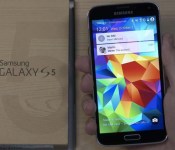
Unlocked Galaxy S5 now receiving Lollipop update in Germany

Samsung has at last started rolling out the eagerly-awaited and much-anticipated Lollipop update to all unlocked models of its flagship smartphone, the Galaxy S5, in Germany. This upgrade transports the latest version of the Android operating system, together with a multitude of new features, bug fixes and stability improvements.
The full changelog can be seen below:
- Android 5.0 Lollipop update
- Lock screen and Notification: New Lollipop UI style with enhanced privacy features
- Recent apps: Support multiple pages
- Addition of search function within settings
To start the upgrade, make sure you’re connected to a Wi-Fi network. Then, from the home screen, press the Menu key, followed by Settings. Scroll to the bottom and tap ‘About Device’, followed by ‘Software Update and ‘Update Now’.
Come comment on this article: Unlocked Galaxy S5 now receiving Lollipop update in Germany
Samsung ready with new eMMC 5.1 compliant memory

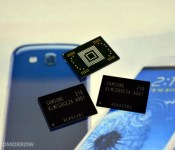
As we all know, smartphones and tablets contain thousands of components that make them the miniature computing devices that they are. In the race to one-up each other in terms of specs for all these components, manufacturers often focus on the latest processor technology in an effort to speed up what can be processed and how many items can be processed at once. With processors becoming so fast and powerful, that introduces the potential for other bottlenecks to surface. One of those potential clogs is in the memory included in our devices as those chips try to handle all of the data going into and out of the processor. To address that, a new standard for memory – eMMC 5.1 – has been established and Samsung has announced they are ready with new products that capitalize on the standard.
Samsung’s new product line based on the eMMC 5.1 standard includes chips with 64GB, 32GB and 16GB densities. Samsung notes that the 64GB solution can achieve up to 11,000 input/output operations per second (IOPS) and 13,000 IOPS for reading and writing operations respectively. For comparison, current external micro SD cards typically run at 1,500 IOPS and 500 IOPS, so the improvements are quite impressive. Samsung also says the 64GB version is capable of sustaining a maximum speed of 250 MB/s for sequential data reading and 125 MB/s for sequential data writing.
Samsung says they have improved the ability of their chips using this new standard to multitask activities, including the streaming and playback of Ultra High Definition video content. They think this will help OEM manufacturers take advantage of a growing wave of UHD content that consumers will want to view on their mobile devices.
Samsung also includes a new “Secure Write Protection” security protocol that can be used to limit access to secured areas of the eMMC to designated users.
According to Samsung, this new, faster eMMC will join Universal Flash Storage in the marketplace as a solution for manufacturers who need fast memory in their mobile devices. Samsung plans to be a player in the UFS market as well, so they should be positioned to supply manufacturers no matter which option they choose to employ.
source: Samsung
Come comment on this article: Samsung ready with new eMMC 5.1 compliant memory
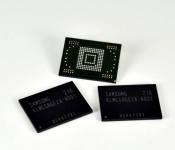
Samsung announces faster eMMC 5.1 flash memory chips

Today, Samsung announced its first flash memory chips based on the newly approved eMMC 5.1 standard. eMMC is an embedded version of the MultiMediaCard standard, which packages the NAND memory and controller into a single chip. This technology is found in all smartphones and tablets on the market today. Earlier this month, Samsung began mass producing the industry’s first combined DRAM and eMMC ePOP memory package.
Samsung states that its eMMC 5.1 chip will be available in 64GB, 32GB and 16GB densities, just like its existing eMMC 5.0 options. The 64GB eMMC 5.1 memory module features a maximum speed of 250 MB/s for sequential data reading and 125 MB/s for sequential writes. For comparison, eMMC 5.0 allows for reads at 250 MB/s and writes at 90 MB/s, so the writing speed has been improved. Furthermore, random read performance has been boosted from 7,000 IOPS to 11,000 IOPS and random write performance reaches 13,000 IOPS, up from 7,000 IOPS.
Samsung also boasts that its eMMC 5.1 chips will feature eMMC’s first command queue function, allowing for multiple commands to be queue up in advance rather than sending new commands only once the previous one has been completed. Samsung’s solution also includes “Secure Write Protection”, that ensures only designated users will be able to access secured areas of the memory.
Essentially, eMMC 5.1 provides slightly faster data transfer speeds and will smooth out performance in some situations on your mobile device, particularly when it comes to saving high definition video content and moving big chunks of data around.

Samsung Galaxy Note Edge receives Android 5.0.1 in Australia

Samsung has been fiercely rolling out Lollipop updates to all of its eligible devices, like the S5, Note 3, S4, and Note 4, and the Note Edge is no exception. The update is available OTA and is a little less than a Gigabyte of storage, so If you live in the land down under, be sure to spam-check for updates all day long until you get yours.
If you need a refresher, Android 5.0, or Lollipop, brings Material Design to the UI, heads-up notifications, a much improved notifications system, multiple user accounts, a new multitasking interface, and Android Smart Lock. Other changes are battery life, security and performance improvements.
Source: Sammobile
Come comment on this article: Samsung Galaxy Note Edge receives Android 5.0.1 in Australia

Samsung hints at quick charging in “Next Galaxy”
Earlier today, Samsung Mobile’s tweeted a video about the “Next Galaxy,” which is expected to be the S6.
It serves as a teaser for Samsung’s Unpacked event on March 1 and is intentionally vague. The entire scene consists of a shot from a desk of a high-rise office or an apartment pointed toward a panoramic window. A short monologue of “The faster I am, the more that gets done, and the more time I can give to others” ensues as a time-lapse occurs from day to night.
It’s reasonable to assume this means at least one of two possibilities. First, the Galaxy S6, despite most likely forgoing the Snapdragon 810. will have a powerful, 64-bit, multi-core processor. When I think of time and electronics, I also think of battery life, and as we know, battery life is often the Achilles heel of our devices. It’s essentially expected that the S6 will have a decently sized battery, but this could be hinting at quick charging.
Possibly, this feature will come through wireless charging. Samsung Tomorrow, Samsung Electronics’ official blog, discussed the history of wireless charging and its importance as a future industry standard shortly after the aforementioned tweet. It also noted that the company has been able to more than double the speed of it compared to wired charging.
FEATURED POSTS


(function() var script = document.createElement(‘script’);script.src = ‘https://stacksocial.com/widget.js?publisher=androidguys&type=editorial_post_widget_preferences’;script.async = true;var entry = document.getElementsByTagName(‘script’)[0];entry.parentNode.insertBefore(script, entry);)();
http://www.androidguys.com/pubgalaxy/728×90.html
The post Samsung hints at quick charging in “Next Galaxy” appeared first on AndroidGuys.
Samsung looks to advance in growth and acquisitions after a difficult 2014

It’s no secret that Samsung’s mobile division struggled throughout 2014. From selling 40% fewer Galaxy S5 handsets than anticipated to swapping out dozens of mobile division executives last year, the Korean tech giant knows they have a lot of work to do in 2015 and beyond. And according to an interview with a certain Samsung exec, the company may have a pretty good plan to do so.
Just in this past year, Samsung has lost its spot for the top position in China to Xiaomi in the lower-end market, and has also felt the heat from Apple in the high-end market. Moreover, Samsung’s profits declined for the first time in three years in 2014. Even though Korean companies are notoriously more frugal when it comes to dividends, that didn’t stop the company from giving investors a massive 40% dividend boost and its first share repurchase since 2007. But now, the company plans to steer its $56 billion cash reserves toward arguably more important avenues, including mergers, acquisitions and overall company growth.
Robert Yi, head of investor relations at Samsung, told Reuters:
Dividends and other forms of shareholder returns are responsibilities that the company has for shareholders, so we will make efforts to meet them. But our primary objective is growth and that is what we are communicating to our shareholders.
In the past year or so, Samsung hasn’t made developments on any major mergers or acquisitions, which disappoints investors in the long run. It seems as though the company would like to change that mindset, Yi says:
We are primarily focused on M&A deals for companies that would be good fits to Samsung’s current businesses, and we believe that know-how and experience accrued from such transactions will make bigger M&A deals possible going forward.
Many crucial changes have been made in hopes to return major growth to the company. Among the ‘Project Zero‘ initiative with its upcoming Galaxy S6 and creating original smartphones like the Galaxy Note Edge, it seems as though the company is on the right track. Samsung has made a ton of sacrifices this past year, and hopefully cutting back on investor relations, among other changes, will become a vital move for the company.

