


Samsung will take on Google and Amazon in the cloud
Cloud computing! Doesn’t the mere mention of it just get your blood pumping? Okay, it might be dull, but we all depend on those data centers for CPU-intensive services like Google Now and Siri, storage for photos, documents and video, and infinitely more. So, it’s big news that Samsung has acquired Joyent, a US-based cloud platform, for an undisclosed sum. The company will be able to power its mobile apps, internet-of-things (IoT) business and storage, and possibly break into artificial intelligence (AI), an area dominated by Google, IBM’s Watson and others.
The Korean company currently relies heavily on AWS, Amazon’s cloud company, to power apps and storage for its mobile customers. Joyent will be able to take a lot of those chores on right away, and handle more in the future. “As we heard Samsung’s vision — which included using [our services] for a new generation of mobile- and IoT-based applications — it was hard not to get excited,” Joyent CTO Bryan Cantrill said in a blog post.
As we heard Samsung’s vision — which included using [our services] for a new generation of mobile- and IoT-based applications — it was hard not to get excited.
Samsung wasn’t specific about what those apps are, but it has many that could likely use Joyent’s services like Knox, S Health and S Voice. It could also potentially market services like deep learning and cloud storage to other companies. Joyent currently services Fortune 500 companies and sites like Storify, and Samsung says that it will continue to operate as a standalone company.
Joyent shows that Samsung is acting more like Google by acquiring services instead of developing them internally, as it has traditionally done. For instance, the company recently bought LoopPay, which it developed into Samsung Pay. When it tried to go the internal route, things didn’t go as well — remember S Cloud? Samsung was developing the storage service for Galaxy devices but eventually scrapped it, reportedly because it couldn’t come to terms with a third-party storage provider. With Joyent in its pocket, it may be able to resurrect that and other ideas.
Via: WSJ
Source: Joyent
Samsung Leak Reveals ‘Smart Glow’ Rear-Side Notification System for Phones
An interesting leak has emerged online this morning that suggests Samsung is about to bring a new type of light notification technology to the rear case of its smartphones.
Android phones often come with a separate notification LED on the front of the handset that alerts users to missed messages and calls. Otherwise, notifications are usually assumed to relate to the display of a mobile device.
However, leaked specs and images that appeared on Dutch mobile tech site Galaxy Club show a new type of notification system for the back of a phone that Samsung is calling ‘Smart Glow’.
Smart Glow system expected to appear in the Samsung Galaxy J2 (Image: Galaxy Club)
The system features a luminous ring that runs around the handset’s rear camera lens and which lights up to alert users, glowing different colors depending on the function in use.
For example, the ring of light will glow to indicate that the rear camera has detected a face, allowing the user to take a selfie with the superior-quality rear lens.
The Smart Glow technology may also be used to communicate alerts when the handset has been placed face down on a surface, allowing users to choose specific colors to indicate particular notification types. Colors will also show when the battery is running low or when it has reached a full charge.
The website suggests that the notification system will appear in the Samsung Galaxy J2, due to launch in India later this year. The feature has yet to be officially announced by Samsung, so the likelihood of its appearance in the company’s flagship phones like the Galaxy Note 7 remains unknown.
The idea that Apple might one day try something similar with a future iPhone is not impossible. The most obvious candidate for the implementation of a rear notification system is the iconic Apple logo that appears on the rear of every iPhone.
The same logo on a MacBook lid glows whenever the laptop is opened, and speculation that Apple planned to use a lighted logo on its phones has existed ever since iPhone 6 leaks began appearing showing a chassis cut-out and the use of an embedded logo.
Those rumors were never realized, although third-party hacks do exist that allow iPhone 6 owners to make the logo on their handsets light up using LEDs.
Early rumors for next year’s so-called “iPhone 8” suggest the Cupertino company won’t debut a spec-bumped, internally upgraded “iPhone 7s”, but a completely overhauled handset with major design changes and new, next-generation features, like wireless charging, a Touch ID-equipped OLED display, and no home button.
At its Worldwide Developer Conference earlier this week, Apple announced a raft of updates to notifications and the way that developers are able to present them to users in iOS 10. No hardware announcements accompanied the conference, however.
Update: One of our forum members has noted that a setting in iOS 9’s Accessibility options enables visual notifications on an iPhone using the rear LED flash. To use the setting, open the Settings app, tap General -> Accessibility, and Toggle LED Flash for Alerts to ON.
Related Roundup: iPhone 8 (2017)
Tag: Samsung
Discuss this article in our forums
Samsung’s ‘Smart Glow’ reinvents the notification LED
One of the perks of owning an Android phone is that manufacturers often include a notification LED that tells you when you have missed calls, tweets or text messages that need a response. Samsung has installed them in its mobile devices from time to time, but it may soon ditch them altogether in favor of something it calls “Smart Glow.” SamMobile reports that the Smart Glow feature consists of a colored luminous ring that surrounds a device’s rear camera and notifies users of calls and texts, but also when the battery is low or has reached full charge.
The feature’s main purpose is to provide at-a-glance notifications, but it will also help with selfies. If a user attempts to take a photo using the more powerful rear camera on a Samsung device, Smart Glow’s “Selfie Assist” option will kick in and light up when it detects their face, automatically snapping a photo a few seconds later.
Reports suggest Smart Glow will head to the upcoming Galaxy J2, which is destined for India. Samsung has yet to publicize the feature, so there’s no official word on whether it will make it to flagship phones like the Galaxy Note 7 or future Galaxy S handsets.


Via: SamMobile
Source: Galaxy Club (Dutch)
Samsung Galaxy S7 Active review
For the past few years, Samsung has introduced a rugged version of their Galaxy S flagship a few months after the former launched so it came as no surprise to see the Galaxy S7 receive the same treatment. With the original Galaxy S7 already sporting water and dust resistance despite its glass finish, the need for an Active variant was diminished, yet Samsung clearly sees demand for a rugged flagship.
- Galaxy S7 Review
- Galaxy S7 Edge Review
- Galaxy S7 Active vs Galaxy S7 Quick Look
In past years, the Active range has always differentiated heavily from the Galaxy S flagship with diminished specs the compromise for a more durable offering. Yet this year, it shares many of the same specs as its flagship sibling meaning there’s very little to differentiate the two handsets.
Is the Galaxy S7 Active an after-thought or is it the final piece in the jigsaw of the perfect smartphone? Is brawn more important than beauty? Our Galaxy S7 review called the handset refined, polished and possibly the best smartphone ever but does this also apply to the Galaxy S7 Active? Find out in this, our Galaxy S7 Active review.
Buy the Galaxy S7 Active now!
Design

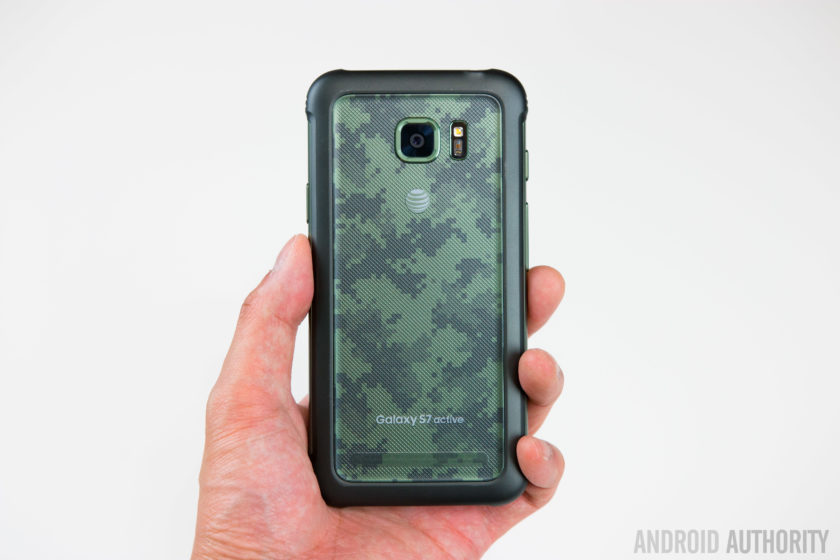
The biggest difference between the two handsets is in the design; the original Galaxy S7 features an all glass and metal design but the Galaxy S7 Active swaps this out for a more rubberized body. Like previous Active devices, the rubber build does result in quite a thick phone that is honestly a little bit bulky but this trade-off is certainly not new to the Galaxy S7 Active.
Most people who drop their phone find the handset can break (often beyond repair) when it lands on a corner or leading edge and to prevent against this, Samsung has reinforced the corners in a bid to ensure the Active doesn’t suffer the same fate as other less durable handsets. Naturally, you do lose the sleek curves and corners of the original Galaxy S7 but the compromise is certainly worth another look when you consider this phone is much more likely to survive a hefty drop.

The rugged exterior means the Galaxy S7 Active conforms to the MIL-STD-810G military standard for protection against extreme conditions. As a result, the phone is rated as being resistant to drops from heights under 5 feet and being able to survive harsh conditions including salt, dust, humidity, rain, vibration, solar radiation, transport and thermal shock. Like every rugged smartphone, the Galaxy S7 Active does have a limit and you will be able to break it if you try hard enough but it’ll survive a lot more knocks than most, if not all, other current flagships.
Build quality aside, the Galaxy S7 Active also trades the capacitive navigation keys of the Galaxy S7 Active for physical hardware buttons for the recent apps and back keys. Instead of the simulated vibration-based feedback provided by the original’s capacitive keys, the Galaxy S7 Active’s keys provide real tactile feedback and although they take getting used to, they are certainly very easy to press.
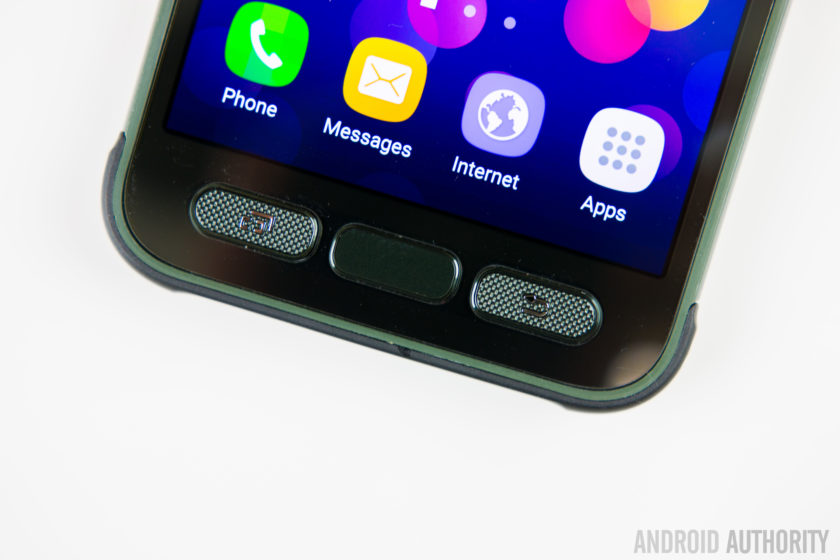
The home button is no different to other Samsung devices but unlike last year’s Galaxy S6 Active, you still get the home button which means the Active range now supports authentication-based features such as Samsung Pay.
The majority of other buttons and ports are in the same place as the Galaxy S7, with the exception of the headphone jack which is moved to the top of the phone. The Galaxy S7 Active does gain the ‘Active key’. The key is completely user definable and can be configured for three different actions – your standard short press, a long press and a double press – which can be used to open any application you choose, with a further option to allow the app to open when the phone is locked.
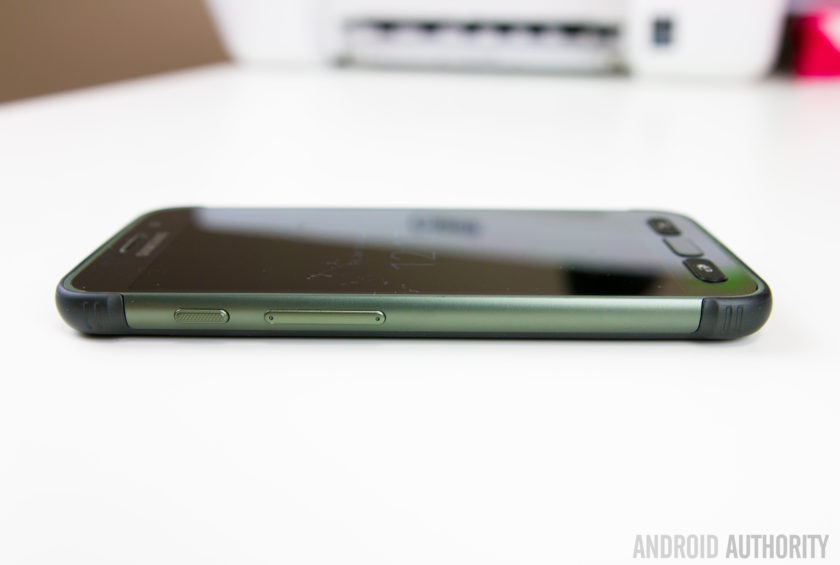
How does it feel to go from the sleek and slender Galaxy S7 to the larger and beefier Galaxy S7 Active? The simple way to explain it is that the Active very much feels like the Galaxy S7 inside of a case, which comes complete with the front lip to protect against any damage. Yes, it doesn’t have the sleek finish of the Galaxy S7 but the rugged features mean this smartphone can withstand more than most and if the fragileness of the Galaxy S7 is a concern for you, the Galaxy S7 Active certainly addresses these.
Display
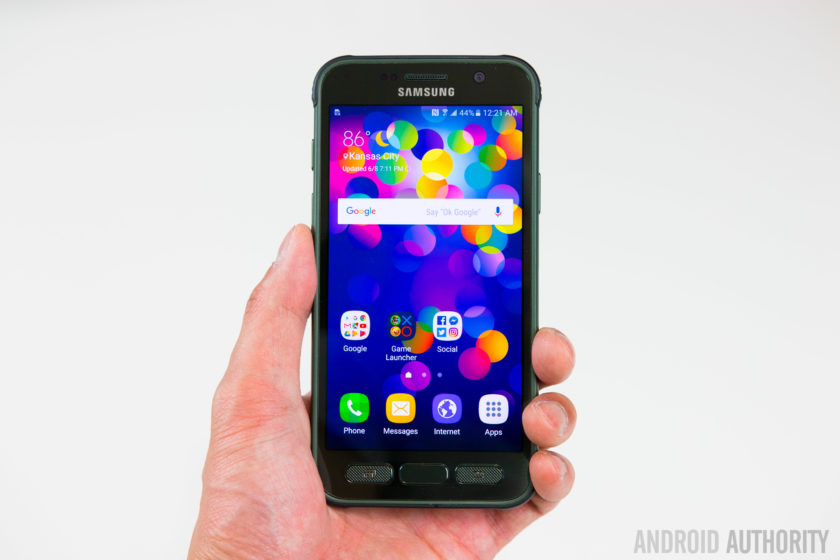
While the Galaxy S7 Active shares the same 5.1-inch QHD Super AMOLED display as the Galaxy S7 – which offers 2560 x 1440 pixels resolution – it does gain one very crucial feature: shatter resistance.
The display is shatterproof up to 5 feet meaning the handset should survive a drop from shoulder height for most people, or so Samsung claims. The display is protected by a Corning Gorilla Glass 4 panel – which we know is susceptible to shattering – with a plastic protector on top so shatter resistant, not shatterproof, is the more applicable word to describe the display.
A problem with screen protectors or devices that use a plastic panel on top of the display is that often it can detract from what could be a very good display. Luckily, with the Galaxy S7 Active, this is not an issue but the plastic panel does scratch easily, which may eventually detract away from the Active’s appeal.
Battery Life
The last major change between the Galaxy S7 and Galaxy S7 Active is the size of the non-removable battery. Last year’s Galaxy S6 sported quite a small battery (at 2560mAh) and this year, Samsung beefed it up by 18% to a more acceptable 3000mAh in a bid to provide improved battery life.
 Related: Samsung Galaxy S7 battery life review99
The Galaxy S7 Active raises the bar yet again, with a 4000mAh battery that is 33% larger than its sibling, and even bigger than the excellent 3600mAh unit inside the Galaxy S7 Edge. On occasion a larger capacity battery doesn’t always translate to exceptionally better battery life but Samsung clearly has the formula figured out, with the Galaxy S7 Active proving to excel in the battery department.
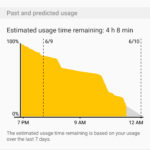


Despite heavy usage that included hours of gaming and YouTube streaming, the Galaxy S7 Active’s battery proved to be stubborn and very difficult to drain completely in one day. During our testing, screen on time often exceeded 7 hours despite resource-intensive tasks throughout the day and there’s no doubt that the Galaxy S7 Active offers the best battery life in the Galaxy S7 family.
Performance & Hardware

Aside from the key differences outlined above, the rest of the Galaxy S7 Active is very much the same as the Galaxy S7. Under the hood, this is powered by the Qualcomm Snapdragon 820 processor with 4GB RAM and with the Active being exclusive to AT&T in the USA, it’s unlikely we’ll see an Exynos-powered version launched in the near future.
On paper, the thought of AT&T’s additions to the software would lead to the assumption that performance will be inferior to a device that doesn’t have this additional load but in actual performance, the Galaxy S7 Active shows no signs of having carrier apps added. In regular use, there’s no lag of note and generally performance is almost identical to the Galaxy S7.
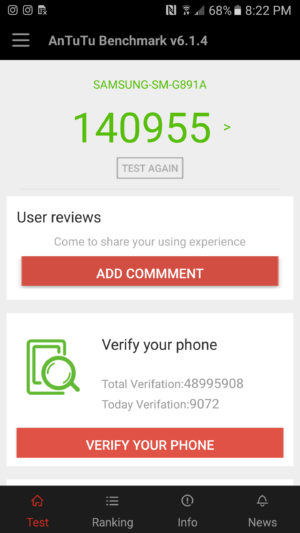
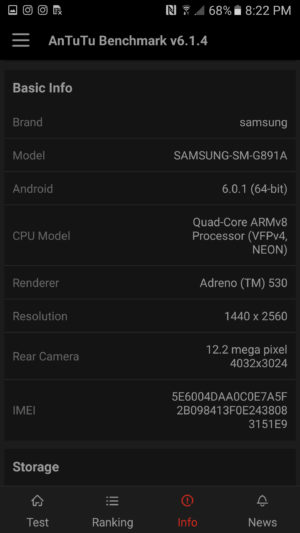
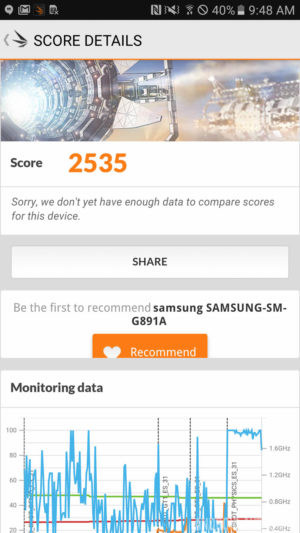
Running the usual benchmarks also corroborates this theory, with the Galaxy S7 Active proving to be on-par with, if not better, than the Galaxy S7 and S7 Edge. In AnTuTu’s benchmark test, the S7 Active scores 140955, whereas the regular S7 scored 129375. Moving on to GeekBench 3, the S7 Active scores 2282 in the single-core test and 5201 in the multi-core test, which is almost identical to the 2269 and 5156 scored by the Galaxy S7. Our last benchmark result comes from 3DMark, where the Galaxy S7 Active scores 2535 while the regular Galaxy S7 scores 2528.
Overall, there’s no denying that the performance of the Galaxy S7 Active is certainly one of the best on the market and unlike previous years, keeping mostly similar internals to the regular Galaxy S7 family has meant the Galaxy S7 Active offers performance on par with, if not better, than the best flagships on the market.
Camera
The camera on the rear of the Galaxy S7 Active is the same 12MP sensor with f/1.7 aperture and lightning fast dual autofocus found in the regular Galaxy S7. The images produced are sharp, vibrant and contrasty and the camera excels in most lighting conditions.
 Recommended: Camera shootout: Galaxy S7 vs the best flagships339
Like the regular Galaxy S7, you can still double press the home button to quickly launch the camera and the camera software remains mostly the same, with features such as selective focus and live broadcast to YouTube also present.
One new feature that does set the handset apart is the Aqua mode which has been made specifically for the S7 Active and it lets you use the active key to take photos and the volume keys to record video when you’re using the S7 Active underwater.
Galaxy S7 Active Camera Samples:

With the Galaxy S7 offering an excellent camera experience and the Galaxy S7 Active sporting the exact same camera offering, it comes as no surprise that Samsung’s latest rugged flagship has an excellent camera. The addition of an aqua mode arguably makes the camera better than the Galaxy S7 but whatever the condition, you can certainly rely on the Galaxy S7 Active’s camera.
Software

The Galaxy S7 Active is running on Android 6.0.1 Marshmallow with Samsung’s TouchWiz interface on top. Generally, the Galaxy S7 family sports a heavily refined user experience that has been optimised and streamlined to offer the best performance possible and, for the most part, the S7 Active certainly continues this trend.
Where the issue arises however is in the handset’s exclusivity with AT&T in the USA, which inevitably leads to the addition of carrier apps and bloatware to the software. From the Galaxy S5 to the Galaxy S7, Samsung worked hard to make its software bloat-free and as streamlined as possible while keeping the company’s targets in mind but the AT&T bloatware undoes a lot of Samsung’s positive move.


That being said, the benchmarks and real-world usage reveal that the carrier bloat doesn’t have a big effect on the performance, which is not typical of the normal effect carrier bloat has on a smartphone. Yes, none of the apps can be uninstalled and you’re unlikely to use some of the preloaded apps – which include AT&T’s own services, Lookout security, the Yellow Pages and Direct TV – but they don’t seem to have a marked effect of any kind on performance.
For some users however, non-removable carrier bloat can be a deal breaker and that’s really the biggest downside to the Galaxy S7 Active. For more on the overall software experience, check out our TouchWiz Feature Focus video below:
Specifications
Here’s the key specs for the Samsung Galaxy S7 Active:
| Display | 5.1-inch Super AMOLED display 2560 x 1440 resolution Shatterproof display |
| Processor | Quad-core Qualcomm Snapdragon 820 2x 2.15GHz, 2x 1.6GHz |
| RAM | 4GB |
| Storage | 32/64GB |
| MicroSD | Yes, up to 256GB |
| Durability | IP68 rating
MIL-SD-810G certified (dust, salt, humidity, rain, vibration, solar, transport, thermal shock resistant) |
| Cameras | 12MP rear camera with f/1.7 aperture, 1.4-micron pixels, OIS 5MP front camera with f/1.7 aperture |
| Battery | Non-removable 4000mAh battery |
| Fast charging | Yes |
| Wireless charging | Qi and PMA |
| Software | Android 6.0 Marshmallow |
| Dimensions | 9.9mm thick 185g |
Gallery
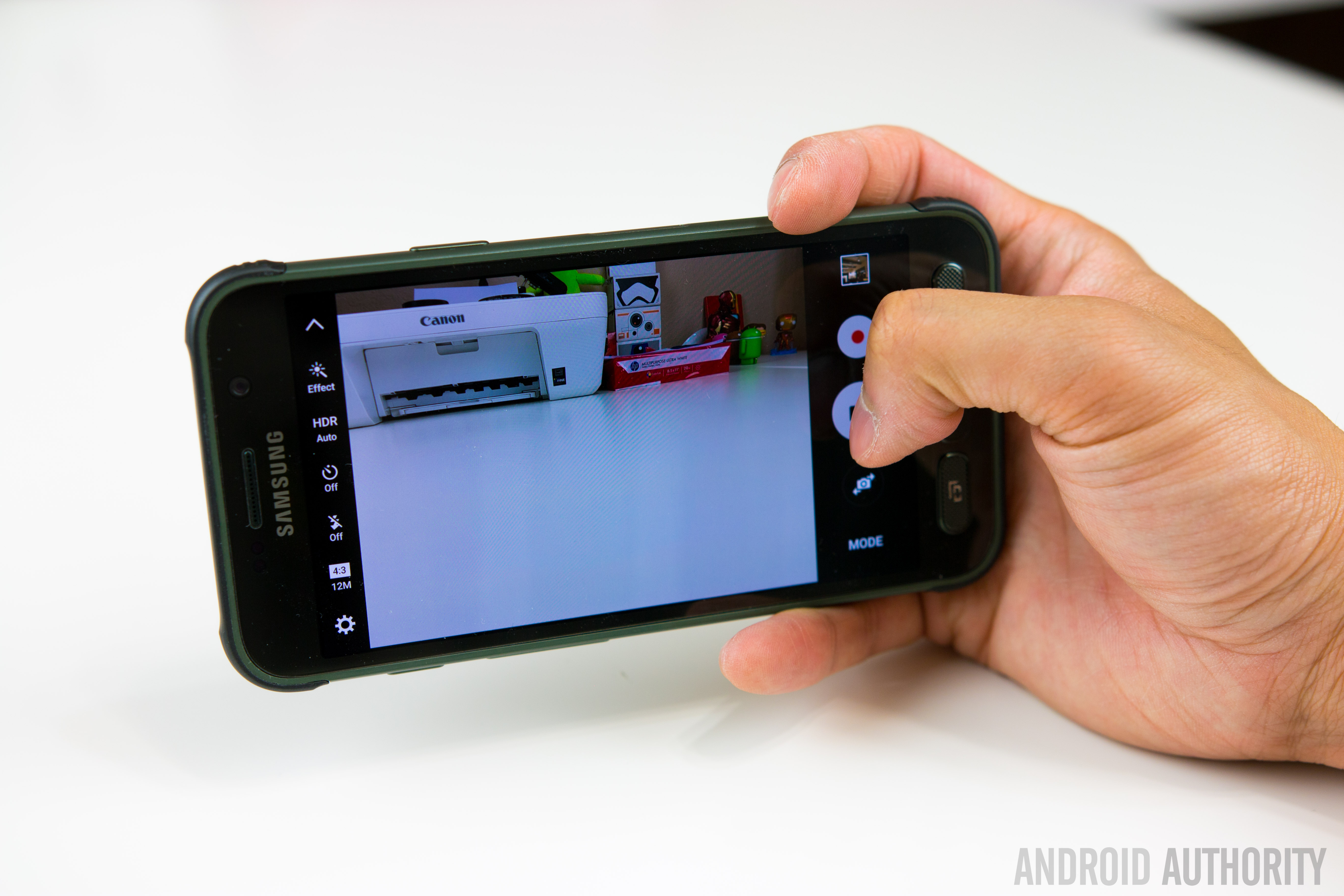
Conclusion

There’s no denying that a rugged smartphone with the capabilities of the Galaxy S7 Active will appeal to a lot of users but AT&T’s exclusivity, coupled with the effect on software, does mean a lot of users won’t be able to acquire the Galaxy S7 Active even if they wanted to. In fact, a few years in with proven interest in the Active range, it remains surprising that Samsung hasn’t struck deals to bring the Active range to other carriers and markets.
If the Galaxy S7 were a sports car, the Galaxy S7 Active could only be considered a tank; both will get you to your final point but only one will handle whatever you throw at it.
The Galaxy S7 Active is certainly not the best looking phone but the more rugged design and better battery life are more than worth the compromise. In fact, considering the more fragile build of the Galaxy S7 and its susceptibility to damage, the S7 Active is arguably the better smartphone. If the Galaxy S7 were a sports car, the Galaxy S7 Active could only be considered a tank; both will get you to your final point but only one will handle anything you can throw at it.
- Galaxy S7 Review
- Galaxy S7 Edge Review
- Galaxy S7 Active vs Galaxy S7 Quick Look
The Galaxy S7 Active shows that sometimes, brawn really is more important than beauty.
With comparable performance and hardware, an excellent camera and much better battery life, the Galaxy S7 Active is arguably what the Galaxy S7 should have been. At first glance, the S7 Active may not seem like the smartphone for you but don’t be fooled: they say you shouldn’t judge a book by its cover and the Galaxy S7 Active shows that sometimes, brawn really is more important than beauty.
What do you think of the Galaxy S7 Active and would you rather have the sleek Galaxy S7 or its rugged, more durable cousin? Let us know your views in the comments below!
Samsung Galaxy S7 Active hands on
The world turned upside down last year with the introduction of the Samsung Galaxy S6, as the Korean company didn’t hold back from gracing the device with a brand spanking new design that people finally agreed was premium. As much as we were all delighted by this new direction, there was just one major thing that was shed in the process that the Galaxy S5 offered that its successor did not: a water-resistant construction. And that’s arguably what made the eventual Galaxy S6 Active unique from its sibling.
- Samsung Galaxy S7 Review
- Samsung Galaxy S7 Edge Review
- Samsung Galaxy S7 vs S7 Edge
This year, however, they brought back water resistance to the Galaxy S7 – while also retaining the same premium design language that they’ve established. All of this will make anyone wonder what’s in tow for the forthcoming Galaxy S7 Active, that would differentiate it enough from Sammy’s prized flagship. Don’t worry, there’s more than meets the eye with this rugged one, so let’s quickly go over what this new phone in the Galaxy S7 family is all about.
Buy the Galaxy S7 Active now!
Design
The most distinguishable difference here is that the S7 Active features a design that’s substantially more rugged in nature. That shouldn’t surprise anyone, as it largely doesn’t deviate from the designs of previous Active devices. It’s not premium by the imagination – as the glass meets metal bezel design of the standard Galaxy S7 is replaced by one that’s mostly dominated by the same textured rear pattern we’ve seen before – accompanied by soft touch matte bumpers around the sides of the phone to absorb shock.
Speaking of shock, this phone doesn’t have the same fragileness of the Galaxy S7. Rather, the durable materials and tight construction employed here provides the Galaxy S7 Active with MIL-STG-810G specification. Not only is it able to withstand most drops, but the phone is built to withstand numerous environmental conditions – such as extreme temperatures, dust, low pressure/high altitude, and yes, full submersion under water. There’s really no need for a case for something like this, since you know, the phone itself acts like a protective case.
ADVERTISEMENT
While it’s not the prettiest in Sammy’s stable, it’s all about the utility with its design – so with that, most people can understand the reasoning for its particular design. Yes, it’s technically bulkier and heavier, making it a bit tougher to manipulate with one hand, but all of this is necessary in giving it that indestructible nature. How indestructible you ask? Well, we managed to drop it a few times from a height of 4 feet onto the pavement without any major impact to its operation or performance. Still, every phone does have its own breaking point but the S7 Active will survive a lot more than your average smartphone.

Display
The same display in the S7 is present here with the S7 Active, so that’s a 5.1-inch 1440 x 2560 Super AMOLED panel. As usual with AMOLED screens – especially the ones from Samsung – it’s detailed, sharp, produces some very iridescent colors, and offers exceptional wide angles. Everything about it seems to be on the same level as the Galaxy S7, including the new Always On display feature that keeps the time and some other relevant information on display at all times.
What’s different, though, is that the S7 Active benefits from being substantially more resilient to drops – meaning, it won’t crack if it’s dropped. The “shatter resistant screen” definitely holds up over most other screens, but we’re happy to notice that its visibility and clarity isn’t subdued or greatly impacted. Given that Samsung’s AMOLED screens have shown their superiority in terms of color accuracy and brightness potency, the resistance aspect of the display is merely icing on the cake.

Hardware
Before getting down and gritty with the usual hardware specifications, let’s quickly take note about some of the notable hardware additions/changes. The first being the addition of a fingerprint sensor, which is a first for the Active line. It’s something that has become expected amongst high-end phones of late, so the addition of it here gives the phone that contemporary status – enabling it for Samsung Pay – as well as another layer of security. It’s flanked between two other, rather larger sized physical buttons: the back and quick menu keys.
The thicker chassis of the phone isn’t just attributed to the extra cushion it’s packing to give it that almost indestructible nature, but rather, the mammoth 4000 mAh battery that’s stuffed inside. That’s one of the largest (if not largest) capacities Samsung has been able to cram into its smartphones, so that should aid the Active in having more longevity than the regular Galaxy S7. Additionally, you’ll find wireless and rapid charging in tow with the phone.

Now, this wouldn’t be an Active branded smartphone if it didn’t have the “Active” key, which is positioned above the volume controls along the left edge. Just as before, it brings up the “Activity Zone” to deliver on point information at a moment’s notice – they consist of the weather, temperature, barometer, compass, flashlight, stopwatch, and S Health. The button also doubles as a shutter key as well when the camera app is running, which is pretty handy when you’re trying to snap a photo under water.
Helping to power the phone is a quad-core 2.15 GHz Qualcomm Snapdragon 820 SoC coupled with 4GB of RAM and the Adreno 530 GPU. Much like anything brand new, out of the box, the S7 Active performs as you’d expect – snappy and fast. And given that it’s almost unchanged from the Galaxy S7, the S7 Active should perform handsomely when it comes to graphics processing. Storage amounts to 32GB with our particular unit, but it can be supplemented with the available microSD card slot.

Camera
In following tradition, the Galaxy S7 Active borrows the camera from the S7 – so that’s the same 1/2.6” 12-megapixel sensor with an f/1.7 aperture lens, phase detection auto-focus, OIS, and an LED flash. There’s also the quick launch function, too, that allows us to jump right into the camera app by just double pressing on the home button/fingerprint sensor.
 Samsung Galaxy S7 vs Note 5 camera shootout: More Pixels or Bigger Pixels?
Most people are going to be inclined to believe that the camera’s performance will be close, if not the same, as the standard Galaxy S7. As an all-around device, you can absolutely believe that the S7 Active will take some stunning photos and videos. The only other thing worth mentioning here is how there are a few manual controls available now with video recording under “Pro” mode, which is something we haven’t seen before in a Galaxy. Adjusting parameters like shutter speed, white balance, and focus all on the fly are all now possible and it’s likely we’ll see this come to other Galaxy S7 phones in a future update, although it might take a while.
Software
Frankly speaking, there’s not a whole lot different with the TouchWiz experience here with the S7 Active, which is running on top of Android 6.0.1 Marshmallow. The usual visuals are all there, so there’s nothing out of the ordinary. Some will like it, others will hate it, but there’s one thing we can agree about this most streamlined edition of TouchWiz to date – it’s incredibly powerful and comprehensive.
ADVERTISEMENT
Power users will love it, especially with its true multi-tasking experience with multi window, one-handed mode for easier handling, and all the other assorted smart gestures with the experience. Even though TouchWiz remains to be an acquired taste, it’s one of the last remaining few custom Android experiences that offers more depth over the stock experience.
Conclusion so far
Knowing that water resistance and storage expansion has been brought back to the Galaxy S7, some wonder if the Galaxy S7 Active will have some meaningful value over its sibling. That’ll undoubtedly depend on what you want in a phone. Being more ruggedized and all, the S7 Active will remain in working condition for much longer than the standard S7, since it’s been constructed to withstand some serious punishment – whereas the S7 has the premium design, but with more fragileness. Another thing to note is the larger size battery stuffed inside of the phone, which should propel it to last far longer as well.


Sure, the look of the phone won’t appeal to anyone, but if you place utility high on your list over most things, the Galaxy S7 Active will fit the bill – albeit, its price is $100 more than the standard S7 over on AT&T. That means you’ll need to fork over close to $800 to buy it outright, versus $700 for the S7.
- Samsung Galaxy S7 Review
- Samsung Galaxy S7 Edge Review
- Samsung Galaxy S7 vs S7 Edge
The S7 Active is launching on June 10 from AT&T and will be available on AT&T’s new Next plans: for those wanting it on the standard Next plan, it’ll cost you $26.50 per month for 30 months but on the shorter AT&T Next Every Year, it’ll cost $33.13 per month over 24 months. What do you think of the S7 Active and are you going to buy one? Let us know your views in the comments below!
Buy the Galaxy S7 Active now!
The Gear Fit 2 is Samsung’s best wearable yet
Samsung has made plenty of wearables over the years, but few were as immediately impressive as the Gear Fit. Its curved screen and relatively slim design almost made us forget the company’s early, clunky Gear smartwatches. Now with the $179 Gear Fit 2, Samsung has refined its original design to make it a lot more useful for athletes. It has built-in GPS, a slightly larger screen and smarter activity tracking. It’s Samsung’s best fitness wearable yet, but it’s still a tough sell compared to competing devices from the likes of Fitbit.

Hardware
The Gear Fit 2 is an evolution of the original Fit’s design in all of the right ways. Its 1.58-inch curved touchscreen display is now flush with the band, so that it no longer sticks out awkwardly. It reminds me of Microsoft’s Band 2, which also benefited from having a curved display sitting right alongside the wristband. The screen is also slightly wider now, which makes it more useful for actually reading information, and there’s less of a bezel around the sides so it’s almost like an edge-to-edge display.
Beyond that screen, the Gear Fit 2 looks restrained. The top half of the device is made from some fetching-looking metal, while the bottom is more of a subdued plastic. There are only two buttons on the side of the device, which serve as home and power buttons. On the bottom there’s a heart rate sensor and two small connectors for its charging stand. The relatively minimalist design is a stark cry from the overly complex wearables we used to see from Samsung.
For the wristband, it looks like Samsung is using the same plastic material from the last model, which remains flexible yet sturdy without feeling too stiff. You can disconnect the wristbands easily from the sides of the device, which will be useful if you ever feel the need for a new look down the line.
Under the hood, the Gear Fit 2 now runs a dual-core 1GHz Exynos 3250 processor and 512MB of RAM. (As someone who remembers being very excited when I got 512MB of RAM on a desktop, I find that latter stat hard to fathom.) Both of those specs are significant upgrades from the first Fit, which had a measly 160MHz processor and 8MB of RAM. It’s no wonder we found the original to be underpowered. There’s also GPS onboard the Fit 2 now, along with 4GB of storage for music and a barometer sensor for stair tracking.
Software

Samsung is using its homegrown Tizen OS to power the Gear Fit 2, something it also uses in TVs andother wearables like the Galaxy Gear 2. And instead of being tied to Samsung’s phones, the Fit 2 is now compatible with any Android phone running 4.4 or above. There’s no word about iOS support yet, though. (Is it even worth the effort?)
Thanks to Tizen, the Fit 2 is much more capable than its predecessor. You’ve got multiple watch faces to choose from (and more can be downloaded through the Gear app), some of which will show fitness stats alongside the time. You can also customize the screens you see as you swipe through the Fit’s interface. I have it set up to show the number calories I’ve burned, the number of steps and stairs I’ve taken, and my heart rate. Naturally, there’s also a screen for quickly logging a workout.
The Fit 2 supports 15 different workout types, including common things like running and cycling, and more specific activities like yoga and pilates. It’s now smart enough too to automatically detect five different types of workouts, something competing health trackers from Fitbit and Jawbone have been able to do for years.
Thanks to its onboard storage (and vastly more functional OS), the Gear Fit 2 can also send locally stored music right to your wireless headphones. It can also control music stored on your phone, and it can tap into Spotify through your phone as well. Basically, if you prefer to run completely unencumbered, or with your phone, the Fit 2 has you covered.
To control the Gear Fit 2, you’ll have to rely on Samsung’s Gear app for Android. And to track your workouts, there’s Samsung’s S Health app. More on those in a moment.
In use

In day-to-day use, the Gear Fit 2 felt just as comfortable to wear as the Apple Watch Sport and Jawbone’s Up24 (which are among my favorite wearables). It sits well on your wrist; most of the time you’ll forget it’s even there. I’d still like to see Samsung make it even thinner, so that it doesn’t rise above your wrist as much, but the Fit 2 is nonetheless on par with competing wearables in terms of thickness.
I also had no problem putting it on, and keeping it stable, throughout the day. The Fit 2 has a simple clasp design that makes it easy to slip on while you’re on the go. That’s a good thing, because I’ve fought with plenty of wearables (especially from Fitbit) that are simply a chore to secure. And even though it’s easy to wear, I also had no trouble with the Fit 2 falling off (which was a killer issue with the Jawbone Up 3).
When it comes to tracking basic things like your steps and stairs climbed, the Gear Fit 2 seemed just as accurate as most other modern wearables. Its heart-rate tracking was also solid, delivering readings in line with what I’ve been seeing from the Apple Watch and recent Fitbit gear. But really, if you’re buying this you’re probably more interested in its GPS tracking, and in that regard it didn’t disappoint. It accurately mapped several of my runs through Brooklyn’s Prospect Park (I have a two-mile stretch that I cover regularly). It was also on par with RunKeeper’s location tracking, which I normally use on my iPhone during workouts.
Setting up a manual workout takes a lot of swiping and menu pressing, if you’re moving between a variety of exercise types. But if you mainly do the same sort of workout, it’s pretty easy to just get up and go. The Fit 2’s touchscreen response is fast for such a small wearable, but even so, it’s not something you’d want to deal with much in the middle of an intense session.

The Fit 2 also surprised me several times by accurately tracking how long I walked during my work commute. That’s something other wearables have been doing for a while, but it’s still a useful addition for Samsung fans. It’s also the sort of thing wearables will have to get smarter about moving forward, so hopefully Samsung will be able to add automatic tracking support for more than just five workout types.
While you can view some basic post-workout details on the Gear Fit 2, you’ll have to turn to Samsung’s S Health app for a more detailed view. It’s a fairly clean looking app: The home screen highlights your most recent workouts, heart rate readings and steps. Tapping into a workout lays out everything you’ve done that day, and you can also step backwards to previous days pretty easily. Despite its minimalist look, I still had some trouble navigating around S Health. And it wasn’t always obvious how to access more detailed information about workouts. But perhaps I’ve just been spoiled by better health apps from Fitbit and Jawbone.

As a smartwatch-like device, the Gear Fit 2 fares well. It can display notifications from your phone, and even though it has a tiny screen, there’s enough room to read short text messages and tweets. It’s not a screen where you’d ever want to read long emails, but that’s true of dedicated smartwatches too. You can also have the Fit 2 open up apps on your phone from its notifications, which helped me quickly reply to Hangout messages and texts on several occasions.
Samsung claims the Gear Fit 2 gets around three to four days of battery life from its 200mAh battery. In my testing, which involved constantly wearing it throughout the day and doing a few runs, it usually lasted around two and a half days before needing a trip to the outlet. Speaking of recharging, I was pleased to find that Samsung moved towards a larger charging cradle for the Fit 2. That may sound paradoxical, but the original Fit’s cradle was so small that I ended up losing it pretty quickly. This new version is better suited to staying in one place on your desk.
The competition

The Fitbit Surge.
Since it’s a GPS-enabled fitness wearable, the Gear Fit 2 is best compared to the likes of the Fitbit Surge ($229) and the Microsoft Band 2 ($175). Aesthetically, it has a lot more in common with the Band 2, but if you can get past its looks, the Fitbit Surge is probably a better buy for fitness junkies. Fitbit has a much more robust fitness platform, as well as better integration with third-party services. As with all wearables, aesthetics plays a big part in the purchasing decision, though, so it’s understandable if you’d rather have a better-looking tracker instead of a more functional one.
Wrap-up

With the Gear Fit 2, Samsung has succeeded in making a capable and stylish fitness tracker. But it also doesn’t do anything significantly better or differently than the competition. It feels like a fitness tracker meant for people who really want something to match their Samsung phones, rather than something every consumer would desire. It’s ultimately unremarkable, but that’s mainly because there are so many decent alternatives out there.
U.S. Department of Justice Urges Supreme Court to Send Apple vs. Samsung Case Back to Lower Court
The United States Department of Justice today urged the Supreme Court to overturn an appeals court ruling that was in Apple’s favor and send the Apple vs. Samsung case back to trial court, reports Reuters. The DoJ submitted an amicus brief on Samsung’s behalf as the Supreme Court prepares to hear the long-running Apple vs. Samsung case.
Apple’s dispute with Samsung made its way to the Supreme Court after the U.S. Federal Circuit Court of Appeals rejected Samsung’s final lower court appeal in August of 2015. Samsung’s last option was to ask the Supreme Court to hear the case, which it did in December.
Despite Apple’s efforts to get the Supreme Court to deny Samsung’s request, the court agreed to hear Samsung’s appeal. Samsung, which claims it has been hit with “excessive penalties” for allegedly coping the design of the iPhone, submitted its opening brief to the Supreme Court yesterday.
Samsung claims that the penalties were unfair because Apple was awarded damages from the total profits of the product, while the infringing patent only applied to a component of the smartphone rather than the whole device. This is the issue that the Supreme Court will examine.
In its amicus brief on Wednesday, the Justice Department said it was unclear whether Samsung had produced enough evidence to support its argument that phone components, not the entire phone, should be what matters when calculating damages.
The Supreme Court should send the case back for the trial court to determine whether a new trial is warranted on that issue, the Justice Department said.
Samsung has been fighting a 2012 ruling that determined Samsung willfully infringed on Apple patents.
Apple was initially awarded nearly $1 billion in damages, but a significant part of the decision was reversed in 2015, leaving Samsung owing $548 million. Samsung has already paid the $548 million, but could win its money back if the ruling is overturned.
Tags: Samsung, lawsuit
Discuss this article in our forums
Samsung Rumored to Launch Fully Bendable Smartphones in 2017
Smartphone maker and display manufacturer Samsung is believed to launch a pair of smartphones in early 2017, each with a bendable OLED display. According to people familiar with the smartphones’ development (via Bloomberg), the two devices could be unveiled as early as Q1 2017 — potentially at Mobile World Congress in February — and come in two different sizes, similar to that of the iPhone 6s and iPhone 6s Plus.
Bendable smartphone mockup by Samsung
One phone would have a 5-inch screen when used in a normal handset fashion, and could then be opened to a tablet size that’s “as large as 8 inches.” The smaller alternative is estimated to be sized around a traditional modern 5-inch smartphone, but users would have the ability to fold it in half “like a cosmetic compact” to easily fit it into bags and pockets.
“This product could be a game-changer if Samsung successfully comes up with a user interface suitable for bendable screens,” said Lee Seung Woo, an analyst at IBK Securities Co. in Seoul. “Next year is a probable scenario. Their biggest obstacle was related to making transparent plastics and making them durable, which seems resolved by now.”
Codenamed “Project Valley,” the bendable smartphones won’t be Samsung’s new flagship devices, and are believed to be angled more as an experiment by the company to test the waters of user response to bendable screens. Because of this, the two new handhelds also won’t fall under the Galaxy S line of phones currently running by Samsung, but will be newly named entries in its collection of smartphones.
While not bendable, Apple’s 2017 iPhone is expected to pack in a curved OLED display with an edge-to-edge, bezel-free design, similar to that of Samsung’s Galaxy S7 smartphone. Overall, Apple’s “iPhone 8” is expected to be a huge update year for the company’s smartphone, following 2016’s internals-focused upgrade, so it’ll be interesting to see how the the two handhelds fare against each other when they launch.
Tag: Samsung
Discuss this article in our forums
Samsung might have bendable, foldable smartphones ready for 2017
Bloomberg sources say that Samsung is thinking of introducing phones with bendable screens. In fact, Samsung said that it would have that technology ready by 2017 itself, just a few years ago at its investors conference. However, this goes some way to proving that Samsung has developed the tech enough to bring it to consumer product. A pair of devices will have flexible OLED screens, with one folding like a cosmetic compact and another that transforms from a 5-inch smartphone-sized screen to a display roughly eight inches large; so… a tablet.
Screen tech could be the next battleground between Samsung’s Galaxy series of phones and the Apple iPhone, which is also rumored to pack OLED screens in the future. The phones, codenamed “Project Valley”, may even appear as early as Mobile World Congress, around February 2017. Just give me my picnic blanket 4K TV already. I’ve suffered enough.
Source: Bloomberg
Samsung’s rugged Galaxy S7 Active packs a huge battery
It’s that time of year again: now that Samsung’s latest Galaxy S flagship has been on the market for a while, it’s time for the rougher, tougher Active version to show up. The company has unveiled the Galaxy S7 Active, an AT&T-exclusive rugged edition of the standard S7 that’s built to take a bruising. As with the S6 Active, this isn’t just a regular smartphone with a beefier drop- and water-resistant case. This year’s model has a shatter-resistant 5.1-inch screen, and the battery jumps from the S7’s usual 3,000mAh to a massive 4,000mAh — you won’t have trouble making it through a day of hiking.
The innards are otherwise familiar. You’re still getting a quad HD display, a Snapdragon 820 processor, 4GB of RAM, 32GB of expandable storage, a front fingerprint reader, a 12-megapixel rear camera and a 5-megapixel front shooter. It’s hard to complain, mind you, when the base S7 is one of the more powerful smartphones we’ve seen this year. Just be ready to pay a premium if you like the idea of a Samsung smartphone that can survive your outdoor adventures. The S7 Active will go on sale June 10th for roughly the same amount as the S7 Edge: you’re looking at $26.50 per month on the standard Next plan, or $33.13 per month on Next Every Year.
Source: AT&T
 AIVAnet