


Paradigm PW Soundbar Release Date, Price and Specs – CNET
 Paradigm
Speaker manufacturer Paradigm has revealed its latest high-end sound bar, which will include new features for the company including HDMI inputs and wireless multiroom music capabilities
The $1,299 PW Sound bar features HDMI 2.0a connectivity with includes pass-through support for HDR/4K content as well as DTS-HD and Dolby TrueHD decoding. In addition the sound bar offers to DTS’ multiroom system Play-Fi.
The 46-inch wide unit is a little squatter than the existing Paradigm Soundscape, yet it incorporates nine 2.5-inch full-range drivers inside. The drivers are grouped in threes, and the company says they’re situated so as to generate a wide soundfield.
Paradigm is one of a dozen different companies that supports DTS Play-Fi multiroom streaming. Play-Fi offers streaming from most services, including Pandora, Spotify and Tidal as well as hi-res support.
If the PW Sound bar is too rich for your blood, the company also offers the Soundplay which is based on the same speaker layout and chassis but minus the Wi-Fi and HDMI connectivity. The Soundplay is available for $899.
Customers will be able to add Play-Fi speakers from any brand to act as rear surrounds.
2016.5 Mazda CX-5 review – Roadshow
The Good The lightweight 2016 Mazda CX-5 boasts better-than-average handling and good low-speed grunt from its 2.5-liter engine. The Mazda Connect infotainment system offers a decent list of features and, more importantly, a low level of driver distraction. The i-ActivSense suite of aid features keeps the CX-5 on par with its competition.
The Bad Mazda’s simpler approach to tech means that its infotainment suite lacks many modern features. Android Auto and Apple CarPlay are not available.
The Bottom Line On paper, the 2016.5 Mazda CX-5 is another solid choice for a small SUV. On the road, its dynamic feel and attention to driving detail elevate it head and shoulders above the rest of the class.
The 2016.5 Mazda CX-5 is a mid-year update to a fun little SUV with a playful, puppy dog face. It’s no secret that the CX-5 is one of my favorites, if not the favorite, in this vehicle class and it’s not just because looking at it reminds me of the Mazda MX-5 Miata. Actually, it’s because driving the CX-5 reminds me of the Miata.
When I say this small SUV reminds me of the compact roadster, I’m not saying that it handles like a sports car. What I appreciate about both cars is a sort of purity of purpose and a focus on appropriate driving dynamics. Allow me to explain.
#DrivingMatters
The CX-5 is powered by Mazda’s 2.5-liter SkyActiv four-cylinder engine, which makes a peppy 184 horsepower and 185 pound-feet of torque. The 2.5-liter is mated to a six-speed automatic transmission. Additionally, prospective drivers will have the choice of either front or on-demand all-wheel drive; the latter being useful for regions with four distinct seasons.
Fuel economy is good, but not the best. Its 26 combined mpg (24 city and 30 highway) for the all-wheel drive model is basically on par with the competition from Honda, Toyota and Ford, but won’t win any green awards. Opting for front-wheel drive bumps the EPA’s estimate up to 29 mpg combined.
 Antuan Goodwin/Roadshow
A six-speed manual transmission-equipped “Sport FWD” trim level persists for those few who like to row their own gears. However, that manual transmission is mated to a smaller engine, a 2.0-liter version of the SkyActiv mill that steps down to 155 horsepower and 150 pound-feet of torque, which sort of snuffs out the fun, making it more of a low-cost option.
The CX-5 really shines when driven, which is good because, well, it’s a car. Mazda has proven that it has a knack for knowing what an “engaging drive” actually means, what we’re actually looking for when describing a car as “sporty” and delivering that experience with its vehicles.
The steering is direct, but not twitchy, and delivers the right amount of responsiveness to inputs, making the SUV feel fun around a bend and stable during evasive maneuvers. The suspension is firm and communicative, but also compliant over all but the most severe potholes. All of this works with the peppy engine options that feel well matched with the CX-5’s chassis to deliver a driving experience that won’t trick anyone into thinking they’ve purchased a sports car. That being said, it is still capable of generating grins and inspiring confidence.
2016.5
Mazda
CX-5:
same
great
ride,…
See full gallery


1 – 6 of 34
Next
Prev
So, how is this small SUV like Mazda’s iconic roadster? Neither is concerned with being the fastest or the most powerful car in its class; rather, the aim is to be pleasurable to pilot and easy to approach. Both the CX-5 and MX-5 get the job done with a minimal amount of gadgetry and complication. And that’s what I like most about the Mazda CX-5; it’s a car that produces the core of driving before blowing its bells and whistles.
Speaking of bells and whistles…
Mazda Connect tech
Like the chassis and powertrain tech, the Mazda Connect infotainment and navigation system that lives at the center of the CX-5’s dashboard gets the fundamentals right.
Fitbit Charge 2 review – CNET
The Good Swappable bands. A multi-line OLED display that can show time and fitness data. Always-on heart rate. A great companion app. Affordable price. Five-day battery life.
The Bad Not water-resistant for swims or showers. Lacks GPS. Phone notifications on the Charge 2 display are limited and hard to read.
The Bottom Line If you don’t need water resistance and GPS, the Fitbit Charge 2 is the best overall fitness tracker you can buy.
Lots of things track steps now. Tons of trackers and watches — and even phones — do a good enough job.
In 2016, you buy a fitness band for its app and software. Fitbit does what it does so well and so simply, and across enough platforms and phones and social networks, that it wins out as a platform of choice.
And the best overall Fitbit hardware you can get right now? That’s the new Charge 2, which costs $150 in the US, £130 in the UK, AU$250 in Australia. (A slightly pricier special edition at $180, £150 or AU$290 with a different band finish.) It’s the follow-up to our previous favorite (an no longer available), the Charge HR. The Charge 2 is a slight redesign, with a few new features. I still don’t think anything else nails the combination of app, feature set and functional, affordable design like it does.
If you’re a dedicated long-distance away-from-your-phone runner, or want to swim, or want a fully-connected smartwatch, go with other choices. But the Charge 2 is a do-everything band for the average person. I’ve worn one for about a month now and it’s won me over. It’s the easy answer to “which fitness tracker should the average person buy?”
Just don’t swim with it.

Compact design, larger display.
Sarah Tew/CNET
It’s a Fitbit Charge HR with extras
As I said, the Charge 2 is a similar band to the Charge HR, replacing that older model in Fitbit’s lineup at the identical price. It still has five-day battery and always-on heart rate tracking, but adds a much larger OLED display that shows all the data I wanted it to in the first place. And its design, while still a bit bulky, is sharper: a steel body, glass-covered screen and swappable leather or rubber bands. It isn’t the most jaw-dropping design of all time, but its watch-style buckle fit me securely (it comes in two sizes).
If you’re looking for a small snug band, this might be too bulky for you. Consider the Fitbit Flex 2, a less expensive no-screen waterproof tracker that lacks heart rate.

Multi-line display, at last.
Sarah Tew/CNET
Bigger screen is better
The Charge 2’s new selection of watch faces and the larger vertical LED display mean I can see time, steps and heart rate all at once.
Its screen is not always on, but a lift-to-look gesture works fine, or you can tap the display, or you can press the side button. That side button shifts between modes on the tracker, while tapping on the display brings up extra data (estimated calorie burn, or pace, or resting heart rate).
Onboard features include a stopwatch, exercise tracking mode, heart rate and a new “Relax” mindfulness app. Notifications pop up in a limited way — texts, calendar appointments and phone calls, which scroll slowly across the bottom of the vertical screen. Not great, and you can’t respond to anything, of course, but it’s better than nothing.

Trying to calm down.
Sarah Tew/CNET
Relax = a little mini-mindfulness, sorta
Fitbit’s one small step into the expanding mindfulness wearable tech world is Relax, which only lives on the Charge 2: much like the Apple Watch‘s Breathe app, it is a focused timed breathing exercise that aims to encourage relaxation. It doesn’t sync back any data to the Fitbit app. It gathers a simulated respiration rate from heart rate data, and encourages timed inhale-exhales over 2 or 5 minutes, showing your heart rate afterwards. That’s it.
OK, it got me to focus. But it’s not anything that a regular meditation exercise couldn’t also do. I don’t use it much, but as a freebie bonus, it’s not bad. I just didn’t know what to do with it, and I wasn’t encouraged by my Fitbit to ever go back and use it on a daily basis.

Fitbit’s new trail-based challenges are kinda fun.
Sarah Tew/CNET
Better software, better features
Fitbit’s own app has gotten pretty comprehensive. It’s great. It’s easy to use, and tracks everything you’d need: standing, stair climbing, weight loss, nutrition, water intake, heart rate, exercise, sleep…and oh yeah, steps. And unlike the Apple Watch — twice as expensive or more — it also tracks stair climbing and sleep.
The easy-glance dashboard design has won me over, and I can pair enough other things into the experience, such as hooking in a Withings scale to sync weigh-ins via the cloud, that I never feel like it lacks anything I need.
I also like Fitbit’s tweaks to its other measurements, especially its reminders to move. Unlike many other bands, Fitbit makes you walk 250 steps to “earn the hour.” It made me want to walk more, instead of just standing.
Erato Apollo 7 review – CNET
The Good The Erato Apollo 7 is a lightweight, totally wireless set of earphones that delivers mostly hiccup-free operation. They sound good, are sweat-resistant (they can be used for running), and a charging case with an integrated battery supplies multiple charges on the go.
The Bad They’re expensive, the battery life is only 3 hours and the firmware isn’t upgradable.
The Bottom Line Although it’s a bit too pricey, the Erato Apollo 7 is one of the first truly wireless headphones that works well and delivers decent sound.
Visit manufacturer site for details.
Erato, a Taiwanese startup, bills its Apollo 7 as the world’s most compact true wireless earphones — that emerging category of Bluetooth headphones with separate left and right standalone earbuds with no connecting cable in between. Apple might dispute that claim now that it’s unveiled its AirPods, but the Apollo 7s certainly are very small, lightweight and among the best of this new breed of headphone.
The key to all these truly wireless earphones is that the wireless Bluetooth connection between both your phone (the audio source) and the two buds needs to be rock solid. Or close to it anyway. And that’s what’s impressive about the Apollo 7s: they worked just like a standard in-ear Bluetooth headphones, with minimal hiccups and dropouts. It’s also worth noting that after I paired them with my phone once, I had no trouble pairing them again.

The earphones in their included charging case.
Sarah Tew/CNET
How it works is that you pair one of the buds (I chose the right one) with your phone or another Bluetooth-enabled device, then you turn the other bud on and it pairs automatically to the first bud to form a stereo connection. If you want to use only one bud as a headset, you can do that.
During the nearly three weeks I used the Apollo 7, operation wasn’t totally flawless. There were a few minor glitches. For instance, the headphone locked up once and wouldn’t produce sound, even though it was paired to the phone. Solution: I powered off my phone, restarted it and the issue resolved itself.
I thought the Apollo 7 sounded quite good for Bluetooth earbuds, with a reasonable amount clarity and decent bass. Included in the box are various silicone and foam tips. Using one of the larger silicone tips I managed to get a secure fit and that tight seal really helps improve sound quality (if you don’t like having eartips jammed in your ears, this isn’t the headphone for you).

Each earbud has a single universal control button.
Sarah Tew/CNET
That said, like a lot of Bluetooth headphones, the Apollo 7’s performance can be somewhat uneven. By that I mean that they sound very good with some tracks and not as great with others.
They’re a touch bright in the treble and a bit forward in the midrange. For instance, with Amy Winehouse’s “Valerie — Live, BBC Radio 1 Live Lounge, London 2007” I had to ratchet back the volume because her voice had a little bit of a harsh edge to it at higher volumes. The headphone will also distort with certain tracks at higher volumes, so it’s best to use it at around 60-75 percent volume. (It does play loud enough, however.)
A good wired in-ear headphone, such as the $150 Bose SoundTrue Ultra, which both CNET contributor Steve Guttenberg and I like a lot, easily bests this headphone, with smoother, richer sound. Bose’s SoundSport Wireless also sounds a little better than the Apollo 7 for about half the price. But the SoundTrue is a wired headphone, and the SoundSport is wireless with a wire connecting the left and right earpieces. The Apollo 7, by comparison, has absolutely no wires. Given that stipulation, they they sound relatively impressive, especially compared to the bulk of the current competition. It also helps that that they maintain a good connection.
Comparisons to rival full wireless ‘phones
For comparison in that fully wireless realm, I pitted the Apollo 7 against the Bragi Dash and Earin, the latter of which also lays claim to being the world’s smallest completely wireless earphones.
Of the three, the Apollo 7 had the most reliable connection by a long shot. Although I like the Bragi Dash and Earin — both fit me well — they had frequent hiccups, which made it it difficult to listen to them on the go (I ran with the Dash).
The Earin, which actually weighs less (3.5 grams) than the Apollo 7 (4 grams), is well designed and sounds good but is missing a microphone for making calls (its price has come down to $200 from $280).
Google Pixel Phone Release Date, Price and Specs – CNET
 Google
Every year since 2010, Google has launched a “Nexus” phone into the marketplace — a device made by a third-party manufacturer, with the distinction of being the first one kissed with that year’s version of Google’s Android operating system. Nexus has since become synonymous with higher-end features in a package that’s cheaper than Apple and Samsung’s top phones.
This year, things are probably going to be a little different. Here’s what we know so far, and what’s rumored, about the next Google-branded phone.
There will be two and their names shall be Pixel (maybe)
The word on the web is that Google is doing away with the Nexus brand and plumping for Pixel instead. Why? We don’t know for sure, and it’s only a rumor for now, but Google already has a Pixel C tablet, so the designation at least makes sense. If the rumors are true, we’ll have two phones, the Pixel and Pixel XL. That would work out, too. Last year we saw double Nexus phones as well, the Nexus 6P (made by Huawei) and smaller, lighter-featured Nexus 5X (made by LG).

You could be looking at the Google Pixel and Pixel XL.
Android Police
I don’t have any insider information here, but if I were to guess, I’d say Google might want to start fresh because the Nexus numbering is getting out of hand. Phones named 6P and 5X don’t seem to belong to the same generation (but they did), and with the iPhone 7 phones, four Samsung Galaxy “7” phones and the ZTE Axon 7, another “7” phone would feel played out. There’s also the matter of an existing Nexus 7 and Nexus 9; Google may be running short on names. This would also be a good opportunity to give the phones a new philosophy or price range.
October 4 launch date set
We can’t say for sure that Google will definitely unveil its next phone, but something rectangular is being unmasked on October 4 in San Francisco. Google’s site for the launch, its invitation to journalists, giant billboards and new TV commercials all show a phone-shaped rectangle accompanied by a Google “G” (and various morphing animations from the Google search bar, on the video versions).
We’ll be on the ground covering the event live.
What else do we know about the phones?
Again, we don’t know anything for sure, but we’ve heard plenty of rumors and leaks about phones that may or may not be called the Pixel and Pixel XL. The smaller phone might have a 5-inch screen; the larger one a 5.5-inch display. They could be made by HTC and start at $650 (that converts to about £500 and AU$860), with the Pixel XL costing more. There may also be a financing plan you can buy from Google and an extended warranty, similar to Apple Care.

The back may have an unusual glass panel.
@OnLeaks, Android Authority
The phones could come in three colors, according to Android Police: aluminum, black and bright blue colors. In the US, it’s possible they’ll sell through Google’s Store and Verizon.
The possible specs, pieced together from leaks all over the internet, from Business Insider, Android Authority and Android Police are listed below.
Rumored Google Pixel specs
- 5-inch display with 1,920×1,080-pixel resolution
- 12- or 13-megapixel rear camera
- 8-megapixel front-facing camera
- Qualcomm Snapdragon 820 processor
- 32GB, 128GB storage options
- 4GB RAM
- 2,770 mAh battery
- Android 7.0 Nougat
- Google Daydream-ready
Rumored Google Pixel XL specs
- 5.5-inch display with 2,560×1,440-pixel resolution
- 12- or 13-megapixel rear camera
- 8-megapixel front-facing camera
- Qualcomm Snapdragon 820 processor
- 32GB, 128GB storage options
- 4GB RAM
- Android 7.0 Nougat
- Google Daydream-ready
Will we see any other hardware?
Don’t hold your breath for the Project Ara modular phone with swappable parts; that’s stalled so much that Google has finally pulled it off the table, for now.
But here’s what we do expect:
- Google Home: The voice-activated, AI-using challenger to Amazon’s Echo.
- Daydream View VR headset: The hardware that goes with Google’s forthcoming virtual reality platform.
- New Pixel tablet: Last year’s excellent Pixel C is due for an upgrade.
- 4K Chromecast: The next version of Google’s phone-focused media-streaming puck could welcome 4K streaming on board, and be called the Chromecast Plus or Chromecast Ultra, Android Police reports.
More to come
Rumors and leaks will hit a fever pitch as the October 4 event approaches. We’ll update this story with the best nuggets we find, and we’ll be sure to bring you all the goods from Google’s big event.
Frigidaire FGGF3058RF review – CNET
The Good The $1,150 Frigidaire FGGF3058RF gas range includes some extra cook settings and features, such as a pizza button and a heating element built around the oven’s convection fan. It also boils water quicker than comparable gas ranges.
The Bad The gas range slowly broils burgers, and the oven controls are counterintuitive.
The Bottom Line The Frigidaire FGGF3058RF attempts to offer higher-end features to distinguish itself from similarly priced ranges. But when you dig deeper, this range isn’t much different than the competition.

Chris Monroe/CNET
At first glance, it seems like the Frigidaire FGGF3058RF is a feature-rich appliance available for a reasonable price: $1,150. There’s a heating element built around the oven’s convection fan for more even cooking. It has specialty cooking modes, such as convection roast and a simple button that just says “pizza” for your favorite frozen or fresh pie. And there’s a probe that you plug into the oven wall that tracks the internal temperature of dishes you’re cooking, a feature we usually see on more expensive ovens.
But when you dig a little deeper into this oven’s extras and basic functions, you realize that Frigidaire has created an appliance that is on par with other gas ranges in the less-than-$1,200 price range. The oven takes its sweet time broiling burgers, and it doesn’t bake multiple racks of biscuits as evenly you’d hope, especially with that “true convection.” And the pizza button? It works, but it’s so simple that it almost seems like an unnecessary part of the oven.
Overall, the Frigidaire FGGF3058RF is a decent range. It just doesn’t have enough bells, whistles or cooking prowess to make it any more special than other ranges. Consider the $1,000 GE JGB700SEJSS, a cheaper gas range with fewer bonus features, but an equally good performance.

11
Frigidaire goes big in bid to go home with you
Another day, another stainless-steel range
The Frigidaire FGGF3058RF does little to set itself apart aesthetically from other gas, freestanding ranges. Fortunately, this now-standard design is inoffensive and won’t be an eyesore in your kitchen. The Frigidaire is a 30-inch wide freestanding range coated in stainless steel that’s supposed to be resistant to smudges and fingerprints (it was indeed resistant, but not impervious, so keep stainless-steel wipes handy). Continuous cast-iron grates cover the five gas burners on the cooktop. The range comes with the nice addition of an option of a griddle you can swap over the middle, oblong burner for foods like pancakes or grilled cheese.

The touch panel buttons often control more than one cooking option.
Chris Monroe/CNET
The touchpad controls can be difficult to get the hang of because one button can access multiple features. For example, there isn’t a separate button between convection bake and convection roast; you use the same button to access each cooking mode. And if you’re using the temperature probe, you can decide whether you want the oven to continue cooking after your desired temperature has been reached or if you want it to stop. This is a smart option to give users, but it’s hard to remember exactly how to get to that selection. You need to make sure you hold onto this oven’s user manual so you can keep all the controls straight.
Down in the oven, Frigidaire gives you 5 cubic feet of baking space, which is a bit on the small end for a freestanding gas oven. But in practice, there is plenty of room for large baking sheets and roasts. A convection fan is built into the back wall of the oven to improve the circulation of hot air. As I mentioned earlier, there’s a heating element around the convection fan (in addition to traditional heating elements on the top and bottom of the oven) to heat the air while it’s circulating.
Philips Avance Collection Indoor Grill (HD6370/90) Release Date, Price and Specs – CNET

The Philips Indoor Grill makes meat grilling a smokeless affair for those living in apartments.
Aloysius Low/CNET
Apartment life can be tough. I’ve always wanted to grill a fat juicy steak at home, but I don’t have a garden and don’t want to risk filling up my place with charcoal smoke. But Philips is about to make my grilling dreams come true.
The Philips Avance Collection Indoor Grill may not look like much, but Philips has put plenty of thought into its black box design. Instead of filling up the grill with the usual charcoal, though, all you need to do is plug the Indoor Grill into a power outlet and turn it on.
The Indoor Grill uses infrared heaters, placed at sides. They’re angled to heat the top where you put the meat, but leave a clear space for the fat and juices to drip down into a tray below. This stops the fat from burning up, which is what produces much of the smoke you see coming from standard charcoal grills.
Philips claims there’s 80 percent less smoke compared to its other grill, but from what I could see at the demo, there were barely any smoke from the meat pieces being grilled at around 230 degrees Celsius. And yes, the meat has proper grill marks.
Cleaning seems to be a simple affair. Philips says the top grill and the fat-collecting tray are removable. So you can put them in a dishwasher or clean them with soapy water.
I’m looking forward to giving the grill a try when Philips sends me a unit to test. Until then, it’s the great outdoors for me if I need to cook up a wagyu steak. The Philips Indoor Grill is on sale for $299, which converts to around £230 or AU$400.
Huawei nova and nova plus review
HUAWEI recently announced two new mid-range Android smartphones: the nova and the nova plus. The nova is a 5.0 inch device with 3GB of RAM, 32GB of storage and a Qualcomm Snapdragon 625 processor. The nova plus is a 5.5 inch variant with the same basic internals. Following our hands-on first look at these two device, here is our full review.
Also check out:
- HUAWEI P9 review
- HUAWEI Mate 8 review
- Nexus 6P review
Design
On the inside these two phones are almost identical, however on the outside they are quite different. The norm until now has been that the “plus” variant of a smartphone was essentially a carbon copy of its smaller sibling except with a bigger screen (and maybe a few extras), however that certainly isn’t the case here.
Both smartphones feature full metal unibody constructions, which makes them very sturdy, and allows for a nice and solid feel in the hand. The chamfered edges and the rounded corners give both phones a premium feel. Beyond that, the Nova looks a lot like a mini Nexus 6P, while the Nova Plus borrows its design language from the HUAWEI Mate series.
Although the design language is different on each device, the overall layout is the same on both. On the front is the 5.0/5.5 inch display along with the front facing camera and HUAWEI logo. Neither have capacitive keys as the navigation controls are on screen. On the left is the dual SIM tray which also doubles as the micro SD card tray (replacing one of the SIM cards). On the right is the volume rocker and then power button. On the top is the 3.5mm headphone jack along with a microphone. On the bottom is the USB Type-C port and the speaker grill. The nova plus has two grills, but there is only one speaker on each handset. Flip the phone over and you find the rear-facing camera, the fingerprint reader, a LED flash and another HUAWEI logo.
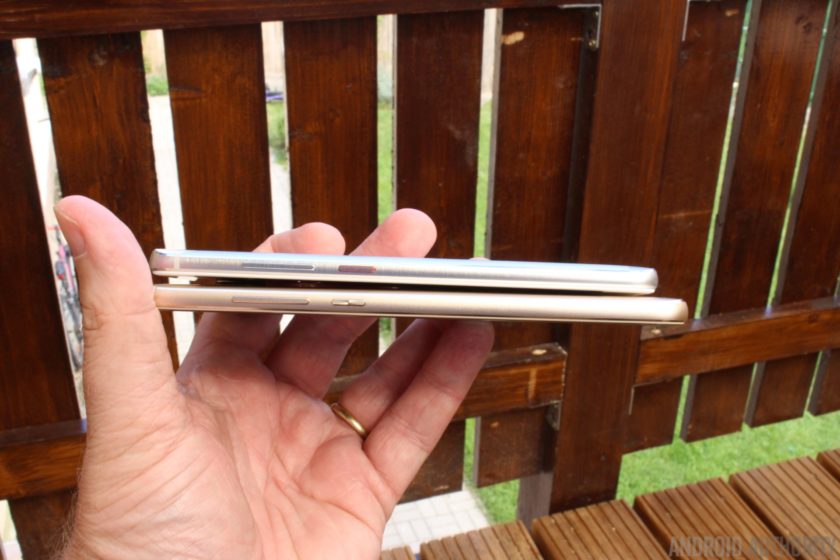
It is from the back that the two phones look most different. The fingerprint reader is round on the nova but more square on the nova plus. The camera is central (with a bump) on the plus, but flush and more to one side on the nova.
Display

On paper the displays for the phones are very similar (except the size). They are both IPS LCD panels and both have a Full HD resolution (i.e. 1920 x 1080). Both displays can be configured in the settings to alter the color temperature and both displays have the same level of brightness (450 nits). Obviously the screen on the nova plus is bigger (at 5.5 inches compared to 5.0 inches) and that means it has a lower pixel density (401 ppi compared to 443 ppi). When placed side-by-side the displays look very similar, however it I had to choose I would say that the nova plus has the better screen, but not by much.
Overall, both screens are crisp with good color reproduction that will provide a good experience regardless of what you’re doing on the screen. My only word of caution is that in very bright, direct sunlight you might find the displays a little hard to read.

Hardware and performance
The HUAWEI nova and nova plus both feature a Qualcomm Snapdragon 625 built using a 14nm process. This is certainly a mid-range processing package. That isn’t necessarily a bad thing, since today’s mid-range phones offer greater performance than some of the high-end devices of only a few years ago. In the CPU side you get eight 64-bit Cortex-A53 cores, clocked upto 2.0GHz. On the GPU side you get the Adreno 506, which supports OpenGL ES 3.1.
In terms of every day use you will find the Snapdragon 625 more than capable. The UI response was good, apps open and close quickly and with 3GB of RAM the multi-tasking capabilities are more than sufficient. If you are a power user then you will struggle with the Snapdragon 625, but for most users will handle just about everything you ask of it. Plus there is the added bonus that the Cortex-A53 core is one of the most power efficient 64-bit cores from ARM, which helps with battery life!
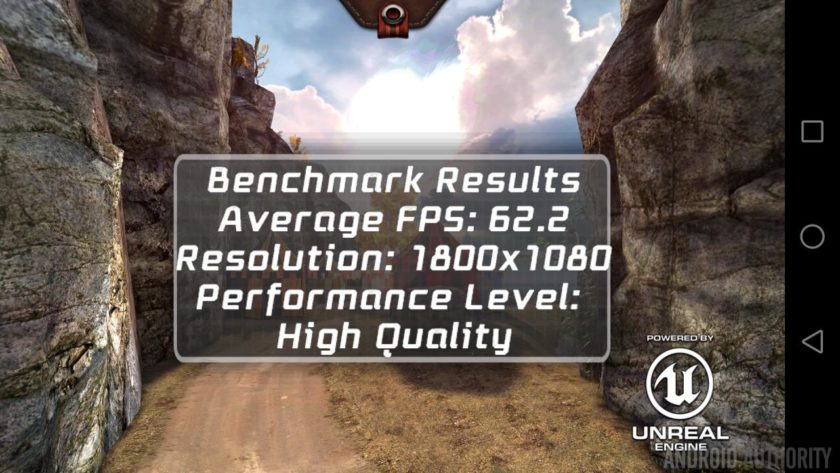
Since the internals of both phones are very similar, both score the same in the popular benchmarks. For AnTuTu you can expect scores of 64969, while for GeekBench 4 the devices scored an average of 840 for the single core tests and 3112 for the multi-core tests. As for Epic Citadel you will get around 60 frames per second in High Quality mode, which is great. However when you bump the details up to Ultra High Quality mode then the GPU starts to struggle a little, scoring just 50 fps.
What that means in real world terms is that the nova and nova plus can handle normal productivity tasks (email, social media, web browsing) without any problems. It will also play 3D games reasonably well, but don’t expect the same level of performance as you would from a leading flagship device. I played Asphalt 8: Airborne and Riptide GP without any problems.
The fingerprint readers HUAWEI’s recent phones (including the Mate 8 and the P9) have been exceptional and I have come to expect nothing less from HUAWEI. The fingerprint readers on the nova and nova plus are equally as good. Since the fingerprint reader is on the back, you can wake and unlock your phone just by putting your finger on the reader. You can also use the fingerprint reader to trigger the shutter while taking photos, to swipe left and right when viewing photos in the gallery, or to answer a call.
Both phones feature a single speaker on the bottom edge, next to the Type-C USB port. The speakers are quite loud and the sound is reasonable considering that they aren’t front facing speakers. Like many smartphones, music can lack bass and sound a bit thin. I found that at full volume some tracks tended to distort and that the sound quality improved when the volume was actually turned down a notch or two. Comparing the nova with the nova plus, the sound quality is approximately the same, however the nova plus is the better of the two.
The nova has a 3020 mAh battery, which is impressive when you consider that the Samsung Galaxy S7 and the LG G5 both have smaller battery capacities. I ran a 3D test to measure the battery life while playing 3D games. According to my calculations you will be able to play 3D games for over 5 hours from a single charge. As for simpler tasks like browsing the web and watching video you should be able to get about 11 hours.
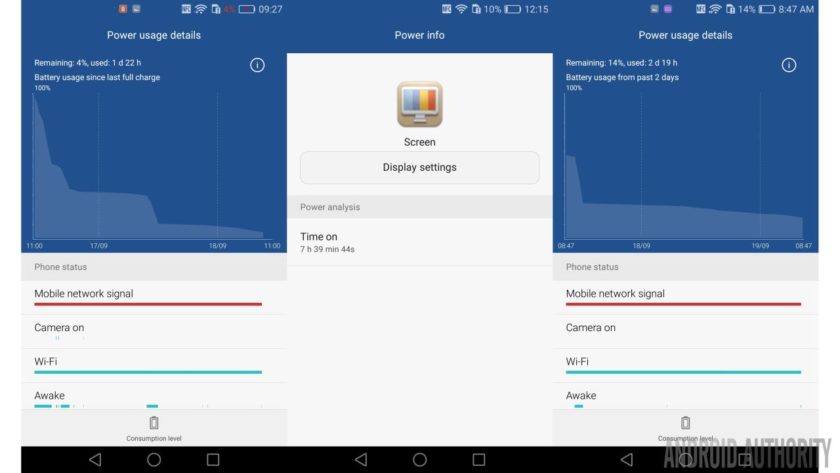
The nova plus has a 3340 mAh battery, even bigger than the nova, mainly to compensate for the larger 5.5 inch display. I ran the same 3D test to measure the battery life while playing 3D games. According to my calculations you will be able to play 3D games for over 5 hours from a single charge. As for simpler tasks like browsing the web and watching video you should be able to get 11 hours.
Overall you will easily be able to get through a full day on either phone, maybe even two. My tests show that you should be able to get around 7 to 9 hours of screen-on time for both devices during a 24 hour period, of course depending on your usage.
Software
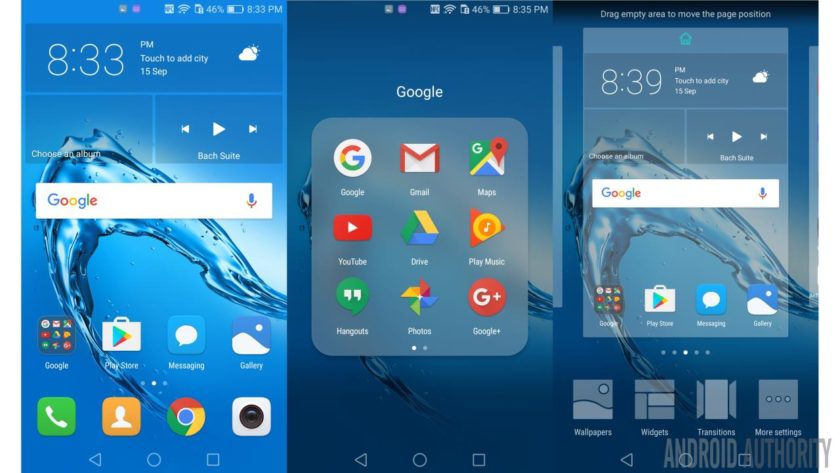
The software experience is identical on the nova and the nova plus, with both running Android 6.0 Marshmallow, with HUAWEI’s Emotion UI 4.1 on top. If you have used a HUAWEI phone before, you will know what to expect here, and once again, you get a very iOS-like user interface, with no app drawer, transparency effects, and home pages filled with colorful icons. For some people the lack of a stock Android experience will be a stumbling block, especially the lack of an app drawer.
If you lack the EMUI launcher then it is also possible to replace it with an alternative like the Google Now Launcher. The trick is to make the Google Now Launcher the default under Settings -> Apps -> Advanced -> Default app settings -> Launcher.
However besides the cosmetic UI changes there are lots of additional features that you don’t get with stock Android including a floating dock, motion gestures, voice wake-up, a one-handed mode and HUAWEI’s own take on a “do not disturb” mode.
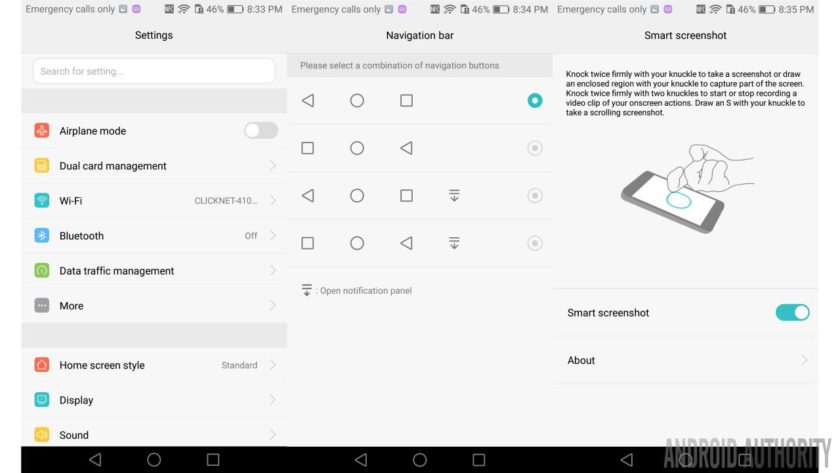
Under motion gestures you can enable motions like flip to mute, raise to ear to answer calls, and a tilt motion to move icons and widgets. The tilt motion feature works from the home screen editing mode. If you touch and hold an icon or widget you can move it to another screen by tilting the phone to the left or right. There is also the Knuckle gestures which allow you to take a screenshot by double tapping the screen with your knuckle, or drawing a letter to open an app. Both types of knuckle gesture can be disabled if you find they misfire.
Since the nova and nova plus both use on-screen keys, HUAWEI as added the ability to customize the order of the navigation buttons. By default the recent apps is on the right and the back button is on the left. However this can be reversed. It is also possible to add a fourth button for opening the notification panel. Tapping the icon is the equivalent to dragging the notification shade down from the top.
HUAWEI has included a battery manager which gives you a high level of control over battery related features. For example you can set a power plan which will tweak the CPU according to your usage (and so save battery when possible). Other battery related options include a whitelist function to ensure that certain apps keep running after the screen is turned off and a power usage firewall which warns you about power hungry apps.
There is also an ultra power saving mode which will disable everything except calls and messages plus activate a simply monochrome UI. When running low on battery power this mode can add several more hours of usage.
Camera
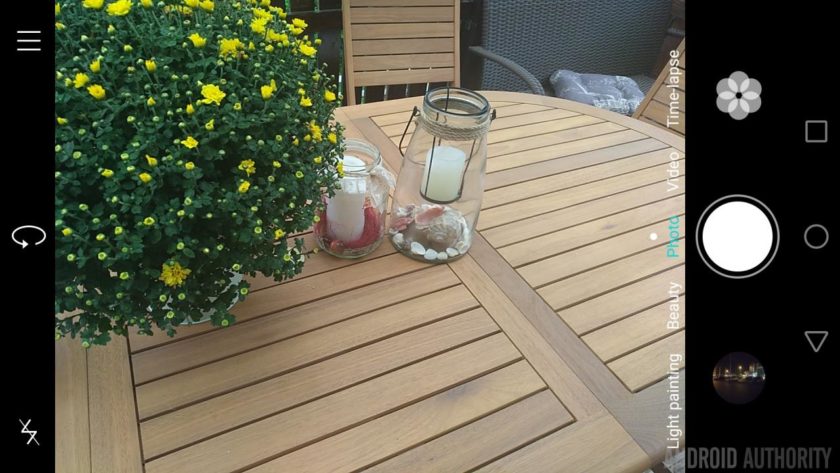
The camera is one area where the nova and nova plus differ significantly. The nova comes with a 12MP rear facing camera that can record video at 4K, plus an 8MP front facing camera. The nova plus has the better setup with a 16MP rear facing camera that includes OIS and 4K video, plus the same 8MP front facing camera.
The camera app is quite nice and includes some interesting features. As well HDR, panorama and the seemingly obligatory beauty mode, there is also a light painting mode, for long exposure shots. The built-in filters include car light trails, for capturing the trails of lights made by moving cars at night; light graffiti, for capturing trails of light in a dark environment; silky water, for silky smooth effects from running water; and star track, to capture the trails of stars and galaxies in the night! However you will need a very steady hand (or better still a tripod) to get the best results.
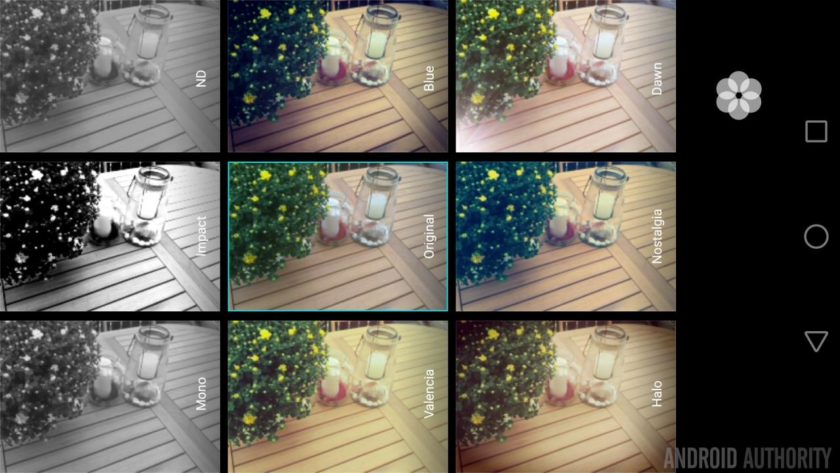
There is also a super night mode, with a long exposure time for night time photos, a slow-motion mode, plus a special Good Food mode for taking close-up shots of your food! Two other interesting modes are the All-focus mode and the full manual (professional mode). The former allows you to refocus pictures post capture and change which object is in focus. The latter gives you control over the metering mode, the ISO speed, the shutter speed, plus the white balance. It also gives you full manual focusing control.
While the camera app is very capable, the actual pictures produced by these devices leave a lot to be desired. Pictures taken in ideal conditions come out quite nice, meaning the cameras are good for outdoor use in good light. However once you move indoors and the lighting is artificial then lots of noise creeps into the pictures.

Both handsets are capable of videoing at 4K in 16:9 from both the rear camera and Full HD using the front facing camera. While the nova doesn’t include Optical Image Stabilization (OIS) it does have a software based image stabilization option when recording video.
Here are some sample shots from the nova so you can see for yourself:

And here are some sample shots from the nova plus:

Specifications
| Display | 5.0 inch IPS panel 1920×1080 resolution |
5.5-inch IPS panel 1920×1080 resolution |
| SoC | Qualcomm Snapdragon 625 | Qualcomm Snapdragon 625 |
| CPU | 8x ARM Cortex A53, upto 2.0 GHz | 8x ARM Cortex A53, upto 2.0 GHz |
| GPU | Adreno 506 GPU with support for OpenGL ES 3.1 |
Adreno 506 GPU with support for OpenGL ES 3.1 |
| RAM | 3GB | 3GB |
| Storage | 32GB + microSD | 32GB + microSD |
| Cameras | 12MP rear facing camera with 4K video, 8MP front facing camera | 16MP rear facing camera with OIS & 4K video, 8MP front facing camera |
| Battery | 3020mAh | 3340mAh |
| Features | Fingerprint scanner, USB Type C, Bluetooth 4.1 | Fingerprint scanner, USB Type C, Bluetooth 4.1 |
| OS | Android 6.0 Marshmallow with EMUI 4.1 | Android 6.0 Marshmallow with EMUI 4.1 |
| Dimensions | 141.2mm x 69.1mm x 7.1mm. | 151.8 x 75.7 x 7.3mm |
| Weight | 146g | 160g |
Gallery

Wrapping up
With 3GB of RAM, 32GB of internal storage, 4K video recording and Full HD displays then the nova and nova plus certainly have the hallmarks of a couple of upper mid-range devices. That is even more so for the nova plus with its built-in OIS and larger display. When I look at the specifications for the Qualcomm processor I myself wanting more, octa-core Cortex-A53 is very yesteryear, however the Snapdragon 625 is built using the latest 14nm fabrication process and as such it is more efficient than octa-core Cortex-A53 processors built on 28nm. I was hoping for a better Snapdragon processor from the 600 series, however after using the nova and nova plus for several days I must admit that the processor package works just fine. It isn’t the fastest and the GPU could be better, but for those looking to buy a phone in the mid-range (and not a flagship), it is more than adequate.
What do you think of the HUAWEI nova and nova plus? Do you plan to buy one, if so which one? Let us know your views in the comments below!
Google Allo review – CNET
The Good Google Allo is available on both Android and iOS, and features a digital Assistant that fetches information for you in a conversational way. Its Incognito Mode erases conversations and has end-to-end encryption.
The Bad Allo doesn’t integrate video calling, and it doesn’t have as many features as its competitors, like baked-in GIF support or control over read receipts.
The Bottom Line It’s not a perfect communications app on Day 1, but the integrated, all-knowing Google Assistant bot sets Allo apart from the messaging competition.
Visit manufacturer site for details.
Does the world need another messaging app? Google says yes. And it believes its Allo messaging app is different enough to compete against Apple’s iMessage, Facebook Messenger, WhatsApp and all the rest. That’s because it’s the first to include Google Assistant, which I can only describe as a mega chatbot that uses artificial intelligence to bring you answers in a conversational manner.
Available as a free download today on Android and iOS, Allo was first introduced during Google I/O in conjunction with Google’s web-calling app Duo (which, since launching a month ago, has now reached 10 million downloads on Android).
Though it sends and receives messages as well as the others, Allo has its own promising features that I found useful. Read on to see what makes Allo stand out and if it has what it takes to be your new chat app.
Google I/O 2016: Daydream, Home and other…
See full gallery


1 – 5 of 15
Next
Prev
Google Assistant: The ultimate bot
Allo’s standout feature is Google Assistant, which is basically a bot you can chat with that uses Google’s vast search database to answer several kinds of questions you throw its way. For example, you can type, “Cafes nearby?” and it will find popular coffee shops in your area (just make sure you have location turned on). You can ask it to translate phrases in different languages, show your latest emails, look up airfare prices and other common queries.
If you’re feeling particularly playful (or lonely), you can play games with it too. (The geography quiz game is educational, but I particularly like the one where you have to guess the movie based only on emojis.)

Assistant confirming sports scores (left) and fetching movie times (right).
Lynn La/CNET
If you’re not already in Allo, it’s faster to press the home button and relay questions to Apple’s Siri or Google’s other digital assistant, Google Now. But Assistant does come in handy when the app is open in front of you (plus you can still ask it questions verbally), and you want to look something up without leaving.
This is especially useful when you’re in a group chat. A search for “popular bars” shows results to everyone on the chat thread, so the group can plan from there. Allo can settle debates, too — like when you and your friend can’t remember what last night’s sports score was or when a particular movie came out. Assistant will immediately put the issue to rest, in writing.
Smart Reply: Never at a loss for words
Smart Replies are generic responses that pop up above the keyboard and text field. Though the replies are canned (for example, autogenerated responses to the question, “Are you busy?” include “What’s up?” “Not really, you?” and, “Yes. Why?”), they can be quite colloquial and somewhat natural-sounding time-savers.

A generic string of Smart Replies (left) and Allo recognizing a photo’s content (right).
Lynn La/CNET
This is a little unnerving since you’re never quite sure if the responses you receive are authentic or just a Smart Reply. The phrases also feel pretty inane if you try to form a full conversation with them (replying to a conversation formed completely from Smart Reply started to feel like chatting with the SmarterChild bot circa 2001). However, they are useful when you’re on the go and have to quickly respond, or you just don’t have the brainpower to trudge through online small talk. Just don’t try and use it for more sensitive, serious conversations.
GE GDE21EMKES Bottom Freezer Refrigerator review – CNET
The Good GE’s slate bottom-freezer sailed through our performance tests and looked good doing it. The slate finish does an excellent job of repelling fingerprints.
The Bad The GDE21EMKES is smaller, less affordable and less efficient than the competition.
The Bottom Line This is a good fridge that can be had for less than $1,500, but strong competitors from LG and Whirlpool can be had for even less. Shop around, or wait for a good sale.
Bottom freezer refrigerators flip the script on the top freezer fridge most of us grew up with. Like the name suggests, bottom freezers move the frozen food compartment down below the fridge, making it easier to access your fresh ingredients.
At $1,650, the GE GDE21EMKES is a slightly expensive example of such a fridge, and all in all, it’s a decent option. The slate finish is a classy change of pace from stainless steel (and one that’s a lot better at repelling fingerprints), and the fridge’s performance leaves little to complain about. That said, there are other bottom freezers like the Whirlpool WRB322DMBB that we like as much as this one, if not more — and most of them cost a little less. The GDE21EMKES is a good choice, but shop around a bit before you pull the trigger.
Here’s a svelte, slate bottom freezer from…
See full gallery


1 – 5 of 12
Next
Prev
Design and features

It’s a simple interior, and not quite as big as the competition.
Tyler Lizenby/CNET
Bottom freezers don’t differ much from model to model. You get your fridge up top, your freezer down below, and, in most cases, not a whole lot of features to speak of. The GDE21EMKES is no different.
Still, it’s an attractive fridge, thanks to the stylish slate finish — it looks good and repels fingerprints to boot. You also get a built-in icemaker in the freezer and a deli drawer in the fridge that slides left and right beneath a shelf to help make it easier to fit large items below.
That sort of storage-minded feature was definitely appreciated, because, at 20.9 cubic feet of total storage space, this bottom freezer is a little bit smaller than the competition. It wasn’t small enough to give me any headaches, though. The in-door drawers are well-sized, offering plenty of room for drinks and condiments, enough so that I had no problem whatsoever fitting our entire load of test groceries inside. I even had room to cram in a couple of our large-size stress test items, as well.
 AIVAnet