


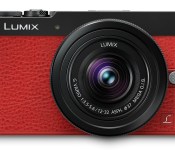
Panasonic’s GM5 mirrorless is still tiny and now has a live viewfinder
 Panasonic has just launched the Lumix DMC-GM5 targeted at shooters who want high performance with a form factor that’s about as small as you can make an interchangeable lens, Micro Four Thirds camera. To remind you (Panasonic has a dizzying array of MFT cameras that even confuses us), the GM5 is the successor to the GM1, the company’s smallest form-factor ILC model. It’s roughly the size of a pack of cards, and weights about 0.62 pounds including a battery and lens. Specs remain similar to the GM1, with a 16-megapixel sensor, 1080p/60fps video, a max ISO of 25,600, a 1/16,000 shutter speed and a new “snap movie mode,” that allows photos and video to be taken at the same time. The other new toy is a 1,166K-dot live viewfinder (LVF) with a 100 percent FOV and full color reproduction. Ironically, most of those specs (other than the pixel count) are lower than Panasonic’s LX100, a new compact, fixed lens MFT model also introduced today. We’re guessing the GM5 will actually be much less expensive, even with a kit lens included — we’ll find out by mid-November.
Filed under: Cameras
.CPlase_panel display:none;
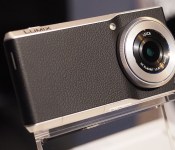
Panasonic’s ‘connected camera’ pairs an Android smartphone with a one-inch sensor and f/2.8 lens

Compact, point-and-shoot cameras are dying, simply because people would rather use smartphones and tablets to snap their dinner and instantly share them to Instagram. Unfortunately, that’s a segment of the market that Panasonic abandoned (at least in Europe) back in 2013. That left the company without a convincing rival to the Lumia 1020 and Samsung’s various phone / camera hybrids. That’s why the company has now launched the DMC-CM1, a “connected camera” (i.e. a smartphone with a proper lens) that’s capable of taking 20-megapixel stills and record 4K video thanks to a one-inch MOS sensor.
For its part, Panasonic knows that the device won’t beat equivalent smartphones on a spec-for-spec basis. Instead, it wants people to concentrate upon the photographic equipment that’s been crammed into this slender device. Perched atop the aforementioned one-inch sensor is an f/2.8 Leica DC Elmarit lens. The lens is fixed, but works equivalent to a 28mm zoom lens, packing an aperture that’ll run all the way up to f/11. A manual control dial runs around the lens, which you can assign to a function of your choice, lending this an old-school feel. In fact, the CM1 looks like the Lumia 1020 by way of Dieter Rams, all austere chrome with cracked-leather style back, and has a weird retro-futuristic look that’s tremendously attractive.
On the surface of it, it’s no slouch in the phone department either, packing a 4.7-inch full HD touchscreen that’ll offer full manual control of your images. Sandwiched between the frame is a 2.3GHz quad-core Snapdragon 801 with 2GB RAM and Android 4.4. The 16GB of internal storage can also, thankfully, be improved with microSD cards up to 128GB in capacity. Battery-wise, there’s 2,600mAh unit lurking inside the hardware, although we’d be concerned that it won’t hold enough juice to get you through a full day of snappin’ and callin’. If there is one downside, it’s that the CM1 is only earmarked for release in France and Germany of Christmas of this year. Still, we imagine that plenty of camera enthusiasts will be racing to get back in contact with some long-lost Gallic grandmother in the hope of scoring one of these as a present.
Steve Dent contributed to this report.
Filed under: Cameras
.CPlase_panel display:none;

Panasonic’s smart mirror turned me into a 1970s space princess

It was going to be either me or my male colleague. That’s a lie: It was absolutely going to be me. It was my last day at IFA, Europe’s biggest technology show, and Brad Molen and I were sitting inside a sparsely decorated smart home that Panasonic had built in the middle of the demo area. Panasonic needed a volunteer to sit in front of its prototypical smart mirror, which applies digital “makeup” so you can sample new looks. I exchanged a look with Brad, imagining his bearded cheeks with blush on them. Then I sat down and agreed to let a machine tell me everything that was wrong with my face.
Embarrassingly enough, this isn’t even the first time I’ve tested such a product for Engadget. Back at CES, if you recall, I got hands-on with a modded Windows PC that used a Kinect sensor to apply makeup and give people nose jobs. If that’s all Panasonic’s mirror did, I would have walked away, my dignity intact. But this thing is a little more sophisticated. With the help of sensors and facial recognition software (the same kind as Panasonic’s cameras), it creates an enlarged, hologram-like image of your face, and then diagnoses your weak areas — wrinkles, smile lines, blemishes, et cetera.
When it’s done, it makes custom recommendations based on your skin condition. In my case, the mirror zeroed in on the dark circles under my eyes, marking the area with a series of blue lines. I was jetlagged, exhausted and operating on very little sleep. “Get this girl some concealer!” it may as well have said. Then it offered to sell me anti-aging products and have me download a juice recipe. Well played, machine. Well played.

From there, you can do all sorts of things to your eyebrows, lips, cheeks and eyebrows, just as you’d expect. For the purposes of this demo, the presenter was using a remote, but it’s also capable of voice commands, including “Mirror off.” In addition, the mirror could in theory sync with your calendar, and recommend entire looks for different occasions. A first date after work? Meeting with clients? Spending the day at a trade show? (J/k: The answer there is “no makeup.”) Of course, I say “in theory” for a reason: Not only is this a prototype, but it isn’t necessarily destined for your home, either. Instead, a Panasonic rep told me, the mirror is really intended for places like salons and department stores. Which is just as well: Only a professional could tell me when a space-alien look is called for.
Brad Molen contributed to this report.
Filed under: Household
.CPlase_panel display:none;

Tomorrow Tesla Motors will announce the location for its battery ‘Gigafactory’ is Nevada

Several states have been in the running for a multi-billion dollar facility Tesla Motors has envisioned to build components for its electric cars (including the $35,000 Model 3), but it appears Nevada is the one. CNBC sources indicated a deal was close earlier today, and now Nevada Governor Brian Sandoval has timed a “major announcement” for tomorrow at 7PM ET. Other sources like Bloomberg claim CEO Elon Musk and other Tesla representatives will be at the event, and also mention that there could be more factories to follow. A joint operation with Panasonic, the ‘Gigafactory’ is key to Tesla’s strategy to lower the price of EVs in the future by working on different parts for the batteries (raw materials, cells, modules and battery pack enclosures) all in one place. Naturally, the prospect of some 6,500 or so new jobs have had southwestern states ideal for its renewable energy plans fighting over the right to play host.
Stay tuned for a major announcement tomorrow at 4PM related to economic development in #NV.
– Governor Sandoval (@GovSandoval) September 3, 2014
Filed under: Transportation
Source: CNBC, Governor Sandoval (Twitter), Las Vegas Review-Journal
.CPlase_panel display:none;

Panasonic’s bringing Technics back with a pair of high-end amps

Technics, Panasonic’s high-end audio brand, may never have actually gone away, but it certainly fell out of the gaze of the mainstream. Now, however, the company feels that it’s the time for the name to make a comeback with a pair of speaker-and-amp combinations that’ll appeal to audiophiles everywhere. At the top end is a “Reference Series” R1, which comprises of a stereo amp, network audio control player and a pair of speakers. If your cash won’t stretch that far, however, then you’ll be able to shift down a gear with the “Premium Series” C700 range, which offers an amp, speakers, network audio player as well as – wait for it – a compact disc player. There’s no word on what the company is going to be pricing this hardware at, but we’d assume that Technics won’t sully its name with some budget devices. Still, it won’t be long until we find out, since both ranges will land in Europe in December, with global sales coming in early 2015.
Filed under: Home Entertainment
.CPlase_panel display:none;

Which 4K TVs are worth buying?

Both Netflix and Amazon stream in 4K. Cameras like the Sony a7S and the Panasonic Lumix GH4 can shoot in 4K. Even smartphones have been getting in on the act, with handsets like the LG G Pro 2 and Sony Xperia Z2 capable of recording 4K video. So with the amount of 4K content available increasing every day, you may have been thinking about buying a 4K set so you too can bask in the glow of 3,840 x 2,160 resolution. But 4K sets don’t come cheap, and you’re going to want to do a bit of research before dropping that much cash. While we don’t really review televisions here at Engadget, we’ve done the next best thing, compiling the opinions of trusted critics from across the web. Which set offers you the most bang for your buck? Do bells and whistles like a curved screen make a difference? Check out a few members of the 4K Class of 2014 below.
Panasonic Life+Screen AX800

Price: $2,300 and up
Samsung U9000

Walk into a room and the first thing you’ll notice about the Samsung U9000 is its curved screen, which CNET says adds a “unique, futuristic look” to a set that is overall “drop-dead gorgeous.” It says the picture is equally stunning, offering “deep black levels, accurate color and great bright-room viewing qualities.” But what about that curve? Though it’s meant to create a feeling of depth and immersion, CNET found it “didn’t have any major effect on the picture aside from reducing reflections somewhat,” and Reviewed.com found it actually made some reflections worse, such that “lamps and lights are occasionally stretched across the entire arc of the screen.” It’s worth noting that the U9000 also includes an improved Smart Hub experience, but you can also find other Samsung sets that are a lot cheaper (and less curvy).
Price: $3,297 and up
Samsung U8550

The Samsung U8550 is a set that eschews the curved screen of its high-end sibling U9000 in favor of “trim bezels and a very narrow panel” that Reviewed.com says “lend this television a modern air.” The picture also does it credit, with LCD TV Buying Guide complimenting its “brilliant images in 4K,” while Sound+Vision was impressed with the “crisp detail and the clean, smooth clarity” of its upconversions. As on the U9000, the Smart Hub has been upgraded with “subtle improvements” that “hit the mark” according to LCD TV Buying Guide, and Reviewed.com says it provides “all of the streaming content and web-browsing functions you’d expect for the price.” And that’s a price that undercuts the competition by $1,000, leaving you some extra cash for an awesome sound or gaming system on the side.
Price: $1,597 and up
Sony X900B

Price: $2,998 and up
Filed under: Home Entertainment, HD, Samsung, Sony
.CPlase_panel display:none;

Tesla seals landmark deal to mass-produce EV batteries in the US

How is Elon Musk going to produce his vaunted $35,000 Tesla when EV batteries are so expensive? By making his own. Tesla has signed a deal with Panasonic that’ll see the pair team up to build the Gigafactory. It’s from here that vehicle packs and cells will be mass-produced on an unprecedented scale that costs are expected to tumble. According to the announcement, Tesla will build the plant and maintain it, while Panasonic supplies the lithium cells, plant, machinery and manufacturing equipment to make the whole thing happen. The Gigafactory is expected to produce 35GWh of cells and 50GWh of power packs by 2020 and will be built just as soon as Musk and co. work out which state — Arizona, New Mexico, Nevada or Texas — depending on which has the better tax rebate renewable energy resources.
Filed under: Transportation
Source: Tesla
.CPlase_panel display:none;
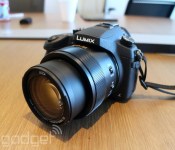
Panasonic’s Lumix FZ1000 is a camera that wants to do it all

Since its beginnings, photo and video enthusiasts have been very fond of the GH4 camera. Now, as it looks to broaden its Lumix portfolio, Panasonic is introducing the FZ1000, a compact shooter that offers 4K (30fps) video-shooting capabilities to folks who may not want to spend too much money. Inside, there is a 1-inch, 20.1-megapixel “high-sensitivity” MOS sensor, paired with a 16x Leica DC Vario-Elmarit optical zoom lens. For $900, you’ll also get a 3-inch articulating LCD, WiFi features, a top ISO of 12,800 and a newly minted AF system which promises to “extremely fast focusing.” Panasonic says its Lumix FZ1000 is aimed at those wanting to shoot great pictures and video, but perhaps don’t have the need (or bank balance) for something as powerful as its $1,700 GH4. If you’re interested, the FZ1000 is set to go on sale late July.
Source: Panasonic

Drone inspectors: UK airline easyJet looks to tech to cut costs

Virgin’s the kind of brand we’re not shocked to see playing with the latest tech — after all, Richard Branson’s got a space plane. Experiments with Google Glass, smartwatches and iBeacon for Virgin have all focused on boosting customer experience, as long as you’re in Upper Class, anyway. European airline easyJet, however, is known for its no-frills, low-cost approach, which is why we’re curious to see the company investing in an “innovation” arm that looks at how new technologies can be applied to aviation, with no immediate return. easyJet sees it differently, though, as the long-term goal is to save money by reducing technical delays, or hopefully avoiding them all together. This has a knock-on effect of improving customer service by minimizing disruptions, of course, but make no mistake: easyJet’s motivated to explore emerging tech because a grounded plane might as well be a money pit.
easyJet envisions reducing aircraft downtime in a number of ways, the simplest (on paper) being better software. In this area, the airline’s testing a system that monitors its fleet in real time, and schedules part replacements before they fail, as well as looking at mobile apps that also take the hassle out of identifying and ordering the right parts. The main issue for easyJet, really, is when a plane is struck by lightning or suffers some other event that might’ve caused damage, and it needs meticulous inspection before returning to active duty. We’re told it can take up to a day for engineers to OK a plane, and it’s this lost time that easyJet is trying to cut dramatically by using a much smaller kind of aircraft: the drone.

Though the airline admittedly has no real idea of when it could deploy drones in support of its engineers, the pipe dream sees UAVs shrinking lengthy inspection times to little more than an hour. Instead of making engineers climb about the aircraft in search of damage, the thinking is drones could help get at hard-to-reach places quickly. While laser scanning and 3D modeling could be part of a drone’s job in the future, easyJet’s still just working on making sure camera quality is as good as it can be. The airline’s working with drone-builders CopterCraft and the Bristol Robotics Laboratory (UK) to perform proof-of-concept studies, with the latter even looking into autonomous scanning, multi-drone setups to divide workload and particularly outdoor flight in turbulent environments.

All aircraft maintenance is managed from a command center next to London’s Luton Airport, and the hope is that drone imagery and scans can enhance communication and data availability with engineers on the ground. Not limited to just drones, easyJet’s also testing hand-held and head-mounted cameras, as well as portable 3D scanners for relaying information back to base. AR headwear from the likes of Epson and Vuzix could also feed information the other way, giving engineers a heads-up as to where an issue might be found. Most of these applications are a long way from formal introduction, but some tech is set to save easyJet money right now. By the end of the month, the 25kg of flight manuals and other paperwork its planes lug around will be replaced by Panasonic’s rugged Toughpad tablets. And, according to easyJet, one kilo costs it $20,000 each year. In an effort to make truly paper-free planes, Sony’s large e-paper slates are also expected to substitute in for the plethora of forms the crew must fill out for each flight.

easyJet considers all these projects investments, and ones that will eventually pay off. It’s not concerned with other airline’s riffing of the ideas, either, and in some respects hopes to be a leader in assessing new technologies for their potential in aviation. Most of all though, easyJet wants its planes in the air as much as possible, getting you on your way and making dollars in the process.
Sharif Sakr contributed to this report.
Filed under: Robots, Tablets, Transportation, Wearables, Software, Sony
Source: easyJet

Panasonic’s medical robot returns after the first-gen sold but two

Remember Hospi, the digital porter from 2004? We wouldn’t blame you if you didn’t, since Panasonic only sold two of the things in the better part of a decade. Now, the company is looking for a do-over, having redesigned the robot to actually provide some use to Japan’s hospitals. This time out, the Hospi is designed simply to transport medicines to patients and take medical records to staff members. Not that it’s just carrying around the odd beaker or folder, since Panasonic’s designed the gear to lug around 44 pounds of weight at any one time. Given that each robot costs almost $100,000, you’d think it might be cheaper just to hire some interns or plumb in a vacuum tube system — but it transpires that one hospital used the latter, and it cost almost $10,000 a month just to keep it running.
Filed under: Robots
Source: The Asahi Shimbun
 AIVAnet