



What you need to know about Microsoft’s acquisition of Nokia

Nokia hasn’t always been a phone manufacturer. The company dabbled in paper products, footwear and tires before it became involved in the wireless industry. Starting today, it begins a new chapter as its Devices and Services division gets swallowed up by Microsoft in a $7 billion deal. Change is in the air, but very little is known about what exactly will be different now that the two companies are coming together in holy matrimony. Neither party was legally allowed to discuss details about the acquisition in public.
Today, Microsoft gets to flip the switch and Nokia gets to switch its business cards. (A shame, since its cards are very happy-go-lucky.) But this is just the beginning of a lengthy move-in process in which the two companies can finally start working together as one. Chances are we’ll still be asking questions about the merger several months down the road, but as execs explained to us, these kinds of procedures take time to get everything sorted out. For now, what should we know about the merger?
What is it?

Microsoft will take over Nokia’s Devices and Services business, which includes both Smart Devices and Mobile Devices. In other words: The Lumia, Asha and X series are now all under Microsoft’s umbrella. Design teams, supply chain, accessories, employees, developer relations and most of Nokia’s manufacturing plants and testing facilities are also on Microsoft’s side, as are most of the company’s services like MixRadio, Store and more. Here, Nokia’s mapping entity, is considered a separate business and isn’t included as part of the deal, but Microsoft has agreed to a 10-year licensing agreement.
Microsoft will also control IP agreements and any third-party contracts related to Nokia’s devices. Symbian should fit in this category, as well as any partnerships Nokia had with Qualcomm and other silicon companies. And in case you were wondering, the company’s imaging talent will make the switch over to Microsoft as well.
Since Microsoft retains rights to the Lumia and Asha brand names, the company will take advantage of them for the time being. Anything Nokia had in the pipeline will likely still come out in the next several months (unless Microsoft decides to veto certain products). A true Microsoft phone probably won’t be seen for at least 10 months, since it usually takes a long time to push a device through the development process.
Stephen Elop, who served as Nokia’s president and CEO, is now executive VP of Microsoft’s Devices Group and will report directly to CEO Satya Nadella. In this role, he oversees the company’s entire hardware lineup: phones, tablets, Surface, Xbox, Perceptive Pixel products (PPI) and even accessories. Additionally, 25,000 Nokia employees will make the transition over to Microsoft.
Why is this happening?
Microsoft and Nokia were already the closest of BFFs, but they still had to act as separate companies. Even though the two collaborated frequently, they each had to go through different development processes; both companies had their own resources, tools, culture and trade secrets, which created a lot of inefficiencies. By bringing Nokia into the fold, Microsoft can now work on both firmware and hardware from day one, theoretically making the process of developing, manufacturing and distributing a new phone or tablet much more efficient.
Additionally, Microsoft claims that with a greater understanding of how hardware and software work together, it will be able to apply that knowledge to its relationships with existing partners, developers and operators.
What will happen to my phone?

If you own a Nokia device, nothing should change. Your phone won’t mysteriously stop working or explode, but even if it does, Microsoft will honor any warranties you had in the first place. In a blog post, Elop reiterated his commitment to continued support for featurephones, as well as the Lumia, Asha and X lineups. We’d like him to be more specific, of course, but he likely means that Microsoft will stick to the current roadmap of new devices and firmware updates. Whether the company drifts away from this strategy later on is a different matter entirely, but existing Nokia users shouldn’t notice any changes to their phones as a result of this transition.
In a similar fashion, owners of other Windows Phones won’t see any changes either. At the moment, there isn’t any reason to suspect that Microsoft will magically stop working with other companies on updates or new devices; this wasn’t the case with the company when it launched the Surface, and it appears that Microsoft is actually expanding its relationships with other partners, as we’ll discuss shortly.
How do Microsoft’s partners feel?
Aside from generic press statements, most of Microsoft’s partners aren’t discussing how they feel about the acquisition, but we’re guessing there are mixed emotions. Reports say that Samsung teamed up with Google in China last month, arguing with regulatory officials that Nokia’s patent-licensing fees would go up under Microsoft rule; in fact, licensing in general has always been, and will continue to be, a concern. However, a handful of new companies have stepped forward as Windows Phone partners, including LG, ZTE and Lenovo and several Indian phone makers, which suggests that many companies are embracing the change instead of shunning it.
Perhaps these new partners are just open to the idea of launching a Windows Phone and are just waiting to see what happens after today’s merger. After all, few if any of the listed companies have announced their plans, and the rumor mill is curiously dry. Granted, it’s never a bad idea to have a partnership like this in your back pocket just in case it comes in handy. If any of Microsoft’s partners (outside of Samsung) are worried about not getting equal treatment, they aren’t speaking up about it — of course, this wouldn’t be anything new, since Nokia was considered the Windows Phone poster child ever since it started supporting the platform in 2011, so not much has actually changed in that sense.
How does the future look?
According to Microsoft, the future looks bright. However, mergers are historically much messier than the flowery press releases lead you to believe. They’re often riddled with layoffs, and customer-support issues, so it’s hard to believe that everything will just go as smoothly as planned.
As more details about the transaction come to light, there are two areas that we’ll be paying close attention to. The first is organizational: Will Microsoft keep all 25,000 employees for the long term, or will it have to streamline the workforce as is often the case? The second is in the form of device support. While Microsoft says it will continue to support Nokia’s entire portfolio, will it eventually drop the X because it runs on Google’s mobile OS? Will Lumia phones get Windows Phone updates before everyone else, or will the company treat all of its partners fairly? We still have plenty of questions, and now that Nokia’s device division is part of “One Microsoft,” the company can finally start answering them.
Filed under: Cellphones, Wireless, Mobile, Microsoft, Nokia
Nokia is now officially part of Microsoft

As expected, Nokia’s devices and services business has been officially acquired by Microsoft today. The date was set earlier this week, and it seals the deal the two companies entered into last September. Nokia has long been allied with Microsoft, committing fully to Windows Phone, but as explained when the merger was announced, Microsoft’s new arm will continue to support feature phones like the Asha and Nokia X ranges, as well as smartphones (we’ll have to wait to see what “support” means exactly). The obligatory press releases from both companies don’t reveal any grand plans or shift in focus, but each side has issued some closing remarks, if you like.
Microsoft CEO Satya Nadella said:
“Today we welcome the Nokia Devices and Services business to our family. The mobile capabilities and assets they bring will advance our transformation. Together with our partners, we remain focused on delivering innovation more rapidly in our mobile-first, cloud-first world.”
Stephen Elop, former Nokia CEO who’s moved over to become head of Microsoft’s hardware division, penned an open letter with similar sentiment:
“As Microsoft and Nokia Devices and Services come together as an expanded family, we will unify our passion, dedication and commitment to bringing you the best of what our joint technologies have to offer.”
Filed under: Cellphones, Mobile, Microsoft, Nokia
Source: Nokia, Microsoft, Elop open letter (Nokia)
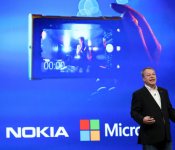
Microsoft and Nokia finally tying the knot on April 25th

Let the wedding bells ring! Microsoft announced this morning that it finally has something we’ve been curious about since September: the actual date the company will complete its proposed acquisition of Nokia’s devices and services business. In a blog post, Microsoft’s General Counsel Brad Smith explained that all of the legal hurdles have been cleared and that the merger will officially take place this Friday, April 25th. “We look forward to introducing the next billion customers to Microsoft services via Nokia mobile phones,” Smith said.
Microsoft will manage the Nokia.com domain and the company’s social media presence for up to a year, and former Nokia CEO Stephen Elop will be in charge of Microsoft’s devices group, reporting directly to CEO Satya Nadella. Aside from this, Microsoft has been pretty tight-lipped on details about what the post-acquisition world will be like, mainly due to legal restrictions. After this Friday, however, we hope the company will open up a bit more about what we can expect going forward.
Filed under: Cellphones, Wireless, Mobile, Microsoft, Nokia
Source: Microsoft Blog
Google could be working on an even cheaper Nexus

If the Nexus 5 wasn’t budget enough already. a new report has surfaced that suggests Google has partnered with MediaTek for a very low-priced Nexus smartphone.
With Nokia lining up their budget Android handsets aimed at developing markets, it’s expected that the MediaTek processor will power the Nexus device that could sell for only $100 in order to further spread the Nexus brand.
Whilst details are scarce at the moment, it certainly makes sense for Google to offer a budget Nexus device running pure Android to not only advertise Nexus, but also promote Android as Google intended.
SOURCE: mtksj
The post Google could be working on an even cheaper Nexus appeared first on AndroidGuys.
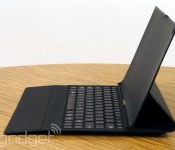
Nokia stops selling Lumia 2520 tablet over electrical shock concerns

Nokia has issued a product advisory for certain Lumia 2520 chargers and has temporarily suspended sales of the Windows tablet in the UK and parts of Europe. The notice applies to its Europe- and UK-only AC-300 charger, along with the 2520 travel charger accessory, which is also available in the US. Use of those products should be discontinued immediately due to a shock hazard, though Nokia said that no incidents have been reported yet. 30,000 chargers are affected in total, but only 600 of the travel accessories were sold in the US. That means you’re free to use the tablet stateside (without the travel charger, of course). But if you’re located in the UK and certain other European countries, your Lumia 2520 will have to go on ice pending a fix. More information and updates are available from Nokia right here.
Source: Nokia

Microsoft’s deal to buy Nokia gets thumbs-up from China

When one massive corporation buys another one, it’s not as simple as handing over the dosh and winking. There’s also the small matter of the world’s competition authorities, which check that the deal won’t affect market conditions. China has finally given its blessing to the Microsoft – Nokia tie-up, meaning that the pair can make their marriage official, probably before the end of April. Of course, that only gives us a few days to work out a facetious portmanteau to name the pair — Microkia and Nokrosoft are all we’ve got so far.
Filed under: Cellphones, Tablets, Mobile, Microsoft, Nokia
Source: Nokia

Here’s what you missed at Microsoft’s 2014 Build conference

We came, we saw, we barked orders into a phone. Though Microsoft’s annual developer conference is technically called “Build Windows,” we actually spent far more time at this year’s event playing with handsets — almost no PCs, come to think of it. Indeed, the star of the show was a husky-voiced lady (fembot?) named Cortana, Microsoft’s new Siri-like personal assistant. Of course, Cortana wouldn’t exist outside of the next version of Windows Phone (that’d be v. 8.1.), which we also got a glimpse of this week. In case you missed our three-hour liveblog — or were too busy following our Amazon Fire TV coverage — we’ve got a neat recap below. We promise we’ve left out all the boring bits about developer tools. Mostly, anyway.
Windows 8.1 Update

OK, we lied: there actually was some Windows news this week. And yes, we did play with at least one full-fledged PC. Microsoft announced a fairly modest update for Windows 8.1, and almost all of the improvements are aimed at winning over mouse-and-keyboard users. For instance, you can now pin Metro-style Windows Store apps to the desktop, with the Windows Store shortcut pinned by default. Speaking of the desktop, PC makers now have the option of booting to the desktop by default, though you’re really only likely to see that on traditional PCs, maybe not hybrid devices.
Other changes: when you right-click on something on the Start Screen, you’ll see your options pop up right there, where your cursor is, not at the bottom of the page. Wrapping up, there are dedicated power and search buttons on the Start Screen; you can pull up the desktop Taskbar even when using Windows Store apps; and Metro-style programs now have a Title Bar up top allowing you to close out by hitting an “X” in the upper-right corner. Really, lots of things that should have been baked into Windows 8 to begin with.
Return of the Start Menu

Oh, and speaking of things that should have always been part of Windows 8, Microsoft casually dropped some major news toward the end of its epic keynote: the company is planning to bring back the Start Menu you all know and miss. This time, though, it won’t just include a list of desktop programs, but there’ll be a second pane over on the right showing Live Tiles with Windows Store apps. Smart move, we say: not only would it make Windows 8 feel more familiar to new users, but it would drive home the point that whether it’s a desktop app or a Windows Store download, it’s all the same OS.
Cortana

Who needs Siri when you can have an assistant named after the life-saving sidekick in Halo? Though Microsoft’s new voice recognition program isn’t perfect, it’s at least rich in features, and does basically everything you’d expect of a modern voice-controlled personal assistant for your phone. That means, you can use Cortana to help you compose emails and texts, set reminders, take notes and search the web (with lots of help from Bing, of course). Also, much like Google Now, Cortana gets smarter over time as she learns more about your various likes, interests and late-night taco addictions (not that there’s anything wrong with that). Using a Notebook feature, you can input a lot of this information yourself, including Quiet Hours when you’d rather not be interrupted by phone calls (even then, select people, like your family, can still get through).
In our brief hands-on, we found that Cortana only responded when we phrased our queries in a certain way. (Pro tip: start with verbs. As in, “Remind me to ask Brian for a status update.”) Also, you have to press a button on-screen anytime you want Cortana to start listening. Still, Cortana’s only in beta and indeed, Microsoft tells us it’s working on an always-listening mode similar to what you’ll find on the Moto X. Better language recognition is also in the works, according to company reps, which means you might get away with saying “Can you find me a Thai restaurant in Palo Alto?” Lastly, Microsoft promises the final version of Cortana will have even more “personality” — whatever that means.
Windows Phone 8.1

But there’s more to Windows Phone 8.1 than just Cortana. The OS update, which will hit existing devices in the coming months, brings a number of new features, including a drop-down Action Center for notifications that looks suspiciously like the one in Android. Windows Phone users also get a customizable lock screen and a Windows Store that makes it easier to find featured apps — two improvements we first saw on Windows 8.1 for the desktop. Additionally, Windows Phone 8.1 ushers in a Wi-Fi Sense feature that automatically accepts the terms of service for networks, and securely shares your router’s password with contacts in Facebook, Outlook.com and Skype. Thus, you can give them guest access to your internet, but not your full network. Finally, there’s a new weekly view in the calendar, and you can use “Shape Writing” to draw letters on the keyboard, à la Swype.
New Lumia phones

What would a Windows Phone update be without some new hardware to go with it? Once Microsoft finished its three-hour opening-day keynote, Nokia held a party of its own, where we had a chance to play with the newly announced Lumia 930, 630 and 635. Though the 930 is clearly the flagship, it’s also incredibly familiar. In fact, it’s basically the Lumia Icon we reviewed two months ago, just with support for global LTE (the Icon is exclusive to Verizon in the US). But, for those of you outside the States who have been ignoring the Icon for just that reason, here’s a quick refresher: the phone has a 5-inch, 1080p screen, a 20-megapixel PureView camera and a quad-core Snapdragon 800 processor. The main difference, aside from those foreign LTE bands? The color options. Yes indeed, while the US model comes in just black and white, the 930 will be also available in orange and neon green.
Moving on down the line, the 630 and 635 are more or less identical to each other — at least on the outside. Both have a 4.5-inch screen with a 854 x 480 display, 5-megpaixel camera, Snapdragon 400 processor and a modest 512MB of RAM. The main difference is that the 630 is 3G-only with a choice of a single-or dual-SIM setup. The 635, meanwhile, runs on LTE and uses just one SIM. The Lumia 630 will cost $159 / $169 off-contract, depending on whether you get the single- or dual-SIM version. The 635, meanwhile, will cost $189.
Windows Everywhere

Get ready to see even more Windows apps on even more devices. As part of its opening-day keynote, Microsoft told a crowd of developers that it will now be possible to write a Windows app for one platform — say, Windows Phone — and then port it over to the tablet or desktop, all with minimal work on the back end. From there, developers will have the option of offering their apps in such a way that consumers only have to pay for it once, though they’d still be able to download it multiple times across different kinds of devices (tablets, PCs, et cetera). In theory, devs will also be able to write universal Windows apps for the Xbox too, though Microsoft will still curate the selection, as well as decide which apps require an Xbox Live Gold subscription.
Additionally — and this is big news — Microsoft announced that Windows would be free for phones, tablets smaller than nine inches, and miscellaneous gadgets that fall into the “Internet of Things” category. That gives manufacturers a bigger incentive to build Windows devices, which can only mean more options for you, the consumer. Finally, Microsoft also said it intends to bring Windows to robots and a “new class of small devices,” which we can only assume means wearables.
A look at Office for Windows tablets

It was just last week that Microsoft came out with Office for iPad, and now we’re seeing a glimpse of what Word, Excel and PowerPoint would look like on Microsoft’s own Windows OS. After teasing a touch-friendly “Metro” version of Office last year, the company is now ready to give us a slightly deeper look. The company used its day-one keynote to show us a few screenshots of the app-in-progress, which sports the familiar Ribbon UI and makes good use of gestures like pinch-to-zoom, and finger-highlighting. No word yet on how feature-rich it will be, but we can only hope it will be just as functional as the new iPad suite.

Nokia shows off ‘MD-12’ Bluetooth speaker to match its new smartphones

It’s not all fun phones and games at Nokia’s Build shindig here in San Francisco. In addition to giving us a closer look at the new Lumia 930, 630 and 635, the company is showing off a Bluetooth speaker to accompany them. The MD-12 (even Stephen Elop seemed embarrassed by the name) is available in the same cheerful color palette as the new handsets, including a bright orange hue. On the audio front, this is really just a companion device, but Nokia is claiming the bass is still better than you’d expect on a device like this. As for size, it’s especially compact — this thing is about the size of a hockey puck, making it even smaller than, say, the Mini Jambox. That said, there appears to still be a robust battery inside: Nokia is claiming 15 hours of audio playback, compared with 10 hours for the Mini Jambox. No word on when, exactly, it will go on sale, but Elop himself said it will cost $55.
Filed under: Peripherals, Microsoft, Nokia
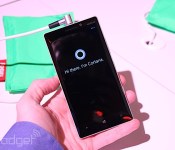
The Nokia Lumia 930 is a global version of the Icon (hands-on)

The Nokia Lumia Icon is a fantastic Windows Phone that comes with a bunch of top features that most Windows Phone users haven’t been able to enjoy until recently, but it had one critical flaw: it was an exclusive to Verizon, which meant that only a handful of users in the US could buy it. For the rest of the world, the only way to get a top-of-the-line Windows Phone (in nearly every spec, that is) has been to buy the Lumia 1520, but its large 6-inch display — though beautiful at 1080p — simply made it too big for a lot of people. Fortunately, that’s about to end because Nokia announced a global version of the Icon known as the Lumia 930.
Interestingly enough, there’s not much of a difference between the two devices. This actually is a bit surprising, considering Verizon has historically landed design exclusives with Nokia like the Lumia 822 and 928. The resemblance is definitely striking, with the only major hardware changes manifest in the presence of GSM bands instead of CDMA and the additional colors that Nokia will offer.
Unlike the Icon, Stephen Elop mentioned that we likely won’t be seeing the 930 in the US — at least, not on a carrier, and not anytime soon. Still, this will be an ideal Windows Phone for many folks in other corners of the globe; it comes with pentaband LTE (bands 1, 3, 7, 8 and 20), quad-band HSPA+ (up to 42.2Mbps) and quad-band GSM/EDGE, so you should be able to get solid speeds nearly anywhere you go, even if you’re not getting LTE in your neck of the woods.
The 930 will come in four color options: white, black, bright orange and bright green. Just like on the Icon, these colors are mainly reflected as part of the polycarbonate panel on the back, and aren’t swappable like the covers on the 630 and 635, also announced earlier today.
Ultimately, Nokia’s latest high-end device takes the Lumia Icon and resolves a lot of our primary concerns with it: it now has global LTE and HSPA+ for international users around the world, it comes in more colors and isn’t limited to just one specific carrier. And if the 5-inch 1080p display and Snapdragon 800 processor fit the bill, you’ll want to keep your eyes peeled for it starting in June for around $599 (though price may vary on market and operator).
We’ll have a video and a bunch more images ready for you shortly, but here are a few to get you started.
Filed under: Cellphones, Wireless, Mobile, Microsoft, Nokia
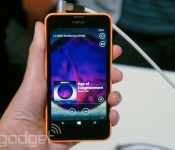
Nokia Lumia 630 and 635 bring Windows Phone 8.1 to budget seekers (hands-on)
Nokia may not be an official part of Microsoft yet — that should finally happen later this month, if you ask either company — but that doesn’t stop the phone maker from cranking out more devices at the software giant’s developer conference. This morning at Build, Stephen Elop announced three new Lumia devices, although two of them are about as close to twins as you can possibly get: the Lumia 630, which is a 3G device that comes in single and dual-SIM flavors, and the 635, which adds LTE. Both are sub-$200 smartphones aimed squarely at both emerging markets and anyone else who just wants a Windows Phone 8.1 device without spending a lot of money in the process.
At 4.5 inches, the pair of devices hit a sweet spot in display size, but its 854×480 FWVGA resolution isn’t going to bedazzle. It’s an inexpensive phone, however, so it’s not horrible given what you’re paying for. The handsets aren’t necessarily designed from a premium perspective, but just like the 620 and 625 before them, these phones are colorful and offer interchangeable shells, which make them a lot more personable and customizable. In addition to the standard black and white hues, you’ll be able to choose from green, orange and yellow (all bright).
When we played with the new devices, we saw two different types of covers. One of the options is matte, while the other is a two-toned option that is essentially an inverted version of the Lumia 620′s cover. They’re easy to swap and they add an element of fun to the phones. It’s 9.2mm thick and has blunt edges that slant slightly, and this actually works in the handset’s favor — sure, it’s not the thinnest device on the market, but it’s very comfortable and easy to hold.
Thanks to this morning’s update to Windows Phone, the Lumia 630 comes with a whole bunch of firsts for a Windows Phone: the inaugural dual-SIM device, the first we’ve seen with virtual soft keys and the first without a physical shutter button on the right-hand side. If you’re going to be using the 5MP rear camera on a regular basis, you’ll at least be able to add the camera into the action center as a quick access shortcut. You’ll also be able to take advantage of Cortana, the new virtual assistant on Windows Phone 8.1.
It comes with a Snapdragon 400 chipset and a mere 512MB of RAM, which means it doesn’t have that much extra horsepower. Fortunately, we were pleasantly surprised in our first impressions; when we played with the 630, it felt a lot snappier than we originally expected. Of course, we’ll have to see if that translates into regular real-world use in our full review when the time comes, but at least for now we’ll take this as a good sign.
When the devices come to market in May, the single-SIM 630 will be $159, while you’ll be able to get the dual-SIM variant for $169 and the Lumia 635 for $189. This may not be quite as inexpensive as the tremendously successful Lumia 520, but we’d be very surprised if we don’t see a Lumia 530 or similar with Windows Phone 8.1 sometime in the near future.
Dana Wollman contributed to this report.
Filed under: Cellphones, Mobile, Microsoft, Nokia
 AIVAnet