



Vsenn enters the modular smartphone market

Thus far the modular smartphone market has yet to manifest itself with actual products that consumers can buy. Google is getting very close with Project Ara and appears to be on track for a 2015 release. Google may get some competition from a new entrant to the yet to be established market. A new company called Vsenn has launched a web site indicating they are working on a modular smartphone.
The web site that surfaced for Vsenn claims the company was co-founded by a former program manager from the Nokia Android X project. Equally lacking in detail are specs for the device that is being worked on. Vsenn does indicate three modules will be swappable – the camera, battery, and processor/RAM combo. Along with the internal hardware, the company says they will offer a variety of back covers to customize the looks of the device.
Two other key concepts have been released by Vsenn. For security purposes, they will use triple layer protection to protect data on the device. A free VPN service will also be available for device owners as well as a secure cloud service. Vsenn also says they will install a vanilla version of Android on the device and they are committing to keeping it up to date for at least four years.
source: Vsenn
via: AndroidCentral
Come comment on this article: Vsenn enters the modular smartphone market

The top 15 smartphones you can buy right now
 It’s possible you already purchased one of the smartphones we listed in our buyer’s guide last July, but things tend to move quickly, and with fresh handsets from names like Apple, Samsung and Motorola, some of you may already be itching for an upgrade. To that end, we’ve made some fresh additions to our list of the latest and greatest smartphones out there today. Sure, our official Holiday Gift Guide is just around the corner, but this update will help you make some quick decisions, or at least get a head start on that holiday wish list.
 Filed under: Cellphones, Apple, Samsung, Sony, Microsoft, HTC, Nokia, Google, LG
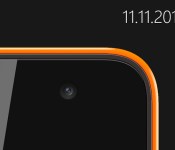
Microsoft will unveil its first Nokia-less Lumia on November 11th

Thanks to Chinese regulators, we’ve already got a pretty good idea of what Microsoft’s first Lumia will look like, but now the company is ready to start showing it off. Microsoft says it will reveal the low-budget handset on November 11th, likely confirming the 5-inch qHD display, 1.2GHz processor, 1GB of RAM, 8GB of storage and 3G-only connectivity we’ve seen approved in Asia. While the handset retains Nokia’s familiar design, it will be the first to sport Microsoft’s logo, which’ll be located beneath the earpiece on the front and in a vertical stripe running down the back.
Filed under: Cellphones, Mobile, Microsoft
Source: Conversations Blog
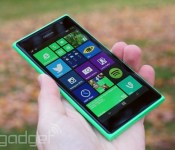
Microsoft’s low-cost Lumia 735 is coming to Verizon, according to the FCC

Windows Phone fans on Verizon haven’t had many cost-conscious options; you’ve usually had to spring for premium devices like the Lumia Icon or One M8 for Windows. Thankfully, that high-priced status quo might not last much longer. A variant of Microsoft’s budget-minded Lumia 735 has passed through the FCC’s regulatory gauntlet carrying Verizon-friendly cellular frequencies (including LTE data), supporting some earlier rumors. There don’t appear to be any special tricks in store, although the smartphone would pack GSM and HSPA+ for your international trips. Don’t hold your breath waiting to get a 735, though. While the filing potentially lets Verizon ship the handset before the end of the year, Windows Central claims that it isn’t on the slate for 2014. You may not see this lower-end Lumia for a few months, if it arrives at all.

Filed under: Cellphones, Mobile, Microsoft, Nokia, Verizon
Source: FCC
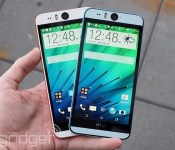
AT&T launches new HTC phones, Lumia 830 and G Watch R on November 7th

When it rains, it pours — on top of its Galaxy Note Edge announcement, AT&T has unveiled launch plans for no less than six smart devices that should reach stores by November 7th. It’ll be a particularly big day for HTC fans, who’ll get the Desire Eye ($150 on contract, $550 off), One (M8) for Windows ($200/$670) and RE camera ($199 contract-free). And that’s just the start. The previously promised Lumia 830 will arrive at the same time, costing $100 on contract and $450 up front; you’ll get a free Fitbit Flex activity tracker with the Windows Phone if you act quickly. Meanwhile, smartwatch lovers will like that both LG’s G Watch R and Motorola’s Moto 360 will go on sale for respective prices of $299 and $249. That’s a lot of release info to digest, but it’s hard to complain too much about getting so many gadgets in one day.
Filed under: Cellphones, Wearables, Mobile, Microsoft, HTC, Nokia, AT&T, LG, Lenovo
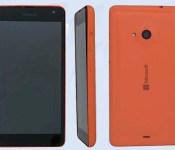
This is what Microsoft’s first Nokia-less Lumia looks like

If we’re honest, Microsoft’s RM-1090 doesn’t look like a device that’s destined to pop up on future trivia quizzes. Yet, when you’re asked “Which smartphone was the first to carry Microsoft’s branding?” it’s this slab that you’ll have to remember. The dual-SIM handset has popped up at both the FCC and its Chinese equivalent, packing a 5-inch qHD display and 3G-only radios, so it’s clearly a low-budget device. Still, the vertical stripe running down the back is just as we’d expected, although it’s still surprising to see the Microsoft logo beneath the earpiece instead of good ol’ Nokia. Since the handset has now popped up at the regulators, we can expect it to hit stores sooner rather than later, if you’re looking for a piece of technology history, at least.
Filed under: Cellphones, Mobile, Microsoft, Nokia
Via: Engadget Chinese

Nokia rumored to be designing an Android-powered flagship

Back in July we reported that Microsoft was killing off any Android-powered Nokia smartphones that were in development, but new rumors claim otherwise. According to a couple China-based tech sites, the design team behind the underrated Nokia N9 are back at it, designing a new Android-powered flagship. Due to Microsoft’s acquisition of Nokia, it is unlikely the phone will bare Nokia’s timeless logo, but it will undoubtedly come with a sleek design like the N9′s, if it ever comes to fruition. After the mixed reviews of the Nokia X, does this rumor pique anyone’s interests? Let us know in the comments below.
Source: MyDrivers
Via: Phone Arena
Come comment on this article: Nokia rumored to be designing an Android-powered flagship

Nokia Lumia 735 review: more than just a selfie phone

Hardware

One glance at the 735 and it’s immediately clear that this is a textbook Nokia (or rather, Microsoft Mobile) design. Its minimalist, rounded plastic shell looks like a Lumia 920 or 1020, just without the bulk; the newer Lumia is only slightly narrower and taller to accommodate its 4.7-inch screen, but it’s noticeably thinner and lighter, at 0.35 inch thick and 4.7 ounces. It’s one of the most comfortable phones I’ve held in a while, and about my only gripe is that the sharp-angled corners occasionally dig into my palm. I’m also a sucker for the matte mint-green finish on my test unit, since it’s at once eye-catching and resistant to dust and smudges. Don’t worry if this or the glossy orange is too garish for your liking, by the way — there are black and white models if you’re a little more conservative.
Not that the ergonomics have improved across the board, whether you’re comparing it to the 720, 920 or other previous Windows Phones. You’ll still find the volume and power buttons in easy-to-reach places on the right side, a headphone jack on the top and a micro-USB port on the bottom. However, you won’t see a dedicated camera key like you saw on the 720 as well as the more recent 830 and 930. Let that sink in for a minute — the Lumia 735, a smartphone devoted to spur-of-the-moment selfies, doesn’t have a quick way to take those selfies. It’s an odd regression on a device that’s otherwise a clear step forward, and it takes some of the fun out of a signature feature.

You may forgive that gaffe with the controls knowing the improvements to expandability. You can now pry off the entire rear shell, which lets you not only add microSD storage (already possible on the 720), but also swap covers and replace the 2,220mAh battery pack. If you regularly find yourself on weekend trips where wall outlets aren’t an option, or you just can’t stand USB battery packs, this could prove to be a lifesaver. The 720’s Qi-based wireless charging has carried over, too, so you can plunk the 735 down on a compatible charging plate at the end of a long day rather than fiddle with cables. Just be ready to buy a microSD card if you’re a shutterbug or otherwise tend to chew through free space. There’s only 8GB of built-in storage, so you’re going to run out of room very, very quickly if you aren’t ruthless about deleting files.
Beyond this, the back holds both a speaker and a 6.7-megapixel camera with flash and a wide-angle lens; on the front, you’ll see an earpiece, a mic and the phone’s centerpiece 5-megapixel selfie camera. You won’t find capacitive navigation keys, however. As with the Lumia 630 and 635, you’ll have to get through the Windows Phone interface using on-screen buttons. I didn’t have a problem with these controls taking up visual real estate, but it could be a concern if you don’t like toggling software keys on and off just to maximize the usable screen area for your apps.
Display and sound

If the Lumia 720’s display was a disappointment, the 735’s is a joy. Instead of a slightly cramped 4.3-inch, 800 x 480 LCD, you’re now looking at a 4.7-inch, 1,280 x 720 AMOLED screen. There’s much more room to breathe here, and visuals that once looked blocky are now crisp. The switch to AMOLED virtually guarantees deep blacks with full image quality at almost every viewing angle. Colors still pop without any obvious signs of oversaturation, and the output is wonderfully bright — so bright that I had to turn the brightness down to “low” when I wasn’t testing the battery. Suffice to say that you’ll have little trouble using this Lumia in bright sunlight.
That doesn’t mean it’s flawless, of course. There are sharper screens if you’re willing to go to higher-end hardware (the 750p Apple iPhone 6 and 1080p HTC One M7 come to mind), and it’s notable that the second-generation Moto G sports a 5-inch, 720p LCD at a lower price. Moreover, you don’t get the Lumia line’s hallmark Glance feature, which shows the time and basic notifications while your phone’s asleep. I found myself missing that convenience more than a few times during my trial run; I don’t want to wake my phone up just to know how late I’m going to be. The 735 does have both a high-sensitivity and a double-tap-to-wake option, mind you, so it’s still a good pick if you either like to wear gloves or don’t want to reach for the power key every single time.
Sound on this Lumia isn’t nearly as impressive. The rear-firing speaker is loud, but there’s virtually no bass; you’ll definitely be plugging in headphones to enjoy your tunes as they were meant to be heard. And while the grille is positioned at an angle that keeps it exposed on a desk (such as during a speakerphone call), it’s a little too easy to muffle the sound while holding the phone in your hand. Given how closely the 735 resembles the 920 and 1020, I’m surprised Microsoft’s mobile team didn’t keep the speaker in an unobstructed position on the bottom.
Software

Windows Phone 8.1 is no longer all that fresh, but it’s still an important factor in whether or not you’ll like this device. If the Lumia 720’s software felt undercooked, the 735’s comes across as well-done. There’s a notification area to catch those important alerts, and Cortana’s voice command engine will do your bidding; the Word Flow keyboard gives you swipe-based typing, and you have more control over the look of your home screen (including folders and wallpaper). There are still gaps in the OS, such as Microsoft’s unorganized settings and Cortana’s inability to handle timers. Even with the hiccups, you can pick the Lumia 735 without feeling that you’re sacrificing basic features from Android or iOS just to get some of Windows Phone’s key advantages, like Live Tiles and deep tie-ins with social networks.
It’s also appealing for what you don’t get: bloatware. Aside from the curious inclusions of Gameloft’s GameHub and the Domino’s Pizza app — no, really — my unlocked test unit was limited to the expected batch of Lumia apps (such as Beamer screen sharing), MSN apps (like Sports) and Here navigation tools. The best part? You don’t have to keep many of these titles. Even if you wind up with a carrier-locked 735, Windows Phone will let you uninstall nonessential apps to either free up storage or remove clutter.
The platform still has an app deficit, though, and it remains an Achilles’ heel. Don’t get me wrong: Most of your needs are easily covered. You’ll find Instagram, Swarm, Vine, WhatsApp and other staples of the modern smartphone experience. However, there are still a few holes. If you lean heavily on Google’s ecosystem, Windows Phone still isn’t for you. You’ll find alternative apps like IM+ (for Hangouts messaging) and MetroTube (for YouTube), but the platform remains best when you’re taking advantage of Microsoft’s own wide array of software, like Skype and Xbox Video. The more pressing issue is simply the lack of “last mile” apps that cover specialized services and utilities, such as your local bank or transit authority; you may have to make do with websites or unofficial tools. The Windows Phone Store’s selection is healthy, but Microsoft needs to focus more on the quality of its catalog, not just the quantity.
Camera

Photography is ostensibly why you’re here — if it weren’t for the promises of high-quality selfies on a budget, there wouldn’t be much to capture your imagination and lure you away from other smartphones. Thankfully, the Lumia 735 lives up to that billing… so long as your expectations match the price, anyway. The 5-megapixel front-facing camera is sharper than what you’ll normally find in this class, and the combination of a wide-angle lens and a relatively bright f/2.4 aperture (both carried over from the 720) produces shots that are well-lit and let you fit an absurd amount of content into the frame. There was plenty of room for three people if I held the phone at arm’s length, and solo self-portraits can easily include tourist attractions or other scenic backdrops.
With that in mind, Microsoft definitely isn’t setting a new high watermark in photography. The Lumia’s front cam has a slightly bluish tone, and shots in moderately dim settings are prone to both noise and occasional blurring. The dynamic range and shot-to-shot performance are also lacking. It’s not uncommon to see blown-out skies in daytime images, and you frequently have to wait a couple of seconds as the 735 processes a photo; you won’t be taking rapid-fire snapshots any time soon. I’m also of a mixed opinion about Lumia Selfie, Microsoft’s app for — what else? — front-facing pictures. Its Auto Selfie mode is great for using the rear camera to capture photos, and there are plenty of filters and face-specific adjustments, but you have little control over the photo before you tap the shutter. If there’s a sickly hue from a nearby street lamp, for instance, you’ll have to fix it later. These limitations are fine for the price, but I’d prefer phones like the HTC One M8 (with a brighter f/2.0 lens) or iPhone 6 (with burst selfies and smarter image processing) if money wasn’t a factor.
And the back camera? You’re still dealing with the 720’s 6.7-megapixel sensor and a wide-angle f/1.9 lens, so the story hasn’t changed much versus a year ago. It’s fine for the price range, but the quality varies wildly depending on the situation. While images are often vivid and sharp in good lighting, there are occasional moments when the results are lifeless or flat-out inaccurate; like many Lumias, it periodically wrecks the color balance for no apparent reason. As with the front shooter, the main cam’s dynamic range is limited and tends to hide detail in both highlights and shadows. It’s capable enough in low-light situations, but don’t let that sweet-sounding aperture fool you — you’ll still have to keep a steady hand for night shots.

Microsoft partly makes up for these shortcomings through its superb Nokia Camera app. The software doesn’t just give you far-reaching control over elements like focus, sensitivity and white balance, but also presents all that control in a meaningful way. You’ll see the effects of most changes in real time, and they’re simple enough that you’re encouraged to experiment. Case in point: Fully automatic shooting ruined a nighttime river scene, but the manual controls let me take a long-exposure, low-sensitivity image that was far more pleasing. You can also tie Nokia Camera into other apps through software add-ons (“lenses”), so you’re only a quick hop away from the likes of Bing Vision searching or 6-second Vine clips.
Video recording on either of the 735’s cameras (both of which can handle 1080p) mirrors the visual quality you get with stills, just with reduced input over the picture. You’re mostly restricted to tuning white balance and focus when shooting with the main camera, and those few options go away with the front unit. Microsoft’s real ace in the hole here is audio recording. As with many recent Lumias, there’s a Rich Recording setup that prevents very loud noises from overwhelming the microphones, such as bass at a concert. The Lumia can be overzealous in muffling sounds with the default settings; occasionally, it sounds like you were recording from a closet. Nonetheless, that’s still preferable to the unlistenable messes you frequently get from other phones.
Performance and battery life

Gauging the Lumia 735’s speed is difficult. If all you’re doing is measuring specs, it’s no great shakes. Although the quad-core 1.2GHz Snapdragon 400 processor and 1GB of RAM are miles above the dual-core chip and 512MB of RAM of the 720, they’re strictly par for the course among low-end phones these days. In fact, the extra memory is this phone’s only real performance advantage (albeit an important one) over the Lumia 630 and 635. Why would you pay Microsoft’s asking price when something like the Moto G has similar innards for less?
| Lumia 735 | Lumia 720 | Lumia Icon | |
|---|---|---|---|
| WPBench | 245 | 179 | 471 |
| SunSpider 1.0.2 (ms) | 1,237 | 1,440 | 538 |
| AnTuTu | 12,060 | 7,348 | 25,750 |
| SunSpider: Lower scores are better. | |||
Because specs don’t tell the full story; that’s why. No, the 735 won’t outrun high-end beasts like the Lumia Icon or One M8 for Windows, but it thrashes the Moto G in the SunSpider web browser test (1,237ms vs 1,534ms) — proof that Microsoft can wring out additional performance through software. You’d be hard-pressed to tell that this wasn’t a flagship just by steering through the basic Windows Phone interface. Scrolling is fast and fluid; transitions happen at a brisk pace; and many apps respond as quickly as you’d hope. If all you’re doing is checking Facebook and playing music, this lower-end Lumia will serve you as well as something costing twice as much. It’s certainly a better pick than the 630 and 635, whose low memory is going to curb your ability to run games and other intensive apps.
There’s only so much Microsoft can do, however, and it’s when you dive into demanding apps that it becomes clear you’re not using a powerhouse. Besides slower web-browsing performance (it’s roughly half as quick as the Icon in SunSpider), the 735 just isn’t great for 3D gaming. A modest title like Wings on Fire plays smoothly, but you can expect stuttering in a visually rich arcade racer like Asphalt 8. No, it wouldn’t be reasonable to demand blistering frame rates from a device so cheap, but you will have to dial your expectations back a notch.

You won’t have to worry much about battery life. That 2,220mAh pack isn’t huge in an era when some mid-size phones pack upwards of 3,000mAh, but it’s also driving modest hardware. That’s reflected in the healthy longevity I got during my stint. The Lumia 735 managed 9.5 hours in a battery-rundown test that involved looping an HD video at medium brightness with email, Facebook and Twitter running in the background; that’s actually half an hour better than Microsoft’s official estimate. It’s more than enough to get through a day of moderate use that includes Instagram, Twitter, Swarm check-ins and instant messaging, although I would get nervous if someone invited me to enjoy a long night out.
No matter what, cellular performance comes up aces. The unlocked 735 I tried sadly didn’t support North American LTE frequencies (only bands 3, 7 and 20), but it still managed very respectable averages of 21 Mbps for downloads and 8 Mbps for uploads on Rogers’ dual-carrier HSPA+ network in Ottawa, Canada. It should play nicely on AT&T’s network in the US, if you get the same model. Call quality, meanwhile, is excellent. Both ends of the conversation are loud and clear, while the noise-cancellation feature does a fine job of squelching background audio — a recipient couldn’t even tell that I had loud music playing in the background during one test. You should anticipate similarly stellar voice calls on the Lumia 730’s two lines, but it’s going to be slower given that it only supports single-carrier HSPA+ data.
The competition

The Lumia 735 is entering a crowded field of not-quite-entry-level smartphones, and your choices are going to vary dramatically depending on what platforms you’re willing to use and where you live. You’re likely to run into a few common alternatives, though, so let’s dig in.
When you limit yourself to Windows Phone, the 735 is a fairly safe bet — in part because it’s tough to find brand-new handsets that directly compete in both price and size. A lot of what’s available is a clear step down in both memory and screen quality, such as the Lumia 635 or Huawei’s Ascend W2. If you have a set spending limit, you may want to consider the Lumia 1320. You’ll give up the 735’s camera prowess and quad-core processing, but you’ll get both a gigantic 6-inch display and a long-lasting battery. If anything, the biggest threat to the 735 is the next step up, the Lumia 830. You’ll lose some quality in selfies, but you’ll also get a more powerful 10-megapixel rear camera, a hardware camera key, more storage and a slightly larger 5-inch screen. Even then, it’s still tempting to pick the 735. It delivers nearly all of the 830’s performance and display quality in a package that leaves lots of cash left over for accessories.
If you’re not wedded to Microsoft’s ecosystem, the rivalry becomes much fiercer… and frankly, the Lumia doesn’t emerge unscathed. Not surprisingly, the elephant in the room is Motorola’s second-generation Moto G. You’re getting most of the experience for a smaller outlay (€199 or less in Europe, $180 in the US), and you’ll get both a higher-resolution rear camera and a larger screen, to boot. While the 735 does have LTE data, wireless charging and better selfies, you’d have to value those a good deal to justify the premium. HTC’s Desire 616 offers a similar bargain, although it’s not as easy to find. Samsung’s comparably priced Galaxy Grand 2 is no real threat, but do look at Huawei’s Ascend G6 — while you lose screen sharpness, you’re getting a good selfie cam and a higher-resolution rear shooter for less cash.
Wrap-up
I won’t lie: I came into this review worried that the Lumia 735 would lean too hard on the selfie angle at the expense of other features, much like the 720 did. Happily, this isn’t the case. The 735 (and by extension, the 730) is really a capable, stylish budget smartphone that just happens to take some nice self-portraits. Microsoft Mobile has ironed out many of the kinks from the 720 while simultaneously lowering the price. How can you not like that? To me, the 735 is the real successor to Nokia’s cult favorite, the Lumia 620. It costs a bit more, but it still strikes a fine balance among attractive design, affordability and solid performance. The 630 and 635 are only worth considering if you simply must have a modern Lumia and can’t justify spending more.
Having said this, there are a few big items on my upgrade wish list. The 735’s cameras could stand to perform better, particularly in darker scenes; it really needs a camera key, or at least a lock screen shortcut; it’d be nice to get both a faster processor as well as more built-in storage. And yes, the app supply remains a concern. The Lumia 735 is a very good phone for what you’re paying, particularly if you’re committed to Windows, but it stops short of greatness.
Filed under: Cellphones, Mobile, Microsoft, Nokia

Microsoft is finally dropping the ‘Nokia’ from Lumia

Over a year after the acquisition was first announced, Microsoft is officially replacing the Nokia Lumia brand. In a blog post today, the software giant revealed its upcoming smartphones will now be known as Microsoft Lumia. The new Microsoft branding will appear on future phones from the company, with a plain black version of the company’s four-squared logo also set to make an appearance.
Tuula Rytilä, Microsoft’s SVP of Marketing for Phones, says the company is looking to unveil its first own-brand Lumia phone “soon.” Rytilä is also keen to note that the change in nomenclature will not affect the support of current Nokia devices. Although the Nokia name will no longer be used for smartphones, low-end phones — the company calls out the Nokia 130 — will still be sold under the banner. Nokia still has brand cachet in Europe and developing markets, and it’s likely that Microsoft will continue to exploit that fact for years to come.
Filed under: Cellphones, Mobile, Microsoft, Nokia
Source: Microsoft (Nokia Conversations)
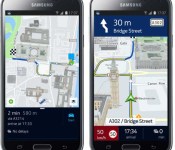
Nokia’s HERE Maps now available on all Android devices

Well that exclusive was short lived. About 2 weeks ago, Nokia’s HERE maps made its debut on Android, but only for Samsung devices through the Samsung Apps Store. I’m not sure I ever understood the exclusive, but I definitely don’t understand the fact that it only lasted 2 weeks.
Nokia has made the HERE Beta app available to the rest of Android. Unfortunately it’s not in the Play Store. You will have to hit the source link below to grab the APK and manually install it yourself.
Being a Beta, you’re sure to run into a bug or two. For example, it was found that some cache cleaner apps will delete the navigation voices. Nokia has promised a fix, but they are still a couple of weeks away from accomplishing it.
If HERE maps is something you would like to try, then hit the source link below to get started.
sources: Nokia / Download Beta
Come comment on this article: Nokia’s HERE Maps now available on all Android devices
 AIVAnet