


Nexus 5 and Nexus 4 owners are experiencing issues with Android 4.4.3 update
 The Android 4.4.3 update started going live earlier this month, hoping to fix the issues that have plagued the devices since Android 4.4.2, from which the Nexus 5 appears to have suffered the worst. While it’s expected that not all bugs will be fixed in any given update, we’re already hearing reports that Nexus 5 and Nexus 4 owners have issues with Android 4.4.3 after updating their devices. Some of the issues include Wi-Fi connection issues, lag in the dialer app and random reboots that were supposedly fixed in Android 4.4.3 have resurfaced on the Nexus 4. Other users have reported 3G issues, problems with battery life and notifications, and to top it off, some of these issues have also been spotted on the Nexus 7 and Nexus 10.
This isn’t particularly good for Google seeing as this update was supposed to fix all the issues that owners have been living with for some time now, though with Google I/O just around the corner and the possibility of Android 5.0 having been teased, it’s possible Google’s full development efforts were diverted elsewhere. Whether Google will fix these issues before moving all the way up to 5.0 remains to be seen, but you may just have to make do until then.
Have you updated to Android 4.4.3 and also experienced some of these issues? Let us know if you have down below in the comments.
Source: Android Origin via Phones Review
//<![CDATA[
ord = window.ord || Math.floor(Math.random()*1E16);
document.write('’);
//]]>

Android 4.4.3 is Finally Here! HTC One E8 Officially Announced! – The ManDroid Show

Android 4.4.3 is finally here my friends. Some of have it. Most of you don’t. In a perfect world, we would all have it. But in the Android eco-system, it takes some time to get the latest Android, but we must be patient friends. HTC announced the HTC One E8, which is pretty much just the plastic version of the HTC One M8. Let us know how much you are loving Android 4.4.3.
News Topics
Android 4.4.3 OTA update for the Nexus 7
HTC One E8 announced
ASUS Padfone S is the Padfone X
Son Xperia Z Ultra 2 teased
//<![CDATA[
ord = window.ord || Math.floor(Math.random()*1E16);
document.write('’);
//]]>
Android 4.4.3 Ready for Nexus! Samsung Leaks their Devices Getting Android 4.4.3! – Device Updates

Device Updates is here for you, and Android 4.4.3 is on everyone’s minds today. Yes, some of you probably already have it on your Nexus device, and hopefully a lot more of us will be getting it soon. Let us know just how great it is running on whenever device you have it one, and go ahead and enjoy the video you see below.
Device Updates
Android 4.4.3 factory images for Nexus
T-Mobile Nexus devices receiving Android 4.4.3 OTA update today
AT&T Galaxy Note 3 Receives update
Samsung devices receiving Android 4.4.3 updates leak
//<![CDATA[
ord = window.ord || Math.floor(Math.random()*1E16);
document.write('’);
//]]>
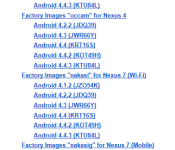
Android 4.4.3 Factory Image for Nexus Devices Released
Earlier this morning T-Mobile support page listed Android 4.4.3 updates were heading out to the Nexus 4, Nexus 5 and Nexus 7 (2013). It brought up a lot of questions, like, will the unlocked versions be getting it. It is a given that the unlocked versions for those devices would be receiving the update, the news was centered around T-Mobile’s carrier versions. For those that might be a little bit more than irritated by the news, there is some other good news out there for you guys. Google has just released the Android 4.4.3 factory image for the Nexus 4, Nexus 5, Nexus 7 and Nexus 10. It does seem to be missing for the Nexus 7 LTE version though. The file size rolls through at 444MB’s and you’ll need fastboot set up to to get it installed.
 If you know what you are doing and just can’t wait for the update to roll trough to your device, then head over to developers.google.com and pick up your image and get to work.
Source: Android Central
//<![CDATA[
ord = window.ord || Math.floor(Math.random()*1E16);
document.write('’);
//]]>
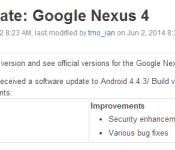
T-Mobile Nexus 4, 5 and 7 Get Android 4.3 OTA Starting Today
Looks like the T-Mobile branded Nexus 4, Nexus 5 and Nexus 7 owners have something to look out for. T-Mobile has listed all three devices on their device support pages this morning with a new OTA, Android 4.4.3. The Nexus 4 and Nexus 7 will both gain version KTU84L and the Nexus 5 will pick up KTU84M.
 All the updates don’t seem to bring in anything crazy or remarkably new. All the OTA lists on T-Mobile state “security enhancements’ and “various bug fixes”. That doesn’t mean that you won’t be excited to get the update. Hopefully it should address some random bugs users have faced like random reboots, camera focus speeds and data dropout issues. Of course those that have no issues won’t be as excited to see the update as one who have been experiencing issues.
Anyone out there see the update yet? Has it improved things, or made things worse?
Source: T-Mobile (Nexus 4, Nexus 5, Nexus 7) Via: AndroidPolice
//<![CDATA[
ord = window.ord || Math.floor(Math.random()*1E16);
document.write('’);
//]]>
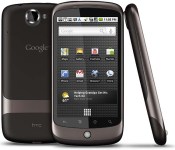
Looking back: A brief history of Google’s Nexus devices
Sometimes when a smartphone is released, it is very easy to tell what the manufacturer was aiming for. Unlike some popular lines of smartphones like Samsung’s Galaxy S series or HTC’s One series, Google’s Nexus line has received some interesting feedback over the years. Does the term ‘Nexus’ mean what it did when Google started this line? Which one of these devices was truly iconic for it’s time? Let’s take a look back.
HTC Nexus One

Introduced: January 2010
Android version: 2.1 Eclair – 2.3 Gingerbread
Notable hardware features: HTC used their familiar build for the time – matted plastic with brushed metal accents. Oh, and a trackball. It also sports a 3.7-inch 480×800 AMOLED (or Super LCD) display, 1 GHz Qualcomm Scorpion CPU with 512 MB RAM, 1400 mAh battery, and a 5 MP camera.
How it was sold: The One was sold mainly for developers and launched as $529 unlocked, and offered a “pure Android” experience with an unlockable bootloader. Also, this was Google’s first attempt to sway people to buy a device online without seeing in stores. Perhaps a bit ahead of its time, the Nexus buying experience would evolve over the years.
Despite the lawsuits and patent troubles, the reaction was very positive. These were some of the best specs anyone has ever seen on a smartphone. Everything was great about the phone except for the price, even by today’s standards.
Samsung Nexus S

Introduced: Nexus S: December 2010, Nexus S 4G: March 2011
Android version: 2.3 Gingerbread – 4.1 Jelly Bean
Notable hardware features: Samsung opted for a slimy hyperglaze plastic for their first Nexus, with a slight curve to the screen. It also has a 4-inch 480×800 Super AMOLED display, 1 GHz Samsung Exynos 3 processor, 512 MB RAM, 1500 mAh battery, and a 5 MP camera.
How it was sold: The Nexus S was sold for $530, while the Nexus S 4G was sold for $550. The jump to Gingerbread didn’t change a whole lot, at least talking about the user interface.
At the time, it was one of the best smartphones to date. The first model didn’t support HSPA+, which was a big negative. However, Google seemed to remedy that by offering a 4G model in the coming months. This one wasn’t a huge step up from the One, at least originally, but it did keep users interested in the Nexus line.
Samsung Galaxy Nexus

Introduced: November 2011
Android version: 4.0 Ice Cream Sandwich – 4.3 Jelly Bean
Notable hardware features: Samsung’s second iteration of the Nexus came at us with a completely different design – still plastic, but more textured on the back plate, still keeping the slight curve of the screen and a (very) heavy bottom. This one sports a 4.65-inch 720×1280 Super AMOLED display, 1.2 GHz dual-core ARM Cortex-A9 processor, 1 GB RAM, 1750 mAh battery, a 5 MP rear-facing camera, and a 1.3 MP front-facing camera.
How it was sold: The G-Nex was sold for $399 at launch. Probably the biggest selling feature of this one is the software. The jump from Gingerbread to Ice Cream Sandwich is still the biggest UI overhaul to date, adding tons of new features/improvements.
Due to the software, the Galaxy Nexus became hugely popular. Now, every phone has it’s faults. But it seems to be more apparent than ever in this Nexus. The batter life, though a big jump from it’s predecessor, is terrible. There is no way a smartphone user could get through an entire day on a single charge. That’s to be expected, given the time this phone was relevant. But the phones being launched at roughly the same time had tremendously better battery life that this one. Also, when Android 4.4 Kit Kat was announced, Galaxy Nexus owners were distraught to hear that their phones wouldn’t be receiving the update.
ASUS Nexus 7 (2012)

Introduced: June 2012
Android version: 4.1 Jelly Bean – 4.4 Kit Kat
Notable hardware features: Google decided to rope in popular tablet/laptop manufacturer, ASUS, for their first take at a Nexus tablet. The back was a soft-touch plastic with a golf-ball like texture. It has a 7-inch 1280×800 IPS LCD display, 1.2 GHz quad-core ARM Cortex-A9 processor, 1 GB RAM, 4325 mAh battery, and a 1.2 MP front-facing camera.
How it was sold: The Nexus 7 was announced at Google I/O for $199, bringing Android 4.1 to the table. With the addition of Google Now and other enhancements, the Nexus 7 was a very attractive tablet, especially for the price.
For years, Android tablets have had a big problem. The lack of tablet-friendly applications was a huge negative for Google’s first iteration at a Nexus tablet. Ultimately, the tablet did very well with the common consumer. It was a big change in the Nexus family – not only was it not a phone, but it was aimed at the average consumer. Also, the $199 price point was an invitation for developers to pick one up and start working on tablet-friendly apps.
Samsung Nexus 10

Introduced: October 2012
Android version: 4.2 Jelly Bean – 4.4 Kit Kat
Notable hardware features: Google had Samsung make their 2nd Nexus tablet. This one has a rubbery-soft (very grippy) plastic and front-facing speakers. It has a 10.1-inch 2560×1600 True RGB Real Stripe PLS LCD display, 1.7 GHz dual-core Cortex-A15 processor, 2 GB RAM, a 9,000 mAh battery, a rear-facing 5 MP camera, and a front-facing 1.9 MP camera.
How it was sold: This one was supposed to be announced with the Nexus 4 in an event in New York, but it was cancelled because of Hurricane Sandy. It was still announced later that day for $399. It was running Android 4.2, a notable step up from Android 4.1.
The Nexus 10 was popular, but still carried the same unfortunate handicap that the Nexus 7 had. If the lack of tablet-friendly apps wasn’t apparent enough on the first Nexus 7, it was made very clear on this one. Suffice it to say, it is getting better, but at the time that this tablet was released, it was difficult to find apps that played nicely with a big screen.
LG Nexus 4

Introduced: November 2012
Android version: 4.2 Jelly Bean – 4.4 Kit Kat
Notable hardware features: LG’s first Nexus was beautifully designed. It offered a glass back with a dotted, almost sparkly look to it. It also offered plastic bezels and a screen that curved slightly around the edges. LG”s Nexus has 4.7-inch 768×1280 IPS LCD display, a 1.5 GHz quad-core Snapdragon S4 Pro processor, 2 GB RAM, a 2,100 mAh battery, an 8 MP rear-facing camera, and a 1.3 MP front-facing camera.
How it was sold: Launched alongside the Nexus 10, the Nexus 4 was originally sold for $299. Still aiming at developers, this Nexus offered a very small price point – something the average consumer would be very fond of. It also offered Qi wireless charging – a Nexus family first.
For $299, you’d be hard pressed to find a better smartphone for the price. But for Google to reach that price point, they needed to make some sacrifices. One of those being the lack of 4G. Weird, right? Nexus phones that were released a couple years prior had 4G capabilities, but why not this one? Google seemed to think the HSPA+ support would suffice. There wasn’t much else that didn’t make it on the phone, though. It was a decent step up from the Galaxy Nexus, and showed people that they didn’t need to fork over an entire paycheck for a smartphone.
ASUS Nexus 7 (2013)

Introduced: July 2013
Android version: 4.3 Jelly Bean – 4.4 Kit Kat
Notable hardware features: ASUS got a shot at making a second Nexus tablet. It has a soft-touch back, two long speakers on each end, as well as a big ol’ camera on the back. It has a 7-inch 1920×1200 IPS LCD display, 1.5 GHz quad-core Krait 300 processor, 2GB RAM, a 3950 mAh battery, a 5 MP rear-facing camera, and a 1.2 MP front-facing camera.
How it was sold: The 2013 Nexus 7 was announced at an event called “Breakfast with Sundar Pichai”, Google’s current Senior Vice President, overseeing Android, Chrome and Apps. It launched for $229 – a $30 price increase from the first generation tablet. This one brought Android 4.3 Jelly Bean to the table and a much-improved screen.
The Nexus 7 (2013) has been Google’s most popular tablet to date, fixing just about every gripe that consumers had with the first generation. The speakers are loud and very difficult to cover up, the screen received a much-needed upgrade, and the bezels shrunk on the sides, making the tablet’s screen pop much more. With help from more and more tablet-compatible apps, this device marked Google’s entrance into the mainstream tablet world, offering an affordable, yet glorious competitor to others such as the iPad.
LG Nexus 5

Introduced: October 2013
Android version: 4.4 Kit Kat – 4.4.2 Kit Kat
Notable hardware features: This is LG’s second attempt at making a Nexus phone. The Nexus 5 offers a soft-touch back and a big camera on the back, much like the Nexus 7 (2013). It also offers a 4.95-inch 1920×1080 IPS LCD display, 2.26 GHz quad-core Krait 400 processor, 2 GB RAM, a 2,300 mAh battery, an 8 MP rear-facing camera with OIS, and a 1.3 MP front-facing camera.
How it was sold: The Nexus 5 was announced in a Google+ post for $349, and went on sale in the Google Play Store immediately. It launched with Android 4.4 Kit Kat, and drew people in with its exclusive “Google Now Launcher”.
The Nexus 5 became popular very quickly, mostly due to its price and hardware upgrades. Much like the 2013 Nexus 7, Google fixed most of the complaints users had from the Nexus 4. The addition of 4G bands, a slightly bigger screen, and more durable hardware were it’s best features, by far. The meaning of the term ‘Nexus’ began to change due to the Google Now Launcher. Though still aimed at developers, the consumer market took this one by storm. Google not only offered a cheap price point, but they added exclusivity with some of the services that came with it. Instead of offering a phone with a “pure Android experience”, they opted to give a “pure Google experience”.
Honorable Mention: Google Play Editions

Between the Nexus 4 & 5, Google announced the first ever Google Play Edition smartphones – the GPe Galaxy S4 and the GPe HTC One. Bringing a quality Android experience to top of the line hardware, the GPe phones are a force to be reckoned with… until you look at the price. The GPe Galaxy S4 was announced for $649. Suddenly, the term ‘Nexus’ doesn’t mean cheap anymore. Or, wait… is this a Nexus?
With the promise from Google to receive timely Android updates, the GPe smartphones took an odd spot in the Nexus family, quickly dubbing themselves as the red-headed step children of the group. You love them because they offer a great hardware experience, but that price… oh man, that price. Google is still continuing to announce GPe devices left and right, so here’s the question – what’s their end goal?
Here’s my take, although I may be wrong; it’s the only answer my brain wants to accept as correct. Google has been releasing GPe devices for a while now. At first, it seemed normal for the S4 and HTC One to get the Google treatment. Premium hardware and software, where could you go wrong? Then they started announcing some really odd editions like the Moto G, for instance. The Moto G was already basically a Google-ified smartphone. It ran mostly a stock experience, give or take a few features. So why would they release it?
Manufacturers don’t receive code until the day it’s announced to the public. So with the odd addition of the Moto G to the family, swooping in before they’re whisked off to Lenovo, it gives all of the main hardware manufacturers early code that they wouldn’t have gotten already. Google didn’t have to add any of those phones to their lineup to make any money… they did it for the greater good – early updates for all.
What’s next?
So, does the term ‘Nexus’ mean what it did 4 years ago? Not really. But that’s not a bad thing. There will always be room for the Nexus line in the hearts of pure Android enthusiasts, developers, and consumers who aren’t fond of 2-year agreements. Sure, there are rumors that the GPe devices will take over the Nexus line sometime next year, but one thing is certain: we will always have access to the pure Android experience that we all love.
Sometimes it’s just nice to take a look back and reminisce about devices we love, no? Which of these devices is your favorite? Do you have anything to add about (what I consider to be) the best smartphone line ever? Leave a comment below and we’ll talk!
The post Looking back: A brief history of Google’s Nexus devices appeared first on AndroidGuys.
Paranoid Android 4.1 beta released with reworked PIE controls for KitKat
There are plenty of options when looking to run a custom ROM on your Android device and one of the most popular, besides CyanogenMod, is Paranoid Android.
Official PA ROMs only support Nexus devices, so if you don’t see your device in the downloads, it’s not supported by the main development team, but there may be a port and you just need to search the forums.
Up until recently, the latest PA ROMs based on Android 4.4 KitKat were primarily a stock experience, but today an update was released, PA 4.1 beta, bringing one of the ROM’s killer “flagship” features, PIE controls, its stock navigation replacement.
According to PA, PIE is “a simple, straight-forward replacement of the navigation bar that optimizes the screen space available to the user.”
PIE is basically a fully-customizable replacement for the on-screen navigation buttons and stays hidden off-screen, only seen with a predefined gesture that can come from any of the four sides of the device.
Via Google+, the PA development team said that it faced some problems with the immersive mode introduced in KitKat, and has now released a redesigned version to match the KitKat design philosophy. Instead of porting the feature to its KitKat ROMs, PA completely redesigned the feature for the new version of Android.
PIE controls are now fully-integrated into the core UX with the introduction of “on-the-spot preferences,” so PA users no longer need to sort through endless settings.
Additionally, it gives users status information at a glance when your status bar is hidden in immersive mode, plus the stock Google Now swipe up gesture is now integrated.
If you’ve never tried out Paranoid Android before, be sure to check out 4.1 beta on your rooted, unlocked device, which is now available for the Nexus 7 2013 (Wi-Fi and 4G), Nexus 7 2012 (Wi-Fi and 3G), Nexus 5, Nexus 4, Nexus 10 and the Galaxy Nexus (GSM, Sprint and Verizon). Be sure to grab the latest Gapps as well.
Downloads via +ParanoidAndroidCorner
The post Paranoid Android 4.1 beta released with reworked PIE controls for KitKat appeared first on AndroidGuys.
Check Out the ‘Evolution of Nexus Devices’ Inforgraphic

The Nexus line. What can we say about it? It is truly the core of the Android Community. Pure stock Android on a sleek, sexy designed phone, that top OEMs have a shot at creating. With rumors that the Nexus line ending in 2015, let’s look back at the 5 Nexus phones that have graced their presence to us.
The infographic below is a very detailed description of each Nexus phone, and then it ends with comparing each one of them when it comes to size and design. It is pretty great to se the evolution of the Nexus phone, and just like any Android enthusiast; you got to wonder what the next one will look like. Enjoy the infographic.
Source: Android Me

Rumor: Nexus line coming to an end in 2015?
If true, this may be sad for many, but according to @eldarmurtazin on Twitter, Google will be killing off the Nexus line by next year in favor of Google Play Edition devices.
The Nexus program has been around since January 2010 when the HTC Nexus One was announced. All Nexus devices have been pure Google Android, with no custom skin on top of them. Highlights of the Nexus program have been that the devices have “usually” been unlocked, were “usually” sold directly by Google and have been the first to receive software updates.
While it may seem this is the natural progression, killing off the Nexus line once phones started shipping with stock firmware, in my opinion, I don’t think that Google is ready to kill it just yet.
One thing that people have praised the Nexus program for is that it has offered the choice of an off-contract at a reasonable price. Besides the Moto G, which isn’t in the same class as the Nexus 5, there is no GPE device that is that inexpensive. The HTC One is $599 from the Play Store and the Samsung Galaxy S4 is even more expensive at $649. Besides the only GPE tablet, LG’s G Pad 8.3, and the Moto G, there are no reasonably priced GPE devices.
Devices like the Moto X have proved that selling a cheaper device is possible, but who knows if Samsung, Sony and HTC will ever release a high-end GPE device that is also relatively inexpensive.
With comments from Android director of engineering Dave Burke (from the August 2013 article from The Verge) that states they’re “halo” devices meant to educate the rest of the ecosystem, I’m not sure I believe the death of the program.
“Basically what Nexus allows us to do is set the standard … [we can] demonstrate how Android runs and hopefully influence other device manufacturers to take what we’ve done and do even better,” he said in that interview.
There was also another reason for its existence, that Google needs hardware on which it can develop Android and Burke said “as an engineering team creating a mobile platform — we can’t do that in the abstract. We need to do it on a real device that we’re carrying with us.”
Well, anything is possible, but only time will tell if Google is putting an end to the Nexus. That being said… where’s that new Nexus 10?
via Twitter
The post Rumor: Nexus line coming to an end in 2015? appeared first on AndroidGuys.

Android 4.4.2 Binaries and Factory Images Get Posted by Google

Google has been on top of things lately, with releasing Android 4.4.1 to the Nexus family last week, then releasing Android 4.4.2 this week. They have also been updating their apps, and announced two additions to the Google Play Edition family. No one is complaining that is for sure, and today, they just posted the Android 4.4.2 binaries and factory images for anyone that wants them.
Google actually didn’t post the binaries or factory images for Android 4.4.1, probably because they knew they were going to release Android 4.4.2 to the public a week later. I know a lot of you might not even consider downloading any of these files, but this does help developers get new ROMs out quickly, and if you do end up flashing your device into certain oblivion, you can flash the factory image to get it back to stock. So if you feel like you need to download the files, head over to the Google page provided below.
 AIVAnet