


A Closer Look at Apple’s CPU Improvements for iPhone 7 and Apple Watch
At last Wednesday’s media event, Apple introduced two new processors – the A10 Fusion for iPhone 7 and 7 Plus and the S2 for Apple Watch Series 2. Although Apple only briefly covered the S2 during the presentation, it did spend a good deal of time talking about A10 Fusion. The ‘Fusion’ suffix refers to the heterogeneous architecture that the A10 features, which has two high-power, high-throughput cores and two much smaller cores that are more power efficient.
Apple also introduced another very important piece of standalone silicon in its new AirPods, dubbed the W1 chip. In total, this represents a great deal of engineering work done by Apple over the last year, and the A10 is the most significant to Apple’s system-on-a-chip (SoC) line since the company’s transition to 64-bit.
Apple unveiled the biggest technical changes featured in the A10 at the very beginning, boasting a four-core CPU with 3.3 billion transistors. While Apple never disclosed a transistor count for the A9, it very likely fell somewhere in the middle between the 2 billion count on the A8 and the 3.3 billion of the new A10. A transistor count well under 3 billion seems probable for the A9; otherwise it would have been worth boasting about on its own.
The 3.3 billion number for the A10 is well over 50 percent larger than the A8, and the large jump is likely mostly thanks to the addition of two new, albeit small, CPU cores along with a greatly enhanced image signal processor (ISP). Apple also disclosed that the GPU remains a six-cluster design, while benchmarks suggest that the L1 and L2 cache sizes remain unchanged.
Given that the process node is not expected to be different than the A9 fabricated on TSMC’s 16nm FinFET process, it is very likely we’ll be looking at a larger die size compared to its predecessor. However, it is also likely Apple was able to optimize placement and sizing on what is now a more mature process, without the added complexity of producing a twin design on Samsung’s competing 14nm FinFET process.
The leaked logic board shots also suggest a larger device package than the Apple A9, although it is unclear if the new InFO packaging processor has any influence on device package footprint.

Apple also revealed that A10’s peak performance could be up to 40 percent greater than the A9 featured in the previous generation. The 2.33 GHz core speed showing up in benchmarks is roughly 25 percent faster than the 1.85 GHz seen in the A9, meaning Apple has found another 25 percent peak improvement through architecture enhancements.
A 25 percent clock speed increase is significant given that the process node likely did not change, meaning the increase was likely enabled by the better thermal performance of InFO packaging. It is also likely only possible because of Apple’s heterogeneous architecture which now features a pair of high-speed cores along with a pair of low-speed, power conscious cores.
Apple’s clock speed increase is probably more than just turning up the dial on voltage to make the cores run faster. By introducing the pair of low-speed cores, Apple opened up a whole new spectrum of dynamic voltage and frequency scaling (DVFS) options for completely disabling cores or their sub-parts. Apple designed its own performance controller to manage workloads between the cores, and we know from some industry sources that Apple does cache-sharing so that the caches don’t have to constantly read each others’ contents to be ready for a switch lest they face a delay in getting current data when they switch on.
This concept may sound familiar because ARM introduced it all the way back in 2011 with the Cortex-A15 “Eagle” design in 2012 with the “big.LITTLE” moniker. ARM’s big.LITTLE scheme also features a performance controller and cache coherency mechanisms, but it had to be designed with Linux OS performance management in mind, whereas Apple can retool iOS as needed for any software interfaces to the performance controller. As time goes on, we may learn more about which caches are shared versus which are updated with some coherency mechanism.
The boost to 2.33 GHz clock speeds brings Apple much closer to the clock speeds of competitors from SoC makers such as Qualcomm and Samsung, and Apple may also have made some transistor changes to reach those speeds. By increasing voltage, and choosing transistors with higher static leakage (unavoidable waste power), Apple can get to these higher clock speeds. Apple’s chip team can also make architectural designs that have a higher power footprint in general, whether it be at a higher transistor count, more management power overhead, or more switching activity through a different logic implementation.
The takeaway is that making these sacrifices is now okay because they are more equipped to deal with the thermal implications, and they don’t have to deal with the static power draw of all of these changes when the circuit is not in active use because they can simply turn it off and switch to the low power core.
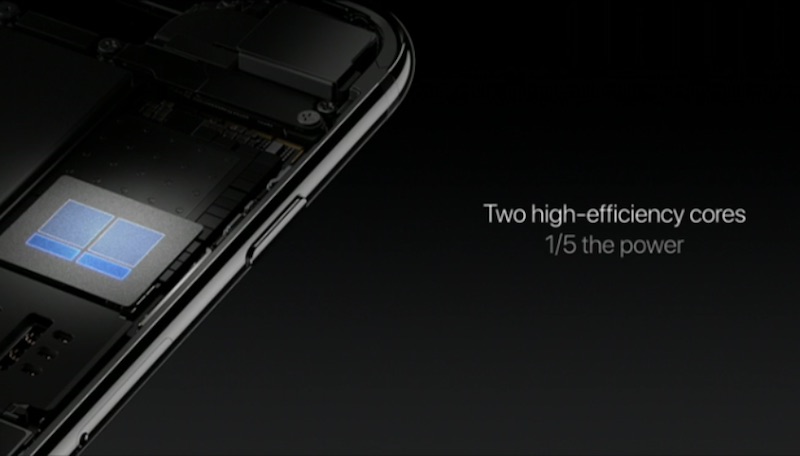
Apple’s two small cores in the A10 have drawn just as much interest as their larger cousins, with a lot of speculation centered on whether they too are an Apple custom design, or if they are a variant of a stock low-power core from ARM, such as the Cortex-A53. After so many years of full custom designs, it is fair to ask why Apple would opt for an off-the-shelf solution for its low power CPU, but there is certainly still precedent for it.
By all indications, the first-generation Apple Watch features a Cortex-A7 CPU design. The Apple Watch comparison is interesting because Series 2 was merely increased to a dual-core design up to 50 percent faster than the original. The same question of custom vs. stock design is relevant here, and it is possible that the dual-core CPU in S2 is the same dual-core featured as the low-power option in A10.
The main question centered around this architecture shift is why now would be the appropriate time for Apple to do a heterogeneous architecture. One possibility is that Apple’s main core designs had been optimized so much that there were few gains to be had, and those gains would have been with serious diminishing returns. Ratcheting up the clock speed is an easy way to get more performance, but the thermal and power costs associated with that may have been the driving force for the split.
Die size is not unlimited either, and as long as there were gains to be had by making the CPUs bigger, Apple may have opted to go that route. The enhanced functions of the ISP may have also been a good reason to raise the L3 SRAM cache from 4 MB to 8 MB, which does have some impact on the die size as well. Going forward, it’s important to remember that CPU clock speed won’t be unlimited either, as high-end desktop CPUs have been stuck between 3 GHz and 4 GHz for the past decade, for example.
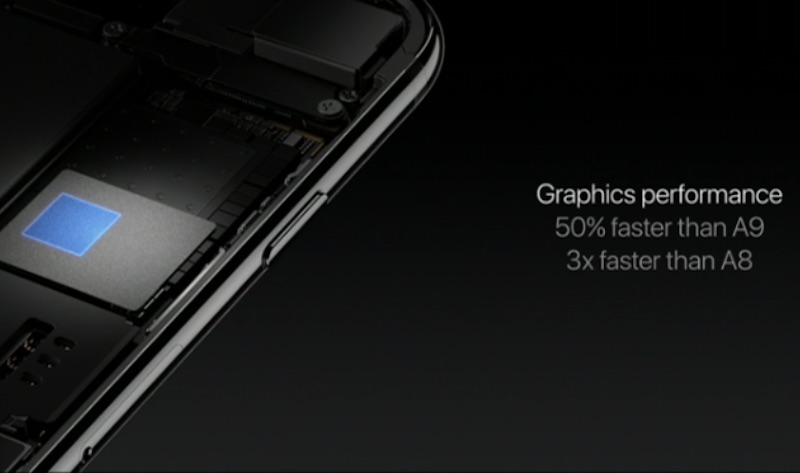
Apple finished up its technical disclosure by talking about the graphics power of the A10. Fortunately, Phil Schiller mentioned it was a six-cluster design, so we know it matches the cluster count on the A9. Apple’s performance claims also suggested that the A10 GPU can be up to 50 percent faster than the A9’s GPU while consuming only 2/3 the power.

We also know Apple used the same process node for the A10 as on the A9. Since the announcement of the 7XT series of GPUs from Imagination Technologies that was featured in the A9, there has only been one new type of high-performance GPU announced from ImgTec, and it was simply to add computer vision and compute performance enhancements to the existing 7XT line.
The power reduction alone rules out that Apple increased clock speeds to make these performance claims, so we are likely looking at some significant changes that feature an unannounced GPU, an Apple-designed GPU, or some other major architectural shift that we don’t know about. It is possible Apple could claim some gains through enhancements in metal, but up to 50 percent improvement in speeds seems a rather high claim for that.
Apple’s performance boost claims have historically tended to actually show in benchmarks, so this will be an area of particular interest when the GPU gets fully benchmarked and pictured under a microscope.

The introduction of Apple’s AirPods was also an important moment because they feature Apple’s new W1 wireless connectivity chip. In the announcement, Phil Schiller put special emphasis on it being Apple’s first wireless chip, suggesting that there are more to come. We have been waiting several years since Apple first hired several RF engineers from Broadcom, and this small Bluetooth chip could be a stepping stone to Apple providing its own RF components such as the Wi-Fi chip or even the cellular baseband modem in future devices.
This is a very tough sector to get into and be a competitor in the general marketplace, however, as seen with Intel’s own LTE offerings likely featured in the new iPhone, for example. Rather than being built from the ground up, those chips are the product of Intel’s acquisition of Infineon and manufactured on a TSMC process rather than Intel’s own. The potential gains for custom wireless chips are also less clear than with fully custom CPU solutions seen in SoCs, so this does not necessarily mean Apple’s ambitions stretch that far.
We’re likely to find out much more in the coming weeks as the teardowns begin, exhaustive benchmarks are run, and the more advanced analyses from firms such as Chipworks begin to trickle out. From there, we’ll have a better picture of the specific methods and techniques Apple has used to increase chip performance and potentially have a better idea of what’s coming next.
Related Roundups: Apple Watch, watchOS 2, watchOS 3, iPhone 7
Tags: A10 Fusion, S2, W1
Buyer’s Guide: Apple Watch (Buy Now)
Discuss this article in our forums
Apple Hit With Class Action Lawsuit Over iPhone Upgrade Program Woes
Boston law firm Block & Leviton today announced it has filed a class action lawsuit against Apple on behalf of iPhone Upgrade customers who are dissatisfied with how Apple handled iPhone 7 and iPhone 7 Plus pre-orders last Friday.
When customers who participate in the iPhone Upgrade Program went to pre-order an iPhone 7 or 7 Plus, they were forced to reserve a device from a local Apple retail store rather than being able to make a traditional online purchase. Many retail stores did not have sufficient stock to meet demand, leaving some customers unable to select the model, color, or storage capacity they desired.
Many iPhone Upgrade Program members were unhappy with the ordering process and an inability to reserve a desired iPhone for launch day. Apple has responded to customer frustration and has been collecting customer information to attempt to get customers their iPhones as soon as possible. Apple’s efforts have not, however, prevented today’s lawsuit, which claims iPhone Upgrade Program users will face future upgrade delays due to the situation.
But, the lawsuit alleges, iPhone Upgrade Program customers, unlike every other customer, were shut out from reserving the most in-demand phone models and colors.
These customers are unable to “get in line” to reserve their favored devices. Instead, they are told to simply “check back.” In the meantime, they will continue to be required to make monthly payments on their older iPhones, and their eligibility for future iPhones will be delayed, the lawsuit alleges.
The lawsuit asks Apple to reimburse iPhone Upgrade members who are forced to make extra payments while waiting for a new iPhone, make upgrade members eligible for a 2017 iPhone in September regardless of upgrade delays, and seeks to require Apple to make all of its iPhone inventory available to upgrade members.
Apple’s iPhone Upgrade Program, arguably designed for the company’s staunchest fans, allows customers to upgrade to a new iPhone each year. Customers can upgrade after as little as six months, so long as they have made 12 iPhone payments and trade in the iPhone in question when upgrading.
Tag: iPhone Upgrade Program
Discuss this article in our forums
Best Sprint phones

Sprint offers some of the best phones on the market. We’ve rounded them up just for you!
Sprint doesn’t exactly play well with others, so the selection of unlocked phones that you can bring to its network is rather limited. If you are trying to bring your own unlocked phone to Sprint, it’s best to head to the nearest location and ask if your device is compatible.
That being said, it has a relatively decent list of phones that you can buy straight from them, including some of the top Android phones available right now.
We’ve rounded up a quick list of the best they have to offer.
- Samsung Galaxy S7/S7 edge
- HTC 10
- LG G5
- Samsung Galaxy Note 7
Samsung Galaxy S7 and S7 edge

Samsung’s flagships are arguably two of the best phones money can buy at the moment (I say “arguably,” but let’s not fight). With the powerful Qualcomm Snapdragon 820 processor in place, these devices run faster than any Samsung phone ever has.
They feature Quad HD (2560×1440) displays, which are gorgeous and protected by scratch-resistant Gorilla Glass. The edge screen functions may not be incredibly useful on the S7 edge, but the bigger 5.5-inch screen is a perfect blend of being pocketable and large enough to comfortably watch videos on. That being said, the 5.1-inch S7 is pretty much the perfect size.
Unlike the other phones on this list, the Galaxy S7 and S7 edge are waterproof. Gone are the days of reaching out of the shower, drying off your hands, and fervently sending text messages before your precious device is splashed. Take these phones into the shower if you want. They’re good to go in up to 5 feet of water for about 30 minutes. After that, however, all bets are off.
One of the best features of each of these devices is the sizable battery. They’ll both last you at least a full day without needing a charge – depending on your habits, of course. Each model comes with 32GB of storage, but thanks to the microSD card slot that can support up to 200GB, you can expand your memory space at anytime.
If you’re after top-of-the-line Android goodness, look no further.
Check out our reviews of the Galaxy S7 and Galaxy S7 edge for more!
See Galaxy S7 at Sprint
See Galaxy S7 edge at Sprint
HTC 10

The HTC 10 is HTC’s best phone to date and a current titan among Android phones. With its solidly built aluminum body, gorgeous Quad HD display, and more-than-capable camera, the HTC is value-laden and one of your best options with Sprint.
One of the HTC 10’s best features is its impressive audio capability. It has a front-facing tweeter in the ear piece and a bottom-facing subwoofer, each with its own amp and Dolby-processed sound design. The headphone amp is also impressively powered, delivering crystal clear audio, even at higher volumes.
HTC added adoptable storage to the HTC 10, so you can expand your storage (up to 2TB) and mount it so that it becomes apart of your system for good. Once you pick up your HTC from Sprint, you should check out our roundup of the best microSD cards for the HTC 10.
Sprint sells the HTC 10 in Glacier Silver and only the 32GB version.
See at Sprint
LG G5

LG’s latest, the G5 is an innovative phone with an exceptional camera, great fingerprint sensor, and some very interesting “Friends” in the form of detachable modules that can add certain functions to your phone, like the LG CAM Plus, which adds some physical camera buttons to the phone and an extra 1,200 mAh battery, so that you’re not eating up your main battery while you’re snapping shots.
The battery may have shrunk between the G4 and the G5, but unlike the Galaxy S7, you can just swap out the G5’s battery for a new one, so if you’re going to be out for a day or two with no access to a charger, you can just carry an extra battery with you. If you are near a charger, you’ll be quite pleased with the G5’s USB C port with Quick Charge 3.0 compatibility. You’ll be up and running in no time.
As mentioned, the 16MP rear-facing camera is excellent and there’s even an option 360 degree camera for more fun.
Sprint lets you pick your color, so you have your choice of silver, titan, gold, or pink.
Check out our review for more!
See at Sprint
Samsung Galaxy Note 7

Whether you’re a busy professional or a sensitive college kid, you might find the the Galaxy Note 7’s bigger display to be particularly helpful for your day-to-day. Samsung’s 5.7-inch smartphone features a bright Super AMOLED display and an optional Blue Light filter setting, which makes it easier to read the screen at night. The phone also comes equipped with the latest hardware, as well as a stellar 12-megapixel rear-facing camera, and a stowable pressure-sensitive stylus. You can read more about the Galaxy Note 7 in our review.
Sprint offers the Galaxy Note 7 in Black Onyx, Coral Blue, and Titanium Silver.
Samsung Galaxy Note 7 recall FAQ
Note: Samsung has issued a broad recall for the Galaxy Note 7 due to battery issues. We still recommend the Note 7, but we advise checking with Sprint to ensure that it has received new stock of the phone with batteries from an updated supplier. Follow the link above for more information.
See at Sprint
Police could soon identify you by your hair proteins
Police and archaeologists regularly depend on DNA evidence for identification, but it has a serious flaw. DNA degrades under environmental conditions like heat and light, so it may be useless even if you have a ton of samples. However, Lawrence Livermore researchers have a better way: they’ve established a method of identifying humans based on hair protein markers. The markers are much more resilient than DNA (scientists found markers in remains about 250 years old) while remaining unique, with no one person sharing the same marker count and patterns. You only need a few hairs to get a result, too, and the ultimate goal is to pinpoint someone using a single strand of hair.
Don’t expect it to reach crime labs just yet. Although the current technique is already effective at identifying one person out of a million, that still leaves some room for doubt. The lab wants to pick up to 100 markers that would be enough to single out a person from the Earth’s entire population. And did we mention that the current identification process takes about 2.5 days? Law enforcement would likely want a faster turnaround to catch suspects and identify victims while a case is still fresh.
If Lawrence Livermore can improve the process, it could usher in a new era for investigations. DNA would still be useful, but you’d frequently have an alternative for those moments when genes simply aren’t an option. You’d stand a better chance of identifying a murder victim even if they’ve been left out in the open for decades, and you could easily confirm someone’s lineage through remains dating back multiple generations.
Via: MorningTicker
Source: Lawrence Livermore National Laboratory
Apple’s kid-friendly iPad coding app arrives tomorrow
There are lots of initiatives to teach kids how to code, including ventures from Google, Minecraft and even the Star Wars franchise. However, with Swift Playground, Apple is actually prepping kids for a potential career at, well, Apple. The company has announced that the app, based on the Swift language used for iOS, OS X, WatchOS, tvOS and Linux, will arrive alongside iOS 10 tomorrow (September 13th).
As Engadget’s Nicole Lee discovered during a hands-on, it’s actually a nice way way to learn programming. It assumes that kids have zero knowledge, but produces actual Swift code that can be used to develop real apps. At the same time, it’s open-ended — young coders learn in a non-linear way, so enthusiastic kids can skip ahead if they want. It rewards students regardless of the quality of code, but gives extra kudos for well-optimized solutions.
Apple says there are over 100 schools and districts teaching the app this fall in the US, Europe and Africa. Apple will also offer its own “Get Started with Coding” workshops that will show the basics of Swift Playgrounds. It’ll also offer a drop-in hour for folks who want extra help with “challenging puzzles” in the app. If you want to get a head start on your kids (you’re gonna need it), the workshops and drop-in sessions will be available at select stores in the US, Canada, UK, Australia, UAE, Netherlands and Hong Kong.
Titanfall’s mobile debut is a ‘Hearthstone’ with mechs
If I told you Titanfall was coming to smartphones, what kind of game would you envision? A side-scrolling shoot-em-up similar to Metal Slug? A Titan customization tool? Or a portable-friendly strategy game like Advance Wars? Well, I’ve got bad news. Titanfall: Frontline is none of those. It’s a digital card game similar to Hearthstone. But wait! Before you dive back into Blizzard’s tavern, hear Respawn out. The company has teamed up with Nexon, best known for the MMO Maplestory, to build out new cards and mechanics that could feel authentic to the Titanfall universe.
So maybe, just maybe, it’ll be more than an uninspired reskin? Titanfall: Frontline has “hundreds” of pilots, robots and special ability burn cards, which players can accrue and incorporate into their own decks. The game will accommodate different play styles too, so you can choose to rush your opponents with a group of light, nimble pilots, or wear them down with slower, defense-oriented troops. Oh, and of course, you’ll be able to drop a titan onto the field, turning the tide of battle in decisive moments.
Titanfall: Frontline is coming to iOS and Android this fall, no doubt to coincide with the release of Titanfall 2. It’s a common tactic employed by the video game industry — with so many players on mobile, it makes sense to target them first, or simultaneously with a free-to-play title. With their interest piqued, the hope is that they’ll then drop the cash on the premium console experience. Square Enix is making a similar play with Justice Monsters Five, ahead of the release of Final Fantasy XV this November. Titanfall: Frontline is a trickier proposition, however, as the card-dueling genre is so far removed from its adrenaline-fuelled mech shooter origins.
Source: Titanfall Frontline
Instagram lets anyone filter words out of comments
Instagram is making good on its promise to bring word filters to everyone. The photo-centric service has announced that anyone can now filter their comments to keep out abusive (or just plain annoying) feedback. If you’re tired of dealing with harassment or “get more followers” spam, you won’t have to spend ages blocking users or reporting individual comments. It’s just a matter of choosing the right keywords to keep discussions civil.
Co-founder Kevin Systrom is quick to admit that filters and similar user tools “aren’t the only solution.” Ultimately, Instagram itself has to be smarter about banning users and preventing hurtful comments from showing up in the first place. However, this latest move puts a lot of power in your hands — you can set a baseline level of quality that keeps out some offenders without silencing comments altogether.
Source: Instagram
The RetroUSB AVS just replaced my childhood Nintendo
When I was a child, I fought with my brothers. A lot. It was part of being the youngest, and part of being a family. Most of our sibling rivalry died with our youth, but one single, never-ending quarrel outlived our childhood: the Nintendo Entertainment System. My oldest brother and I have been bickering over our original NES for decades. Who really owns it? Me, the guy who scoured garage sales to build our collection of classic games, or him, the firstborn who — by sibling law — is right by default? To this day, we still argue about whose house our childhood console should live in. Today, that war finally ends. I don’t need our old Nintendo anymore. I have the RetroUSB AVS.
Think of the AVS as an unofficial hardware refresh for the original Nintendo Entertainment System. It plays the same games and even uses the original controllers, but everything else is brand-new. Instead of pushing a fuzzy, ugly picture through ancient composite cables, it pipes a crisp, high-definition signal over HDMI. In lieu of a cumbersome AC adapter, the AVS uses a humble USB cable — and can be powered solely by the media port on your HDTV. And, unlike the RetroN 5 or Analogue NT, the AVS is all new hardware: a custom FPGA board programmed to replicate the NES’ original processor. No emulators. No repurposed hardware.
OK, that might sound like splitting hairs. After all, don’t all three of these consoles pipe HD NES games to modern televisions via HDMI? Well, yes — but how they do it varies wildly. The RetroN 5, for instance, is actually a $160 Android device that runs cartridges through an emulator. It’s also widely derided in the gaming community for allegedly stealing code. The Analogue NT is completely legit, and actually uses repurposed Famicom chips to run the games on a mix of old and new hardware — but it’s also a premium device, costing a steep $500. The AVS is something of a happy medium: It’s not made from original parts, but it authentically replicates their functionality without legal ambiguity. At $185, the RetroUSB AVS is comparatively affordable too.
Nostalgia by design

The RetroUSB AVS’ trapezoidal chassis is nothing short of a love letter to the NES’ iconic design. Obviously, the monochromatic color scheme is a nod to the black and gray tones of the original’s case, but it’s the little things that make this homage truly delightful. This includes the shape of the lid that covers the console’s cartridge slot, and “power” and “reset” buttons that look and feel identical to their 1980s inspiration — but the most wonderful (and pointless) details can be seen only when you turn the console over.
Here you can see three trenches leading up to an empty recessed square that represents the original NES’ unused expansion slot, vent placement that mirrors the layout of the original console, and foot pads that look identical to the rubber nubs on my childhood console. All of these design nods are completely unnecessary, and on a part of the device most users will never even bother to look at. Clearly, the designers love the original Nintendo. It shows.

As much as I love how weirdly accurate the AVS’ retro design is, it might be nostalgic to a fault. That cover over the console’s cartridge slot does look exactly like the old NES chamber lid, but it’s a lot longer too. It feels like a compromise, designed to ensure that users can more easily insert and remove games — but opening and closing it feels awkward. I’m constantly worried it’ll bend too far and snap off. With front-loading US region games, it at least feels secure when the lid is closed, but Japanese region Famicom titles use a separate top-loading cartridge slot that forces the door to stay open. It looks weird, and it makes me nervous.
Speaking of games, loading them can be a bit tricky. US titles slide in horizontally, just like on the original, but I never managed to seat a cartridge into the connector on the first try. Wiggling them back and forth a little usually did the job. The connector also holds on to games tightly — removing them was just as much an exercise in wiggling as putting them in. It’s not a deal-breaker, but I do wish changing games were a little easier.

Finally, it’s worth noting that the AVS features four controller ports and a Famicom expansion slot — which enables compatibility for the rare four-player NES game (they do exist!) and for extra controllers compatible with the original Japanese Famicom.
Practically pixel perfect

Playing NES games on the RetroUSB’s console is like putting on prescription glasses for the first time: It brings a blurry, indistinguishable mess of light and color into focus. OK, the original NES isn’t that bad, but the difference between composite cables and 720p over HDMI is startling. Did you know that Mega Man’s sprite actually has white behind its eyes? I didn’t. It always blended in with the character’s pale skin tone. Backgrounds that were once a blurry haze of color now appear as distinct patterns; characters and stages are flush with “new” details and brighter colors. It’s a surreal experience: I’ve been playing these games for 30 years, but now it seems like I’ve never really “seen” them before.

I know what you’re thinking: Can’t I already play NES games in HD through the Nintendo Wii U’s Virtual Console? You can, but they’ll look worse. For some reason, the Wii U’s VC implementation presents classic games in dull, muted colors with a side of blur. I tested Punch-Out!!!, Dr. Mario and a couple of Mega Man games side by side, and the Wii U versions looked worse by every measure. The games are no less fun on the official hardware, but they lack pop and polish compared with how my old cartridges look on the RetroUSB AVS. Here, the AVS does better than even Hyperkin’s RetroN 5 — which looks much sharper than the Virtual Console but tends to have overblown, inaccurate colors.
Best of all, every classic game I own ran perfectly on the AVS — and that’s not something I can say about every NES clone console I’ve come across. Most of these products use NES-on-a-chip solutions that either gets audio wrong or simply won’t play certain games. Paperboy, for instance, isn’t playable on either the Retro Duo or the FC Twin, and both consoles play off-key audio in specific games. Not so with the RetroUSB AVS: Everything I played looked and sounded exactly as it was supposed to. It even got the glitches right, faithfully reproducing minor visual hiccups in Mega Man 3 and Super Mario Bros. 3 that were present on the original hardware.

Of all the devices that play NES games in my house, the RetroUSB AVS is the most accurate, hands down — but that doesn’t mean it’s perfect. When compared directly with my childhood NES, it’s clear that the AVS color palette is just a bit brighter. It’s not overblown or washed out like the colors on the RetroN 5, but it does come across as a bit richer than the original hardware. I noticed it most in Castlevania and Mega Man 3. On the AVS, the bricks of Dracula’s castle have more red in them, and Mega Man’s helmet appears to be a darker shade of blue.
When I asked RetroUSB’s Brian Parker about the difference, he chalked it up to differences in televisions. “NTSC,” he joked. “Never The Same Color.” I’m probably just seeing the difference between a clear digital signal and the fuzzy output of the old console’s composite cables. Even if the colors are wrong, Parker says it’s just part of the console’s NES/RGB lookup table. “Easily changed with a firmware update,” he says. The AVS also outputs only in 720p, but considering it still looks better than the RetroN 5 and Wii U at 1080p, it’s a flaw I’m happy to overlook.
Extra features

If you’re looking for a console to imbue your classic games with fancy graphics filters, instant-save-state features and other bells and whistles, look elsewhere: The AVS keeps things pretty simple. Beyond simply playing classic games in crisp, high definition, this console doesn’t do much. In terms of visual options, the AVS allows users to switch between NTSC and PAL modes, adjust the screen margins (to hide overscan garbage in specific games) and adjust scanline darkness. The console’s controller menu allows you to turn on some basic turbo features and see how many gamepads are connected, but that’s about it.

At the end of the day, there are only two special features that the AVS adds to the vanilla NES experience: built-in cheat codes and an integrated scoreboard. The first is self-explanatory: The AVS automatically recognizes the game in its slot and offers players a short list of the most popular Game Genie codes. The second takes a little more legwork; if the AVS is being powered by a PC or Mac’s USB port, users can download companion software that will keep track of their in-game score while they play and allow them to upload it to an online leaderboard.
Unfortunately, the AVS itself doesn’t make this process clear, presenting users with only a menu that fails to connect to an amorphous server. There are no setup instructions for the scoreboard in the console’s menu or the manuals that came in the box, or even on the product’s website — I had to ask Parker via email. Still, it’s a neat feature if you can get it up and running.

Finally, RetroUSB offers one special feature that no competitor can boast: new NES games. The company has kind of made a name for itself in manufacturing new cartridges for homebrew developers, and it’s neat to see that business cross over here to create a series of “launch titles” that work on both the AVS and the Nintendo’s original hardware. I tried Twelve Seconds, a simple jumping game that challenges you to race to the top of the screen as fast as possible. None of the $45 launch titles seem particularly complex, but there’s definitely a thrill to playing a new NES game after all these years.
Wrap-up

For me, the AVS is the ideal replacement for my original hardware — it plays my cartridge collection perfectly, with better visuals than the original — but it’s not for everybody. Gamers who need modern conveniences like save states and graphic filters will probably rather have a RetroN 5. Folks seeking a nostalgic experience, but who don’t already own a library of classic games will probably be happier with the 30 built-in games that come with Nintendo’s NES Classic. Even hardcore collectors who demand that their games run on original hardware have other options in the expensive Analogue NT Mini or a Hi-Def-NES mod.
If you have a classic game collection, however, and you don’t care for the prestige of original hardware or the allure of added bells and whistles, check out the RetroUSB AVS. It’s probably the best modernized NES experience you can get for under $200.
Curiosity rover sends back stunning pics from Martian mountains
NASA’s Mars Curiosity rover may have taken a little break earlier this summer, but the craft has been back at work and beamed some excellent images back to Earth late last week. Curiosity has been exploring the “Murray Buttes” region of Mount Sharp and send back color photos of what NASA Curiosity Project Scientist Ashwin Vasavada called “[a] road trip through a bit of the American desert Southwest on Mars.” Indeed, these large color photos are evocative of what you might see down in Arizona or New Mexico.
The rover isn’t just trying to collect postcard-worthy images, though. Vasavada said that “studying these buttes up close has given us a better understanding of ancient sand dunes that formed and were buried, chemically changed by groundwater, exhumed and eroded to form the landscape that we see today.” Basically, this up-close view of the buttes is helping NASA understand the history of Mars and how its landscape has changed over time.
While the Curiosity team has only released a handful of images thus far, there are plans to take the photos from the rover’s Mast Camera and build some large mosaics from stitching multiple images together. But even the individual images are worth viewing (you can see them all here). The next move in Curiosity’s journey is to continue going south and higher up Mount Sharp — chances are good we’ll get some spectacular shots from that part of its trip before too long.
Source: NASA
People and EW! launch a joint online video network
Time Inc. has announced that it’s launching PEN, an online video network serving clips and shows from People and Entertainment Weekly. The service is free, supported by advertising and will broadcast more than 300 hours of original programming in the first 12 months of operation. The rest of the on-demand schedule will be filled by an “extensive library” of on-demand clips from Time Inc’s library of shows. PEN arrives tomorrow, September 13th, and will also syndicate shows from other Time Inc. properties, including Time and Sports Illustrated.
PEN is an abbreviation of the People / Entertainment Weekly Network and will basically translate the two’s current video properties to this new network. Variety describes the business as an online-only equivalent to E!, where Time has cut out the cable middleman in favor of pushing its stuff straight to the consumer. As such, the platform will be available in browsers as well as on Fire TV, Apple TV, Chromecast, Roku and Xfinity.
PEN isn’t striving to knock HBO and its kin off its perch, however, and will stick to low-budget reality-style programming. That includes talk shows, red carpet broadcasts and interview shows with actors and TV presenters. In the first week, viewers will be treated to shows such as an interview with Jimmy Kimmel, a documentary about Patrick Dempsey and EW Reunites the Cast of Friday Night Lights.
Variety’s report about PEN breaks out the most interesting nugget about PEN’s birth, which is that the service has around 12 employees. That’s because most of the video shows are actually being created by the staffers at People Magazine and Entertainment Weekly. That way, there’s little-to-no cost actually involved in starting the network because almost all of the assets are already created in house. Which reminds us a little bit of this:
Source: People EW Network (PEN)

