


Galaxy Note 7 vs iPhone 7 Plus: Function over form

Should I buy an iPhone 7 or a Note 7?
Samsung stumbled out of the gate with the Galaxy Note 7 in a way that may permanently damage the Note brand, but that doesn’t change our thoughts on the phone itself. The Note 7 represents unprecedented polish from Samsung, and a well-tuned feature set that can’t be easily replicated. It’s the best Android phone you can buy today if price isn’t a concern, which makes it the perfect phone to compare to Apple’s iPhone 7 Plus.
Samsung and Apple have both placed a premium on quality camera experiences, the fastest, most accurate fingerprint systems, and an external design that reinforces brand recognition. Here’s what happens when you put the two side by side.
Hardware

Apple and Samsung have done their level best to release exquisitely polished rounded rectangles with cameras on the back and home buttons on the front. On both phones, the display takes up a significant portion of the front, and whatever color you choose to buy dominates an otherwise featureless rear.
That all may sound generic, but it makes a solid point: the two phones look more similar than ever before. We’re comparing Apple’s Black iPhone 7 Plus to Samsung’s Black Onyx Note 7, and it’s genuinely difficult to tell them apart from across a room when they are sitting face up. If we had somehow been able to secure a Jet Black iPhone 7 Plus, a feat that is at the time of writing close to impossible, the differences would be even less obvious. This point is interesting for two reasons. One, it’s unusual for Apple to release a phone outside of the S cycle that doesn’t have a significant external redesign; and two, Samsung’s industrial design really is that damn good nowadays.
When you pick up the Note 7 and iPhone 7 Plus, the differences become a lot clearer. The matte black iPhone offers a textured surface with a little grip, while Samsung’s glass back encourages you to firmly grasp the sides to prevent slipping. This detail is more important for the noticeably larger iPhone 7 Plus, whose body makes it difficult to reach all the way across the screen with a thumb. Apple has done nothing to improve screen-to-body ratio on the 7 series which produces a device that is larger than the Note 7 despite a smaller display.
The display isn’t just smaller, it’s also packing a lower resolution — 1080p vs 1440p — and is a full 118ppi less dense. There’s simply no contest between these two displays. Samsung offers a brighter panel with sharper text, and the curved AMOLED design means images simply fall off the edge of this phone. Both displays even make us of the new, 26% wider DCI-P3 Color Gamut, which means you’re seeing true-to-life colors more akin to a human eye. Reds are redder, and yellows more sunny.
Earlier I referred to the iconic indented circle on the front of iPhone 7 Plus as a button, but that’s no longer accurate. There’s no physical button there anymore, just pressure-sensitive glass and a fingerprint sensor. This is Apple’s “Taptic Engine”, similar to what you’ll find in an Apple Watch or a MacBook trackpad. In Apple’s other experiences, this new vibration motor offers a unique experience that not only accurately simulates a button press, but delivers enjoyable tactile feedback in a non-disruptive way.
That these phones are the only two that sit on this very expensive pedestal as truly premium experiences is significant.
On the iPhone 7 Plus, this experience doesn’t quite mimic the press of a button. You feel the click all the way through the body of the phone, which is a little disorienting for the first day or two that you use it. One thing it does not do is negatively impact the performance of Touch ID, which is still one of the best fingerprint sensor experiences available today. It’s no more or less convenient than it was before, which means it still offers something nearly identical to what you get on the Galaxy Note 7. The only real benefit to this new design will be found over time, with no need to get the home button replaced after two years of aggressive use.
It wouldn’t be a Note without the S Pen, and as with every previous year Samsung has improved pressure sensitivity and made some mild ergonomic changes. You either rely on that pen every day and love that it exists or you pull it out once to confirm it exists and never use it again, and that’s fine. It’s a great tool for those who want the feature, and that’s what Samsung is all about right now. Samsung also continues to include a 3.5mm headphone jack, removable storage, and wireless charging. None of these features can currently be found on the latest iPhone, and whether any of these features needs to exist continues to be a heated topic of debate.
Both of these phones look and feel excellent from the moment you pick them up in the morning to the moment you set them down to charge at night. The build quality for both is exceptional, and that these phones are among the only two that sit on this very expensive pedestal as truly premium experiences is significant.
Software

It doesn’t usually make a lot of sense to compare iOS to Android. Google and Apple focus on entirely different things, and at the end of the day you either place value in polished singularity or unified diversity. Android connects as many aspect of your apps to each other for a great overall experience. For iOS, each app is its own special playground that only talks occasionally to a handful of other apps, but it’s a really nice playground. In short, this section is not about to debate the merits of iOS and Android.
This iPhone 7 Plus regularly takes the Note 7’s lunch money when it comes to performance.
Instead it’s important to credit Apple for such an incredibly polished software experience on iOS 10, due in no small part to the amount of control Apple has over its processor. Put simply, the iPhone 7 is the fastest phone in existence today. Downloading apps from the App Store happens in the blink of an eye, and opening those apps has never been faster. This iPhone 7 Plus regularly takes the Note 7’s lunch money when it comes to performance, from the smoothness of rotating from portrait to landscape to the sub-second launching of the camera app. It’s more than a little impressive, and you can feel it in every aspect of the software.
That being said, it’s time for Apple to catch up with some much needed features. It doesn’t do the user any good to make the camera launch this fast if you still have to jump through hoops to get to it in the first place. Samsung’s home button double tap means I can reach into my pocket and have the camera app loaded before I’m even ready to line up the shot I want to take. Apple needs an equivalent, and it doesn’t exist yet because they’re only just now figuring out that people want a clear all button for their notifications.
If Apple can be dinged for moving too slowly on obvious features, Samsung needs to be held accountable for stuffing everything but the kitchen sink into their version of Android. Between carrier bloatware, a retina scanner than only works occasionally, and an entirely separate apps store with its own rules, it’s easy to be overwhelmed by Samsung’s offerings. Some of it is well hidden, like the Virtual Reality platform that only activates when you connect your phone to the Samsung Gear VR, but not everything treats the user with the same level of respect.
If Apple can be criticized for moving too slowly on adding features, Samsung needs to be held accountable for stuffing everything but the kitchen sink into their version of Android.
Samsung and Apple both face interesting software challenges this year. Apple is polishing themselves into a corner, creating UI experiences where there are back buttons in the notification tray and design guidelines that lead to frequent accidental taps. Samsung still lacks overall optimization, and has a nasty habit of pushing things on the user. Neither experience is “the right way” for everyone, but it’s not hard to see how so many would see Apple’s offering as the more palatable choice.
Camera

Few places in the smartphone world have been as competitive and engaging as the camera. For years Apple was the name when it came to the best phone camera, but the last two years Samsung and others have stepped up in truly significant ways. Apple furthered that conversation with the addition of a second sensor and lens in the iPhone 7 Plus, which offers 2X optical zoom (a 56mm equivalent focal distance) without needing to rely on digital zoom.
That slight difference in aperture turns out to mean there’s a difference in low light photography, and it usually works in Samsung’s favor.
Samsung’s focus this year is on a single great 12MP camera with an f/1.7 aperture and OIS. On paper it’s very similar to Apple’s 12MP sensor, paired with lenses at f/1.8 or f/2.8 depending on whether you’re activating the zoomre shooting in. Both phones capture plenty of detail and fantastic colors, but Apple also takes photos in the same DCI-P3 Wide Color Gamut as on the iPhone 7 Plus display, which means those colors are more true to life. Samsung’s Note 7 sensor will capture lots of amazing color, but it can occasionally appear artificially saturated.


iPhone 7 Plus on the left, Galaxy Note 7 on the right.
That slight difference in aperture turns out to also mean there’s a slight difference in low light photography, and it usually works in Samsung’s favor. Night photos with iPhone 7 Plus are greatly improved over its predecessor, but still introduces noise to compensate for the darkness. You also don’t want to use the 2X zoom mode at night at all if you want great shots, which is unfortunate. Despite being slightly less low light-capable, Apple maintains the same motion capture capability at night, and Samsung currently does not. Low light blurriness isn’t a constant problem for the Note 7, but it can occasionally ruin an otherwise great photo.
You really can’t go wrong with either camera here. They’re both amazing for smartphones, and the quality differences between the two are so slight you’re unlikely to ever be able to tell the two apart — something we put to the test quite recently with a blind camera test.
Experience

Despite the unusually small number of changes to the exterior of this phone, the iPhone 7 Plus feels alien to me. The home “button” doesn’t feel like a button, but that doesn’t stop me from pressing it as I once did out of habit. This habit took a full day to break, and now I’m comfortable with pretending. I know if I press down I’ll feel a click all the way up in my fingertips, but it’s alright. The whole bottom of this phone is a button now, as strange as that is to say. Even with the ability to adjust how hard that button taps back it’s never going to feel like the button on the iPhone 6s Plus, much less the incredibly well made button on the Note 7.
I don’t really notice the missing headphone jack on the iPhone 7 Plus.
I don’t really notice the missing headphone jack on this phone, much like I didn’t miss the headphone jack on the Moto Z, but I enjoy having it on the Note 7 for one very specific purpose. Samsung’s Gear VR experience is amazing with headphones, and Bluetooth often means dealing with slight delays in audio delivery which is not at all good for VR. Since the lower resolution and lesser pixel density on the iPhone means it’s already not very good for any form of VR, this entire experience doesn’t really have an equivalent on iOS.
Speakers are something different, and in this I give a huge point to Apple. The iPhone 7 Plus fires from both the top and bottom when delivering audio, whereas the Note 7 only fires from the bottom. This isn’t a musical quality benefit since Apple’s speakers aren’t evenly distributed, with one set firing straight at you from the headset holes and the other firing down from the bottom of the phone. For many other things, like when I stick my Note 7 in my cupholder with GPS navigation running, that top speaker on the iPhone 7 Plus is sorely missed.

There really is nothing that compares to Samsung’s display. Apple can tout color accuracy all they want, but the Note 7 is brighter outdoors by a mile, darker in a room with no lights on, and makes everything on it looks amazing.
Once you work those Samsung features into your workflow, it’s downright painful to use a phone without them.
That amazing display means something on the Note 7 is less amazing than the iPhone 7 Plus, battery. The 2900mAh battery in the iPhone 7 Plus is noticeably smaller than the 3500mAh battery in the Note 7, yet somehow Apple is able to routinely deliver a full hour more use. The Note 7 still has no problems getting me to the end of a 15-hour day with 20% or more remaining, which is more than enough for a lot of people, but the iPhone 7 Plus regularly ends the day at 28-30%.
While it’s true many Note 7 owners never unsheath the S Pen after the first week, I happen to love mine. The ability to quickly take a note just by removing the pen is an incredible feature. Grabbing a screenshot to doodle on is great, as well. Samsung has worked hard to make this much more than something you’d give someone who likes to draw, and it’s totally unique to the Note line. It’s one of those things Samsung does well if you dive in and take a look at the features offered. The same can be said of Samsung’s Edge features, which are great if you love a quick launcher for apps you regularly use or want a peek into your calendar.
Once you work those features into your workflow, it’s downright painful to use a phone without them. There isn’t any one thing about the iPhone that offers the same feeling, though it could be argued that pure software polish is that one killer thing.
Which should you buy?

Ultimately, what makes the Samsung Galaxy Note 7 special is the collection of great ideas you can mold into the experience that works best for you. There’s no single feature or experience that grabs you as this truly exceptional thing, but the ability to put these individual ideas together and create your own no compromise phone with its own fun set of features is fantastic. It’s also a little clumsy and a lot confusing if all you want is a “phone that does apps” and lets you post to Facebook.
The iPhone 7 Plus represents more than the next iteration in Apple’s design and software, it’s the next iteration of Apple’s whole ethos. This is a phone that works well as long as you use it exactly the way Apple thinks you should use it. Apple “courageously” created a singular experience that is beautiful and powerful in its own way, but also weirdly limiting and occasionally artificial in ways that are just plain unnecessary.
More: Should you upgrade to the iPhone 7 and 7 Plus?
Which should you buy? Well, if you want a phone you can explore and make your own, knowing it has features you’ll probably never use but will still be a great overall experience, you want a Note 7. If you want the most powerful phone with the truest to life imagery, and don’t mind being told you don’t need other features you might find interesting in order to have that experience, the iPhone 7 Plus is exceptional.
Samsung Galaxy Note 7
- Galaxy Note 7 recall: Everything you need to know
- Samsung Galaxy Note 7 review
- The latest Galaxy Note 7 news!
- Here are all four Note 7 colors
- Complete Galaxy Note 7 specs
- Join the Note 7 discussion in the forums!
Verizon
AT&T
T-Mobile
Sprint
Apple might not be done killing ports yet, Lightning next on the chopping block?
We’re still reeling from Apple’s decision to remove the 3.5mm headphone jack from the iPhone 7 and iPhone 7 Plus in favour of using the Lightning port for connecting headphones instead. But just two weeks after the new iPhones were released, Apple has filed a patent describing a new system that would see data transferred through an optical interface.
- Apple iPhone 7 review: Refining the design rather than ripping it up and starting again
The patent, which has been picked up by Forbes, says the device – it doesn’t refer specifically to the iPhone – would send and receive “optical signals through openings or perforations formed at an external surface.”
“These openings can be sized such that they are not visible or not easily visible to with the naked human eye”.
If Apple were to remove the Lightning port in favour of this new connection system, it would make the iPhone completely port free and possibly even thinner. It would also mean future iPhones would have to come with wireless charging as its only means of drawing power, unless Apple produced a mains-powered accessory.
Just how wireless charging in this new way would work in something like a car remains to be seen. Although, Apple has also previously filed patents for a magnetic charger that would connect to the Apple logo on the back of the iPhone.
And what about data transfer? With no means of physically connecting to a computer and an iTunes account, Apple may force customers to sign up to iCloud storage, although we doubt this will happen.
- Apple iPhone 8 and iPhone 8 Plus: What’s the story so far?
Having said that, the iPhone 8 and iPhone 8 Plus could be launched next year, 10 years since the original iPhone launched and skipping the traditional ‘S’ incremental model. They’re expected to introduce curved OLED screens for the first time on the iPhone and could theoretically represent a complete redesign of the phone. Would that include losing the Lightning port? We shall see.
We’re very dubious here at Pocket-lint that Apple would actually remove the Lightning port, after all, it’s only a patent, it doesn’t mean it will actually happen.
We wouldn’t be surprised if Apple eventually switched the Lightning port out for USB-C to standardise connections with the MacBook, but as for actually removing the port altogether? We’re not convinced.
Garmin Vivofit Jnr fitness tracker encourages your kids to keep active
Garmin has added a new activity tracker to its line-up, but this time it’s strictly for kids.
The Garmin Vivofit Jnr is a fitness tracker designed to encourage children aged from four to nine to keep active, with different fun-looking models that are durable and even swim friendly, thanks to waterproofing.
The tracker also has a one-year battery life so it can be worn 24/7.
It tracks steps, sleep and kids’ activities, encouraging them to play for a minimum of 60-minutes each day. There are challenges that can be set, and fun, educational mobile adventures to be undertaken.
The Vivofit Jnr works with a parent-controlled mobile app, so grown-ups can set challenges themselves and offer rewards for meeting them.
- Garmin Vivoactive HR with GPS and Vivofit 3 are here to make activity tracking smarter
“We’re excited to announce our first wearable just for kids,” said Andrew Silver, Garmin’s senior product manager for fitness.
“It was designed with kids and parents in mind, from its durable and comfortable band to its engaging app that motivates kids to get moving, while keeping parents involved.”
Coming in several styles, including plain black, broken lava, digi camo, purple strike and real flower patterns, the Vivofit Jnr costs £79.99. The included band fits wrists up to 145mm, while an XL band will be available separately for wrists from 146 to 170mm. Existing Vivofit 3 accessory bands also work with the device.
Simple unveils a smarter spin on shared bank accounts
Simple’s online-first approach to banking has been a breath of fresh air for a typically conservative industry. Now, it’s hoping to shake things up again with Simple Shared, it’s own take on joint bank accounts. Just as usual, it allows two people to access and contribute to a single account with two debit cards. But Simple adds an additional layer of transparency, so that you can actually see who made what purchases (yes, figuring that out is actually a problem among married folks). And of course, the Simple Shared accounts also have access to all of the company’s existing saving and planning tools.
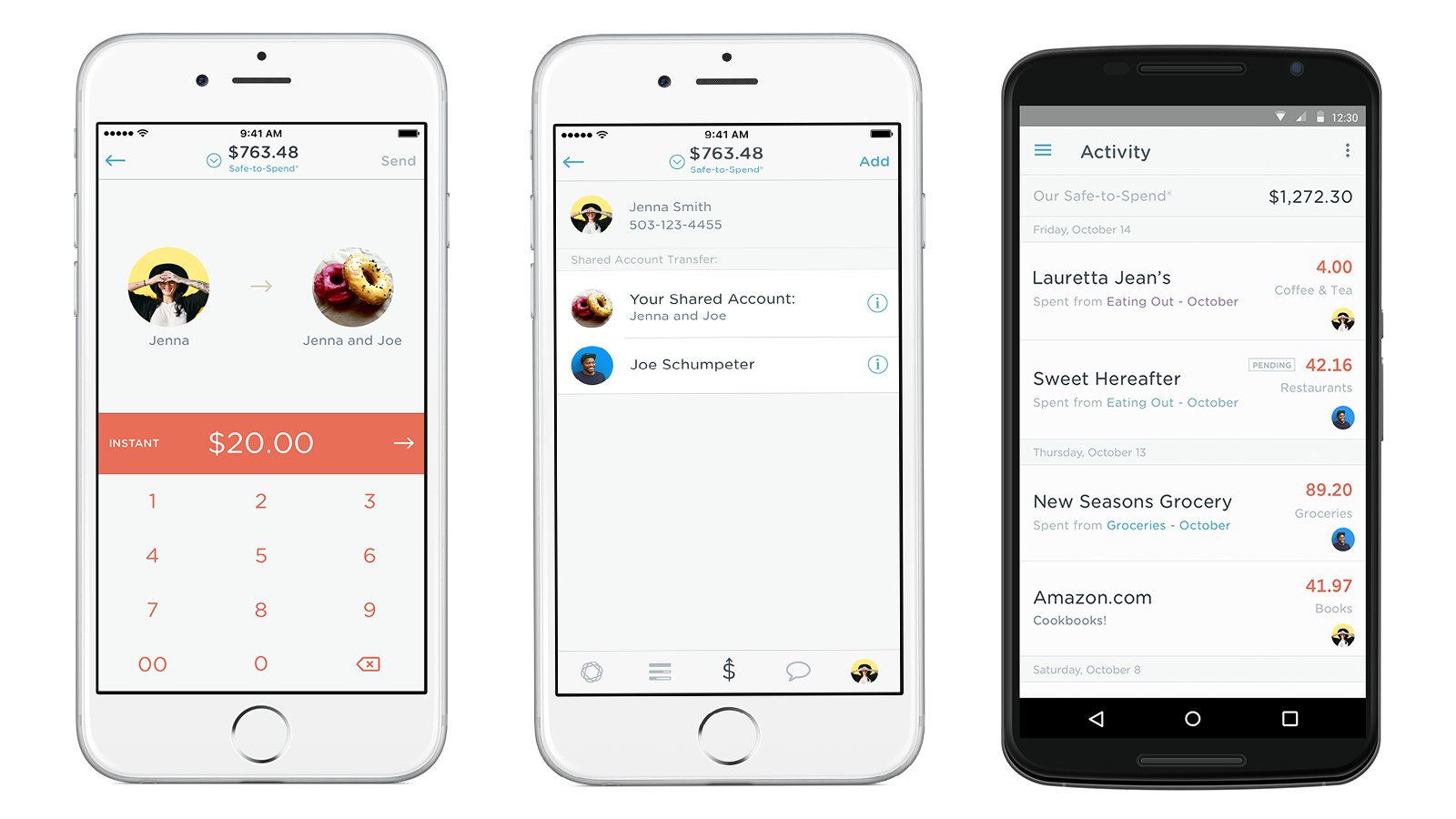
Most intriguingly, Simple isn’t just targeting married couples and longterm couples. Any two people can create a shared account for managing their finances, which could be useful for roommates or friends traveling together. Both customers will also get individual accounts from Simple, which they can swap between the joint account easily in the company’s apps.
As you’d expect, you can also sign up for Simple Shared accounts easily online. That’s a big change from traditional banks, which typically require you and your partner to appear, fill out lots of forms, and prove your relationship.
Simple is keeping its shared accounts in beta testing for now, and it plans to have an official launch once it sees how people use the accounts. That might sound worrisome, but it makes sense for Simple to take things slow, after it faced some serious technical issues years ago which required a hefty infrastructure revamp. The company eventually bounced back, but it seems to have learned its lesson about moving too quickly without enough testing.
Source: Simple
Sierra Nevada is taking the United Nations to space in 2021
Sierra Nevada’s Dream Chaser might not have won NASA’s space taxi contract, but at least it’s taking the United Nations to orbit. The spacecraft, which resembles NASA’s old Space Shuttles, will launch the UN Office for Outer Space Affairs’ first actual mission in 2021, 59 years after the division was established. It’s meant to give developing nations without a space program the chance to send experiments and other payloads outside our planet, though any UN member can apply for a spot on the vehicle. UNOOSA will even offer technical assistance to countries that have no experience developing microgravity payloads.
UNOOSA director Simonetta Di Pippo said in a statement:
“One of UNOOSA’s core responsibilities is to promote international cooperation in the peaceful use of outer space. I am proud to say that one of the ways UNOOSA will achieve this, in cooperation with our partner SNC, is by dedicating an entire microgravity mission to United Nations Member States, many of which do not have the infrastructure or financial backing to have a standalone space program.”
The UN will choose submissions in 2018, and countries whose projects are selected will have to pay part of the mission’s total bill. Sierra Nevada officials said poorer nations will likely a get a price break, though. Plus, the Office for Outer Space Affairs is currently looking for sponsors to ensure participants will pay the least amount possible.
Via: Space
Source: Sierra Nevada Corp
Ask, and Siri will make Skype calls for you
When Skype updates on desktop and gives the “improving your experience” message it’s usually pretty easy to dismiss that as a bald-faced lie. But the latest iOS update actually sounds really useful. The VoIP service will now tap into Siri for making calls, pull contact information from the app into your contact list and, like Facebook Messenger before it, make incoming calls look like regular ones. It all sounds genuinely useful. As always, if the update hasn’t hit your iOS 10 device yet, that’s what the source link below is for.
Source: iTunes, Skype blog
Surgeons could use these fake elastic bones to fix injuries
A team of American scientists have developed a 3D-printed bone biomaterial that can coax your own skeleton to grow and fix injuries on its own. They haven’t tested it on humans just yet, but they were able to use their creation to repair a monkey’s skull and to fuse rat spines. The synthetic material called “hyperelastic bone” is primarily made of ceramic and polymer and can be manufactured using an expensive but commercially available 3D printer. It’s dubbed hyperelastic, because unlike other bone graft materials, which are typically brittle, it’s flexible, strong and not prone to chipping or breaking.
More importantly, it remains porous and absorbent even if it’s crammed into a small space. Those properties are significant, because your biological materials, such as your blood vessels, need to be able to infiltrate the materials to regrow real bones. Adam Jakus, one of the the team members from Northwestern University, said their hyperelastic bone is “purely synthetic, very cheap and very easy to make.” Since it can also “be packaged, shipped and stored very nicely,” he hopes it can be used even in developing nations.
That won’t be anytime in the near future, though, since the material has to undergo further testing before any hospital starts using it to mend fractures and other bone injuries. The team is pushing for human trials within five years’ time, but it’s worth noting that the FDA has yet to approve a 3D-printed regenerative bone material for testing on actual patients.
Via: Reuters, IEEE
Source: Science Translational Medicine
‘Fuze’ Case for iPhone 7 Aims to Bring Back the 3.5mm Headphone Jack
A new iPhone 7 and iPhone 7 Plus case launched recently on Indiegogo, called “Fuze,” with the explicit goal of providing an integrated 3.5mm headphone jack directly into the body of the protective case. With an integrated Lightning adapter that plugs into the iPhone 7, the Fuze case provides users with the ability to charge their new iPhone and listen to music simultaneously without the need of a dongle or adapter.
As a bonus, Fuze also provides extra battery life to the iPhone, and is rated for 2,400 mAh for the 4.7-inch iPhone 7 and 3,600 mAh for the 5.5-inch iPhone 7 Plus. As a comparison, Apple’s Smart Battery Case for the iPhone 7 is rated for 2,365 mAh. Fuze said its own case provides “a doubled battery life,” with sync-through charging so users can charge their iPhone, the case’s battery, and listen to music at the same time.
Fuze restores 3.5mm audio jack for iPhone 7 and 7 Plus. It delivers a doubled battery life as well as scratch and shock protection, all while maintaining the iPhone’s compact profile. We need your help to bring back the jack. When you purchase Fuze, you purchase the freedom of choice.
The company said that its case is made out of durable TPU and ABS plastics, which Apple uses in its first-party battery case, to provide protection against drops and scratches. Fuze also lacks the “chin” of Apple’s Smart Battery Case, “adding only 5mm (.2 inches) to the overall thickness of the phone.” The case weighs 2.9 ounces as well, which the company equates to less than a deck of playing cards, so Fuze in total “keeps the slim design the iPhone is known for,” without unnecessary or bulky additions.
The campaign has a goal of $60,000 over the next month, with the first “super early bird” perk priced at $49 for one Fuze case, going to a basic early bird level at $59, and landing on the predicted retail price of $69 once the first two tiers sell out.
Users can choose from white, black, gold, rose gold, and blue colors for the case, and the company is currently claiming that the first units “should arrive before December 23” of this year. All the same, potential backers should note the sometimes disappointing nature of crowdfunding campaigns, which could lead to schedule postponements, design alterations, or cancellation.
Related Roundup: iPhone 7
Discuss this article in our forums
Apple and George R.R. Martin Debut ‘A Game of Thrones’ Enhanced Edition iBook
Apple today launched an “Enhanced Edition” for A Game of Thrones [Direct Link], the first book in George R.R. Martin’s fantasy series A Song of Ice and Fire (via The Guardian). The new digital edition marks the 20th anniversary of the release of the novel, and its four subsequently published sequels are also coming soon in the new remade format: A Clash of Kings (October 27), A Storm of Swords (December 15), A Feast for Crows (February 2), and A Dance with Dragons (March 30).
The enhanced editions offer interactive maps, author notes from Martin, glossaries, family trees, and illustrations that “add to the adventure, whether you’re new to the books or speak fluent Dothraki.” For fans still waiting for the sixth book in the series, The Winds of Winter, each enhanced edition comes with an excerpt from the upcoming novel that was previously published on Martin’s website.

“We’re now entering a new period in the history of publishing,” said Martin, announcing the new edition. “The digital book gives readers the ability to experience all this rich secondary material that had not been possible before. These enhanced editions, available only on iBooks, include sigils and family trees and glossaries. Anything that confuses you, anything you want to know more about, it’s right there at your fingertips. It’s an amazing next step in the world of books.”
In a video on the iBooks page for the new collection, Martin calls his partnership with Apple “an amazing next step in the world of books,” thanks to the interactivity infused in each edition that can help explain the sometimes overwhelming nature of his novels. Fans interested can purchase A Game of Thrones for $8.99 today [Direct Link], and pre-order the other four books for $11.99 each.
Tag: iBooks
Discuss this article in our forums
2017 iPhone to Feature Glass Design With Stainless Steel Frame on High-End Models
KGI Securities analyst Ming-Chi Kuo has outlined further predictions for next year’s iPhone lineup, claiming the popularity of Jet Black models will encourage Apple to return to glass casing for 2017 models, as the material tends to have a higher gloss finish than metal.
While a glossy finish is possible for metal casing, we identify two prerequisites for the 2017 new iPhone to be competitive in terms of casing design, considering competitors will definitely launch smartphone models with glossy metal or glass casing prior to Apple’s launch: (1) adoption of a glossy finish design; (2) enhanced productivity and higher yield will prevent a supply shortage, as has happened with jet black casing, which is manufactured at an unsatisfactory yield rate of 60-70% due to the metal material; and (3) better scratch resistance will improve user satisfaction. All things considered, we see glass casing as the only option.
Kuo believes Apple is more likely to stick with slightly curved 2.5D cover glass on the 2017 iPhone, as used on iPhone 6s, rather than adopt a fully curved 3D design, in light of mass production considerations and drop test performance. Kuo previously said Apple will launch a 5.8-inch iPhone with a curved OLED display and glass casing next year, which a subsequent report said will be a high-end model. The other models would retain LCD displays with 4.7-inch and 5.5-inch screen sizes.
Kuo said the new glass casing will be reinforced by an aluminum metal frame, while stainless steel will be used for high-end models.
Metal frame can be stainless steel or aluminum, with former more likely for high-end models. As all-glass casing is not possible at present given technological bottlenecks, a metal frame surrounding the edge is necessary for reinforced structure design. As stainless steel has a better look than aluminum and costs more, we expect only high-end new iPhone models to come with a stainless steel frame next year.
The analyst believes Foxconn will be the sole supplier of high-end iPhone models next year as the exclusive manufacturer of the new stainless steel frame. Meanwhile, glass material supplier Corning and glass casing makers Lens Technology and Biel Crystal are said to be beneficiaries of the new glass design.
Related Roundup: iPhone 8 (2017)
Tags: KGI Securities, Ming-Chi Kuo
Discuss this article in our forums

