


These products and services work with Google Home

Which products and services work with Google Home?
Google first introduced Google Home to the world back in May at Google I/O 2016, later revealing the final product alongside the Pixel in October. From everything we’ve seen, Google Home seems primed to eventually link up with any smart device in your home and allow you to control everything with just the sound of your voice.
Google has announced which products and services will be supported at launch, but there’s sure to be plenty more to come in the future. Continue to check back to this article in the coming months, as we’ll surely be updating this list as more products and services are added. We’ve broken things down into two categories — home automation products and supported services.
- Home automation
- Chromecast
- Nest
- SmartThings
- IFTTT
- Phillips Hue
- Supported services
- Spotify
- Pandora
- Google Play Music
- TuneIn Radio
- YouTube
Home automation
Chromecast

It should come as little surprise that Google Home works with Chromecast. Google hit it out of the park with their compact, Wi-Fi enabled dongles for video or audio that you simply hook up to your TV or stereo and allow you to stream media straight from your phone, tablet, or laptop.
Google Home takes things to the next level by allowing you cast video and audio from its supported services using only your voice. As if Chromecast wasn’t convenient enough already. I can think of many scenarios where I might want to pull up something from YouTube or change a playlist while I’m busy in the kitchen or otherwise preoccupied. Currently only YouTube is supported for video, but expect more services to be added — Netflix, Hulu and the like — as time goes on. We’ve linked to the 2015 model below, which remains a fantastic value at only $35… but it only displays at 1080p. If you’re interested in some higher definition, Google is set to start shipping a new Chromecast for 2016 — the Chromecast Ultra — which costs twice as much but supports 4K video.
See at Google
Nest

Nest is one of the best known manufacturers of smart home automation products, which include self-learning, Wi-Fi-enabled thermostats, smoke detectors and security cameras.
With Google Home and a Nest thermostat, you’ll be able to effortlessly control the temperature of your home using only your voice. Nest also works well with other smart products, such as lights, doorbells, and smartlocks.
See at Amazon
SmartThings

Samsung’s SmartThings is a very capable and customizable home automation system that features five different smart sensors for home monitoring, all linked together wirelessly via the Hub. The SmartThings Home Monitoring Kit comes with a Hub, two Multipurpose Sensors, a Motion Sensor and an Outlet. You can configure them however you like in your home, then get instant notifications if anything is out of the normal. You can also buy additional sensors, including an Arrival Sensor and a Water Leak Sensor.
SmartThings is incredibly versatile as it is, but we’re super excited to see what integration with Google Home will look like.
See at Amazon
Phillips Hue

Phillips is one of the leading manufacturers of wireless LED smart bulbs. The Phillips Hue lineup features a multitude of different lighting options for around your home, which must be configured through the Phillips Hue Bridge via. You’re able to connect up to 50 lights to one Bridge and then configure and control them in so many different ways.
We should expect Google Home to work just as well with Phillips Hue lights as it does with Apple Home Kit, meaning you’ll be able to set and adjust your Phillips Hue lights throughout your house without leaving the couch, or easily turn off all the lights when you’re leaving the house or it’s time for bed.
See at Amazon
IFTTT
IFTTT is a free web service that lets you create chains of conditional commands, called “recipes,” to automate processes between apps and smart home devices. IFTTT is an abbreviation of “If This Then That”, and that’s exactly how the recipes function. For example, say you’re concerned about your teenager getting into the liquor cabinet when you’re away. If you have a SmartThings Multipurpose Sensor on the liquor cabinet door, you can create an IFTTT recipe that goes “if the liquor cabinet door is opened, call my phone,” so you’ll know instantly if something’s up.
IFTTT is compatible with a ridiculous number of IoT devices, applications, and online services — including Google’s OnHub router — and is something you should definitely check out with or without Google Home. But with day one compatibility with IFTTT, we’ll be super interested to see what sort of recipes folks can cook up and how fluidly it will integrate with Google Assistant.
Supported services
Spotify

Over 100 million people use Spotify for all their music streaming needs. Of those, 40 million are paid subscribers. The point here is that Spotify is massively popular and if you aren’t already using it, you probably know a bunch of people who do.
With Google Home, simply say “OK Google”, followed by your favourite artist, album, song, or playlist, and your music will almost instantly start playing through the Google Home speaker. This is absolutely perfect for playing music in the kitchen when your hands are too messy to be handling a phone, or for setting the right mood for a party or intimate evening. We’re also eager to see how smooth it is to use Google Home to cast your Spotify music to your Chromecast Audio-enabled speakers for an even better audio experience.
Pandora

Pandora is a fantastic music recommendation platform which is used by over 200 million people in the U.S., Australia, and New Zealand. It’s a customizable internet radio streaming service that allows you to curate your own streams using algorithms that recommends new music it knows you’ll love based on your musical tastes and how you’ve rated other music.
With Google Home, you’ll be able to throw on your favorite Pandora station using just your voice. In its current iteration, Google Assistant is unable to identify songs like Shazam or other apps of that sort, but we’d hope to see your Google Assistant give you the information about a song you’ve just discovered on Pandora, just by asking “what song is playing?” as well as an option to rate songs and skip if necessary.
Google Play Music

Kind of a no brainer, but Google Home will obviously play well with Google Play Music. And that’s great news, since Google has slowly build its core music app to encompass a full-fledged streaming service featuring 35 million songs available on-demand (with a subscription) along with mood- and activity-based stations (you may have known it as Songza), along with being a great option for podcasts. A natural fit with Google Home, you’ll definitely want to get a Google Play Music subscription if you don’t already have one.
TuneIn

Believe it or not, but some people actually prefer to listen to the radio. TuneIn is absolutely the go-to app for accessing online radio, music, and talk stations. Even with the free version, you get access to over 100,000 radio stations from around the world, along with over five million podcasts as well. If you decide to upgrade to the premium subscription, you’ll also get access to live NFL and MLB play-by-play, along with a large library of audiobooks.
It will be really interesting to see how third-party streaming services such as TuneIn are integrated into the Google Home experience via the Google Assistant, whether you’ll be able to make a broad request (“Play a top-40 radio station from the UK in TuneIn”) or stick to more specific requests based on your app usage (“Play my favorite local radio station in TuneIn”).
YouTube

YouTube is another obvious starting point for Google to incorporating video search and playback controls with Google Home. Some might be disappointed with a lack of support at launch for Netflix, Hulu and other video services, but with so much content available on YouTube and natural alignment within Google’s existing ecosystem (hello, Chromecast), it’s a great place for Google to finetune their voice searching capabilities before opening things up for other video services.
Google Assistant on the Pixel currently only works well with YouTube for video — you can ask to open up Netflix or other apps, but have to navigate the rest of the way from there. But we’re likely not too far off from being able to come home, say “OK Google, cast The Office on Netflix to the living room” and binge watch the night away, for better or for worse.
YouTube is also the world’s largest music streaming service, becoming such a primary destination for lovers of music that they came out with the YouTube Music app. A subscription to YouTube Red is required.
The YouTube Music app isn’t available for everyone just yet, but it too is listed as being compatible with Google Home. The Pixel’s Google Assistant frequently completes music requests using YouTube, so we’d imagine it to be just as smooth an experience with Google Home.
What you do you think?
Are there any services or products you’re hoping to connect and control via Google Home? Let us know in the comments!
Google Pixel + Pixel XL
- Google Pixel and Pixel XL review
- Google Pixel XL review: A U.S. perspective
- Google Pixel FAQ: Should you upgrade?
- Pixel + Pixel XL specs
- Understanding Android 7.1 Nougat
- Join the discussion in the forums!
Google Store
Verizon
ICYMI: Treat all your wine right with a $1,500 fridge

Today on In Case You Missed It: A wine fridge called Plum can scan your wine bottles, seals so they stay fresh and then calibrates the temperature inside for maximum deliciousness of pour for every glass. Downside? It’s $1,500 so you could take a vacation to wine country instead. Meanwhile, Harvard scientists announced a 3D-printed heart on a chip that has integrated sensors, so it can be used to test medications, which should rapidly accelerate medical studies.
The most detailed Milky Way Galaxy yet is here. The particle accelerator on a chip talk at the SLAC lab is here and the Singapore driverless bus news is here. For drones attempting a lightbulb change, go here. As always, please share any interesting tech or science videos you find by using the #ICYMI hashtag on Twitter for @mskerryd.
WhatsApp is rolling out video calls on Android
Whatsapp, the $19 billion app used by over a billion folks, may finally be ready to support video calls. As Android Police noticed, the feature now works for some Android users, even without an update. However, anyone can try it by installing the latest beta (2.16.318), which is up on APK Mirror. If you do so, you’ll notice a camera icon next to your contacts and will be able to place video calls provided your friends have the feature, too.
Hopefully it will stick this time. A Whatsapp beta from May had video calling enabled, but the company pulled it shortly afterwards. The feature is becoming more common with chat apps — parent company Facebook’s Messenger app has supported it for over a year on mobile. Other popular apps, however, like Telegram and Signal, lack video calling for now.

The feature wasn’t turned on for me in the latest release, but I was able to use it by installing the APK beta. After my colleague Nick installed it too, I was able to place a video call between France and the UK. Both sound and video quality were excellent, though both of us were on WiFi with fast (1 Gbps and 60 Mbps) connections.
It’s good news for folks who can spare the data, but Whatsapp users in the developing world will probably stick with text unless they can get a solid connection. Even then, the most popular way to use video in many countries is to send short video clips back and forth, as the NY Times recently observed.
Via: Android Police
WiGig will bring superfast WiFi to devices next year
The WiFi Alliance has finally certified “WiGig,” a high-speed, 60 GHz standard otherwise known as 802.11ad. Using beamforming, it can yield speeds of up to 8 Gbps, or nearly 1GB per second from a distance of up to 10 meters. As many as 180 million devices using the standard, like routers, laptops and smartphones will arrive by the end of next year, the group said. It also unveiled the first five certified WiGig products from Intel, Dell and Qualcomm, among others.
The WiFi Alliance notes that the new standard operates in the “less congested” 60 GHz spectrum, which should aid speeds. It says that manufacturers can implement “handoff” technology so that your phone and router will automatically switch to 2.4 or 5 GHz WiFi if you leave the room, for instance. Samsung, among others, has already released uncertified WiGig devices.
8 Gbps is around three times faster than the best 802.11ac routers can do right now. However, in the real world, most current devices can only hit 600 Mbps or so, less than a fifth of the theoretical maximum in some cases. In theory, 802.11ad should be faster, thanks to the beamforming and distance limitation, but you’ve essentially got to be in the same room as the router to benefit from such speeds. Of course, your smartphone or laptop would have to support the standard too, not just the router.
Qualcomm’s WiGig video from CES 2016
Nevertheless, if the new standard can do even 20 percent of the promised speeds, it’ll be useful in a lot of cases. If you usually work from the same room and transfer files around your network, for instance, you’ll no longer need a wired gigabit connection. And folks with Google Fiber or other high-speed internet services should get faster wireless speeds — my router and smartphone combination limits me to 200 Mbps, for instance, while my laptop gets 1 Gbps via wired ethernet.
The first mobile device to carry the standard is the Dell Latitude E7450/70, and both Intel and Qualcomm have certified router solutions. Expect a flood of devices to carry the standard soon, including smartphones, tablets, and notebooks. By next year, many will probably factor the standard into their “buy” decisions.
Source: WiFi Alliance
Tesco trials receipts sent directly to your smartphone
Some receipts are just about worth keeping — you may have second thoughts on the fit of those new jeans, after all — but the scrolls you receive at supermarket checkouts are basically just paper waste. Every under-the-kitchen-sink plastic bag has one of these unread companions, but things could get a bit lonelier under there if Tesco’s latest tech trial is successful. At one store in Harlow, Essex, the supermarket is testing out a paperless receipt system that skips the printer and sends it straight to your phone instead.
The method is a bit clunky as it stands. Customers are given a unique sticker they pair with a mobile app. They then scan this sticker on a special reader at the checkout, which pushes the receipt to their smartphone, storing it within the app. You know, just in case they want to revisit it later to figure out how they managed to spend £100 on two meals and a bottle of mouthwash — thanks, Brexit.
Tesco is very keen to stress this is a limited trial scheduled to run until next month, and a wider rollout of the system will only be considered after hearing customer feedback. It’s not too much of a stretch to imagine a similar but slicker system being integrated into Tesco’s PayQwiq app in the future, though. PayQwiq is Tesco’s own mobile wallet service that lets you pay at the checkout by scanning a QR code on your phone’s display, also removing the need to carry a separate Clubcard. It’s currently supported in 528 stores across London and Edinburgh, but Tesco hopes to expand support nationwide by the end of the year.
Via: Mashable
Google adds a food delivery shortcut to Maps for iOS
Not content with a simple navigation app, Google has updated Maps for iOS with a handy food delivery shortcut. So when you tap on a nearby restaurant, perhaps to see its opening times, you’ll soon see a button titled “Place an Order.” Tapping this will give you a few different options (these will vary depending on your country and the business in question) such as Grubhub, Seamless and Eat 24 in the US. Select your preferred service and you’ll be thrown across to the relevant iPhone app. It’s a small addition, sure, but one that could make ordering dinner just a little faster at night.
Via: Mac Rumors
Source: Google Maps (iOS)
Apple Forecasted to Report First Full-Year Revenue Decline Since 2001
Apple will report its fiscal fourth quarter earnings results later today, and both the company and analysts project a year-over-year decline in iPhone sales and overall revenue for a third consecutive quarter. Apple will then have posted its first full-year revenue decline since 2001, with the decline expected to continue through the holiday quarter. Wall Street projects Apple will return to growth in 2017.
Apple previously forecasted September quarter revenue of between $45.5 billion and $47.5 billion, which would be up to 12 percent lower than the $51.5 billion in revenue it posted in the year-ago quarter. The consensus among analysts is around $47 billion in revenue, at the higher end of Apple’s guidance, according to earnings estimates aggregated by Philip Elmer-DeWitt and Jim Edwards.
Apple analyst Neil Cybart of Above Avalon has forecasted declining sales across Apple’s entire core product lineup, including 43.7 million iPhones, 9.1 million iPads, 5 million Macs, and 1.9 million Apple Watch units. One continued bright spot for Apple is expected to be its services category, projected to rise 20% to $6.1 billion on the strength of the App Store, Apple Music, iCloud, and AppleCare.
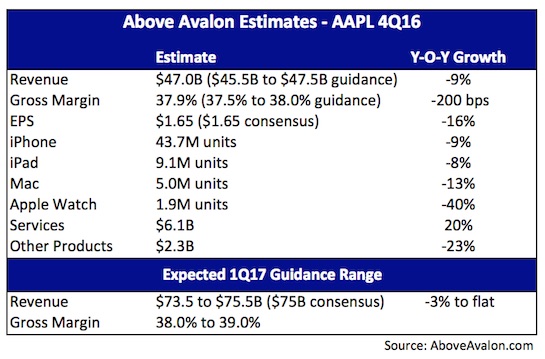
Apple analyst Brian White of Drexel Hamilton continues to recommend AAPL stock to investors, noting that shares remain undervalued. His price targets remains $185, or nearly 57% higher than Apple’s $117.86 price at the time this article was published. White believes Apple’s “sales, profit and iPhone cycle have bottomed” and that iPhone 8 sales can drive another year of growth.
Apple will report its fiscal fourth quarter earnings at 1:30 p.m. Pacific Time, followed by a conference call to discuss the results at 2:00 p.m. Pacific Time. MacRumors will be providing full coverage of Apple’s earnings results alongside a live transcript of the call. Check back for the latest updates.
Tags: earnings, AAPL, Above Avalon
Discuss this article in our forums
BlackBerry officially announces DTEK60, available now for £475
The BlackBerry DTEK60 has been no secret, we’ve known it’s been coming for some time now, the Canadian company even accidentally leaked the specs itself and a German retailer said it would go on sale on 25 October. Those leaks have rung true and it’s now official and available to buy.
- BlackBerry DTEK60 all but confirmed with leaked pre-order page
The DTEK60 is BlackBerry’s flagship Android phone for 2016 and has been made by TCL, the same company responsible for Alcatel’s range of smartphones, which is why is bears a similar design.
As was previously leaked, the DTEK60 has a 5.5-inch Quad HD display with a scratch resistant glass and a special coating that the company claims protects against smudges and fingerprints. There’s a fingerprint scanner for unlocking the phone and authorising purchases via Android Pay and BlackBerry’s own Smart Keyboard promises to learn your typing speed and accuracy to help better predict words you want to write.
It runs on a Qualcomm Snapdragon 820 processor with 4GB RAM, so it’s a little behind other flagships fitted with the 821 processor, but it’s sure to be no slouch in day to day use.
You’ll find a 21-megapixel camera on the back with dual-tone LED flash and autofocus, and an 8MP snapper on the front. BlackBerry has also fitted a 3000mAh battery which it says is good for 24 hours of use and the 32GB of internal storage is expandable up to 2TB via microSD card.
And of course, being a BlackBerry device, it will come with the security that have made the company famous and even comes with a DTEK app to monitor the OS and your apps and will let you know when your privacy may be at risk.
You can buy the BlackBerry DTEK60 now from BlackBerry’s online store for £475 which includes a case and rapid charger free of charge.
Samsung Galaxy S8 to launch in March and come with 5.5in 4K display?
Following the demise of the Galaxy Note 7, many analysts thought that Samsung would bring the launch of the Galaxy S8 and S8 Edge forward to try and regain some customer loyalty. Those predictions could well come true as the company is expected to unveil the new flagship on 26 February, at least that’s according to a leakster on Weibo which has been picked up by Phone Arena.
- Samsung could bring forward S8 launch in wake of exploding Note 7
The leakster also says the S8 will come with a dual edge curved screen, similar to the recently launched Xiaomi Mi Note 2. Given a dual edge curved screen is rumoured, the leaked specs will likely refer to the S8 Edge, but it’s interesting to note that no flat screen version has been mentioned. However it would tie in with rumours from the Korea Herald which said there would be no flat screen variant for 2017.
The S8/S8 Edge is also said to come with a 5.5-inch 4K display, which of course will only show its full potential with native 4K content and there’s been two different processors listed. They include an Exynos 8895 or Snapdragon 830, it could be that Samsung will make two versions of the phone, destined for different markets. The fact the post on Weibo says there’ll be 6GB and 8GB RAM versions could tie in with this theory.
- Samsung Galaxy S8 specs leak; 30MP camera, Snapdragon 830 processor and built-in projector
- No flat bezel Samsung Galaxy S8 for 2017, tipped to have Edge screen only
Other features are said to include NFC, Samsung Pay and an 80 percent screen to body ratio.
The post says the S8 will be announced on 26 February, a day before Mobile World Congress. If true, we’d likely see the Galaxy S8 on sale in March
Uber’s self-driving truck company completes a 120-mile beer run
If you’re in Colorado and grab a can of Budweiser, it’s possible that you might be sipping beer delivered by Uber’s autonomous truck company. Today, Otto confirmed that on October 20th, it “completed the world’s first shipment by a self-driving truck,” a delivery that involved transporting 2,000 cases (or 51,744 cans) of Bud from Fort Collins, Colorado to Colorado Springs along Interstate 25.
Although impressive, this “world first” is mostly promotional. The Verge reports that a human driver first navigated the truck from a Anheuser-Busch depot to a weigh station in Fort Collins. From there, Otto’s self-driving technology was deployed and the Volvo big rig drove the remaining 100 miles to Colorado Springs without any outside assistance. Once it entered the city, the driver — who monitored the journey from the sleeper berth in the back — resumed control and completed the final manoeuvres.
With Uber’s self-driving cars taking to US streets and Otto now starting to make its first shipments, the company is finally starting to realise its vision as a logistics company. Right now, deliveries are marketed as a step towards a “safe and productive future” across US highways, allowing drivers to rest while their vehicle does the hard miles. However, with Uber’s rapid expansion into cities worldwide, it likely won’t be long until it’s self-driving trucks can negotiate confusing inter-city streets too.
To mark the Budweiser milestone, Uber is now inviting potential partners to enquire about its haulage offering, which it’s now calling Uber Freight. “Our partnership with Anheuser-Busch is just beginning,” says the company in a blog post. “Our companies are excited to transform commercial transportation together.”
Via: The Verge
Source: Otto Blog

