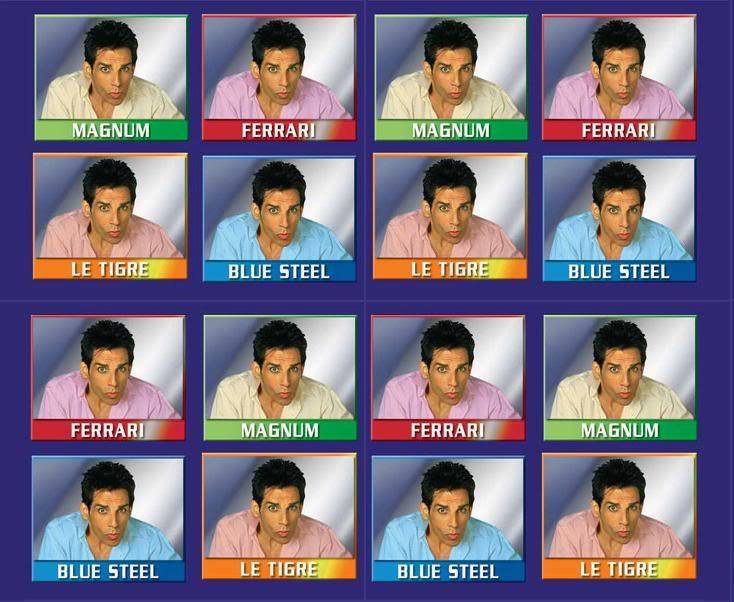
Small is not for all: Derek Zoolander embraces the Samsung Galaxy (S6)
For anyone who has seen the 2001 movie Zoolander, there is one particular part that rang true to the hearts of phone-ees: Derek Zoolander, portrayed by Ben Stiller, had an impossibly small mobile. Resembling a miniature Motorola Star-Tac, the fabulous flip phone was just one of the plethora of gags and jokes that littered the movie. Times, however, have changed, and so too have Derek Zoolander’s tastes:

“We’re holding…the GALAXY???? It looks like me!”
The above poster, teasing the United Kingdom release of the movie, has both Derek and his rival/friend Hansel (portrayed by Owen Wilson) staring into their souls, as mirrored back at them via selfies. Of course the bigger surprise is what they are holding: the Samsung Galaxy S6.
A sign of the times

Yes, this was the original phone Derek once had to deal with. How could you see anything on that?
Indeed if one thinks back to 2001, concepts of selfies and even smartphones were non-existent. In those days, people who took pictures of themselves were typically labeled as vain (I’d like to say I took selfies before they caught on), all the more so given that basically all phones – save for those sold in Japan – only had rear cameras, if that. Selfies have since gone on to become such a craze that not only are there accessories to facilitate taking them, but also an entire spin-off, referred to as belfies.
Likewise, at the turn of the century, everything mobile was about miniaturization. Zoolander itself was making an almost meta statement about how en vogue the trend was. Ironically, these days phones under 5-inches are now labeled as “Mini”, something that would be unthinkable even a few years ago, when the average display was around 3.5 or 4-inches.
Oh, and just for reference, while the Zoolander phone was never actually manufactured, there is at least one micro-mobile that did come to market:

The Frisk Phone is perhaps the smallest mobile EVAR.
Samsung Showcase

Perhaps the larger issue here is just how eager Samsung is to plant produce placement in movies. The Verge points out that the Samsung logo in the promo picture isn’t prominently visible, something that could be a result of the camera angle, or perhaps the fact that no licensing agreement is in place at the moment. Were the latter true however, it would seemingly be prudent for Paramount Pictures, the studio behind the film, to remove the logo entirely, or just use a generic product so as to avoid potential legal problems.
Either way, Samsung spends a lot of money on movie marketing, with this year’s Jurassic World having prominent placement. The company has also made it a point to sponsor the Olympic Games. It will remain to be seen as to how aggressive this kind of marketing continues given the company’s new decisions to take radical action and change things up to stay competitive.
Big Money and Marketing

The movie poster also reminds us of the recent stories about 007’s latest outing, Spectre. Leaked e-mails from Sony indicated that James Bond himself, Daniel Craig, didn’t want to use an Xperia because it wasn’t “the best”. Perhaps even more interesting however, Samsung allegedly offered up $50 million to have its Galaxy products sponsored in the new film.
Given that Sony is indeed producing a special James Bond-edition Xperia Z5, it goes to show just how these product placements and sponsorships can be used to the advantage of their creators. Also consider that Verizon had an NFL-colored back for the Moto X, and even ZTE is making an NBA-branded Axon Phone.
One need not even go into the madness that exists in Japan, where each major carrier actually has phones branded as “Disney Mobile.” In fact, the LG G4 didn’t release here at all, but it did release a lower powered, re-branded and remodeled variant which is marching proud with Mickey Mouse:
This is in addition to other marketing tie-ups, including one from Sharp featuring Neon Genesis Evangelion, and others with Sony and Hatsune Mikku.
Wrap Up

Everyone loves to see the models looking beautiful and thin.
Suffice to say, Derek and Hansel’s latest vie for vanity is certainly a fair talking point. In just one self-centered selfie, the moralistic models have spoken volumes about not only the changes in the mobile industry over the years, but also the marketing money that makes movies. It’s brilliant really, as one of the main points of modeling is to let the photographs speak for themselves.
One might even get a bit more meta and say that mobiles themselves have become models as companies like Samsung have finally made the bold decision to focus on looks over functionality, at least by some critics’ standards. This year’s flagships in particular have come under great scrutiny given their forgoing a removable battery and support for microSD.
Still, now that we known Zoolander isn’t afraid to get a Galaxy, can we expect a special edition next year from Samsung? Or, perhaps even more relevant: will the male model have a new pose to promote it?
Test drive the new Firefox OS 2.5 Developer Preview on your Android device
(adsbygoogle = window.adsbygoogle || []).push();
Firefox OS has somewhat fallen off the radar of late – not for those who love it, of course – but it appears the Mozilla team is trying to engage more people in its latest update, the Firefox OS 2.5 Developer Preview. Unlike previous previews, this version of Firefox OS can be loaded, as an app, on an Android device and run as a launcher of sorts – for those who have tried Ubuntu through their virtual operating system, this appears to be pretty much the same thing.
For those who have kept track of Firefox OS, you’ll be interested to know that the changes in this latest version include:
- Add-ons: Just like the add-ons we’ve come to love in desktop browsers,Firefox OS add-ons can extend just one app, several, or all of them, including the system app itself.
- Private Browsing with Tracking Protection: A new Firefox privacy feature, Tracking Protection allows users to control how their browsing activity is tracked across many sites.
- Pin the Web: Pin the Web removes the artificial distinction between web apps and web sites and lets you pin any web site or web page to your home screen for later usage.
If that sounds like your cup of tea, you can find the APK and more information on the Mozilla site (source link below), and also includes instructions if you want to take the next step and move your Android device fully over to Firefox OS.
What do you think of the Firefox OS 2.5 Developer Preview? Let us know your thoughts in the comments below.
Source: Mozilla via Phone Arena
The post Test drive the new Firefox OS 2.5 Developer Preview on your Android device appeared first on AndroidSPIN.
Snag a 1st Gen Moto 360 for $99.99 from Google
(adsbygoogle = window.adsbygoogle || []).push();
The holiday shopping season is fast approaching. In a few short weeks retailers will fighting for your hard-earned dollar on Black Friday. Some of you might even be fighting your fellow shopper for a door buster deal. Hopefully many of you will shop online and just tackle UPS or FedEx in your driveway. For those who still haven’t pulled the trigger on an Android Wear device, Google has your back right now with the 1st Gen Moto 360 for $99.99
At that price you could get yourself one and someone else one too. Google is offering up the Android Wear toting smartwatch in black on black or silver on grey. While it isn’t as customizable on the outside as the new 360, it is hard to not want to drop a Benjamin for it. Especially if you don’t have an Android Wear watch, or know someone who has really wanted one for a while. Head off to the Google Store and get your 1st Gen Moto 360 ordered today.
The post Snag a 1st Gen Moto 360 for $99.99 from Google appeared first on AndroidSPIN.
Amazon Underground has three times as many Android apps than ever before

Amazon has been playing around with a pretty interesting business model lately, and their use of it involving Android apps has seen a 300% growth since its inception.
The idea is simple. Creators should get paid in proportion to the amount of time a consumer engages the creative content. Amazon first came up with the idea when crowds of writers with cartoonish dollar signs in their eyes flooded the Kindle self-publication platform with an unrelenting tide of werewolf erotica.
For years, Amazon had been trying to establish itself as a serious publishing operation, but eliminating the traditional gatekeepers of publication had some unexpected results. Suddenly, the professional writers they wanted to showcase had to dog paddle in a sea of poorly written lupine lust hocked at $2.99 a pop. Something had to be done.

Amazon solved their problem by introducing Kindle Unlimited, an intriguing system that pays a writer for how many pages a reader reads of their book. The werewolf erotica economy, which banked on titillated readers forking over cash in exchange for a few hastily read pages of drivel, suddenly collapsed. Now the people who began profiting were creators who produced well-crafted, engaging writing that found and maintained an audience.
As an encore, Amazon turned their attention to their Free App of the Day program, a system that provided a different paid app free of charge each day to Amazon device owners. They decided to replace Free App of the Day with Amazon Underground, a system very similar to Kindle Unlimited that pays developers based on the number of minutes users stay engaged with the app. Amazon Underground launched with a selection of paid Android apps (which Amazon device owners can access for free), and as of this week the size of that selection has tripled.

Hypothetically with this model in place, developers who create engaging and useful apps will be paid well by Amazon, and the developers who create whatever the app-equivalent of werewolf erotica is will get left out in the cold.
It’s such a new payment model that there’s no guarantee how well this will play out for developers. However, if you’ve got an Amazon device and the Amazon Underground store, it’s a win-win for you. More paid Android apps than ever are available to you for free. Might as well check ‘em out.
BlackBerry Priv shows up on Amazon for $699.99… even if only for a bit

The BlackBerry Priv has a lot of us going nuts over that sweet, sweet keyboard. The only issue is not all of us can enjoy it quite yet. It’s now on AT&T, BlackBerry’s website and some other retailers, but we know some of you prefer sticking to Amazon, which wasn’t an option until today. Well… at least it was for a while.
BlackBerry‘s first Android smartphone showed up on Amazon today, tagged with a $699 price, which just so happens to be the same price you can get it for elsewhere. The benefit here is that the phone is completely unlocked, so you can use it with whichever carrier of your preference. Oh, and Amazon Prime member get that awesome free 2-day shipping!
More BlackBerry articles
- It’s official: Android-powered BlackBerry Priv coming this year
- I’m excited about the BlackBerry Venice, are you?
- BlackBerry Priv: wireless charging or not?
What’s the issue? Well, the phone became “currently unavailable” very quickly after it went online. Not so private after all, huh? But it sure seems to be a privilege to own it. Are people busting through digital doors to get the Priv? Is there simply not enough devices to meet demand? It’s hard to tell at this point, but at the very least we know Amazon is on board with the keyboard-clad handset.

Just in case you need a memory refresher, the BlackBerry Priv has everything most users could need in a smartphone. Aside from the iconic design, solif build quality and amazing keyboard, this phone sports a Qualcomm Snapdragon 808 processor, 3 GB of RAM, 32 GB of internal storage, a microSD card slot, an 18 MP rear camera, a 2 MP front shooter and a generous 3410 mAh battery.
Keep in mind there is also a Verizon version in the works, so this phone will be everywhere very soon. There’s nothing like buying it unlocked, with no compromises, though. Is Amazon your retailer of choice?
Google Maps now has offline navigation support
(adsbygoogle = window.adsbygoogle || []).push();
For the longest time, Google Maps has been capable of saving maps for offline use, but has always lacked one crucial piece of the puzzle – offline navigation support. This is particularly important for the frequent traveller who doesn’t necessarily have readily available access to data, but Google has finally come through for us all. Starting today, Google Maps now has offline navigation support and the update will start rolling out to all Android apps from today – iOS is “coming soon”.


To use the new functionality, you’ll need to download the map before you start your navigation – once downloaded, you’ll be able to use the map almost as if Google Maps was still connected to the Internet. The questions that come to my mind are how much storage this functionality requires and whether the re-routing part of the navigation is still going to work as well once the data connection is cut. All the same, it’s great to have this functionality and there are a lot of people that are going to be happy about this.
http://playboard.me/widgets/pb-app-box/1/pb_load_app_box.jsWhat do you think about Google Maps now having offline navigation support? Let us know your thoughts in the comments below.
Source: Google Blog via Droid-life
The post Google Maps now has offline navigation support appeared first on AndroidSPIN.
First generation Moto 360 is now only $100

The first generation of the Moto 360 turned heads last year, with some calling it perhaps the best Android Wear device to-date. Back then it would have cost you $250, but this week the price just dropped from $149.99 to $99.99 at the Google Store.
If you’re looking for style, the Moto 360 (Gen I) has it in spades. Its minimalist design allows it to elegantly with pair with a variety of ensembles, and it’s round face struck many as a refreshing, retro-futuristic design move. The screen face is a little bit too big for some, especially those with narrower wrists, but the larger display brings ease of interaction and readability to this small device.
.rvs_wrapper
width: 350px;
.rvs_wrapper.align_left
float: left;
.rvs_wrapper.align_right
float: right;
.rvs_wrapper.align_center,
.rvs_wrapper.align_none
width: 100%;
.rvs_wrapper.align_center
text-align: center;
.rvs_wrapper.align_center.cbc-latest-videos ul li
float: none;
display: inline-block;
vertical-align: top;
.rvs_wrapper.cbc-latest-videos:not(.align_none) ul li:nth-child(2n+1)
clear: both;
.rvs_title
font-weight: 600 !important;
margin: 0 !important;
font-size: 24px !important;
.rvs_wrapper.align_right .rvs_title
padding-left: 20px;
.rvs_title a
font-family: ‘Roboto Condensed’;
color: #3a3a3a;
.rvs_wrapper.cbc-latest-videos ul
padding-top: 10px;
.rvs_wrapper.align_left.cbc-latest-videos ul li,
.rvs_wrapper.align_none.cbc-latest-videos ul li
padding: 0 15px 0 0;
.rvs_wrapper.align_right.cbc-latest-videos ul li
padding: 0 0 0 15px;
float: right;
.rvs_wrapper.align_center.cbc-latest-videos ul li
padding: 0 7px;
.rvs_wrapper.cbc-latest-videos ul li > a
font-weight: 400;
.rvs_wrapper.cbc-latest-videos ul li > a .yt-thumbnail
margin-bottom: 0;
@media only screen and (min-width : 480px)
body #page .rvs_wrapper.cbc-latest-videos ul
width: 100% !important;
@media only screen and (max-width : 480px)
body #page .rvs_wrapper.cbc-latest-videos
width: 100%;
float: none !important;
overflow-x: auto;
overflow-y: hidden;
body #page .rvs_wrapper.cbc-latest-videos ul
overflow: auto;
max-height: none;
body .rvs_wrapper.cbc-latest-videos ul li
float: left !important;
clear: none !important;

The second generation of the Moto 360 took things up a notch both visually and in terms of specs. Admittedly, the first generation Moto 360 doesn’t quite have the power to run the large, circular screen as swiftly and responsively as users have come to expect from their smartphones, and the battery life ranges from about 8-14 hours, depending on usage. For some, this saw the Moto 360 (Gen I) dying just before bedtime each day. The Moto 360 (Gen II) increased processing power, RAM, and battery life… but the pricetag on that gorgeous beast still towers over its still-functional predecessor at $300.
If you’re looking to give Android Wear a spin for the first time, and you want something that’s attractive and effective – if not the absolute bleeding edge of the industry – maybe it’s time to give the Moto 360 (Gen I) a whirl. It’s never been more affordable to get this much style and usefulness out of an Android Wear device.
Xposed framework for Android 6.0 Marshmallow could arrive this week

Towards the end of October we told you that Xposed framework for Android 6.0 Marshmallow would soon become available for all. While that’s still the case, we’re now getting word of an official, yet still tentative, release date. According to developer rovo89 on XDA, we could see the first stable version of Xposed released sometime later this week.
The developer says he currently has Xposed running on his Nexus 9, and he’s fixed the root cause of a few main crashes, which he says needed ample time for analysis. And although there are a few more things he needs to test out before releasing the framework to the masses, we can expect a stable release by the week’s end. He also notes that even though it will likely be stable enough for everyday use, not all modules will work out of the box due to the amount of changes in AOSP.
 See also: Android 6.0 Marshmallow updates roundup – October 29, 2015
It shouldn’t be long now until Xposed becomes available for all. We’ll be sure to let you know if we hear anything regarding a release date.
Google rolling out an update that simplifies Hangouts video calls on the web

Today in a Google+ post, Google software engineer Eduardo Fernández announced that Hangouts users on the web would be getting a new update that seeks to improve the overall quality of video calls while simplifying the interface.
Fernández claims that the goal of this update is to help make users less concerned with navigation, allowing them to focus on the conversation at hand. Hangouts on the web will load calls faster, have a more intuitive UI, and the team has made adjustments to the way Hangouts renders video so as to make image quality sharper and cleaner. Google has been using this updated version of Hangouts for some time now, but Fernández cautions that these changes are still in their infancy. We can probably expect some further tweaking somewhere down the line.
 Related: Google introduces a new central location for Hangouts on the web
For those frightened and unsettled by change, Google has added the option to revert to the old interface. To do so, simply click the menu at the top right of Hangouts on the web and select “Original version.”
So far, these changes are not available for those using Google Apps for Work. Only a small number of Hangouts users have received this update so far, but Google plans to expand the scope of the update in the coming days. Keep an eye on your Hangouts interface over the next week or two, and see if you like the changes the team has been working on.
Apple Music now available on Android

Apple Music has finally made its way to Android.
Apple first announced that its new music service would be coming to Android devices sometime “this fall”, though we really haven’t heard much about it since then, aside from a few leaked screenshots. The majority of the features Apple originally announced would come with the service have made their way to the Android version, including the Beats 1 radio station, the Connect feature and the ability to get handpicked recommendations based on what you’re listening to. Since not all features are available in this first release, the app technically sports a “beta” tag for the time being.
Apple notes that music videos are missing from the Android version, and signing up for a family plan requires a Mac or iOS device for now.
#gallery-1
margin: auto;
#gallery-1 .gallery-item
float: left;
margin-top: 10px;
text-align: center;
width: 20%;
#gallery-1 img
border: 2px solid #cfcfcf;
#gallery-1 .gallery-caption
margin-left: 0;
/* see gallery_shortcode() in wp-includes/media.php */


Interested Android users can sign up for a three-month free trial. After the trial is up, individual plans will cost $9.99 per month, and when family plans become available, you can have up to six members on the same account for $14.99 per month.
The new Apple Music application for Android looks pretty similar to its iOS counterpart, though you can tell Apple at least tried to make it look a bit more like an Android app. It has a slide-out hamburger menu on the left hand side and even an overflow button for extra settings on each individual track. Interested in trying it out for yourself? Head to the Play Store link below for the download.