


ICYMI: Better 3D viewing and your new robot gardener

Today on In Case You Missed It: MIT developed a 3D projector system for movies that could get rid of 3D theater glasses altogether. An automated farming machine can plant, water and maintain the garden in your backyard with hardly any effort on your part (beyond set-up, assembly, and that ‘discounted’ $3,000 pricetag).
One of my favorite YouTubers has a new DIY for Pokemon fans. As always, please share any interesting tech or science videos you find by using the #ICYMI hashtag on Twitter for @mskerryd.
Xbox One S ‘Halo’ and ‘Madden 17’ bundles arrive August 23rd
Microsoft dropped the price of the original Xbox One to $249 over the weekend, and now the company is offering more details on the new Xbox One S. The first two bundles that pair games with the smaller 4K-ready console will ship August 23rd, but they’re up for pre-order today. First, a Madden NFL 17 option comes with a One S that offers a download of the game, 1TB of storage, seven Madden Ultimate Team Pro Packs and one month of EA Access for $349. Unfortunately, there’s no 500GB model available with the popular football title and the bundle will only be available in the US and Canada for now.
Not into sports games? There’s a Halo Collection Xbox One S bundle as well. You’ll have the option of 500GB or 1TB of storage alongside five games with Halo 5: Guardians and Halo: The Master Chief Collection. Both models will be available at retailers (including Microsoft Stores) in the US, Canada, Australia and New Zealand for $299 and $349. In the US, Microsoft says the 1TB bundle will only be available in limited quantities online and at the company’s retail stores. If you don’t live in one of those places, don’t fret: Microsoft said more bundle news is on the way as we get closer to the Xbox One S launch.

Talkshow offers the ability to host your own AMAs
A few months ago, a messaging app called Talkshow debuted with an interesting premise: all of your conversations on it are public. Everyone can “listen in” on the chatrooms you create, sort of like podcasting but in text form. One of the ways it differentiated itself from Twitter is that strangers can’t just butt into the discussions — they have to be invited. Otherwise, they could only offer canned responses. Now, however, outsiders can participate in a more engaged way, thanks to a new feature called Q&A.
Michael Sippey, one of Talkshow’s co-founders, says that the feature was born out of users holding impromptu Ask Me Anything sessions. But the only way for the audience to chime in was to be promoted to co-host, where they can say anything they want. They could then be removed from the discussion, but adding and removing these guests can be a hassle. The new feature, however, lets viewers submit questions and/or responses, which the host can review before allowing them through. It’s like a moderated comments section, but in real-time.

The Q&A feature is entirely opt-in, and is something that a host can toggle on or off. The default prompt is “Ask anything,” but you can customize it to whatever you like, such as “What’s your favorite Pokémon” or “What’s on your holiday wishlist.” Hosts and co-hosts can see all Q&A submissions, but only the host can decide what to publish. If a submission is accepted, the person who sent it in will get a push notification. You can then end the Q&A at any time during the conversation.
“It’s audience engagement, but more controlled,” says Sippey. “It keeps the host in control of the show.” He envisions that the feature will be used in AMAs of course, but he also foresees people using it for interviews or audience polling. “It’s a way to get feedback.”

“It’s going really well,” Sippey says about Talkshow’s progress since its launch. “People who are sticking around are really enjoying it.” When asked about the rise of public chat apps — Public is another one that debuted recently — he attributes the popularity to a general hole in the market. “Twitter is not great at ongoing conversation; the timeline is a very difficult place to navigate a particular topic,” he says. “Facebook is mostly for friends and family, not for public conversations.” An app like Talkshow, however, fills that void. “If people are good at it, it can be entertaining content.”
Right now Talkshow is sort of a mix of media — journalists have used it for event liveblogs — as well as community discussions around topics such as Pokémon Go. “Sometimes they’re not producing it for anybody but themselves.”
“Is it media? Or is it a chat product?” he queries rhetorically. “We’re straddling that boundary right now.”
T-Mobile adds Apple Music, Fox Now and more to Binge On
T-Mobile’s adding a whole bunch more entertainment services to its ‘Un-carrier’ plans today, meaning lower data bills for customers that just can’t bear to switch off Quantico while out and about.
New services joining the Un-carrier program include ABC, Fox Now, Apple Music and a whole host of others, including some more specialist providers like the sign language channel DPAN.TV. In total there are now more than 100 different entertainment services available, a four-fold increase from its launch eight months ago.
It might be growing at quite a clip, but not everyone is so happy about it. Researchers at Northeastern University say that Binge On doesn’t live up to the hype and regularly falls below minimum service standards, such as maintaining a minimum 480p resolution.
Net neutrality supporters also argue that Binge On flies in the face of the FCC’s Open Internet Order by making some video services more attractive than others. T-Mobile subscribers probably care less though, ’cause hey, they’ve got free Pokemon Go data for a year too.
Company president, CEO and enigmatic front-man John Legere says that over 765 million hours of video have been streamed for free so far and that it’s a winning formula for businesses and users, as it’s free to both.
Source: Business Wire
US government agency calls for the end of SMS authentication
The US agency that sets guidelines and rules in cryptography and security matters is discouraging the use of text messaging in two-factor authentication. In the latest draft of its Digital Authentication Guideline, the National Institute of Standards and Technology (NIST) states that “[out of band authentication] using SMS is deprecated, and will no longer be allowed in future releases of this guidance.” Out of band authentication means utilising a second device to verify your identity.
NIST doesn’t make clear why it’s deprecating SMS two-factor, but there are a few reasons that make sense. Most phones display text messages on their lock screen, meaning a would-be attacker would be able to authenticate just by looking at your phone. There are also considerable flaws in signalling protocols that make SMS more vulnerable than other methods.
NIST’s guidelines aren’t legally binding, but the industry will pay attention to them. So what’s the alternative to SMS? There are plenty. The most prevalent are dedicated applications that deliver a two-factor code that refreshes every 30 seconds. Google Authenticator, Authy, Duo and other apps all essentially do the same thing with slight differences in presentation and execution. If you work for a large company, you might have used hardware that works on a similar principle, such as RSA SecurID dongles.
There are still plenty of sites and services that only offer SMS-based authentication, while others such as Facebook support both app- and SMS-based methods. And, of course, there are inexplicably some services with no protection at all. Instagram is one such outlier — it’s been slowly bringing two-factor to its userbase this year, but at the time of writing has yet to complete that roll out.
Via: TechCrunch, Tom’s Hardware
Source: NIST (section 5.1.3.2.)
Google’s Omnitone adds 3D audio to web-based VR
Realistic sounds can turn good VR experiences into great, truly immersive ones, and Google’s new open source project can make that happen for web-based virtual reality. The technology, called Omnitone, uses a full-sphere surround sound technique called ambisonics. Simply put, it mimics how sounds are heard in reality. If a VR character is playing the piano, how you hear the music changes based on where you’re looking — turn your head (while wearing a VR headset, of course) away from the pianist, and you’ll hear the music coming from behind. Since it’s open source and has cross-browser support, anybody developing VR games and other experiences for the web can use it for their projects.
The Chrome team wrote in the announcement post:
“Throughout the project, we worked closely with the Google VR team for their VR audio expertise. Not only was their knowledge on the spatial audio a tremendous help for the project, but the collaboration also ensured identical audio spatialization across all of Google’s VR applications — both on the web and Android (e.g. Google VR SDK, YouTube Android app)…
With emerging web-based VR projects like WebVR, Omnitone’s audio spatialization can play a critical role in a more immersive VR experience on the web…We look forward to seeing what people do with Omnitone now that it’s open source. “
Google has a thorough explanation of how Omnitone works on the Open Source blog and has even posted a couple of demo videos you can try. If you don’t have a VR headset you can use to view the demos, make sure to drag the picture around and wear headphones — you might not hear the difference on speakers — when you play them on your browser.
Via: PopSci
Source: Google, Omnitone
OurMine ‘hackers’ are targeting news sites now
OurMine has been making quite a name for itself this summer, pulling off account takeovers of several high-profile targets. Celebrities have, for the most part, been the target, with the most recent attacks being on Sony’s Shuhei Yoshida and Star Trek actor William Shatner. But today, OurMine gained access to the backend of Engadget’s sister news site TechCrunch, marking a significant change in target.
OurMine considers itself an “elite” and “professional” hacker group, and aims to make money by charging companies and individuals to discover vulnerabilities in their account. We wrote extensively about its attempts to essentially extort companies last week, targeting high-profile accounts in order to promote its paid services.
Yet again, rather than being a bonafide hack, this seems to be a relatively simple case of gaining access via poor password practices. The group appears to have entered the site’s CMS (content management system) via a writer’s account. It’s likely, although not sure, that the account in question used the same password across multiple services. OurMine published an article under the writer’s name, put banners at the top of the site, and, as is par for course for the group, encouraged the owner of the account to write in to retrieve their accounts.
Because of the limited nature of the “hack,” TechCrunch was able to quickly roll back the changes OurMine made to its site. The erroneous post was deleted within minutes, and the banners and other accoutrements added to its homepage were removed soon after. While TechCrunch says it’s still looking into exactly what happened, it seems the situation is under control for now.
Olympic athletes are training with brain-altering headphones
Many of the athletes heading to the Rio Olympics are using some form of technology to help them out, but some of them are relying on particularly unusual gear. Halo Neuroscience has revealed that several athletes are using its Halo Sport headphones to (hopefully) improve the effectiveness of their training. The wearable is meant to stimulate your brain’s motor cortex into a momentary “hyperplasticity” mode, where it can more effectively build neural connections — if you’re in the thick of resistance training, you may move on to heavier weights that much sooner.
These are competitors you may recognize, too. On top of athletes from Sierra Leone (sprinter Hafsatu Kamara) and Trinidad & Tobago (hurdler Mikel Thomas), three of them are US medal-winners: 4 x 400m relayer Natasha Hastings, relay sprinter Mike Rogers and 400m hurdler Michael Tinsley.
This is as much marketing for the Halo Sport’s fall launch as anything else, so there’s good reason to be skeptical (especially given the $649 pre-order price). However, you can look at this as a grand experiment that goes beyond Halo’s existing partnerships. If the athletes training with these headphones come home from Rio with medals, it’ll suggest that this brain-changing headgear can produce quantifiable results.
Source: Halo Neuroscience, Medium
Office 365 gets smarter with cloud-powered features
In case you couldn’t already tell, Microsoft is all about the cloud these days. Its cloud services were the highlight of its last earnings report, and now it’s bringing even more cloud intelligence to the Office 365 subscription productivity suite. That includes new features for Word, Outlook and PowerPoint that’ll make it easier for you to get work done.
Word
If you find yourself hopping between a web browser and your Word documents a lot, you’ll appreciate Researcher, a new feature that’ll let you dive into reliable sources right from Word. It uses the Bing Knowledge Graph to identify information related to your document (you can also specify what you’re looking for), and with a few clicks you can pull in quotes and other data into your files. Researcher will also properly cite where it’s getting that information from.
Another new feature, Editor, powers up Word 2016’s grammar proofing capabilities with the cloud. Microsoft says it’s using machine learning, natural language processing and its own linguistic expertise to polish you’re documents. Editor can suggest alternative phrasing when your language gets complicated, and it’ll also alert you of possible word confusion (like when you might mean affect instead of effect).
It’ll also get better over time, thanks to the cloud (and you can expect that to be true for all of the features mentioned today). Microsoft says an update this fall will add even more visual indicators to Word’s proofing alerts — grammar notifications will be highlighted with a blue double underline, while writing style alerts will get a gold dotted line.
Outlook

Microsoft is bringing features from the now defunct Accompli mobile email app into Outlook 2016 on the desktop. That includes Focused Inbox, which highlights the most important emails you’re getting, and “@mentions,” which lets you alert specific people that a message is important when they view it in Outlook. Focused Inbox is something that first showed up in the Outlook mobile app, which now includes elements of Accompli and the mobile calendar app Sunrise. The @mentions feature, which first appeared on Outlook on the web, automatically adds people to the “To:” field when you mention them, and you’ll also be able to filter messages that you’re mentioned in.
PowerPoint
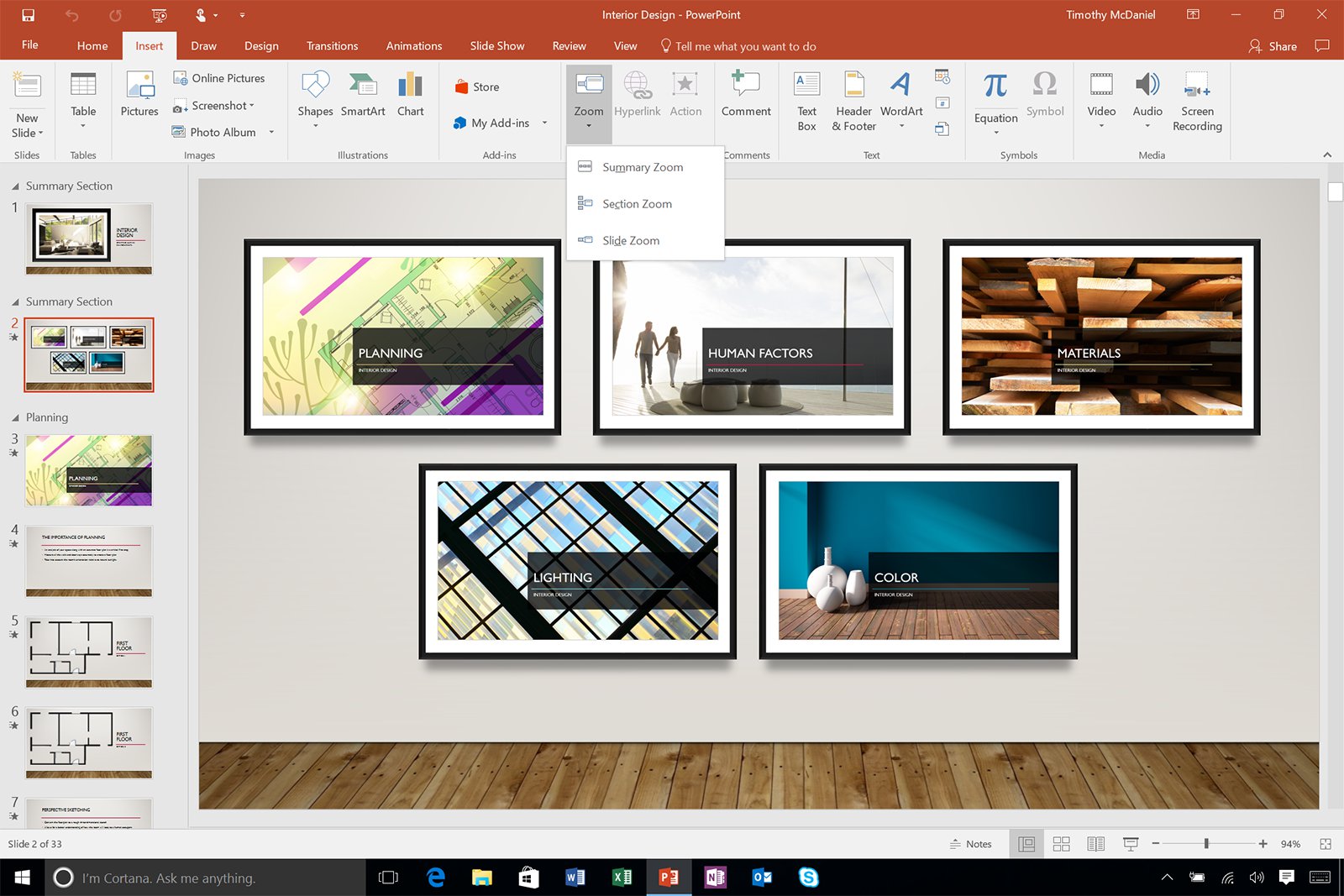
Finally, Microsoft is letting you create more flexible presentations in PowerPoint 2016 with a feature called Zoom. Instead of just stepping through slides in numerical order, Zoom lets you bounce around from a single summary slide, so you can tailor presentations to specific audiences. You can also create Zoom slides to step through sections of your presentation. The feature will be available to Office Insider users on desktops today.
Source: Microsoft
Android will now automatically send your location to 999 operators
When you call 999, operators need to know exactly where an emergency is before they can dispatch the required service. That information can be difficult to share if you’re in unfamiliar surroundings but a new update coming to Android will take all of the guesswork out of locating where you are. It’s called the Emergency Location Service and it uses available WiFi connections, GPS and mobile masts to pinpoint your location and share it with an operator while you’re speaking with them.
Google says that it isn’t in the business of collecting location data and that it’s new feature is “solely for the use of emergency service providers.” It is only sent when you make an emergency call, either directly to an operator or via your mobile network. The good news is that EE, BT, Three, Vodafone and O2 are all on board at launch.
Because the feature is enabled via a Google Play Services update, 99 percent of existing Android devices (Android 2.3 and up) are capable of supporting the Emergency Location Service. It’s already live in the UK and Estonia but Google says it is “actively engaging with more countries and operators” to make it available in new territories.
Source: Google Europe Blog

