


Nissan may stop making its own electric car batteries
Nissan has long made its own electric car batteries thanks to Automotive Energy Supply, its team-up with NEC, but it appears to be having second thoughts. Sources speaking to both Nikkei and Reuters understand that Nissan plans to sell its controlling stake in AES, with NEC likely following suit. It’d just be less expensive to buy batteries from an outside supplier, according to tipsters. While it’s not certain who would snap up the business, the car maker is supposedly in talks with both Panasonic and “overseas companies” that include Chinese firms.
You won’t get Nissan to confirm the rumor any time soon: while it’s not denying the reports, it says they’re “speculation” and “not based on any announcement.” NEC and Panasonic aren’t commenting, either. A sale would make sense, though: the lithium-ion battery market is getting increasingly competitive at all scales, prompting even giants like Sony to sell to companies that can afford to cut costs and run on thinner profit margins.
If Nissan and NEC do jump ship, the potential buyer could have a lot of clout in the electric transportation world. Panasonic already has a close partnership with Tesla on car batteries — it’d become a powerhouse if it could scoop up the business of another big EV pioneer. Non-Japanese companies, meanwhile, could use this to get a leg up when supplying BYD and other automakers determined to ditch gas-powered cars. If there’s any truth to the rumors, you’ll see the repercussions for a long time to come.
Source: Nikkei, Reuters
Which monitors are worth buying?

With all the work you do, the games you play and the videos you watch, you spend a lot of time staring at your monitor. So why not do your eyes a favor and make sure you get one that’s got exactly what you need, whether it’s precise colors, fast response time or just a pleasing design? We’ve delved into some of the better monitors currently on the market to let you know which ones give you the best view for the money.

Best of CES 2015 Awards, PC: Lenovo LaVie HZ550
#fivemin-widget-blogsmith-image-431162display:none; .cke_show_borders #fivemin-widget-blogsmith-image-431162, #postcontentcontainer #fivemin-widget-blogsmith-image-431162width:570px;display:block;
 trydocument.getElementById(“fivemin-widget-blogsmith-image-431162″).style.display=”none”;catch(e)
Lenovo typically brings a lot of new product releases to CES. And it did it again in 2015. However, there was one particular highlight: a 13-inch laptop with top-end specs, but somehow weighing in at 1.7 pounds.This is Lenovo (and NEC’s) slender LaVie HZ550. For reference, that’s 43 percent lighter than the latest MacBook Air — and in person you’d think it was a dummy laptop shell. Despite that, the laptop still packs fifth-generation Intel Core processors: It’s got muscle too. Was it the best PC we saw at CES? We think so, yes.
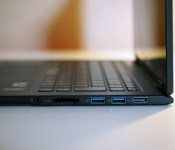
Lenovo’s skinny new ultraportable claims to be the lightest 13-inch laptop

It’s impossible to convey in a photo how light Lenovo’s new ultraportable, the LaVie HZ550, is. So instead I’ll say this: When I first picked it up, I was sure I was handling a prototype; some sort of dummy unit without any actual components inside. In fact, though, the HZ550 is very real, and at 1.72 pounds, it’s stupidly, record-breakingly compact; in fact, Lenovo claims this is the world’s lightest 13-inch laptop. What’s more, the company just announced what it says is the lightest 13-inch convertible notebook: a machine called the HZ750, which has a 360-degree hinge that allows it to fold back into tablet mode. At 2.04 pounds, it’s lighter than any laptop with a touchscreen and rotating hinge has the right to be. Either way, even in a field of increasingly skinny notebooks, both of these stand out.
But let’s back up for a minute. If the name “LaVie” rings a bell, it’s because it was originally the brainchild of Japanese computer maker NEC, which is already known in its home country for making some pin-thin noteoboks. For four years, the two companies have been building laptops together as part of a joint venture, a deal that has allowed Lenovo to take a bite out of the Japanese PC market, the fourth largest in the world. What we’re seeing now, though, are the first machines NEC and Lenovo are planning to sell outside the land of the rising sun. So while laptops this thin might already be commonplace in Japan, they’re likely to be received in the United States as something of an oddity.
And odd they are. Not just because they’re thin and light, mind you, but because they’re actually quite powerful. Under the hood, you’ll find surprisingly muscular parts — none of this low-powered Core M business, but full-fledged fifth-generation Intel Core processors. Battery life, meanwhile, is rated for somewhere between seven and eight hours of video playback, which, if true, would put it on par with some significantly thicker and heavier laptops. An impressive thing, that — especially since both machines will be offered with 2,560 x 1,440 screens. It isn’t easy achieving long battery life when you have to light up quite that many pixels.
The two LaVies also surprisingly sturdy, considering how insubstantial they feel in the hand. That’s largely thanks to a magnesium-lithium alloy, which makes the machine light, but nigh on impossible to bend in your hand. In addition, Lenovo had to get creative with the display. According to the company, the HZ750’s touchscreen is directly bonded, and uses film instead of cover glass. Additionally, Lenovo used one of Sharp’s IGZO displays, which at least partially explains those big battery life claims — after all, Sharp panels are known for being energy-efficient.
On paper, then, at least, the LaVies seem like the ultimate no-compromise machines: super thin, super light and still very powerful, with long battery life, to boot. If there are any tradeoffs we can glean just by looking at the spec sheet, it’s that the HZ550 — the 1.72-pound machine — doesn’t have a touchscreen. Meanwhile, the HZ750, the one with the 360-degree hinge, can’t pull off quite as many poses as the Yoga line. In this case, you can use it as a notebook (natch), or fold it back into tablet mode, but you’d be putting it into Stand or Tablet mode at your own risk. The reason: The HZ750 is missing the sort of rubber bumpers you’d typically find on a Yoga. Because rubber bumpers make a machine thicker than it needs to be, don’tcha know. Interested? These arrive in May, and yes, they’re priced like the no-compromise machines they are: $1,299 for the HZ550, and $1,499 for the HZ750.
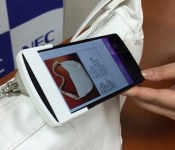
NEC wants you to spot counterfeits using your phone’s camera

Want to find out whether or not something at the street market is a fake? In the future, you might only have to snap a photo with your smartphone. NEC has developed “object fingerprint” technology that compares the tiniest details of an object (such as the metal or plastic grain) with images in a cloud database; if something doesn’t look quite right in that cut-rate handbag, you’ll know right away. It’s useful beyond piracy, too. You could trace the origins of legitimate items, or make sure that repair crews are using the right parts.
The technology isn’t perfect. You’ll need a macro lens (including one that NEC plans to release) to get the necessary high-detail shots. The Japanese firm also hasn’t said whether or not you’ll have easy access to its anti-counterfeit tool, although that partly depends on its negotiation skills; it’s hoping to partner with other companies to make the phone-based scanner a reality by March 2016. If all goes well, though, you’ll always have a way to spot black market goods.
Filed under: Cellphones, Mobile
Via: PCWorld
Source: NEC (translated)

UK police begin trialling the world’s fastest face recognition tech

With more than six million CCTV cameras in operation, Britain is the most watched country in the world. London’s police officers are trialling body-worn cameras to help bring about “speedier justice,” but only now are other forces beginning to find efficient ways to process that surveillance. Leicestershire Police today confirmed it has become the first force in the UK to test NEC’s NeoFace face recognition software, which it hopes will “transform the way criminals are tracked down.” NeoFace’s strengths lie in analysing “dozens” of facial features from digital images captured by CCTV or police body cameras and matching them with the 90,000 photos stored on Leicestershire Police’s database.
Because processing only takes a matter of seconds (NeoFace ranks number one in independent face matching speed and accuracy tests), it stands to eliminate the need for officers to manually search for possible matches, which can take hours. Although the face recognition tech is only now making its UK debut, it has already proved invaluable in the US. Just last month, the Chicago Police Department used the system to sort through 4.5 million booking photos to help convict a suspected armed robber. Unfortunately, Leicestershire Police can’t submit NeoFace’s findings as evidence in court — instead it’ll serve as a useful tool to detect possible suspects (and also their family members) and develop new lines of enquiry.
Filed under: Software
Via: The Next Web
Source: Leicestershire Police

Facial recognition software helps convict a robber

Watch Dogs‘ vision of a super-connected Chicago may be truer than you think. A local judge has convicted Pierre Martin of armed robbery after police used facial recognition software (NEC’s NeoFace) to match surveillance camera footage with an existing mugshot. While the cops still used witnesses to confirm their findings and make an arrest, the technology was vital to pinpointing Martin in the first place — it’s doubtful that investigators would have had time to sift through 4.5 million booking photos.
If you’re thinking that the conviction has a slightly Orwellian vibe, you’re not alone. However, it’s notable that Chicago’s software is only really useful for catching repeat criminals who already have a database presence, like Martin; it won’t help with first-time arrests. That tidbit won’t be completely reassuring given ongoing concerns about a surveillance-happy US government, but it’s now clear that the system can at least prevent habitual offenders from slipping through the cracks.
Filed under: Science, Software
Via: Sky News
Source: Chicago Sun-Times
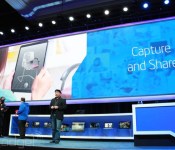
Intel unveils RealSense hardware and software line, including 3D camera module

The takeaway at today’s Intel press event? All signs point to the RealSense product line — a number of hardware and software products that “make interaction with technology simple, more natural and immersive,” according to Intel’s own words. The first product bearing the compound name is the RealSense 3D camera. Intel describes the product as “the world’s first integrated 3D depth and 2D camera module that helps devices ‘see’ depth much like the human eye,” suggesting that this isn’t just a substitute for Leap Motion or Kinect.
The camera does full-color 1080p and has an on-board sensor for gesture and face detection. The latter of which apparently helps it “understand emotions.” It also recognizes foregrounds and backgrounds, so you can replace that messy room and make it appear as if you’re Skypeing from the Moon. But, if you’re looking for something more practical, you can also use it to scan objects in 3D using 3D System’s Sense software. The RealSense 3D camera is set to be integrated into a number of diverse devices come the second half of this year, including tablets, Ultrabooks, laptops and all-in-ones, from top companies like Acer, ASUS, Dell, Fujitsu, HP, Lenovo and NEC. Seven such devices are being demonstrated today, and Intel itself has a demo unit.
If you’d rather talk to your computer than wave at it, there’s also a next-generation version of Dragon Assistant from Nuance that will be part of Intel’s RealSense push. Of, course, while all this sounds good on paper, it remains to be seen how much people will actually want to wink, point or shout at their laptop to get it to open Netflix or point Chrome towards Engadget.
Filed under: Cameras, ASUS, Intel, HP, Dell, Acer, Lenovo
Source: Intel
NEC dual-screen Android Cloud Communicator LT-W tablet first look
 At CES, NEC has unveiled a hinged Android tablet with dual screens. NEC is not specifying if this is an all-work or all-fun tablet, it’s kind of in between. They suggest that it could make a great e-reader, a digital notebook for students, or whatever developers come up with. The “Cloud” part of the “Cloud Communicator” name means that NEC thinks the LT-W would be great for generic cloud services, but really, it’s just an Android 2.1 tablet with WiFi, Bluetooth, and optional 3G — there’s nothing special in here that makes it particularly well-adapted for magically pulling data out of the cloud.
As for the “Cloud Communicator” part of this tablet’s moniker, NEC is saying that this tablet would be great for generic cloud services. Other details on the LT-W; it’s running Android 2.1, interacts with a stylus, supports Wi-Fi connectivity, and optional 3G connectivity.
 AIVAnet