


Moto E LTE (2015) Review: The perfect budget phone

Last year Motorola released the Moto E, a phone that was built to last and priced for all. We found it to me a fantastic phone for the money, but with all technology, things continue to evolve, and Motorola has upgraded just about every spec on the device for 2015. Based on the suggested retail, the LTE version should cost a little more ($20) than last year’s $129 price point, but you can find it for much lower.
Is the new Moto E a worthy upgrade? Well I have spent a little over a week with it so let’s find out.
Design
At first glance, you might not be able to tell the difference between last year’s model and this year’s model. They did upgrade the display from 4.3-inches to 4.5-inches so it’s slightly bigger, but it has the same overall design. At the front, you will notice that the lower microphone is no longer covered with silver trim, which gave us the false impression that the Moto E sported stereo sound. Also at the front, you will notice a front-facing camera at the top right, which was something that the original did not have.
The back looks identical to it’s predecessor, but there is one big difference. The back plate is no longer removable. This means that you can no longer change the color of it via Moto Shells, but there is still the ability to customize. You are able to snap out the accent side band and swap it with what’s called a Moto Band, adding a little color.


The first question I had was why not offer both customizable Moto Bands and the Moto Shells? My guess is that since the Moto E is geared towards emerging areas or those on a very strict budget, it’s unlikely the consumer would be able to afford all sorts of accessories like that. The Moto Bands might be a little too subtle based on what Motorola has done in the past, but it’s now more affordable. They offer six colors, but they are in sets of three (Turquoise, Purple, Raspberry or Red, Blue, Golden Yellow), So for $19.99 you get three colors, and you can swap out the color as often as you like depending on your mood. Changing the entire back plate might be a little more fun, but the Moto Shells cost $14.99 for each color. It might not seem like it, but Motorola is offering more customization at a lower cost.
The Moto Bands are easy to remove. You will find a tiny slot at the bottom left back of the phone. Just pull up on it, and it will snap right off. It’s kind of weird because you think the whole back is going to come off, but only the Moto Band does. The Bands have the silver buttons for power and volume that fit over the the main buttons of the device. Removing the band also reveals the microSD slot and nano SIM slot, which reside on the left side. If you get the dual-SIM version, you will find the second slot on the right side.


The Bands fit perfectly and most people would never know that it was removable. It just looks like it’s part of the phone. That’s a result of Motorola’s fantastic engineering, which they have demonstrated very similarly with Moto Shells on the Moto G and last year’s Moto E.


As far as overall design goes, this phone isn’t going to knock your socks off. It’s not a premium flagship phone so it’s not supposed to. However, this phone is far from chintzy, and just like it’s predecessor (and every other Motorola phone) it’s solid and feels like every attention to detail was made.
Hardware
The Moto E features a 4.5-inch qHD (960 x 540) IPS LCD display (245 ppi), a 1.2 GHz dual-core Qualcomm Snapdragon 200 (3G model) or a 1.2 GHz quad-core Snapdragon 410 (LTE model), Adreno 302 GPU (3G model) or Adreno 306 GPU (LTE model), 1GB of RAM, 8GB of internal storage, microSD slot for up to an additional 32GB of storage, 5 MP rear camera (4:3) with 720p video capture, VGA front-facing camera, 2,390 mAh battery, WiFi 802.11 b/g/n, and Bluetooth 4.0 LE.
Bands by Model:
Moto E with 4G LTE – US GSM (XT1527) AT&T / T-Mobile
GSM/GPRS/EDGE (850, 900, 1800, 1900 MHz)
UMTS/HSPA+ (850, 1700 (AWS), 1900 MHz)
4G LTE (2, 4, 5, 7, 12, 17)
Moto E with 4G LTE – US (CDMA) – Sprint / Verizon
GSM/GPRS/EDGE (850 / 900 / 1800 / 1900 MHz)
WCDMA (850 / 1700 / 1900 MHz)
CDMA (800 / 850 / 1900 MHz)
4G LTE (750/850/1700/1900 MHz)
Moto E – US GSM (XT1511):
GSM/GPRS/EDGE (850, 900, 1800, 1900 MHz)
UMTS/HSPA+ (850, 1700 (AWS), 1900 MHz)
Moto E – Global GSM (XT1505):
GSM/GPRS/EDGE (850, 900, 1800, 1900 MHz)
UMTS/HSPA+ (850, 900, 1900, 2100 MHz)
Performance
The processor has been upgraded from a Qualcomm Snapdragon 200 to a Snapdragon 410 (LTE-only). What this means is that it’s now quad-core, but it’s also more efficient. I didn’t have too many issues with last year’s model. Yes it would occasionally hang, but I didn’t think anything of it with the price point. This year’s model comes with Lollipop out of the box and the quad-core might add a little more punch, but it wasn’t that noticeable.
The display resolution is the same at qHD (960 x 540), which seems so 2011, but at 4.5-inches it gets the job done. I personally think displays are becoming overrated with each passing day. Manufacturers keep pushing the envelope, and in most cases, the average consumer doesn’t see the difference. The colors on this phone might not pop as much as say the Galaxy S5 or Galaxy S6, but I don’t think the demographic is looking for that either.
I should also note that the internal storage has been bumped to 8 GB from 4 GB. Still not a lot, but there is a big difference between 8 and 4, trust me. You also have the option of inserting a microSD card of up to 32GB for plenty of pictures, music, and video.
Battery
The battery gets a significant upgrade, from 1,980 mAh to 2,390 mAh. If there was one issue I had with last year’s Moto E, it was the battery, but it looks like Motorola has fixed this. The bigger battery obviously helps, but the Snapdragon 410 being more efficient is also a factor. I ran my usual video rundown test in which I loop video constantly while connected to LTE (3G last year) to see how fast the battery depletes. Last year’s model was only good for about 6 hours, which is pretty dismal. This year’s model was a lot better lasting 10 hours and 23 minutes. Now we know that the average Joe isn’t running video all day, but this test gives us a clearer indication on how good the battery is. In everyday life with moderate use, you will have no problem going from wake up to bedtime. Motorola promises 24 hours, but I see it more like 16 to 20 with moderate use.
Software
The Moto E sports Android 5.0.2 Lollipop out of the box and the best part of it is that it’s fairly stock as in Motorola has barely skinned it like other manufacturers such as Samsung and HTC. They do make some subtle changes here and there though. For example, when you first power on the phone, the stock Lollipop restore apps feature has been replaced with Moto Migrate, which is Motorola’s own app for restoring apps, contacts, music, etc. from a previous phone to a new phone. Most of everything else is just like a Nexus device right down to the Google Now Launcher.
Probably the best part of the overall software is that Motorola was able to include more of their proprietary features on this year’s Moto E. For example Moto Display is now available, which lets you see your notifications without turning on the entire display of the phone. You also get QuickCapture, which lets you open the camera app with a quick double twist of your wrist. The popular Moto Assist and Moto Alert return as well. Assist allows you to set certain functions for when you’re sleeping or in a meeting (from your calendar). Moto Alert allows you to share your location to others. I have include videos below of Moto Display (from the Moto X 2014), Moto Actions (from the Moto X 2014), and Moto Alert (from the Moto E 2014).
Click here to view the embedded video.
Moto Actions (Note: the Home and Driving functions as well as the Wave To Silence and Approach for Moto Display are not available on the Moto E)
Click here to view the embedded video.
Click here to view the embedded video.
Motorola has done a great job with offering apps that are actually useful rather than serve as bloatware. That’s something that you can’t say about other manufacturers. Throw in Lollipop, which is the most recent version of Android, and you have a winner.
Camera

What can you expect from a camera that’s on a phone that costs only $149? Certainly not award winning, but it more than gets the job done when there is a decent amount of light. It actually does a decent job in low light, but expect a lot of noise. I should also note that there is no flash for those really dark shots. The rear camera will give you 5 MP if you set it to 4:3. However, you will only get 3.7 MP in widescreen mode, which happens to be the default. The front-facing camera was non-existent on the original Moto E so it’s nice to have it here, however it’s only VGA (640 x 480).
The software is pretty much identical to what you will find on other Motorola phones. It’s a very simple interface in that when you swipe to the left, you will get to the Gallery and swiping to the right will bring up the Camera Settings. You won’t find all that many settings to tweak as this software is meant to just point and shoot. Speaking of that, you can tap anywhere on the display to capture a photo, which makes it so much easier. As I mention earlier, you can use QuickCapture to open the Camera App quickly by double shaking your wrist (even when the display is off). For a $149 off contract phone with LTE, I was happy with the overall performance.
Here are some example shots in a variety of situations.
Outdoors


Low Light


Closing
The suggested pricing for the Moto E (2015) is $149 for the LTE version and $119 for the 3G version. However, you can find the LTE version for as low as $99 on Verizon and Boost Mobile/Sprint Prepaid. Yes, there are other inexpensive phones out there, but those are generally from lesser known companies or the specs aren’t as good. The Moto E is made from Motorola, one of the pioneers of radios and cell phones. I was buying Motorola phones back in the early 1990’s so there is a lot of history there. If you’re going to buy a budget phone, doesn’t it make sense to buy one from a trusted and known company like Motorola? Now don’t get me wrong. The Moto E isn’t just about the brand because buying on brand name alone isn’t worth anything unless it’s backed up with a great product. The Moto E isn’t the perfect phone, but it’s probably the perfect budget phone. It not only makes sense for developing countries, but it’s also perfect for seniors and children.
Motorola took what was already great and made it into something even greater. You can’t go wrong with that in my book.
Come comment on this article: Moto E LTE (2015) Review: The perfect budget phone
Verizon launches Sapphire Blue Ballistic Nylon version of the DROID Turbo

Another color option of the Motorola DROID Turbo has made its way to Verizon. The carrier announced today the availability of the handset in Sapphire Blue Ballistic Nylon.
Right now, customers of Verizon can purchase the very capable handset in this new color option for $199 with a two-year contract or $24.00 per month when using the carrier’s Edge program. The latter choice spreads payments of the full retail price over twenty-four months. Verizon also notes that customers can get $100 bill credit when a new smartphone is activated on its Edge program. Those who go for the two-year contract option can hand over their current smartphone and receive the same amount.
We agree in saying that “Sapphire Blue Ballistic Nylon” is likely one of the longest names possible for a color option.
Source: Verizon
Come comment on this article: Verizon launches Sapphire Blue Ballistic Nylon version of the DROID Turbo
Verizon offering Sapphire Blue Ballistic Nylon version of Droid Turbo
Verizon announced the Motorola Droid Turbo in Sapphire Blue Ballistic Nylon earlier today. It can be purchased online or in stores for $199.99 on a two-year contract or $24.99 a month for 24 months on Verizon Edge.
Also of note: customers will receive a $100 bill credit with every new smartphone activated on Verizon Edge. This also applies to trade-ins of decently functional, old smartphones for the purchase of a Droid Turbo.
The post Verizon offering Sapphire Blue Ballistic Nylon version of Droid Turbo appeared first on AndroidGuys.
Moto E LTE (2015) now available on Verizon Prepaid for $99

If you’re looking for a great deal on a prepaid phone, than look no further than the Moto E LTE (2015). It’s now available at Verizon for only $99 complete with Verizon branding. That’s $99 without a contract. Let me repeat…..That’s $99 without a contract.
The Moto E is no kids toy either as it sports a 4.5-inch qHD (960 x 540) display, a quad-core Snapdragon 410, 1 GB of RAM, 8 GB of internal storage, microSD for up to an additional 32 GB of extra storage, 5 MP rear camera, VGA front-facing camera, 2,390 mAh battery, and Android 5.0.2 Lollipop right out of the box. Plus, it’s compatible with Big Red’s fast 4G LTE network. You simply cannot go wrong.
It looks like they only have the black version, but don’t forget that you can change that accent color with Moto Bands.
Our full review should be posted later today, so be sure to check that out as well. In the meantime, check out our hands on and first impressions video below….
Click here to view the embedded video.
source: Verizon
Come comment on this article: Moto E LTE (2015) now available on Verizon Prepaid for $99
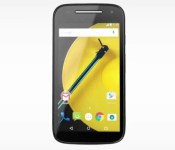
Moto E (2015) 3G now available in India for Rs. 6,999

The low-end war is heating up in India, land of Android One and Yureka Yu. The latest salvo comes from Motorola, which just launched the 3G version of the new Moto E for just Rs. 6,999.
Lunched on February 25, the second generation of the Moto E ups the specs but keeps the same low price tag that made its predecessor stand out in the crowd. The 4.5-inch device is now making its way to India, and the fact that it took Motorola just two weeks to bring it here speaks volumes of how important is India to the Lenovo-owned company.
The Moto E (2015) is now available through Flipkart in black or white, at a price of Rs. 6,999 (about $110). According to the listing, this is an “introductory offer price” valid for the initial batch, so you may want to make up your mind fast.
While the Moto E (2015) packs LTE in some other markets, the version selling on Flipkart is 3G-only. Other specs include a 4.5-inch 540 x 960 pixels screen, a quad-core Snapdragon 200 processor, 1GB of RAM, 8GB of expandable storage, and a 5MP rear camera.
The new Moto E will go up against similar priced Android One offerings, from local manufacturers like Lava, Spice, and Micromax. The latter is also offering the Cyanogen-powered Yureka, through its Yu sub-brand, though the 5.5-inch Yureka is in a somehow different class and costs around $140.
India has become a key market for Motorola; the two generations of the Moto G, in particular, did really well here, and the fast release of the cheaper Moto E (2015) suggests Motorola is eager to grab even more share, at the cost of thin margins. But it’s not just low-end – the mighty Moto Turbo arrived in India earlier this week, following its debut in Brazil, another focus of Motorola.
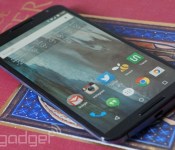
Google’s Nexus 6 will finally reach Verizon on March 12th

Yes, the rumors were true — after a months-long wait, Verizon has confirmed that it’ll launch the Nexus 6 on March 12th, with stores picking it up on March 19th. The Google-powered phone will still be relatively expensive, at $250 on a two-year contract or $27 per month on Edge, but you will get both HD voice calling (Android 5.1 comes standard) and a free 6-month subscription to Google Play Music All Access for your trouble. Is it worthwhile at this point? That’s hard to say. This is still the latest and greatest Android flagship phone, but there’s no question that Verizon missed the boat, as it sometimes does. If you wanted a relatively pure Android experience on Big Red, you probably bought a Droid Turbo or Moto X last fall.
Filed under: Cellphones, Mobile, Google, Verizon
Source: Verizon
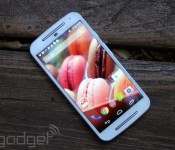
Motorola’s best budget smartphone just got even better

It’s no surprise that the Moto G is the bestselling smartphone in Motorola’s history — it’s always had solid specs and featured a class-leading display. Perhaps the only complaint that can be levelled at it is the fact that neither the first or second generation handsets launched with 4G support. That isn’t to say Motorola isn’t including it, it’s just that it takes a while. Now, finally, the company is making the best budget phone you can buy even faster.
The Moto G with 4G comes unlocked and you can pick one up direct from Motorola’s website right now for £159. That’s nearly ten pounds less than its 3G counterpart. It’ll also be available to by from Tesco, Carphone Warehouse, Amazon, Argos, Sainsbury’s and Asda from March 16th. Although the second-generation Moto G is available to buy in the US, there’s no LTE support for now, meaning you’ll have to wait a little while longer to get your hands on Motorola’s bestseller.
Filed under: Cellphones, Mobile, Google
Source: Motorola
Moto 360 goes live on Moto Maker with various cases, bands and watch faces
Motorola announced this morning that the Moto 360 can now be ordered and customized through Moto Maker. The addition of the Android Wear powered watch gives you the ability to choose from the three cases, dark metal, light metal or champagne gold. After you choose your case you have nine watch bands to choose from […]
The post Moto 360 goes live on Moto Maker with various cases, bands and watch faces appeared first on AndroidSPIN.
Cricket Wireless to offer the new Moto E on March 13th for $129.99
Motorola has certainly been on a push to cover as many carriers as possible with at least one device. Recently the newly acquired Motorola announced the 2nd gen Moto E packing above average specs, Android 5.0 Lollipop and a price tag that is hard to ignore. We know the pre-paid side of Sprint, Virgin Mobile […]
The post Cricket Wireless to offer the new Moto E on March 13th for $129.99 appeared first on AndroidSPIN.
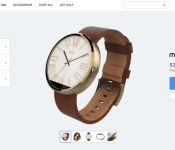
You can now customize your Moto 360 using Moto Maker

Months after leaks, Motorola has finally enabled Moto Maker support for the Moto 360 smartwatch. Customers can pick any combination of bands and body when purchasing the wearable, offering a unique customization experience like no other.
Available body variants include Light Finish and Dark Finish which are both offered for the base price of $249.99. The Champagne Gold unit will cost an additional $30 at $279.99. As far as the bands are concerned, you can get the 23, 24 and 18mm metal bands for an extra $50. The 22mm Stone Leather, Black Leather and Cognac Leather bands are offered for free. So you can get a Champagne Gold body and combine it with Cognac Leather band for just $279.99.
The 24mm metal mono link band will reportedly have delayed shipping, but all the other bands appear to be in stock. The options here are not as versatile as the Moto X, but it’s a welcome addition to allow customers to pick their own materials and design. Hit the links below for more details.
Source: Motorola Blog, Moto Maker
Come comment on this article: You can now customize your Moto 360 using Moto Maker
 AIVAnet