


Action Launcher brings Google’s rumored Android tweaks early
Why wait for Google’s rumored Pixel / not-Nexus phones, when you could use some of their software right now? The latest release of Action Launcher has arrived, and it cribs some of the features noted in Android Police’s leak of the software Google is apparently preparing for its Android devices. According to its developer Chris Lacy, the new release is entirely inspired by the leaks. The reason? As soon as Google makes a change, many of his users request similar features in Action Launcher, but this time, he’s getting out ahead of the curve.
I’ve been trying out the latest version of the app and honestly, I still think the QuickBar widget that brought apps to the search bar is more useful than the Google Search button / weather widget / swipe up dock combo. There are also “Nougat-inspired” outlined folder presets, and the folders themselves can get backgrounds that match your wallpaper. Lacy figures Google will eventually move on from this UI too (remember when it pushed Lollipop tweaks to older devices via the Google Now launcher?), but at least this way you can give it an early shot.

Along with the other new tweaks, it’s available now in the Play Store, but unlocking everything takes a $5 in-app purchase.
Source: The Blerg, Action Launcher (Google Play)
After Math: Los dos
This week has been a one-two punch of tech news. Sony and Apple both debuted a pair of new devices, Microsoft teased the next iteration of its 2-for-1 Surface laptop-tablet and GE dropped big bucks on two 3D printing firms, to name a few. Numbers, because how else will you identify the dichotomies?
Google fixes two serious Android security flaws
Google’s mobile security team has definitely been busy cleaning house this week. The company has released an Android update that closes two security holes that could pose a major threat if intruders found a way to exploit them. The first was only designed for “research purposes” and would only have been malicious if modified, Google tells Ars Technica, but it wouldn’t have been hard to detect or weaponize.
The other flaw behaved similarly to the well-known Stagefright exploit, letting an attacker send an altered JPEG image through Gmail or Google Talk to hijack your phone. The issue, as SentinelOne researcher Tim Strazzere explains to Threatpost, is that it’s both easy to find and capitalize on this vulnerability.
There’s more. Security company Check Point also revealed that Google Play had been hosting apps containing two forms of malware (CallJam and DressCode). CallJam both steered phones to websites that made bogus ad revenue and, if you granted permission, would call paid phone numbers. DressCode would also visit shady ad sources, but it could also compromise local networks. Google has since removed the offending apps, but the infection rate may have been high when users downloaded the software hundreds of thousands (or in a few cases, millions) of times.
While the likelihood of running into this malware is relatively small, it underscores an issue with timely Android security updates. Only Nexus owners get first crack at the fixes — most everyone else will have to wait, provided they’re in line in the first place. Google’s monthly security updates help, but this won’t do much if your phone maker either hasn’t committed to those updates or has left you running an older Android version that can’t get those patches. You may have to either be patient for a more conventional update or move to a newer device if you’re determined to stay current.
Via: Ars Technica, Threatpost
Source: Android, Project Zero, Check Point (1), (2)
The best places to buy and sell a used iPhone
By Jackie Dove
With a new iPhone arriving soon, many people will look to sell their old iPhone for some quick cash. But which places offer the best return and the smoothest process? To find out, Tom’s Guide tested seven services that buy and sell used iPhones.
To find out where you can expect the best return on your dollar, we bought an iPhone from each reseller service and then turned around and re-sold that phone to same service where it came from. We also rated each service on their convenience, ease of use and responsiveness to come up with our rankings.
The key takeaways from our testing:
- Glyde and Swappa top our rankings of the best places to buy and sell a used phone.
- Walmart and Best Buy finished at the bottom.
- We resold our iPhones for an average of 52 percent of what we had paid for them.
- We got the highest rate of return from marketplace services that connect smartphone buyers with sellers; the worst return came from big-box retailers.
How we tested
To best measure how much return you can expect from iPhone resellers, we selected services that both buy and sell used iPhones, evaluating seven. In addition to Glyde and Swappa, we also looked at Amazon, Best Buy, GameStop, Gazelle and Walmart. We bought a used iPhone from each service, and then — without activating or using our newly purchased phone — sold the same model back to the seller where we purchased it.
From most resellers, we bought a 16GB iPhone 6. We purchased a 16GB iPhone 6 Plus from Amazon and GameStop due to availability issues, though we stuck with iPhones released in 2014 to get comparable quotes from resellers. Also, due to availability, some of the iPhones we purchased were tied to specific carriers, which we’ve noted below. In our experience, unlocked phones not tied to any one carrier generally fetch higher prices (though AT&T and Verizon phones have a high resale value, too).
MORE: The Best iOS Apps You’re Not Using
As you might expect, there’s a gap between what resellers will charge you for an iPhone and what they’re willing to pay out when you try selling that same phone back. Just like with cars that depreciate the moment you drive them off the lot, that iPhone you’re hoping to unload will never recoup its value. In our testing, resellers make their money by buying low and selling high.
When ranking these seven services, in addition to measuring how much we got back when reselling an iPhone, we also took the entire process into account. Were the instructions easy to follow? How quickly did it take to get a quote on our iPhone? Did the reseller offer cash or store credit? And how promptly did we receive that cash or credit after completing the sale?
Glyde: Our top pick
What we bought: Space Gray iPhone 6 (AT&T)
What we paid: $359.50
What we got back: $265.60
Rate of return: 74 percent
Cash or credit: Cash and bitcoin
Pros: Best rate of return; Clear explanation of policies with explicit breakdown of fees; Option to wait for a better price; Can verify your identity via PayPal; Flexible payment options
Cons: You’re not required to post a verification photo, a step that can help weed out scammers.

Glyde offers a straightforward, colorful and easy-to-navigate website where you can find an assortment of second-hand iPhones as well as Android models from Samsung, HTC, LG and others. To sell my iPhone 6, all I needed to do was select the website’s Sell tab and type in the phone’s model number, carrier, color and condition. Several questions from Glyde covered details about physical appearance and scratches, personalization, and whether I had included accessories like a power adapter and cable.
Note that prices can change, often from day to day. After trying a dry run, I went back to Glyde to re-enter information about the phone I was trying to sell, and the market price had dropped to $316 from $326.
The market price is what the buyer is going to pay, not the amount I would pocket. Glyde charges a 15-percent transaction fee, while a kit with packaging to ship off your phone will cost you $3. Glyde was the most transparent service when it came to spelling out fees. I wound up collecting $265.60. (That amount would have been $274.10 if I had stuck with the quote from my dry run.) That’s still the highest percentage of return from any vendor we tested, as we got back 74 percent of what we paid for the iPhone.
MORE: Upgrading to the iPhone 7? Read This Before You Do
While I was disappointed with the price drop over two days, I decided to take my profit immediately and hit the List for Sale button. From there, you type in information about the phone, enter your email and Glyde account password, and verify your identity with your credit card or PayPal account. Click the button, and your item is listed. You can post your listing on Facebook, Twitter and Google + right from Glyde’s page.
Two days after I listed my phone for sale, a buyer bit and then reneged within an hour; Glyde notified me via email about both events. The next day, another person offered to buy, which I quickly confirmed. A packing box arrived in the mail, with a prepaid label; all I had to do was drop the package into the nearest mailbox. Three days after the buyer receives and accepts the phone, Glyde posts the money into your account. From there, you can transfer the cash to your bank account, opt for Bitcoin payment or have a check mailed to you for a $2 fee.
Swappa: Runner-Up
What we bought: Space Gray iPhone 6 (Verizon)
What we paid: $465
What we got back: $325
Rate of return: 70 percent
Cash or credit: Cash
Pros: Posted items are approved quickly by Swappa; Ability to adjust listing; Solid rate of return; Added protection via PayPal purchases
Cons: Time-consuming process required for shooting photos of your phone; Agreeing to an immediate trade will lower your rate of return; Mandatory $10 PayPal transaction fee.

Swappa — as in “you wanna swappa?” — is an electronics website that features a fun interface for selling several dozen brands of phones, including Android devices as well as the iPhone. Just type in the specific search term to find the model you want to sell, and if it appears, you get an immediate idea of how much cash you’ll get.
My Verizon-tied iPhone cost $465, and from the site’s initial offer, I would have pocketed up to $307 in cash, which came to 66 percent of the total I paid for the device. Swappa also gave me the choice of selling my phone for from $340 to $559 if I wanted to wait for a better deal. I opted for a better return — and to take the deal, I had to register, either through Facebook or Google+ or via email and password.
It took longer to get my listing up on Swappa than it did with other sites. The process requires you to shoot a verification photo of the phone and its accessories using a specific, rather low-tech approach. You have to set up your shots with the site’s verification number handwritten on a piece of paper next to the phone, and then powerup the phone you’re reselling, so the screen is lit when you take your picture. You repeat the process with any included accessories. The idea is to prevent scams, and Swappa at least offers ample instruction on how to take your picture.
MORE: The Best iPhone 7 Carrier Deals
After I took the photos, Swappa took 15 minutes to verify and approve my entry. From there, it’s a matter of waiting for someone to buy your phone. If you’ve tried to get a higher price, you can revise your listing to Swappa’s lower price, which I did after waiting three days. The phone sold only after I settled on a new price: $335, which netted me $325 once I took into account a mandatory PayPal transaction fee.
That PayPal fee is the only cost — there’s no fee to sell on Swappa — and using PayPal to handle transactions felt safer than having to punch in credit card information. Swappa reviews and approves all listings before buyers can see them. Swappy promptly answered my questions about my listing when I sent queries via email and posted them to Swappa’s Facebook page. When my phone sold, I was notified that money had been deposited in my PayPal account, after which I had two days to mail out the phone.
As an extra added layer of protection, anyone who sells a stolen phone, or one with a damaged screen or water damage violates Swappa’s terms of use, giving buyers recourse through PayPal.
Gazelle
What we bought: Space Gray iPhone 6 (Verizon)
What we paid: $406
What we got back: $210
Rate of return: 52 percent
Cash or credit: Both
Pros: Quick and easy resale process; Multiple options for getting paid for your device; Inspection processensures quality selection of phones on sale.
Cons: Middle-of-the-road payment for trade-ins, compared to other resellers.

Gazelle has an attractive site that makes it easy to get started with your sale: The company trades in iPhones and Samsung Galaxy models as well as Android devices from HTC, Nokia, LG and others that cover the four major carriers.
If you take Gazelle’s offer on your phone, you have a choice of payment via Amazon gift card (which adds an extra 5 percent to your total), PayPal, charitable donation or standard check delivered within 10 days of Gazelle verifying the phone’s condition. Customers buy your phone from Gazelle, not you directly, and the company inspects the device before selling it as certified pre-owned to guarantee the condition. To ensure buyers are satisfied, there is a 30-day return policy.
After you enter your email address and a minimum amount of information about the phone’s brand, capacity and physical condition, you do not have to wait for a buyer — just accept the Gazelle offer, box up the phone and choose how you want to be paid.
As a reseller, Gazelle will appeal most if you want to unload your phone quickly and would like some options for how you’ll be reimbursed. We got back only half of the value of the iPhone we had bought, though.
Amazon
What we bought: Space Gray iPhone 6 Plus (unlocked)
What we paid: $549.99
What we got back: $265
Rate of return: 48 percent
Cash or credit: Amazon gift card
Pros: Process is clearly explained; Trade-in offer is immediate; Amazon offers free mailing label for sending in your phone.
Cons: Prices paid are fairly low; You’re restricted to store credit; Trade-in links can be hard to find.

To sell your old smartphone on Amazon’s massive website — which appears to sell a huge variety of almost every brand imaginable — requires an eagle eye and some clicking around to find the right path. In the end, typing the exact item into Amazon’s search box, clicking on a result and finding the trade-in link on the page was the quickest way to get an estimate.
For an iPhone 6 Plus that we bought for $549.99 from the e-commerce giant, Amazon offered $265 in trade — less than half of what we paid. While your phone’s appearance and condition may be acceptable to you, Amazon reserves the right to inspect the device and asks straightaway if you will accept a lower price or if you want the phone sent back if your price and Amazon’s don’t match. After my phone passed inspection, Amazon deposited the proceeds of my gift card directly into my account.
The company’s trade-in program offers an Amazon gift card in exchange for your used phone. If you don’t mind registering as an Amazon seller — which involves entering credit card and tax info — you can sell your phone on Amazon’s individual seller marketplace. But that’s a lot of hoops to jump through for a one-time sale, especially when the gift card can be used to buy any of the hundreds of thousands of things Amazon sells on its site.
GameStop
What we bought: Space Gray iPhone 6 Plus (AT&T)
What we paid: $459.99
What we got back: $240
Rate of return: 52 percent
Cash or credit: Both
Pros: Choice between cash or store credit; Simple process; In-store staff were helpful and professional during our testing.
Cons: Middling return on the value of our phone; Requires a visit to a brick-and-mortar store to complete your sale.
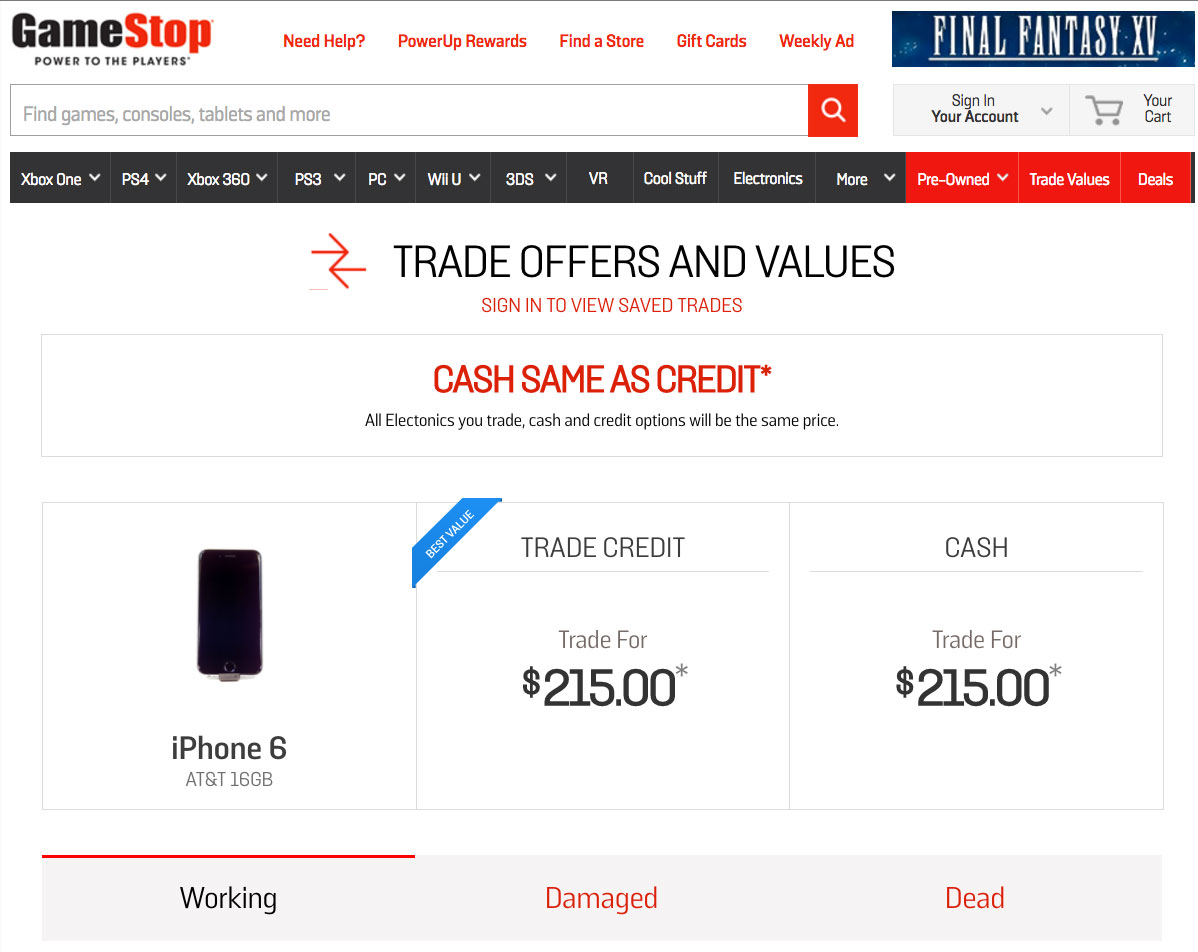
GameStop takes a different approach than other resellers because of its focus on games. While some resellers offer a mix of cash and credit, GameStop customers may be more inclined to trade in their phones for store credit in games, VR headsets and gaming systems, in addition to the refurbished iPhones and Samsung Galaxy models available on the GameStop site. The transaction is straightforward except for one thing: The final turnover of your phone for cash or gift cards must be done in person.
The website offers a list of the phone types GameStop accepts for trade. A working iPhone 6 Plus that has no missing parts, cracks or dents will trade or get cash totaling $240. That’s a little more than 52 percent of the $459.99 we had paid GameStop for the same phone the previous month. A damaged phone will trade for $95, while a dead phone gets $25.
My trade-in experience took just 15 minutes, as the pleasant and efficient clerk behind the counter tested the phone and looked up records. I walked out with a $240 gift card.
GameStop lets you search for stores within a 15-mile radius of your zip code. If there’s no retail outlet near you, you’ll want to turn to a different reseller.
Walmart
What we bought: Space Gray iPhone 6 (Straight Talk)
What we paid: $369
What we got back: $125
Rate of return: 34 percent
Cash or credit: Credit
Pros: Simple transaction requiring little information; Free shipping label supplied.
Cons: Very low return on resales; Limited to in-store credit.

You’ll find plenty of phones available for sale at Walmart, including contract, unlocked and refurbished phones available for the major carriers as well as the retailer’s in-house Straight Talk network. What you won’t find is the option to get cash back for your phone. It’s store credit and no negotiating.
It’s easy enough to go through the process, using the Gadgets for Gift Cards link. The used iPhone 6 we bought from Walmart netted a $125 offer, 34 percent of what we paid, which was the lowest return from any reseller. Interestingly, the phone was tied to Straight Talk. Had we tried selling back an unlocked phone or one tied to AT&T or Verizon, Walmart would have given us $160 in credit.
Once you approve Walmart’s appraisal, just log in to your account or create a new account with your email and mailing address. Walmart offers a printed label that you can use to pack up your phone and send it in. After that, just wait for your gift card to arrive via email, which it did within three days of receiving my phone.
Best Buy
What we bought: Space Gray iPhone 6 (AT&T)
What we paid: $599.99
What we got back: $208
Rate of return: 35 percent
Cash or credit: Gift Card
Pros: Trade-in process is simple, if you have no questions; Trade-ins at the store are handled efficiently by friendly staff.
Cons: Long wait times for answering questions on Best Buy’s 800-number; Low rate of return.

Best Buy has a busy website that features a vast variety of iPhones and flavors of Android phones for sale. But it’s still fairly easy to find the place to trade in your older iPhone. If you do, be prepared to accept payment in credit. Like Walmart and Amazon, Best Buy doesn’t deal in cash for phone trade-ins.
We paid $599.99 for an iPhone 6 that arrived in a sealed box (for an iPhone 6s oddly) but with no earbuds included, the only used phone we bought that was missing an item. That didn’t affect my trade-in price; when I turned in my iPhone for resale, the Best Buy clerk said I didn’t need to include accessories. But Best Buy’s offer was the second-lowest return from any reseller: just a $208 gift card, or 35 percent of what we paid for the iPhone.
MORE: Best Cellphone Plans for Your Money
Getting a quote from Best Buy’s website is simple enough. All I had to do was list the phone’s color, carrier and condition to get a trade-in value that I could redeem in person or by mail. Getting answers to questions proved more difficult. I called Best Buy’s toll-free number to ask about the missing earbuds and an issue with the phone’s IMEI number, and waited 20 minutes and through three transfers before I was told it would be a better idea to do my trade-in at a store. That took a much more efficient 15 minutes.
Other options
You don’t necessarily need to go through a reseller or e-commerce marketplace to unload your aging iPhone. Certainly, Craigslist offers the opportunity to find a willing buyer, and depending on your negotiating skills, you may be able to get a bigger return than you would from a reseller who’s going to offer you a set price.

That said, handling a sale on your own can be a hassle, and there’s always the risk of running into scammers. A reseller or reputable marketplace removes a lot of the headaches and potential risks.
If you’re planning on using the money you get from trading in your phone to finance the purchase of a new phone and you’re committed to a specific wireless carrier, you may want to see what that carrier will offer you for your old phone. Verizon offered us the best quote on an iPhone 6, with a $265 trade-in value. AT&T quoted us a price of $200 for a 16GB iPhone 6, while T-Mobile and Sprint offered $191 and $159, respectively. Those quotes assume a phone is in excellent condition, and the amounts can vary based on which carrier your old phone is tied to. You receive the trade-in value in the form of credit or a gift card.
Where to buy a used phone
Our testing of reseller services focused primarily on selling a used iPhone, because that’s where you’re likely to experience the greatest amount of variance, from the money you get back for your phone to the simplicity of the resale process. In contrast, shopping for a used iPhone from these sites is a pretty similar experience, though there are a few differences worth noting.

In terms of selection, you’ll generally find each service offers a wide degree of smartphone models and capacities. In our search for a used iPhone 6, we found that models tied to AT&T and Verizon were plentiful while T-Mobile and Sprint devices were in shorter supply. Amazon, Glyde and Swappa offered the widest range of phones in terms of carriers and capacities.
Used iPhone shoppers will find the best range of prices at Swappa, though lower-priced phones are likely to have been well-used. Glyde, Gazelle, GameStop and Amazon also offer attractive pricing on used phones depending on what model you’re looking for.
We found it easiest to shop for a used iPhone at Glyde and Swappa, which conveniently group iPhone models together, allowing you to drill down to the version you want. Despite its wide selection, Amazon offers very cluttered search results; type in iPhone 6, and you’re just as likely to get entries for the 6s, 6s Plus and 6 Plus as you are for the model you want. Walmart and Best Buy feature helpful filters for removing superfluous search results.
We should note that we ran into one quirk when buying our phones from Glyde and GameStop, though that’s likely a result of how we ordered our iPhones. Because we bought our phones through our corporate office and shipped them to an editor at another location, both Glyde and GameStop flagged our initial purchases, requiring us to set up a PayPal account to complete the deals. Most shoppers won’t run into that problem, though it could flare up if you’re buying a used phone as a gift for someone who has a different address than yours.
More from Tom’s Guide:
- Walmart, Best Buy Offer Worst iPhone Trade-in Deals
- The Best and Worst iPhone Trade-In Deals
- iPhone 7 vs iPhone 7 Plus: What Should You Buy?
- Why You Shouldn’t Get the iPhone 7
- iPhone 7 Camera Tech: Can Apple Be the Best Again?
Anti-encryption bill changes would limit some effects on security
A Senate bill that would demand encryption backdoors may be on ice for now, but it’s now poised to come back — with a few limitations. Just Security claims to have obtained proposed changes to the bill that would scale back its requirements to placate critics of its effect on privacy and security. Some of them could make a meaningful difference, but there’s a concern that this wouldn’t change the underlying problems with the legislation.
Most notably, it would only ask that companies and individuals make “reasonable efforts” to offer technical help when law enforcement wants access to encrypted data. That could be an out for companies designing encryption that they can’t break themselves. The proposals would also limit the scope of demands to whoever is responsible for controlling the encryption process (providers would be off the hook), and would no longer require access in cases of spying, terrorism, or critical infrastructure like electrical grids.
This still leaves significant problems, though. As Just Security asks, how do you define who controls the encryption process? Does this exempt certain companies, or put them on the hook the moment law enforcement thrusts a device into their hands? The limitations on surveillance and terrorism may also be more a matter of ceding jurisdiction to other Congressional committees than a privacy-minded gesture.
Moreover, the infrastructure limitations may only serve to highlight the problems with mandating backdoors and other guarantees of access to encrypted systems. If you’re worried that weakening encryption would put power plants at risk, why is it okay to put the broader public at risk? And wouldn’t weakening security for one hurt the other? There’s no known timetable for when a revised bill would show up (after the election seems more likely), and there’s no guarantee that it’ll keep these exact changes. However, it’s clear that Senators Dianne Feinstein and Richard Burr still don’t have a firm grasp on how encryption works. It’s virtually impossible to create security holes that only law enforcement can climb through, and a toned-down proposal won’t change that.
Source: Just Security
The iPhone 7 is the walled-off computer Apple has always wanted
So Apple killed the headphone jack with the iPhone 7 and 7 Plus. But what does that really mean? Think back to Apple’s origin story and the tale of the two young Steves, Jobs and Wozniak, building their first computer in a garage. From the start, Jobs pushed for simpler technology, with fewer ports and expandable options than other PCs had at the time. And then there was the original Mac, which was criticized for requiring special tools to open up.
That philosophy has only evolved throughout Apple’s lifetime. Look at the iMac, the iPod and, of course, the iPhone, all of which were vastly simpler and more “user-friendly” (but less “tinker-friendly”) than their competition.
Now we have portable computers whose only I/O port is Apple’s very own Lightning standard. No matter what you think of the headphone jack, there’s no doubt that losing it gives Apple even more control over what you can actually do with its latest phone. There won’t be any room for surprising innovations like Square’s credit card reader, or the shutter mechanism used by most selfie sticks. (Yes, there’s a Lightning-to-3.5mm adapter included with the new iPhones, but that still gives Apple more control over how that port is used.)

To create devices for the Lightning port, accessory makers have to sign up for Apple’s MFi (Made for iPhone/iPod/iPad) program. As we say goodbye to the 3.5mm jack, we’re also saying goodbye to a port whose history goes back over 100 years, and whose development was open to just about anyone. That not only gives Apple control over what you can do with the iPhone you own, it’s also another way for it to charge developers licensing fees. (It’s possible to make counterfeit Lightning devices, but Apple doesn’t exactly encourage that.)
That Apple is pushing users toward wireless audio, which still can’t reach the quality levels of wired headphones, isn’t too surprising. Even though it revolutionized the portable music world with the iPod and iTunes, Apple historically hasn’t been concerned about how things actually sound. Early iTunes songs were highly compressed 128kbps files, and Apple pushed its awful white earbuds on consumers for years. The EarPod was a step up in quality, but it still paled in comparison with similarly inexpensive alternatives. (They’re also a terrible fit in my ears; a slight head shake is all it takes to make the EarPods fall out, which doesn’t bode well for the new wireless AirPods.)
Sure, buying Beats was a sign that Apple might finally be looking closely at audio quality, but that was also as much about brand recognition and software. At least the company was wise enough to debut a new wireless Beats lineup this week.
On the one hand, it makes sense for Apple to tighten its control over the iPhone’s hardware — it’s simply what the company has always done. The new MacBook was criticized for only having a single USB-C port, but at least that’s an industry standard. For anyone who’s used Apple products and felt trepidation over how it manages its ecosystem, the iPhone 7 is a red flag. It probably won’t be long before we see the company remove headphone jacks from the iPad, and perhaps even the MacBook. Those are also devices where internal space is scarce, after all.
In what will likely be the beginning of a tech industry meme, Apple’s marketing head, Phil Schiller, said the reason the company dumped the 3.5mm port was “courage.” But as we’ve argued endlessly, that’s not really the case. A better word for Apple’s reasoning? “Opportunistic.”
Judging from the responses on the web, the Apple faithful (unsurprisingly) is fully on board with the company’s decision to drop the 3.5mm jack. But as someone who’s invested in several pairs of great headphones, doesn’t want to have an annoying dongle sticking out of my phone all day, and enjoys the miraculous ability to listen to music and charge my phone at the same time, it’s a big problem. Most troubling to me: It limits what I can actually do with a device I own.
I won’t be upgrading to the iPhone 7, and I might even hold off on next year’s even more enticing redesign. For now, I’m planning to run my 6S into the ground. But I’m ready to give Android phones (with headphone jacks) an even harder look in the future.
Samsung plans formal Note 7 recall with the US government
While Samsung has already announced its own recall and replacement program for the Galaxy Note 7, following reports about the phone’s potentially explosive batteries, it hasn’t yet gone through the formal process with the US government. It looks like that’s about to change soon, as Recode reports that Samsung is finally working with the U.S. Consumer Product Safety Commission around an official recall. There’s no announcement just yet, but it should hopefully mean that Samsung is able to ensure a more thorough recall of the Note 7 than it can on its own.
For now, both Samsung and the CPSC are pushing Galaxy Note 7 customers to avoid using or charging their devices. According to Samsung, only 24 in a million devices are affected by the potential fire risk. But do you really want to play Russian roulette with a device that’s in your pocket or right by your face?
“CPSC and Samsung are working cooperatively to formally announce an official recall of the devices, as soon as possible,” the agency said in a statement to Recode. “CPSC is working quickly to determine if a replacement Galaxy Note 7 is an acceptable remedy for Samsung or their phone carriers to provide to consumers.”
Source: Recode
iPhone 7 trade-in programs require two-year contracts
If you’re looking to get your hands on an iPhone 7 in the coming weeks but wasn’t fast enough to secure one when preorders open, there’s still hope. All four major phone carriers have implemented their own iPhone 7 promotions, but despite their seemingly generous offers, there are quite a few caveats that might keep you from cashing in.
All the carriers (Verizon, T-Mobile, Sprint and AT&T) are offering special trade-in programs that read nearly exactly the same in print, with differing names the only real thing that separates them. The deal is such that if you trade in your qualifying iPhone 6s or iPhone 6s Plus, you’ll receive credit across 24 months toward your purchase of an iPhone 7.
There aren’t too many stipulations when it comes to the device you can trade in, except for the fact that it must be in “good working and cosmetic condition,” and you’ll only receive a credit of $650 toward the phone of your choice.
It may take a few cycles for the credit to show up, which is normal, but the iffy part is this: You have to keep your line active for a full two years.
While companies like Verizon touted the abolition of contracts, they still seem to be in vogue, just under a different name, “savings” in this situation. The deal may technically make your new iPhone 7 free, but you’re paying with it with your time as a customer at the carrier of your choice.
It doesn’t render the promotion useless by any means, but it does demonstrate the fact that carriers are still pushing many of the same ideas they were when they were still running with contracts. They’re just framing it differently. It’s still a good deal if you want to trade in your existing phone and have no qualms with staying with your current provider, but make no bones about it: it’s still a contract, even if it’s not in name.
Via: 9to5Mac
European commission pulls free roaming plan after complaints
The European Commission has pulled down its free roaming plan for European residents, just days after it first posted it. “In light of the initial feedback received, President [Jean-Claude] Juncker has instructed the services to withdraw that text and to work on a new proposal,” the EC said in a statement. Consumer groups had assumed that free roaming in Europe would come with no strings attached, so were surprised to see relatively short, strict limits. “The Commission is setting the bar too low,” consumer group BEUC told Politico.
The EC proposed 90 day limits for free roaming, with no more than 30 days in a row. Critics expecting unlimited usage across the EU were incensed, though, accusing regulators of giving in to telecoms that want to preserve roaming profits. Despite pulling the draft after just four days, the commission called its plan a “major success” and downplayed criticism of the documents. “As we have promised, roaming charges will disappear. Nothing changes there,” it said.
EU couldn’t make it up pt 92: European Commission spokesman says the roaming plan – the one Juncker just pulled – is a ‘major success’
— Danny Kemp (@dannyctkemp) September 9, 2016
The commission says the 90-day limit is necessary to ensure that people don’t buy a cheaper phone plan from a country they don’t live in. The period is based on another Euro rule that requires members to register their residency if they stay somewhere more than 90 days in a year.
The move is obviously a setback to Juncker’s government, which made the free roaming policy a top priority. The commissioner in charge, Andrus Ansip, called it “one of the best achievements of the European Union in the last few weeks.” The commission is determined to introduce the new rules by June 2017, so it’s got just nine months to prepare a plan that works for everyone.
Juncker’s own party, the European People’s Party (EPP) opposed the proposal and took credit for the plan’s withdrawal. “We are fighting for the end of roaming fees for consumers in 2017 and not for solutions with backdoors,” EPP head Manfred Weber told the AFP.
Via: AFP
Source: European Commission
The Engadget Podcast Ep 5: Applesauce
Editor in Chief Michael Gorman, executive editor Christopher Trout and managing editor Dana Wollman join host Terrence O’Brien for a special all Apple edition of the podcast from San Francisco. On the show they’ll search for the definition of courage, tell you what it’s really like on the floor of a major press event and give a state of the Apple union.
The Flame Wars Leaderboard
Wins
Loses
Winning %
Chris Velazco
3
1
.750
Christopher Trout
2
1
.666
Devindra Hardawar
6
4
.600
Nathan Ingraham
3
4
.429
Cherlynn Low
3
4
.429
Michael Gorman
1
2
.333
Relevant links:
- The new Apple Watch mostly looks like the old one
- The Apple Watch Nike+ is a running watch I might actually use
- Two years later, Apple has figured out what its watch is good for
- Apple announces the water-resistant iPhone 7 and 7 Plus
- The iPhone 7 and 7 Plus are all about subtle, powerful changes
- Apple’s AirPods are smart wireless earbuds with a new W1 chip
- Apple’s AirPods toe the line between usefulness and gimmickry
- Apple adds real-time collaboration to iWork
- What happened at the iPhone event
- Courage is not how you sell iPhones
- Nintendo loses a little piece of its identity with ‘Super Mario Run’
You can check out every episode on The Engadget Podcast page in audio, video and text form for the hearing impaired.
Watch on YouTube
Subscribe on Google Play Music
Subscribe on iTunes
Subscribe on Stitcher
Subscribe on Pocket Casts
 AIVAnet