


GoTenna’s new communicator crowd sources for a better signal
If you’re a fan of exploring the great outdoors, especially in areas of devoid of cell service, you may have already sought out a GoTenna. These walkie-talkie-like enablers pair with your mobile device via Bluetooth so you can send messages and GPS data to others in the area using radio frequencies. Today the company is pushing the off-the-grid envelope even further with the introduction of GoTenna Mesh, along with a new premium subscription service and an SDK for developers to play with. The addition of mesh networking makes it one of the first devices of its kind, providing mobile (not fixed point), off-the-grid, long-range communication to users — so long as there’s a smattering of devices to help leverage its capabilities.
This is also the first time GoTenna is launching its product internationally, utilizing available public radio spectrums in each area. Early birds can pick up a set starting at $129 on Kickstarter, but if you wait for the retail launch it’ll run you $179 per pair.
The new hardware is smaller, albeit a touch chubbier-looking than its predecessor, and there’s no longer a need for an antenna extension. The basic range without mesh networking in action is similar to the previous model, covering up to about one mile in urban areas and three out in the sticks. From there, however, once a few devices are in play, the range extends from one device to the next nearby and so on, letting your data daisy-chain its way across greater distances.

The new technology augments the range of communication by sending data pings in the background to various nearby devices, hopping around until an efficient and successful path is found to the intended recipient. As an example, if you’re hiking and have friend A three miles ahead of you (in range) and friend B six miles ahead, the signal can hop from one to the next, retransmitting from the closest device until it gets where it’s going.
Obviously, with a robust network of active devices, the better the service can become. To help build a community for people to share their active locations, GoTenna launched the site: imeshyou.com, where users can anonymously list the area they’re in with their Mesh. That way, you’ll know if you’re heading into an area where you can get a boost from the locals or other travelers nearby.
As before, you use the GoTenna app for iOS and Android to send messages as text or GPS coordinates. There’s still a public broadcast channel that anyone with a device nearby can pick up, while group messaging and one-to-one communication offer end-to-end encryption for privacy’s sake.
The company is also launching its first premium subscription service called GoTenna Plus. During the first 90 days, users can get a year’s worth of service for $10, with the price then landing at $30 per year. This gives you detailed topographic maps, delivery notifications for up to six users at a time, location tethering to keep tabs on other verified users in your group and trip statistics. Plus, there’s network relaying, so you if you don’t have a cell signal, but a connected friend does, you can piggyback on their service and send SMS messages to the outside world.
ICYMI: All aboard the world’s largest boat elevator

Today on In Case You Missed It: The Three Gorges Dam in China is home to the largest ship elevator, hauling up to 3000 tons of cargo from one lower level of water to the higher stream at the top. Meanwhile, Georgia Tech engineers believe their new fabric, which can harvest energy from both movement and the sun, will revolutionize how we keep devices charged.
The three baby parent video is here, and the crystallizing salts are here. As always, please share any interesting tech or science videos you find by using the #ICYMI hashtag on Twitter for @mskerryd.
BlackBerry is done making smartphones
In BlackBerry’s latest quarterly financials released today, the company revealed it’s getting out of the hardware business once and for all, choosing instead to “outsource that function to partners.” It’s not a huge shock given BlackBerry CEO John Chen has foreshadowed the cut and run several times. Earlier this year, he warned that if hardware wasn’t making a profit by September it would be time to call it quits, and he’s kept his word after the Mobility Solutions division posted an $8 million loss for this past quarter. This doesn’t mean we’ve seen the last of BlackBerry handsets, though; they just won’t be produced in-house anymore.
Developing…
Source: BlackBerry
Mastercard is offering free Tube travel with Android Pay
In a bid to boost mobile payments, Mastercard kicked-off a series of promotional events last year where it would pay for Londoners’ travel if they used its cards to tap in and out of the Tube with Apple Pay. It must have been a success, because today the card giant confirmed that it will do the same for cardholders with Android devices, allowing you to travel on London’s travel networks for free every Monday throughout October.
All you need to do is have a Mastercard loaded onto your Android Pay wallet and then use it to touch in and out, like you would an Oyster or contactless card. The offer is available on October 3rd, 10th, 17th and 24th and covers travel up to £30.50 across bus, Tube, tram, DLR, Tfl Rail, London Overground routes and most National Rail services in London. It even covers Emirates Air Line cable car and the MBNA Thames Clippers River Bus service.
If that wasn’t enough, Mastercard has also teamed up with Caffè Nero to offer a free coffee or hot drink on those dates. For both offers, you will need to pay for your travel and drinks initially, but Mastercard will refund the fare (which could take up to 28 days).
Source: Mastercard
Samsung Pay adds in-app coupon search for its anniversary
Samsung Pay is celebrating its first year in America by launching a feature couponers would love. The Korean company has teamed up with the owner of Coupons.com to make redeeming discounts much easier. Now, when you link your loyalty card or account with the app, you’ll be able to browse all the digital coupons that retailer has to offer within Samsung Pay itself. You can also clip all the coupons you want to use, and they’ll automatically be applied when you check out with the app.
Besides the nifty new feature for people shopping on a budget, the payment app is now much easier to use with a new device, as well. It stores your membership, gift and reward cards in the cloud, so you won’t have to scan them or to type in your details again when you finally get that Note 7 replacement or that other Pay-compatible Galaxy phone you’ve been eyeing for quite sometime. Finally, Samsung is giving away 365 Gear S2 smartwatches to lucky Twitter users who tweet out an emoji-filled birthday message for the app. The Gear S2 is Pay-compatible, by the way, giving the winners a way to pay for purchases with a wave of their arm.
Source: Samsung, Quotient Technology
Google adds an Incognito search mode on iOS
Sometimes you need to find something that you don’t want to see listed in your Google search history, even while you’re on the go. Chrome’s Incognito browser sessions can be good for that, but a new tweak for the Google Search app on iOS makes it easy to open up disposable sessions there too. Additionally, it’s set up so that if you leave the app and need to come back to the search, you can lock it using TouchID, so even on a shared device like an iPad, someone else can’t easily see what was in there.
Google says that other changes have made the app more stable with 50 percent fewer crashes, increased compatibility with iOS 10 and added the ability to watch YouTube videos within the app. If you find Incognito searching useful, then you can jump straight into it with 3D Touch by hard pressing the search icon.

Source: Google Search Blog, iTunes
Apple will fix iOS 10’s easier-to-crack device backups
Apple has been big on strong encryption lately, but it’s not immune to making missteps. Security researchers at Elcomsoft have discovered that iOS 10’s local encrypted backups (that is, the ones you create in iTunes) use an older password protection algorithm that’s much easier to crack than the one used in iOS 9 — about 2,500 times easier, according to the team. If intruders can get to your iTunes backups and use a brute force cracking tool, they could have a much simpler time breaking the security and getting access to sensitive info like account passwords or your Health app data.
The good news? Apple tells Fortune that it’s planning to toughen up security in an “upcoming security update.” It also stresses that this won’t affect your iCloud backups, and that using full disk encryption on your computer (such as macOS’ FileVault) can add some extra security in the meantime. You can read the full statement below.
The likelihood of someone both hijacking your computer and knowing that there’s iOS data to swipe is rather slim, so you might not want to chuck out your local backups just yet. However, you’ll definitely want to be careful about doing things that could compromise your computer, such as leaving it in a public space or running it without a tough-to-guess password.
“We’re aware of an issue that affects the encryption strength for backups of devices on iOS 10 when backing up to iTunes on the Mac or PC. We are addressing this issue in an upcoming security update. This does not affect iCloud backups. We recommend users ensure their Mac or PC are protected with strong passwords and can only be accessed by authorized users. Additional security is also available with FileVault whole disk encryption.”
Via: Fortune
Source: Elcomsoft
MLB’s At Bat app now plays highlight videos on your lock screen
With iOS 10, Apple has expanded its devices’ 3D touch applications from gimmicky afterthoughts to quick feature accessibility. It’s also opened up what kind of interactions are possible from the lock screen. Some savvy developers have already combined the two, like those working on MLB’s official At Bat app. Its latest upgrade pops up videos as notifications on your locked screen, which play with just a bit of 3D touch pressure.
You’ll still have to unlock it to view them, but that’s easier than completely opening your device and go into the app to watch baseball clips. It’s a good example of the newfound freedom developers have with the latest iOS to add new functionality to existing concepts, like 3D touch and iMessage. While adding stickers to text conversations is an ignoble start, there’s a lot of functionality we’ve yet to see app makers take advantage of. But at least we have lock screen highlights for the lucky few among us whose teams will advance to the playoffs.
Via: The Verge
Source: MLB At Bat app (iTunes)
DJI’s Mavic Pro takes on GoPro’s Karma with smart features
Between Oakland and San Francisco in the center of the Bay Bridge lies the 400-acre man-made Treasure Island. It’s here that DJI let Engadget fly its compact Mavic Pro drone. It’s DJI’s first fold-up flying machine — arriving barely a week after GoPro announced the Karma — and it continues the company’s commitment to keeping cameras in the sky.
Like the GoPro Karma, the $999 Mavic Pro ($749 without controller — it can also be flown with a phone) is a foldable drone designed to fit in a backpack or large purse. The arms and propellers tuck in to turn Mavic into something that resembles a shoe box. Clearly drone-makers have realized that lugging a suitcase (or very large backpack) to a location isn’t ideal. The trick is making sure these smaller, pliable aircraft still deliver the goods.
During our test flight the Mavic handled much like the company’s Phantom line. That is to say, it’s responsive, agile and in Sport Mode can soar at speeds of up to 40 miles per hour (slightly slower than the Phantom 4’s 44 MPH).
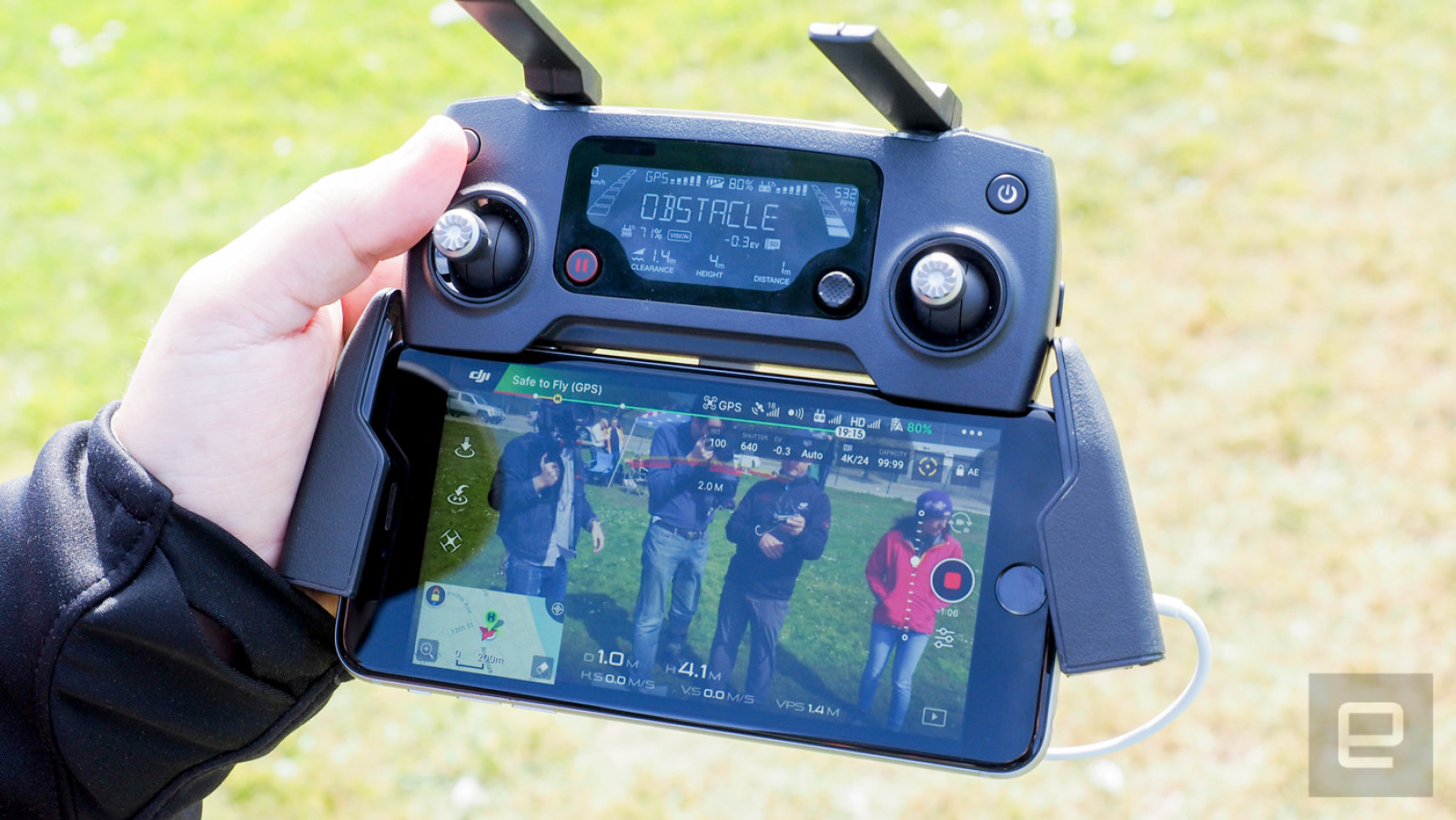
Mavic Pro also ships with a foldable controller that promises an encrypted 4.3-mile range, with support for 1080p streaming to an attached smartphone. This, in turn, can stream to Facebook Live, Periscope and YouTube via the DJI companion app in the same way Phantom-series drones do. We were unable to test the live social media streaming or the range of during our flight, but noted that latency between the Mavic’s camera and the display on the iPhone was nearly non-existent.
The Mavic Pro can be flown with the controller, of course, or just a smartphone (or as we tested, a combination of the two). The latter is the preferred method if you want to use the drone’s advance features like ActiveTrack, Gesture mode and TapFly. Both ActiveTrack and Gesture require the drone to recognize a person which during our tests didn’t always happen right away. These features are actually part of the app, which means they’re the same you’ll find on the Phantom drones or Osmo handhelds.
Once the drone locked on to someone with ActiveTrack, it followed them as they ran and walked around the field. Using on-screen controls, pilots can pivot around the person which is cool, if you want more than just the back of someone’s head in your video. Gesture mode (or selfie mode) was less exciting. While the Mavic is following a person they can make a “camera” gesture in front of their head to start the countdown to a selfie that’s indicated by the device’s flashing lights.

It’s difficult to make the gesture while holding the controller, so we placed it on the ground to enable the feature. Then afterwards we learned that you can’t take a selfie while also shooting video. The controller has a photo button on it; it seems it would be just as easy to just push that. But you know, selfies.
To get all those magic video and photo moments the Mavic shoots 4K at 30 frames per second and 1080p at 96 fps. The 12-megapixel camera can also snap in both portrait and landscape mode. This is possible thanks to the three-axis gimbal. With the controller, pilots can adjust where the camera is pointed independent of the drone’s flight path. The movements are smooth. During our flight, there were winds of at least 14 miles per hour but the photos and videos were void of jitters and shaking.
For pros and newbies alike the obstacle avoidance tech is on point. I was unable to get it to run into Kyle, Engadget’s video guy, despite my best efforts. While testing the TapFly feature — tap on the screen and the drone flies there — it avoided flags that were in its path. The controller also has haptic feedback that will warn you when you’re getting close to an object. DJI notes that if you put it in Sport Mode, you’re on your own when it comes to keeping the Mavic from hitting stuff.

As for keeping the Mavic in the sky, DJI says the drone’s batteries will last 27 minutes. That’s more than the usual 20-minute claim made by many rival devices. Of course, the runtime will be shorter if you’re flying around in Sport Mode. If you do find yourself needing more time, additional batteries cost $89. DJI is also offering a “Fly More” combo for $1,299 that includes the $999 Mavic Pro, two extra batteries, extra propellers, a charging hub, adapter, car charger and a shoulder bag.
As for the flight itself, the Mavic was easy to pilot, and using the controller a better experience than on the Phantom series. If the mission was to make something that’s powerful, small and easier to use, it looks like the company achieved that. The question is whether Mavic is intended to replace the similarly priced and very popular Phantom 3 (which doesn’t have obstacle avoidance), or if this is designed to go after a different customer.
For the price of a Mavic, you can also get GoPro’s Karma, plus the Hero5 Session. The Karma might not have some of the smart features, but with its detachable camera rig, Karma Grip and all-in-one controller (built-in display) shoppers will have to decide between the flexibility of a removable camera, and bonus hand-held stabilizer, or the ability to follow targets and, well, potentially not hit things.
The DJI Mavic Pro is available for pre-order now and will ship in mid-October.
Source: DJI
Galaxy Note 7 finally goes on sale in Europe on October 28th
Samsung’s Galaxy Note 7 was originally set to go on sale in Europe on September 2nd, but on that very day the launch was pulled and a global recall issued on account of their tendency to explode without warning. This made the regional recall process a little simpler for Samsung, given only those who had taken advantage of early delivery preorder promotions had devices in hand, but it also meant Europeans have never actually been able to straight-up buy — battery defects aside — Samsung’s finest smartphone yet. That changes October 28th, however, when the Note 7 will finally go on general sale in the region “subject to full completion of the exchange programme.” Though whether consumer confidence has been irreparably damaged already remains to be seen.
Alongside announcing the European launch date, Samsung has provided a number of updates on how the recall process is going today. In Europe, 57 percent of handsets have been handed over since exchanges began just over a week ago, causing Samsung to predict it’ll have every defective device back by early October. In the US, over 60 percent of Note 7s have been tracked down, up from roughly 50 percent last week — the pace is understandably slower as sales started on August 19th, so there are more handsets out in the wild.
Over 60 percent of phones sold in South Korea have also been exchanged, with Singapore residents leading the pack with more than 80 percent of handsets returned. In the immediate aftermath of the global recall, Samsung lost many, many billions in market value; but apparently people that wanted a Note 7 in the first place are happy to stick with the device, with roughly 90 percent of those choosing to receive a new, non-exploding model. Better the devil you know, we suppose.
Source: Samsung
 AIVAnet