


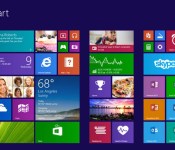
Microsoft may preview Windows ‘Threshold’ in April, launch it in 2015

Microsoft may have just released Windows 8.1 a few months ago, but it’s reportedly on the cusp of previewing its next major Windows version, Threshold. The SuperSite for Windows hears from sources that Microsoft will provide a “vision” for the OS at its Build conference in early April. While there aren’t many details of what the software involves beyond an emphasis on cross-platform unity, the tipsters claim that Threshold will likely be called Windows 9 and center around a refined interface that’s better-suited to desktop users. Whatever the OS looks like, don’t expect to see it in action this spring. Provided the rumors are accurate, the crew in Redmond would only start work on Threshold after Build, and it would ship the finished code in April 2015. The sneak peek would mostly set expectations for developers worried about Windows’ future in an unreceptive PC market.
Filed under: Software, Microsoft
Via: ExtremeTech
Source: SuperSite for Windows
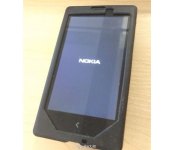
Rumored Nokia Normandy prototype surfaces on Twitter, reveals little

That thing up there? Word on the street (that is, Twitter) is that it’s an engineering prototype of the Nokia Normandy, a low-end Android device due sometime in 2014. The name has been floating around for a few months now, often accompanied by images flaunting Nokia’s usual design cues but without the hardware shutter button or LED flash that adorn its Lumia devices. Normally, that would peg the hardware for Nokia’s Asha line, but rumors persist that the Normandy will actually be running a Nokia-tweaked version of Google’s open-source OS.
Screenshots leaked earlier this month also suggested that the device would support dual SIMs and showed of mockups with touch-screen notifications and a customized Skype app. Unfortunately, the leaked device doesn’t do much to add or detract from that rumor, revealing only a generic back button, a Nokia boot screen and a rubberized case that obfuscates the handset’s features. Still, something is clearly afoot; we’ll let you know when we know what, exactly, it is.
Filed under: Cellphones, Nokia
Via: GSM Arena
Source: Twitter
CES 2014: Gaming roundup

Gaming is once again a thing at CES! Since splitting from the Consumer Electronics Show in 1995 and creating E3, the game industry has sat out much of the past 20 years. Between last year’s big news from Valve and this year’s reappearance of Sony’s PlayStation, it’s never been a better time to be a journalist covering gaming at CES.
In case the resurgence of gaming news wasn’t enough to solidify our belief, the first ever Engadget-hosted Official CES Awards Best of Show trophy went to Oculus VR’s Crystal Cove Rift prototype. Gaming, as it turns out, is more innovative and exciting than the curved TVs and psuedo-fashionable vitality monitors of the world — not exactly a surprise, but validating our years-long assertion feels so, so right.
CES 2014 saw Steam Machines third-party support go official — we even told you about all 14 partners a full 24 hours before Valve loosed the info — a new, crazy/ambitious project from Razer, and Oculus VR’s latest prototype. And that’s to say nothing of Sony’s PlayStation Now and Huawei’s China-exclusive Android game console, or the dozens of interviews we did.
Steam Machines

The ongoing saga of Valve’s PC gaming living room initiative continued at CES 2014, with company head/beloved game industry leader Gabe Newell introducing just over one dozen third-party Steam Machines at a press conference. This is Valve’s second consecutive year attending CES, and the company behind Steam (not to mention gaming classics like Half-Life and Left 4 Dead) made another big splash in 2014. Pricing, specs, and rough launch windows were given to the various Steam Machines, which brings us all one step closer to the much-ballyhooed “Steambox” reality we’ve been hearing about for years now. Heck, iBuyPower’s is named “SBX” — take a wild guess what that’s short for.
Oculus VR’s Crystal Cove prototype

Depth-tracking? Check. Motion blur vastly reduced? Check check. A fancy new OLED screen? Yup, that’s in there too. The latest virtual reality headset from Oculus VR is nicknamed the “Crystal Cove” prototype — for reasons the company isn’t saying — and it offers a massive step up from even the HD prototype we tried back at E3 2013. The first of the trio of new features is accomplished by adding IR trackers to the front of the Rift headset, combined with a camera facing the player (in-tandem with other data collected via internal sensors).
After trying the latest Rift, I spent the rest of CES evangelizing the device to my colleagues. From mobile phone geeks to in-house photog Zach “Honey” Honig (Hi Zach!), no staffer came away unimpressed. Two evenings of heated arguments later, and we chose Crystal Cove for our Best of CES award.
Razer’s Nabu and Project Christine

A wearable from a gaming company? You’ll forgive my confusion, but Nabu is pretty far from normal for Razer. If anything, perhaps we shouldn’t expect Razer to be pedestrian — this is the company, after all, that created the Razer Edge and routinely names its devices stuff like “Kraken.” Between the unbelievably low price ($50 for the dev model), the two OLED screens, and the sophisticated abilities Nabu offers, though, we’re convinced it’s a great, if bizarre, idea.
Where Nabu is ambitious, Project Christine is insane. The crazy-looking modular gaming PC isn’t the same iterative, bland exercise so much of the PC world continues to produce: it’s exactly the kind of bold experiment we’re excited to share with you. Beyond the fact that it’s a modular PC — which, unto itself, is relatively unknown territory — it’s got a custom motherboard, mineral oil cooling, and a design that dramatically stands out from the pack. Christine isn’t necessarily destined for retail (Razer’s still waiting to hear how consumers respond post-CES), but we sure hope it does become widely available at some point.
The Rest
Microsoft and Xbox weren’t really at CES 2014, but I did spend some time speaking with Xbox head Marc Whitten about the Xbox One’s first big post-launch update and his thoughts on the evolving world of gaming. And beyond our hands-on time with the new Rift prototype, company CEO Brendan Iribe talked to us about Oculus VR’s internal game development aspirations. Company founder Palmer Luckey joined us on the show floor stage once again to talk Crystal Cove, as did the always gregarious Razer head Min-Liang Tan. Sony head Kaz Hirai sat down with managing editor Christopher Trout to talk PlayStation 4, “one Sony,” and the just announced PlayStation Now game streaming service. In case it weren’t already clear, there’s a ton of great original gaming coverage to pour over as the weekend rambles on. And that’s just gaming!
Filed under: Gaming, Wearables, Software, HD, Sony, Microsoft
Microsoft’s Xbox head isn’t worried about Steam Machines and Oculus Rift; he’s excited
Two of the biggest stories at CES 2014 involve gaming, and neither involves the big three entrenched console makers (Sony, Microsoft and Nintendo). Oculus VR’s latest prototype, dubbed “Crystal Cove,” and Valve’s Steam Machines initiative are overshadowing even Sony’s big PlayStation Now news, to say nothing of curved displays and wearable whatevers. Despite that overshadowing, Xbox Chief Product Officer Marc Whitten isn’t too worried about either — in fact, he’s really excited about both and what they mean for the larger game industry he loves.
“This is literally the most golden of golden ages that I’ve ever seen around gaming,” Whitten told us in an interview this week at CES 2014. “I think this is what makes gaming great. And you love seeing the passion of seeing someone like Palmer [Luckey] and those guys at Oculus. And seeing someone like John Carmack get on and really be focused on it is great. I don’t know how it could be anything but good.” He didn’t say whether or not dev kits are with Microsoft, but he’s used the headset and likes what he’s seen.
Moreover, he isn’t worried about it cannibalizing Xbox One sales. “It’s just gonna increase the surface area, and I think that’s an incredible thing,” Whitten said. Valve’s Steam Machines initiative is another story.

First things first, we had to know if Whitten had a response to Valve head Gabe Newell’s jab at Xbox One’s 3 million sales number. (Spoilers: he didn’t.) “The last thing I’ll ever do in my entire life is get into a flame war with Gabe Newell. There’s no win in that,” Whitten laughingly told us. Jokes aside, he’s skeptical of the Valve initiative. “I personally don’t know how to think about Steam Machines yet,” he said. “I’m not knocking it or whatever. I continue to think that PC gaming — the sort of uber configuration and I can change everything and I can mod — that’s an important thing and there’s a lot of people that wanna do that.”
Specifically, we wanted to know if he sees the initiative as competition for both the Xbox One and PlayStation 4. Frankly, he doesn’t. “When you get into that living room environment, you don’t want to spend any of your brain cells doing anything but being entertained. I don’t want to work on it; I don’t want to feel like I have to know how it works. I would like to be blowing things up now, or watching a thing now. That’s the fundamental thing that you want to do,” he said. “I think there’s space for both. I’m not sweating it.”
So far, we agree with Whitten’s assessment. The living room experience on a game console like Xbox One or PlayStation 4 remains vastly superior to that of even Steam’s long-running Big Picture Mode (intended for living rooms). In 2014, Valve’s SteamOS and Machines initiative still needs to prove competitive with the new game consoles. With the competition stiffer than ever, we can’t wait to see what everyone has in store. As Whitten said, all of this is nothing but good for gamers.

CES 2014, Day 4: Top five must-see stories you must see

CES may almost be over, but there’s still plenty to talk about at the Las Vegas Convention Center. We learned why Microsoft’s presence at CES may be subtler these days, and that GoPro’s obsession for extreme sports has found a home on Xbox Live. We also saw Fleksy bang out emails on a smartwatch and had our faces digitally rearranged by a Kinect-equipped makeover machine — but that’s nothing compared to what we’ve hidden past the jump. Read on for a look behind the show, technology and awards that define CES 2014, day 4.
The best of the best

Remember those finalists we told you about yesterday? We finally picked through them, and after heavy deliberation, heated discussion and an impromptu water bottle fight, we finally made a call: The winners of the Best of CES 2014 Awards are here. Innovation, clever design and potentially industry-changing tech fill out all 14 categories, and we couldn’t be happier to gush over them. We didn’t do all the work though; 54,511 readers voted on the People’s Choice Award, selecting the Razer Nabu smart band by a landslide. Already scope out the winners? Why not take a look back at how we made their trophies, then?
Creative directions

Celebrities often drop by CES to help promote products, build hype or awkwardly stumble off stage. Sometimes, however, they’re here for more than mere marketing. When The Black Eyed Peas’ will.i.am was named creative director of 3D Systems, we knew we had to ask the musician exactly what he would be doing for the 3D printing giant. “Geeks are the coolest people on the freaking planet,” he told us. “Every young kid in the inner city needs to know that.” will.i.am has big dreams for emerging technologies, education and sustainability, and has a passion for making sure groundbreaking devices like 3D printers don’t get stuck in a stagnant niche. It certainly wasn’t the interview we expected. Check it out.
Autonomous parking

BMW’s self-driving cars may not be ready for consumers until 2020, but its ConnectedDrive parking technology is ready right now. We dropped by the automobile manufacturer’s car lot one more time to check out the BMW i3′s parking package, a $1,000 add-on that outfits the vehicle with ultrasonic sensors and the ability to pass the parallel parking segment of the driver’s exam. It’s not the first automated-parking system on the market, but it is the only one we’ve used that doesn’t require any user input throughout the entire process.
Modular mobile

Here’s a compelling idea: don’t like your smartphone’s camera? Detach it, drop it and add a better one. The concept of a modular cellphone has been floating around for a few months now, but ZTE has actually shown us one. The company’s Eco-Mobius prototype teased us with a device capable of swapping out LCD, processor, RAM, camera and battery modules on the fly — a move that could potentially give users full control over their smartphone’s specifications. Unfortunately, ZTE’s kit was under glass at the show, but it’s still a fascinating look at where the mobile market could be going in the near future.
Behind the scenes

You saw snapshots of what it was like to live a day of CES through an Engadget editor’s eyes; now join us for a more personal tour of the show floor, the Engadget stage and the trailer we’ve lovingly called home for the last week. On this week’s Engadget Show, Michael Gorman and Mat Smith take a behind-the-scenes look at our CES operations. It’s the next best thing to flying out to Las Vegas yourself, and it doesn’t even come with the risk of contracting the trade-show flu.
Filed under: Misc

Microsoft and CES: it’s complicated (not really)

CES: It’s a big deal in the tech world. You know who else is a big deal? Microsoft. So when the tech giant decided to hand over the baton of hosting the event’s opening keynote, ending a 12-year streak, people took notice. Not only that, the software giant also pulled its entire presence on the show floor, causing speculation that Microsoft’s relations with the CEA had degraded over the years, or (more likely) that it had decided the show just wasn’t offering it the kind of airtime it needed for its services and products.
At CES 2014, a Microsoft stand is nowhere to be seen on the show floor. In the build-up to the event, however, a report from the BBC claimed the firm would be “returning” to the show, including an almost polemic quote from the event’s head honcho Gary Shapiro stating that “Microsoft is officially back in the International CES.” This, in turn, was picked up by others, dutifully pointing out that, technically it never left — instead, conducting business away from the show floor. This much is definitely true, as we were part of one such meeting, in which we took the time to find out a little more about the real story behind Microsoft’s sudden departure from the biggest show in tech.
“The keynote and the booth, we haven’t done the last couple of years, but at the same time, the behind-the-scenes meetings with partners, hardware manufacturers, mobile operators and developers are all happening, and that part has actually increased,” Greg Sullivan, director of Windows Phone at Microsoft told us. Clearly, with almost every relevant business partner in town, it’s a great time to talk. Sullivan did go on to say that Microsoft isn’t ruling out a return to the show floor in the future.

Microsoft has many limbs, so it’s not just a case of one faction pulling out. Xbox isn’t here either, and it just launched a once-in-a-decade console. Marc Whitten — chief product officer for Xbox — told us “coming here to talk about new stuff is a little weird, especially for the console market, where so much is driven in November/December.” Yet Sony is here in full force, releasing new PlayStation products, and even theming its non-gaming stuff under the banner “play.” Whitten also told us, in the case of Xbox, it’s more to do with the timing. CES lands just after the big Christmas push, but again, this didn’t seem a concern for Sony; a competitor that’s generally considered to be winning the publicity war.
We’re there; we’re visible; and our products are in booths all over in various form factors.
But if not CES, then what? Sullivan is pragmatic, claiming that it’s a simple case of reallocating budget. A presence on the show floor costs money; money the firm is deciding to spend on other things. Internally organized events like Build are becoming increasingly important for Microsoft. Especially as this gives it the opportunity to host its own show, and not jostle for attention among the thousands at CES. A tactic that Apple employed some time ago (the last presence it had was more than two decades ago), which is clearly working for them. Google, too, has never really done the CES thing, also opting for its own showcase events.
Microsoft’s absence perhaps feels more noticeable due to its long tenure at the CES keynote, making its presence at the show all the more visible. Not that its show floor installations were exactly subtle, either. Its 2011 booth, for example, was a cavernous multi-story complex, almost with its own weather system.

If you spend any time wandering the halls at CES 2014, however, one thing soon becomes obvious: Microsoft is actually present throughout. Its products are so ubiquitous, that even without it trying, tablets, laptops and a host of other devices make sure that famous Windows logo is never far away. Something Chris Flores, director of Communications for Windows is only too aware of. “Although we don’t have a physical booth presence on the floor, we very much have a presence on the floor […] we’re there; we’re visible; and our products are in booths all over in various form factors,” he said.
And here we come to the obvious conclusion. Microsoft isn’t at CES (visibly) because it really doesn’t need to be. It’s also not an indicator of CES’ credibility. We’re told the software firm is also giving Mobile World Congress the same treatment — it will be there, but mainly behind closed doors. Increasingly is looks like the large trade show simply can’t offer the sort of dedicated airtime that a brand like Microsoft requires. This, after all, is the nature of business: assess the value, and make the most profitable decision. For Microsoft — and an increasing number of big names — that decision is to go it alone.

Nokia’s Lumia Black update starts rolling out worldwide (video)

Nokia knows how to start a new year properly — it gave Americans a first shot at the Lumia Black update as 2013 came to a close, and it’s starting 2014 by rolling out the software to Lumia owners around the world. The Windows Phone 8 upgrade is reaching the Lumia 925 and 1020 first; other devices should get it in the weeks ahead. The fresh software brings common features like app folders, Bluetooth 4.0 LE support, an updated Glance screen and the unified Nokia Camera app. Some improvements depend on beefier hardware, however. You’ll need at least 1GB of RAM to use Beamer transfers or Refocus image processing, and only 1020 owners can shoot RAW photos. Whatever device you’re using, you’ll want to hit that Phone Update option in the near future — you may be in for a pleasant surprise.
Filed under: Cellphones, Mobile, Microsoft, Nokia
Source: Nokia Conversations
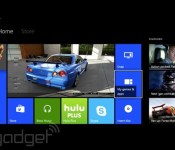
Xbox One’s first big update will address ‘the Live experience,’ expect streaming before E3

Xbox — and Microsoft in general — doesn’t really show up for CES. It’s not hard to understand why: for a big company like Microsoft, there’s no point in competing with the cacophony of voices shouting for attention. “Whenever we want, we can talk about Xbox stuff and get coverage. Why try to talk with 100,000 other things going on?” Xbox chief product officer Marc Whitten told us in an interview this week. Though Xbox isn’t here to show anything off, Whitten’s in town to meet with partners and, as he put it, “It’s just a good time to pop up and see an environmental scan you can get in an immediate dose.” After a long 2013 head down on the Xbox One launch, he’s finally got a second to take the temperature and see the world outside of Microsoft’s Bellevue, Wash. campus.
But we’re not here to ask Whitten about the past. Yes, he’s “really thrilled” with the console’s launch (over 3 million sold by the end of 2013). And yes, he’s very happy with the reaction from consumers. That doesn’t mean work’s over, of course. “There are seams in the product [XB1]. There are still seams in the 360, nothing’s ever done,” Whitten said. As such, first up on the fix docket is what Whitten called, “the Live experience.” Essentially, that’s much of the social features on the latest Xbox console. Whitten takes that stuff personally, having worked on Xbox Live as a service for the last 10 years:
“The feedback we’ve gotten is pretty valid; some of the social stuff is hidden or harder to use than it was on the Xbox 360. So you’re gonna see us come out with an update where, well, we’re going to fix those things. As a person who’s been pretty involved in building Xbox Live for the last decade, I take it pretty seriously when people say it’s harder to get into a party, and the defaults aren’t right, and I don’t like the model. So what I’m trying to do with the team is kind of theme some stuff up. Let’s take an update and really go through a big list of what we’re hearing from customers, what we know is broken with the architecture, areas that we want to improve or complete. I think that’s a theme you’ll really see us push on — that Live experience.”
Based on our conversation with Whitten, it sounds like those Live fixes are coming sooner than later. Promised game streaming functionality, however, may not be coming as quickly. “This is not 100 percent,” Whitten prefaced his statement with. “But my general strategy at E3 is to talk about things that are gonna happen from that E3 to the next E3. So, we are not yet to the next E3,” he added with a smile. So, uh, before June then!

Updates in general, though, will come much faster. While Whitten said we’ll still see the traditional large Dashboard updates, the Xbox One was designed around lessons learned from the 360 before it. One major facet of that design facilitates more regular updates. “The Xbox 360, which I’m still very very proud of, the software architecture was built in 2003. Rethinking [updates] based on everything we learned from 360 was a lot of what went into the Xbox One,” he told us. “You’re still gonna see the big, ‘Hey, here’s the cool stuff we’re doing.’ But you’re also gonna see the box just get better faster than you did in the past.”
First up on that front? “Everything from getting more apps out faster, some of the TV stuff — improving some of that, getting the scale of that internationally where we don’t have some of that. So I think you’re gonna see that come pretty quickly,” Whitten said.
The next big push for Microsoft’s Xbox One starts by March’s Game Developers Conference. As it turns out, the Xbox One gets its first major exclusive game that month in Titanfall as well. And hey, if you ask us, there’s serious incentive for Microsoft to have partying up perfected in time for Respawn Entertainment’s big game.
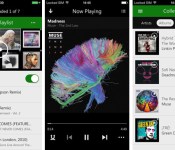
Xbox Music for iOS now plays music offline

Xbox Music landed on iOS with a big splash, but the absence of offline playback hurt its appeal for frequent flyers and anyone else whose internet access isn’t guaranteed. That won’t be a problem now that Microsoft has updated the app with offline support. Tunesters just have to flick a virtual switch to cache playlists for listening in any situation. The move won’t lure subscribers away from rival services that have had offline playback for a while, but it’s hard to object to a little more convenience for Xbox Music loyalists.
Filed under: Cellphones, Internet, Software, Mobile, Microsoft
Via: The Verge
Source: App Store
How to make a CES keynote

Last night, director Michael Bay made an abrupt stage exit during Samsung’s day zero CES press conference. It was awkward, but little more than a square of toilet paper on the bottom of a tennis shoe compared to last year’s Qualcomm keynote. A bizarre mix of stilted theatrics, celebrity appearances and product demos, the presentation was like nothing we’d ever seen — until we took a look back. Qualcomm may have jacked its keynote up on steroids, but many of the tricks it pulled out were already tried-and-true standards. As Sony’s Kaz Hirai prepares to kick things off at CES 2014 this morning, we reflect on 20-plus years of innovative speeches, futuristic predictions and just plain strange behavior.
This is how you make a CES keynote.
Step 1: Think big

John Sculley with Apple’s Newton PDA (Photo by Marty Katz//Time Life Pictures/Getty Images)
When former Apple CEO John Sculley took the stage at the 1992 Winter CES, he set in motion a decade of digital divining by industry bigwigs like Aereo champion Barry Diller and Sony CEO Sir Howard Stringer. Sculley presented a bold vision of the future not only for the US economy and workers on the whole, but also for Apple’s future. His was a world where hand-held devices would lead to a fundamental shift in the way we work and learn. He saw computers, and PDAs specifically, as “revitalizing America’s role” in the global economy by making everyone more productive. The eventual offspring of this line of thinking was the ill-fated Newton. Of course, Apple would eventually return to the idea of a portable computer that embraced many of Sculley’s ideas, but his predictions weren’t exactly spot-on.
Sculley’s not alone. Many of CES’ keynote speakers have painted pictures of the future that were either ill-timed or just plain off. Michael Bloomberg kicked off the 1997 CES with a speech that focused on a new era of digital media distribution. He foretold a robust publishing industry, where writers were in higher demand and readers received the news on digital broadsheets. “The newspaper of a few years from now is made of cloth with transistors hidden in it and essentially a cellular phone with a battery hidden it there as well,” he said.
One year earlier, Compaq CEO Eckhard Pfeiffer spoke of a robust connected home becoming the norm in 2000. His theoretical abode had a computer in every room, each tailored to the needs of its user. In the kitchen, a touch- and gesture-based computer would bring the man of the house CNN Headline News, email, fax and the day’s appointments while he sipped his coffee. In the bedroom, his wife would connect with her doctor through a large-screen PC that also provided weather alerts and restaurant reviews for an upcoming trip to China. Meanwhile, his teenage daughter would connect to her friends in Germany via her I-phone (that’s a capital “I” for internet).
Step 2: Announce something

Bill Gates first appeared on the CES stage in 1995, and in 2000, he gave his first CES kickoff keynote, beginning a 12-year run for Microsoft in that slot. In just over a decade, he and his successor, Steve Ballmer turned the opening night talk from a look at tech’s crystal ball into a platform for launching new products, services and ideas. In 2000, Gates introduced the company’s new Pocket PC and Reader e-book software. The following year, he upped the game showing off the Xbox and teasing “the future of gaming.” Some of these talks were more product heavy than others, but in the time that he was at the helm, Gates announced and demoed everything from smartwatches to internet-connected TVs and HP’s aptly named TouchSmart PC.
It wasn’t all about gadgets during Microsoft’s keynote reign, however. When Ballmer took over in 2009, he announced availability of Windows 7 beta in addition to Windows Live partnerships with Dell, Facebook and Verizon. The following year, Microsoft gave the audience a glimpse at what would become Kinect. That focus on product releases took a turn for the dramatic in 2013, when Qualcomm’s Dr. Paul E. Jacobs took to the stage with a smattering of disparate cultural personalities to unveil its latest processor, the Snapdragon 800.
Step 3: Hire a celebrity

Bill Gates and the Rock show off the Xbox (Photo by Jeff Christensen/Liaison)
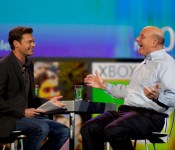
With a cast of characters like Archbishop Desmond Tutu, Pacific Rim director Guillermo del Toro, Maroon 5 and even Big Bird, you’d be forgiven for thinking last year’s keynote felt more like an incredibly intricate high school production of Xanadu than a self-serious press conference. While Jacobs’ state of the industry addresses was by far the most star-studded to date, employing celebrities for the occasion isn’t new. Gates enlisted Dwayne “The Rock” Johnson to show off the Xbox in 2001. In 2004, Jay Leno joined him in introducing MSN Video, followed by Conan O’Brien in 2005. To mark his last appearance as the opening keynote speaker in 2012, Ballmer sat down for a conversation with Ryan Seacrest. The following excerpt from that interview demonstrates just how awkward these cameos can be.
Seacrest: I like that. When you said Metro you looked at me in a strange way, or I thought. Is it the jacket, or the sweater, or the combination?
Ballmer: I was going to say it’s a new design and a new year, but you take it from there, for Microsoft and Ryan.
Seacrest: I’m your mascot.
Step 4: Man up

Steve Ballmer crashes the Qualcomm keynote (Photographer: Andrew Harrer/Bloomberg via Getty Images)
As in the boardroom, so on the CES stage. Over the past 20 years, only four of 63 headlining keynote speakers have been women. Of course, Yahoo CEO Marissa Mayer is slated for a talk of her own on Tuesday and Facebook’s Carolyn Everson will return for her second appearance during a panel discussion Wednesday, but all of their fellow speakers share two things in common. You guessed it: an X and a Y chromosome. This may not come as a shock to those who follow the tech industry closely, but it’s a particularly vexing state of being for a conference (and an entire market) that thrives on innovation and change.
Step 5: If all else fails, get weird
Lead image: AP Photo/Julie Jacobson
 AIVAnet