


Xbox One gets gameplay broadcasting in March update (update)

Xbox One owners eagerly awaiting Titanfall should be glad to hear that the Xbox One’s gameplay broadcasting functionality will light up ahead of the game’s March 11th launch. Included in the second half of the first big Xbox One update is Twitch gameplay broadcasting, enabling users to share gameplay via Twitch.tv (similar functionality already exists in Sony’s PlayStation 4). That update is expected just ahead of March 11th (and Twitch functionality is listed as coming directly on March 11th itself).
Gameplay broadcasting on Xbox One was one of the tentpole features touted at the console’s unveil event last year — the service was delayed ahead of launch, with Xbox lead Marc Whitten telling us at CES to expect it before gaming’s big trade show in June. No real reason is given for the delay; Xbox marketing lead Yusuf Mehdi told the AP that Sony’s version of gameplay broadcasting is, “too limiting,” and Microsoft wanted to take its time to get it right. It’s not clear what that actually means in practice just yet, but rest assured we’re asking Microsoft for more info.
Update: Microsoft detailed the service a bit more this morning. Twitch on Xbox One has at least one feature unavailable on PlayStation 4: the ability to archive streams right from the console. There’s also a video showing the service in action (that we’ve dropped below the break).
Filed under: Gaming, Software, HD, Microsoft
Source: AP

Microsoft’s hardware leader steps aside ahead of Stephen Elop’s arrival

Microsoft said that Stephen Elop would run its hardware division as soon as it finished acquiring Nokia’s device business, and the company has just taken a big step toward making that leadership change a reality. Current Devices & Studios lead Julie Larson-Green has told her staff that she’s leaving her position to become the Chief Experience Officer at the Applications and Services group, which oversees Bing, Office and Skype. The move sees her report to Qi Lu, the app section’s Executive VP. Larson-Green will manage devices until Elop arrives, but the announcement effectively marks the end to her brief 7-month tenure of the crucial organization. She was certainly busy during that time — she oversaw the launches of the Xbox One, new Surface tablets and Xbox Music, among other projects. However, we may not know the full extent of her legacy until sometime after she has changed roles.
Filed under: Gaming, Tablets, Software, Microsoft, Nokia
Source: GeekWire

Bing Maps Preview now lets you explore more cities in 3D

Microsoft’s been hard at work on enhancing the Bing Maps experience within Windows 8.1, and it all started with the release of a preview application last year. With one of the focus areas being 3D exploring, Bing has announced that Maps Preview can now provide a 360-degree view of 15 more cities, both from the US and abroad. Here in the States, this includes Montgomery, Alabama; San Francisco, California; Tallahassee, Florida; and Seattle, Washington, to mention a few. Meanwhile, in Europe, Bing has added 3D mapping access to Duisburg and Dresden in Germany, as well as Marbella and Murcia in Spain. The Redmond-based outfit says we can expect the list to keep growing, too, as it is always working to support additional places.
Filed under: Internet, Software, Microsoft
Source: Bing
BBM coming to Windows Phones this summer

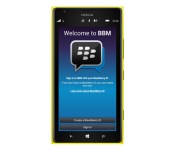
BlackBerry is slowly, but surely covering all its bases in an effort to turn BBM into a cross-platform messaging monster. The quest to return the standard-bearer to its former glory started with iOS and Android, but this summer it’ll be coming to Windows Phones as well. According to the Canadian company, it will ship with all the same functionality as its counterparts on other OSes, including stickers and voice. More importantly though, BBM Groups (which allows you to chat with up to 50 people at once) and Channels will be included as BlackBerry works to fight off challenges from the likes of WhatsApp and Hangouts. Sadly those are all the details we have for now, but hopefully Waterloo will lock down a release date sooner, rather than later.
Filed under: Software, Mobile, Microsoft, Blackberry
Via: SlashGear

Xbox One gets its first price drop, now £400 in the UK

The Xbox One hasn’t been selling as well as the PlayStation 4 on a global level, and that’s partly due to pricing — in the UK, Microsoft’s system costs a lofty £429 ($713) versus Sony’s £349 ($580). That gap is about to narrow, though, as Microsoft plans to cut the Xbox’s price to a slightly more reasonable £400 ($665) on February 28th. The company isn’t leaning solely on that lower price tag to attract gamers, either. It’s also releasing a special Titanfall Xbox One bundle (shown here) that includes both a download code for Respawn’s shooter and a month of Xbox Live Gold for the same price as the regular console. Americans can expect this limited edition system to ship alongside the game on March 11th, while Brits should get it on March 14th.
Filed under: Gaming, Microsoft
Source: Microsoft, Xbox Wire, Game.co.uk
Hands-on with Nokia’s X family of Android smartphones (video)

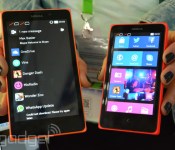
A couple of years ago, we would’ve said that the day Nokia announced an Android device was the day Hades froze over. The hour has come, however, and it’s only slightly chilly this morning. The Nokia X is the company’s inaugural Android-based devices — three of them, in fact — although it’s been tweaked a little bit to fit Microsoft’s and Nokia’s preferences. The devices are known as the X, X+ (pictured above) and XL (pictured after the break), each of which differed by only a small number of factors; and at a cost of 89 euros ($122) for the X, 99 euros for the X+ and 109 euros for the XL, the family fits roughly in-between the Asha and Lumia series in terms of pricing and functionality. The X will be available immediately in growth markets (sorry, enthusiasts in the US, Korea and Japan, it won’t be heading to your neck of the woods through official channels), while the X+ and XL will come later in the second quarter and will come in white, black, cyan, green, red and yellow.
On the outside, the X and X+ both look a lot like a 4-inch version of the Asha 503, with the same matte polycarbonate chassis but without the transparent crystallic case surrounding it. It’s not too tiny that it disappears in your hands, but it’s also not too big to be overwhelming (unless you love larger devices, that is). At 10.4mm thick, it’s not an incredibly thin device but its smaller size helps ensure that it’s still a comfortable fit. (The XL is 10.8mm thick and offers a 5-inch display with the same resolution and 5MP rear camera along with a 2MP front-facing camera; we’ll have more impressions of the XL shortly.)
The phone itself is certainly a basic device, and it shows on the hardware side: the X sports a 4-inch IPS LCD WVGA (800 x 480) display, 3MP fixed-focus camera, a 1GHz dual-core Snapdragon processor, 1,500mAh removable battery, 4GB of internal storage, a microSD expansion up to 32GB and 512MB of RAM; the X+, we’re told, tacks on another 256MB of RAM and comes preloaded with a 4GB microSD card. For an inexpensive pair of devices destined for emerging markets, however, we doubt anyone will complain about the lack of premium specs. We’ve got a gallery of pics below, along with more of our impressions of the Android interface.
Of course, the most intriguing part of the device is the user interface itself. The X family uses a forked version of Android 4.1.2 that uses the standard AOSP but doesn’t have access to Google’s suite of services (such as the official Play Store, Gmail or other core apps). Nokia wants to ensure that the device is focused on Microsoft Cloud services such as Skype (the X will come with a free month of unlimited international calls), OneDrive and Outlook, and it also throws in features like Here Maps, MixRadio and so on. We imagine that putting the focus on these services was the only reason Microsoft would greenlight the project — since this is destined for developing countries and emerging markets, it makes sense that Microsoft wants to get its foot into as many doors as possible.

So what does a Nokia Android UX actually look like in real life? Not surprisingly, it’s a lot like Windows Phone. The X launcher consists of a series of neatly lined-up tiles, although it’s possible to add folders if you’re overwhelmed by apps. Nokia claims that the X reflects the company’s design heritage, and we have to agree — despite its Android framework, it looks and feels very much like a Nokia device. The X also features a menu off to the side called Fastlane (which will be a familiar term for N9 and Asha users), which is the X’s version of a notification menu and logs your favorite/most-used apps, nearly all of your activities, open apps and background processes on the same page. It sounds like a cluster of madness, but the company fortunately kept it looking pretty clean.
Since Nokia’s running the show for all of the core apps, none of them actually look like the way Google has intended. One of our favorite touches was the clock, which Nokia basically copy-and-pasted from the N9. It also includes a Nokia-designed keyboard which even includes swiping gestures (a la Swype or SwiftKey). Third-party app stores and a file manager are also pre-installed. And although it doesn’t use the official Play Store, the X will come with the Nokia Store preloaded. This Store is supposed to feature plenty of Android apps, but they’re specially curated by the company. When asked how particular they are, reps just told us that it’s made things easy for devs: it’ll be a matter of slapping in a few lines of new code into the same APK as they use for the standard Android build, submitting it to Nokia and then finally getting certified by the company. But if the app you’re looking for is nowhere to be found in the Store, a screen pops up with suggestions for other third-party app stores which should feature that particular title. Or, if that doesn’t work, nobody will be able to stop you from sideloading APKs into the phone for your personal use. Since the Nokia UX is simply built on top of AOSP, reps tell us that anything that’s possible within the AOSP is technically possible to do on the X (think launchers, ROMs, widgets and so on).

Will this version of Android get updated, though? It’s never easy to say even for standard Android phones, much less one forked by Nokia. We’re told that it will indeed be updateable (based on consumer need), and individual services can be updated as well; we’d like to give the company the benefit of the doubt, but the reality is that if it’s not successful, there’s nothing preventing Nokia from pulling the support plug.
Color us completely intrigued by the X. As long as you don’t mind the user experience being kept under Nokia’s control, it’s definitely a fun phone to play with. We’ll have to wait until our official review to offer a final judgment, but Nokia’s new smartphone is fun, modern and colorful. We’re still marveling that this kind of discussion is even taking place right now, but it’s fantastic to see the “adventurous” side of both Microsoft and Nokia.
Filed under: Cellphones, Wireless, Mobile, Microsoft, Nokia, Google

We’re live from Nokia’s MWC 2014 event!

Nokia always puts on a show at Mobile World Congress, but this particular event may be a little… different. See, if all the rumors are true, we should expect to see a grand total of zero Windows Phones and one Android device introduced. Perhaps we’ll see a Bizarro version of Stephen Elop get on stage as well, so we’re crossing our fingers. Regardless of what happens, this is definitely going to be a liveblog for the ages, so stay locked in here at 2:30AM ET (11:30PM PT, 8:30AM CET) for all of our coverage!

Filed under: Cellphones, Wireless, Mobile, Microsoft, Nokia

Update to Windows 8.1 coming this spring with more hardware options, benefits for non-touch users

We may be at a mobile show this week, but Microsoft is making some announcements on the Windows side. VP Joe Belfiore, at an event this afternoon, has announced that an update is coming to Windows 8.1 this Spring, which will offer more hardware options, benefits for non-touch users and some changes to the user interface. It brings support to devices at lower price points that have as little as 1GB of RAM and 16GB storage, enables app launching and switching via the taskbar and a new mouse user interface with new options for closing apps and right-clicking to get to the Start screen.
Despite the update’s attention on users of non-touch devices, Belfiore exclaimed: “we love touch, but we do want to make things better for people who don’t have touchscreens.” We’ll update the post as we hear more about this new update.
Facebook Messenger coming to Windows Phone in the coming weeks

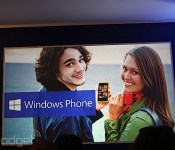
Microsoft VP Joe Belfiore made an announcement that will come as a solid addition to the Windows Phone app ecosystem: Facebook Messenger will be making its way to the platform sometime in the next few weeks. No specific date was given, since it’s still in the works, but we’re told that it’s progressing well enough that Belfiore could announce it. More updates from Microsoft as we get word.
Filed under: Cellphones, Wireless, Mobile, Microsoft

Microsoft: Windows Phone 8.1 will come with more hardware support and is backwards-compatible

Microsoft has made a few announcements related to Windows Phone 8.1 this afternoon in Barcelona. While we don’t expect to see the new update in its entirety until April, we got at least a few satisfying nuggets of info today. First, we’re going to see a lot more flexible support for hardware: 8.1 will be able to support more Qualcomm chipsets, such as Snapdragon 200, 400 and 400 LTE; it will come with TD-LTE, TD-SCDMA and SGLTE support, the ability for phones to use dual-SIM, and virtual softkeys instead of capacitive keys. Devices won’t be required to have a hardware camera shutter key anymore, either (but it’s still offered as an option anyway). Additionally, we’ve been told that devices currently on Windows Phone 8 will be able to get an update to 8.1, so it’s fortunately backwards-compatible to some degree.
Developing…
Filed under: Cellphones, Wireless, Mobile, Microsoft

