


Beam’s interactive livestreaming hits Windows, Xbox this winter
In early August Microsoft announced its acquisition of Beam, a videogame livestreaming service that separates itself from the competition by using tech that allows for low latency and interactive features. Now, Beam has announced it will launch on Microsoft’s gaming platforms (Windows 10 and Xbox One) this winter. That’s not a very specific window, but it will be interesting to see what happens once the parts come together. Currently, Amazon-owned Twitch is the most popular livestreaming service, but Beam’s hook is the ability for viewers to influence the streamer’s gameplay and broadcast.
We’re extremely excited to announce that Beam is coming to Xbox One and Windows 10 this Winter!!
— Beam (@Beam) September 14, 2016
With the support of Microsoft that could mean some interesting new game wrinkles, but so far it’s mostly speculative. Already, Beam lets people play along with Minecraft streamers, and in Rare’s upcoming game Sea of Thieves, the company says you’ll be able to watch from different player perspectives.
Since the acquisition, Beam has launched a few new features including resizeable chat windows, verified social accounts as well as chat replay and activity graphs to go along with archived recordings. Currently, streamers can use OBS or Xsplit to get video of their gameplay on the service, but now we’ll be waiting to see what happens when there’s built-in support.
Source: Beam (Twitter), Beam.pro
Scan photos into Office 365 with Office Lens on Windows 10
Microsoft’s Office Lens app has let folks upload photos from their iOS and Android devices since April 2015. But now your Windows 10-running phone, tablet, PC can snap photos — or even the Hololens, if that’s your thing.
With integration in the latest Windows OS, though, they’ve also added support for Office 365 if your business or personal accounts use that instead. It’s still got all the optical character recognition you’ve enjoyed with OneNote since 2013, meaning the text and figures are searchable once you’ve uploaded the images to OneDrive.
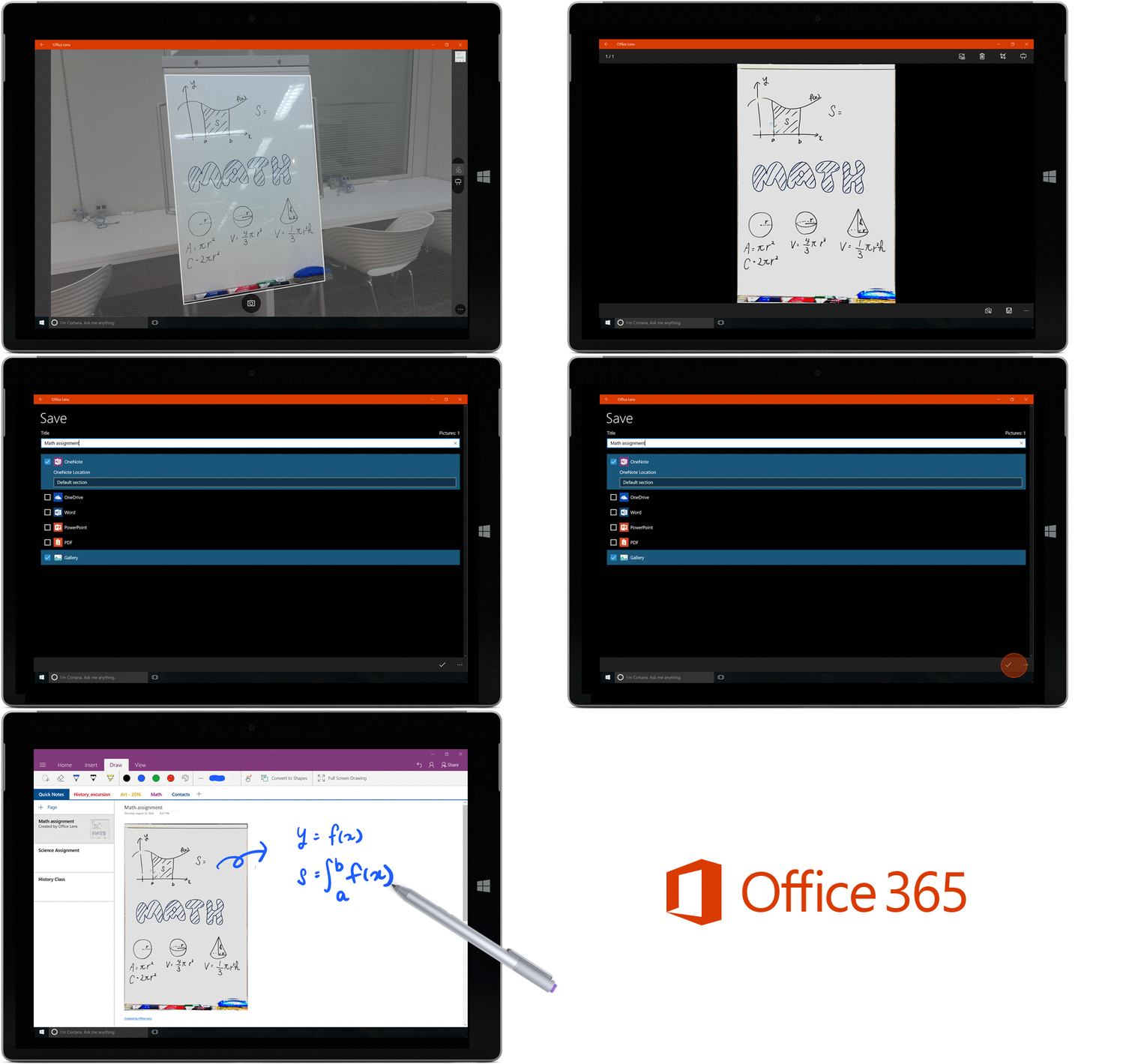
Source: Office blog
Microsoft renames its Health app after the Band wearable
Sure, Microsoft may not be releasing a new version of its Band activity tracker this year. But that hasn’t stopped the company from rebranding its generically named Health app on Android, as noticed by Paul Thurrott. “We’ve got a new name! The Microsoft Health app is now the Microsoft Band app, everything else is the same,” the patch notes say.
Apparently, bug fixes are a part of the update too, but if recent Google Play reviews are anything to go by, the application still needs a ton more where those came from. Over on iOS, the app still carries the Health name. Now to see if a new moniker sparks fresh interest from its developers. Spoiler: it probably won’t.
Via: Paul Thurrott
Source: Google Play
Microsoft brings third-party desktop apps to the Windows Store
Finally making use of the Desktop Bridge announced during Build 2016, Microsoft will now allow third-party developers to bring existing desktop apps into the Windows Store. While the store was mostly an emporium for Microsoft’s own universal apps in the past, this week’s update makes a push towards one unified store for everything Windows.
In the first rollout, Microsoft worked with developers to bring apps like Evernote, Arduino IDE, doubleTwist, PhotoScape, MAGIX Movie Edit Pro, Virtual Robotics Kit and more into the store. As Microsoft’s VP of Windows Developer Kevin Gallo notes in his blog post, “these are the same apps that customers know and love,” only now they get the added security that comes with MSFT’s store management. Most importantly, by opening up the store, third-party developers now have the ability to easily port apps to all devices in the Windows ecosystem from PCs and phones to XBox One and HoloLens. Essentially, the Desktop Bridge gives all developers the ability to create Universal Windows Platform apps and make use of all the APIs that come with it, including Cortana and the Action Center.
Finally, to make things even easier for developers, Microsoft is announcing new Desktop Bridge support from three of the most popular installer technologies: InstallShield, WiX and Advanced Installer. The Desktop App Converter itself is currently available for download directly from the Windows Store.
Via: The Verge
Source: Microsoft Windows Developer Blog
SwiftKey for Android is now powered by a neural network
From today, the popular keyboard app SwiftKey will be powered by a neural network. The latest version of the app combines the features of its Neural Alpha, released last October, and its regular app in order to serve better predictions. It’s the first major change to the main Swiftkey app since Microsoft acquired the London-based company earlier this year.
Understanding why the new SwiftKey is going to be better than what came before it requires a little effort, but the real-world benefits are definitely tangible. See, the regular SwiftKey app has, since its inception, used a probability-based language algorithm based on the “n-gram” model for predictions. At its core, the system read the last two words you’ve written, checked them against a large database, and picked three words it thought might come next, in order of probability.
That two-word constraint is a serious problem for predicting what a user is trying to say. If I were to ask you to guess the word that comes after the fragment “It might take a,” the first suggestion you come up with is unlikely to be “look.” But with a two-word prediction engine, it’s only looking at “take a,” and “look” is the first suggestion. There had to be a better solution. Simply upping the number of words it looks at is impractical — the database grows exponentially with every word you add — so SwiftKey’s initial solution was to boost its n-gram engine with less fallible, personalized data. If you regularly use phrases, SwiftKey uses that data to improve predictions. And you could also link social media and gmail accounts for better predictions.
The Neural Alpha launched last year did away with all those additional layers, and instead relied solely on a neural network for predictions. A neural network is a loose term that defines an algorithmic system, modelled on the way the brain processes information, that can learn from datasets. To train its network, SwiftKey used millions of complete sentences and applied “tags” to each word. These tagged terms helped the network to understand what the sentences “meant,” or more accurately, how they were structured. This tagged database essentially a broad pool of interconnected synonyms, but rather than linking words by meaning, like a thesaurus, SwiftKey’s database links them by their linguistic use.
The SwiftKey that users will be updating to today is fully trained. It’s trained to use its database of tags to examine entire sentences, stringing together words as though they were code to find more accurate suggestions. The sequence of tags that makes up “It might take a” will throw up more suggestions than can possibly be displayed on-screen, but the neural network puts a probability on each, and displays the three most likely.

Neural Alpha’s prediction system was obviously, at its core, far superior to the n-gram method. So why has it taken 11 months for SwiftKey’s users to feel the benefit? Aside from the usual stability and quality assurance side of things, there were some major hurdles to overcome. First, last year’s release was powered by a phone’s GPU, which drastically limited the number of devices that can run it. Second, while Neural Alpha outperforms n-gram, it didn’t always outperform SwiftKey’s personalized predictions engine.
Over the past year, engineers have been working on both those issues. It very quickly became apparent that using GPUs to power the network was not a viable long-term option. Yes, GPUs are better suited to running the math, but there are literally thousands of different Android phones out there, all with slightly different configurations. Executing code on the many different Android GPUs around just isn’t practical, and there was no way to use cloud computing for something that needs to always be working.
What nearly every Android phone does have is an ARM or ARM-compatible processor inside. With that base level of compatibility to work from, SwiftKey reworked its engine to run entirely off the CPU. Naturally, that brings up a worry of speed being affected — the last thing you want is a laggy keyboard. But speaking with Engadget, SwiftKey project manager Ben Leavett said “across all the devices we currently support, people will be able to use this tech, and there will not be a discernible difference in speed.”
As for personalized predictions, the solution they went with seems so obvious: run both the customizable n-gram engine and the neural network simultaneously, and have them compete against each other for your keyboard’s affection. Leavett compared the competition as the two engines trying to see “which can shout the loudest.” The more technical explanation is that both models attach a probability of their predictions being correct, and the app displays the top three.
Part of the challenge of combining these engines was that SwiftKey had to balance the “volume” of these “shouted” predictions. The n-gram system’s opinion of its guessing abilities was far higher than it should’ve been when compared to the neural network’s. In the final app, for the majority of predictions at least, the neural network will now win out. But when you’re typing a phrase you use often, the n-gram system will jump in and “shout louder,” and its suggestion will be the first you see.
Running local neural networks is only just becoming viable on smartphones. Apps like Google Translate can process translations using machine learning, and in recent months Prisma has added offline processing to its iOS app. But neither of these apps are used with the same frequency as you use your keyboard. And SwiftKey’s Android install base is in the “hundreds of millions” range. Overnight, the app’s neural network will become one of the most utilized in the world, and almost certainly the most used on mobile. And very few people will know.
SwiftKey decided not to make a big deal about the switch from n-gram to neural network. The team had considered some sort of notification on installing the update, but quickly realised the tough truth: the majority of users couldn’t care less what’s happening behind the pixels on their phone display. Informing users of the change in an disruptive way was more likely to draw ire and confusion than a celebratory applause for the engineering team. “If it makes the experience better, they’re fine with it,” Leavett explained. Hopefully, it will.
Microsoft is still bragging about Edge’s battery superiority
Microsoft says it has made the Edge browser on the Windows 10 Anniversary Update even more efficient than the previous version, and is again boasting about its performance compared to rivals. When streaming Netflix, the new tweaks will help your Windows 10 PC last 45 percent longer than with Chrome, and 69 percent longer if you’re using Firefox. For general purpose browsing, PCs running Edge last 24 to 43 percent longer than with other browsers, according to Redmond.
Microsoft said it achieved a 12 percent efficiency improvement over the last version thanks to tweaks in both the browser and Windows 10 itself. Other tests are closer, though — Chrome sucks just 11 percent more power on a Vimeo test, for example. In real-world tests, however, Edge trounces both browers, consuming around 450 milliwatts of power compared to 550 milliwatts for Firefox and about 770 milliwatts with Chrome.
While Microsoft called the tests “realistic and transparent,” it’s still running them on its own Surface Books, not third party hardware. And power consumption isn’t everything — Google app users may prefer to stay within the Chrome ecosystem, for one thing. In any case, Edge’s share of the desktop browser market hasn’t budged from around 4.2 percent recently, so Microsoft’s efficiency message doesn’t seem to be getting across.
Its also as much an indictment of Chrome and Firefox as a pat on the back for its own browser. Chrome users have already noticed a significant degradation in performance, and even Google admits that it’s time to fix that. Still, if you need to eke the maximum endurance from a Windows 10 laptop, the latest tests give you a solid reason to consider Edge.
Microsoft probably won’t release a Band 3 this year
Microsoft has no plans to release a new Band this year and reportedly disbanded a team that was working on a port to Windows 10, according to ZDNet’s Mary Jo Foley. In response to a question about the device’s future, it said it will continue to sell and support the current Microsoft Band 2, but was otherwise noncommittal. Sources inside the company, meanwhile, say that no new device is coming in 2016, and if one launches one after that, it’ll still run custom firmware, not Windows 10.
Microsoft instead emphasized the Microsoft Health platform in a statement, saying it’s “open to all hardware and apps partners across Windows iOS and Android devices.” That jibes with its current strategy of porting bread-and-butter apps like Office 365 to other platforms, rather than emphasizing Windows 10 Mobile as before. Microsoft Health helps iOS, Android and PC users monitor exercise, nutrition sleep quality and more, like similar platforms from Nokia, Apple, Google and others.
Microsoft wanted the Band 2 to be a big piece of its Health strategy, but downplayed its role recently. It now seems, again, that it will rely on hardware from other companies, unless it surprises us with a Surface Watch or something. The Band 2 originally cost $250 when it launched in October of last year, but Microsoft has since cut the price to $175.
Source: ZDNet
Twitter comes to the Xbox One, Apple and Amazon TV boxes
Much like Shia LaBoeuf declaring that he isn’t famous anymore, Twitter is now out and proud about not being a social network. No, instead, Twitter is now a broadcasting platform, which means that it needs to put itself in the sort of places you use to watch TV. That’s why the company has announced that it’s launching apps for Apple TV, Amazon’s Fire TV and Microsoft’s Xbox One. It’ll be on these that you can watch some of the new video content that’s coming to the service, including Thursday Night Football.
Twitter isn’t just for NFL nuts, and has signed deals with other sports outfits including MLB Advanced Media and Pac-12, which covers college sports. If you’re more into current affairs, then you’ll be able to view footage from Bloomberg News and tech/finance/video for millennials startup Cheddar — which does two shows a day from the floor of the NYSE. Twitter’s ace up its sleeve is that it also has video platforms of its own: Vine for edited comedy clips and Periscope for live events.
In addition, those using the app on Apple TV are entitled to watch video and have Twitter’s video clip service running alongside. At least, that’s how the release reads, although it’s not clear why people would necessarily want to be distracted from gripping sports events with Harambe vines. What’s more valuable is that Twitter will offer-up a commentary overlay from members of the public that’ll run alongside live events. Company CFO Anthony Noto is quoted as saying that “Twitter has always been a great complement to TV, and now fans can enjoy even more premium video with live Tweets.”
Back in the day, there was an online service called Zeebox that took Twitter’s social component and used it exclusively for adding commentary to live TV. Twitter (and broadcasters) would eventually cotton onto the same idea, turning the service into a real-world peanut gallery that went alongside big name reality shows. But being the most beautifully created peanut gallery doesn’t earn you much money — which is why Zeebox transformed into a beauty blog called Beamly and then became a marketing agency.
Twitter needs to get more eyeballs pointing at its product, because it’s got something of a user growth problem. It has a core audience of passionate tweeters, but that appeal hasn’t translated across to the broader mainstream. Its monthly active user count has remained roughly stable at just over 300 million, putting it well behind services like Snapchat, Instagram and Facebook. Wall street has often punished Twitter for not being as popular as its rivals, even though Twitter’s cult appeal deserves preserving.
Live video, especially sports video, could be the magic bullet that Twitter needs both to invigorate its user base and broaden its appeal. It’s not the only tech firm that’s come to this conclusion, with Amazon reportedly ramping up its interest in bringing sports to Prime. Twitter will also have to fight with Facebook, which considered buying those same Thursday Night Football rights and is also making forays into live sports. Unlike those other companies, however, Twitter doesn’t have a huge war chest that could be used to buy such rights. But given that the big networks can earn up to 21 million viewers for a single game, it may be worth the risk.
Of course, Shia LaBoeuf’s still famous and Twitter’s still a social network, albeit one which is attempting to be many different things to different people. That’s why, in addition to making a big push into broadcast video, it’s encouraging people to come to Periscope with notifications and turning DMs into a WhatsApp-esque chat service. The company is also hoping to make some sort of progress in counting its toxic atmosphere through algorithmic-based abuse removal.
The new apps are launching today, with each platform offering a slightly different global footprint. Twitter for Apple TV is launching wherever you can purchase the device, while the Fire TV edition is only available in the US and UK. If you’re a rocking an Xbox One, you’ll be able to get at the goodies in the US, UK, Australia, Brazil and Mexico.
Microsoft launches Actiongram on HoloLens with a tiny George Takei
Ever wanted to hang out with a tiny, goofball celebrity? If you happen to have a HoloLens augmented reality headset, now you can. Today Microsoft made Actiongram, its mixed-reality filmmaking app, available to all HoloLens owners — and celebrated the launch by giving users access to a hologram of George Takei.
The tiny Takei character is pretty adorable, and allows users to superimpose a laughing, tickling and sword wielding hologram of the actor on any video filmed with the augmented reality headset. The public beta also comes with themed packs with Nyan Cat, Grumpy Cat, dinosaurs, unicorns, historical figures and more. The idea is to allow users to add “hollywood” effects to socially sharable videos without any special skills or expertise — but so far, it’s only been available to a select group of “social storytellers.” Today, that elite group narrows: now all you need is $3,000 to buy a Hololens developer headeset.
Source: Twitter
After Math: Los dos
This week has been a one-two punch of tech news. Sony and Apple both debuted a pair of new devices, Microsoft teased the next iteration of its 2-for-1 Surface laptop-tablet and GE dropped big bucks on two 3D printing firms, to name a few. Numbers, because how else will you identify the dichotomies?
 AIVAnet