


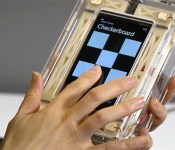
Microsoft wants its smartphone screens to touch you back

While your fingers are in firmly in control of hand-held devices, they’re guided strictly by your eyes — and Microsoft thinks that’s a waste of your sense of touch. Researcher Hong Tan found that using so-called haptics to add tactile sensations to screens can have some concrete benefits. For instance, by adding a keyboard-like “click” feeling to a Surface keyboard cover, one study showed that subjects could type faster and more accurately on it. Other potential uses include enhanced interfaces that let you feel resistance when you move a folder on the screen, or the ability to feel “textures” like rough cloth on a screen.
Several methods can be used to create such feedback. One way is to put a material that bends when charged under a screen to simulate a click, while another uses electrostatic vibration to put a cushion of air under your finger, making a surface feel smooth or sticky. I’ve experienced such haptic feedback myself, and while some sensations are accurate, others are just weird. There’s also the question of extra cost, weight and power consumption to consider. Still, Tan thinks it could find a place in specialized applications like devices for the blind — and Fujitsu even plans to launch a tablet using the tech as early as next year.
Filed under: Cellphones, Tablets, Mobile, Microsoft
Source: Microsoft Research
.CPlase_panel display:none;

Internet Explorer will block old plugins that leave your PC open to attack

Internet Explorer is generally safe for your web browsing needs these days, but that’s not necessarily true of the plugins it runs; one old piece of code could leave your PC open to attack. To that end, Microsoft has announced that Internet Explorer 8 through 11 will start blocking outdated ActiveX controls (Internet Explorer-specific add-ons) when an update arrives on August 12th. Much like what you see in Chrome, you’ll get a warning if a website wants to use an older plugin. While you can force the obsolete software to run, it won’t load automatically until you either upgrade or disable the warnings altogether. IE’s blocking will initially focus on ancient versions of Java, the most frequent target of web-based exploits, but it should expand to other plugins over time.
Yes, this likely won’t affect your day-to-day browsing if you use alternatives like Chrome or Firefox. However, it still promises a safer internet for everyone, not just Internet Explorer users — it should reduce the chances that botnets and other malware will spread. The big catch is that the update won’t affect the many people worldwide (roughly 25 percent in July, according to NetMarketshare) who run Windows XP. Unless they either switch browsers or get newer versions of Windows, they’ll remain susceptible to the rogue code that Microsoft is trying to stop.
Filed under: Internet, Software, Microsoft
Source: IEBlog
.CPlase_panel display:none;

Microsoft OneDrive arrives on Amazon’s Kindle Fire and Fire phone

Folks who fancy Amazon’s Kindle Fire and/or newfangled Fire phone just got another option for go-to cloud access. Microsoft has released a OneDrive app outfitting both of the aforementioned devices with easy access to stored files from the slate or handset. Of course, we’d surmise most OneDrive users have hitched their wagons to Redmond’s own fleet of OSes. At any rate, apps now exist not only for the web retailer’s gadgets, but for PC and Mac with mobile options on Android, iOS, Windows Phone and BlackBerry 10. Bases covered. Microsoft’s OneNote also sorts those trusty reminders and to-do lists across the Fire fleet, too. Ready to employ this version? Head over to Amazon’s Appstore to do just that.
Filed under: Software, Microsoft, Amazon
Source: OneDrive Blog, Amazon Appstore
.CPlase_panel display:none;
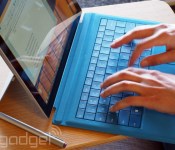
Microsoft’s Surface Pro 3 to hit 25 more countries as losses mount

Microsoft’s Surface Pro 3 is set to arrive in 25 more countries including the UK, most of Europe and China on August 28th. It’s been up for pre-order in many of those regions for a while now, but will finally start to ship by month’s end. The 12-inch model has been treated more kindly in reviews than the previous two models, despite some keyboard issues. However, sales figures for the new model haven’t been released, and past versions have fared poorly — in fact, it just had to write off $38 million in unsold devices, including a model it didn’t even launch. And according to Computerworld, the damage goes even deeper.
Based on filings, the site estimates that Microsoft has burned through a total of $1.7 billion since the Surface series arrived in 2012. About $363 million of that red ink came from the most recent quarter, although it’s likely that the company had to spend a lot to ramp up production of the Surface Pro 3 that started shipping at the tail end of that period. It’s bound to recoup at least some of that investment now that the Pro 3 has hit US store shelves and will soon arrive elsewhere.
We’ve reached out to Microsoft to see if it has any commentary on the numbers. Provided they’re accurate, though, they suggest that the crew in Redmond has been willing to endure a lot to get its first in-house PC range off the ground. Such a sacrifice wouldn’t be out of character for the company, mind you. Its cloud services (including its Bing search engine) were money-losers for years; its game console division only really came into its own during the Xbox 360 era. Microsoft may not be so patient with Surface when new CEO Satya Nadella is focused more on services than hardware, but you shouldn’t expect these slates to disappear in the near future.
Steve Dent contributed to this report.
Filed under: Tablets, Microsoft
Source: Computerworld, SEC
.CPlase_panel display:none;

Viber’s Snapchat-like voice feature comes to Windows Phone 8

Internet calling is what Viber’s mostly known for these days, although the Rakuten-owned service does invest heavily in the messaging side of things, too. Hold & Talk (aka push-to-talk), for example, allows Viber users to send quick voice messages to each other, with the touch of a button. And now, nearly eight months after it came to iOS and Android, the feature is ready to grace Windows Phone 8 handsets. This means contacts can communicate between themselves almost instantly, in a Snapchat-like way but with voice messages rather than pictures. Viber also made some design changes to the application, which brings the looks of it more in line with Microsoft’s desired guidelines after that WP 8.1 software refresh. Your move, Skype.
Filed under: Cellphones, Software, Microsoft
.CPlase_panel display:none;

Visual microphone can pick up speech from a bag of potato chips

You may want to be careful about the conversations you hold in the future; if you’re near a window, someone might be listening in. A team of researchers from Adobe, Microsoft and MIT have developed a visual microphone algorithm that picks up audio by looking for microscopic vibrations in video footage. The technique exploits the rolling shutter effect in digital cameras (where the sensor reads pixels one row at a time) to detect sound-related movements that might otherwise be invisible; the only gear you need is a camera that can record at high frame rates. It’s good enough to capture singing from a bag of potato chips, and musical tones from a potted plant.
Don’t worry about optical eavesdropping just yet. The experiment only got accurate reproduction with specialized cameras that shoot at up to 6,000 frames per second; an off-the-shelf device with 60fps recording can identify people’s voices, but it’s hard to make out words. Provided the technology reaches fruition, it would most likely be used by investigators that want to hear what suspects say when they’re not on the phone. It would be useful for more than surveillance, too, as team member Abe Davis believes the visual mic could identify a material’s properties without making contact. It’s definitely clever tech — let’s just hope that it’s used more for science than snooping.
Filed under: Cameras, Science, Microsoft
.CPlase_panel display:none;

Buffalo Bills coach has issues in first NFL game with Surface tablets

Last night’s Hall of Fame game was the first NFL preseason matchup of the summer. It was also the first time that Microsoft’s new plan to replace binders of printed photos with a fleet of Surface Pros on the sidelines was put into effect. As you might expect, implementing the tech hit a few snags. The so-called Sideline Viewing System provides images for examining pre- and post-snap formations by the opposing team between series, but the option wasn’t in the lineup at kickoff for Buffalo Bills head coach Doug Marrone. “I was told mine was going to work, and mine didn’t work,” Marrone said in a post-game interview. After remedying the issue, the coach was able to leverage the system during the second half, adding “I like it a lot.” Just like teams are ironing out on-field issues in the scrimmages leading up to week one, the new Surface system will need that time to smooth out kinks of its own.
Filed under: Tablets, Microsoft
Source: NBC Sports, WGR 550
.CPlase_panel display:none;

New Xbox One bundle gives you ‘Madden 15’ for free

Microsoft is all about football at the moment. Shortly after outing its Sideline Viewing System for pro players and coaches, as well as a new NFL app for Xbox One and Windows 8, the company has now revealed how it plans to tackle the arrival of Madden 15. Surprise, surprise: it’s an Xbox One bundle. Now don’t expect a unique console or anything like that; instead, the Surface maker wants to lure you in by including the game free as part of this “limited edition” deal. So, in exchange for $399, you get an Xbox One without Kinect and a digital download of EA Sports’ latest addition to the popular football franchise, plus three Pro Packs to use in Ultimate Team mode. The Madden 15 Xbox One bundle is set to hit shelves on August 26th, though you can pre-order right now from some online retailers, including the Microsoft Store.

Filed under: Gaming, Home Entertainment, HD, Microsoft
Source: Microsoft
.CPlase_panel display:none;

Microsoft has a new NFL app for Xbox One and Windows 8

The start of a new NFL season is just around the corner, and Microsoft’s been working hard to improve the experience for football fans on the Xbox One. What’s different now, among other things, is that the company’s NFL application is expected to be ready by Week 1; as opposed to last year, when it showed up in Week 12 because of the timing of the Xbox One’s launch. This time out, there are a lot more features too, with Fantasy Football and NFL Now, the league’s upcoming online video service, playing a huge role in the refreshed version. First and foremost, Microsoft wants its NFL app to feel like your own, which is why it lets you personalize it with content from team and players you’re interested in, as well as different media provided by NFL Network, NFL RedZone, NFL Sunday Ticket and, of course, NFL Now.
As far as Fantasy Football goes, the Xbox One now gives you quick access to a ton of stuff, including a feed of recent events (such as a touchdown catch by one of your receivers), exclusive in-game highlights and the ability to manage teams, all right from inside the app. At the moment, fantasy data is still only integrating with NFL.com leagues, but Microsoft did tell Engadget it’s constantly working to bring more services into the fold — think Yahoo Sports or ESPN’s fantasy offerings. Not surprisingly, the NFL League Feed (pictured above) takes advantage of core Xbox One features like Snap, allowing you to easily keep track of your Fantasy Football stats, even while you’re playing a game or, you know, watching an actual NFL matchup.
Furthermore, the very same application is also coming to Windows 8 devices for the first time. And although differences between platforms do exist, like no HDMI-in TV signal on tablets or PCs, a Microsoft representative told us that the NFL for Windows 8 and Xbox One apps are indeed the same, a universal one, if you will. Conversely, Xbox 360 owners can expect similar functionality to what’s available already — though there is going to be the addition of NFL Now, which brings more on-demand content from the National Football League to the aging console.
Microsoft has promised that its NFL-rich app will arrive in time for the regular season, both on Xbox One and Windows 8, but a “late August” delivery is what it is willing to commit to for now. Don’t you worry, it’ll be here soon enough.
Filed under: Gaming, Home Entertainment, Internet, HD, Microsoft
.CPlase_panel display:none;

Here’s how Microsoft plans to take over NFL sidelines

Are you ready for some football? Because Microsoft most certainly is. To go along with the introduction of a new NFL app for Xbox One and Windows 8, the software giant has also revealed how it plans to help professional coaches and players during games. As part of an ongoing partnership with the National Football League, which began last year and was reportedly worth $400 million over five years, Microsoft created what it calls a Sideline Viewing System. Naturally, the company’s own hardware is a key component to this; the new system is powered by Surface Pro 2 tablets, and it allows NFL teams to review plays instantly on the sidelines and up in the booths. For instance, say the quarterback goes back to the bench, the Surface can then be used to see the opposing team’s defensive formation during the most recent drive — and the same goes for the coaching staff that keeps an eye on the game from higher ground. Players are also able to draw on these images, making it easier for other members of the team to see something which stands out and needs to be checked.
While the new system has the potential to replace paper-printed materials on the sidelines, that’s not what the Redmond-based company hopes to accomplish, not yet at least. The Sideline Viewing System won’t be required to be utilized by NFL teams, but they will all have it at their disposal week in and week out, should they choose to want to integrate it into their workflow. A representative from Microsoft told Engadget the company doesn’t “want to force anything,” adding that, ultimately, it is up to individual players and coaches to figure out what they want to do and use the methods best suited for them.
Moreover, Microsoft says the Surface Pro 2s are owned by the NFL and not the teams, telling us that the tablets were heavily modified inside and out. Sure, these devices are capable of handling water, snow and extreme heat temperatures, but here’s one thing they can’t handle: third-party apps. In other words, don’t expect Johnny Football to be Instagramming while he’s warming up on the bench. Along those same lines, the Surface tablets on the field operate under a private network created by the NFL, which is how the league plans to keep the sensitive photo-viewing app closed off and away from any potential intruders.
It’s worth noting this isn’t the first time Microsoft has made its way to NFL sidelines, as it had done so in the past through the placement of really, really big Surface logos everywhere, as well as many other things behind the scenes. For now, we’d say this is much better. The Sideline Viewing System is making its debut tonight, during this year’s preseason opener game, between the Buffalo Bills and New York Giants.
[Image credits: Microsoft]
Filed under: Misc, Home Entertainment, Tablets, HD, Microsoft
.CPlase_panel display:none;
 AIVAnet
