


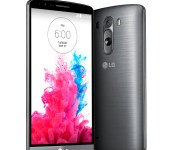
Verizon offering LG G3 for $99 with contract

Verizon will offer the LG G3 smartphone for $99 with a two year service agreement starting from July 17. Those who opt to buy the phone outright can do so for $599.99; EDGE customers can purchase for $29.99 per month over two years. Available in black and white options, the LG G3 includes 32GB internal storage and 3GB RAM. Additionally, the phone boasts a 5.5-inch Quad HD IPS display and quad-core Qualcomm Snapdragon 801 processor. Oh, and don’t forget that 13-megapixel rear camera with laser focus.
Verizon will also carry the LG G Watch on July 17, pricing the smartwatch at $229. Compatible with any Android smartphone running 4.3 or later, the Android Wear device comes in Black Titan and White Gold.
The post Verizon offering LG G3 for $99 with contract appeared first on AndroidGuys.
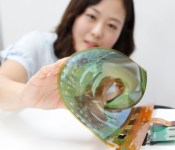
LG has a very flexible 18-inch display, promises 60-inch rollable TVs

It’s been a while since we’ve seen curved and flexible displays following LG’s G Flex and Samsung’s Galaxy Round smartphones. LG Display, is thinking bigger now. It’s announced that it’s been able to create an 18-inch OLED panel that has enough give and flexibility to roll into a tube that’s a mere 3cm across. The prototype currently has a resolution of 1,200 x 810, while it’s a new polyamide film on the back of the panel (instead of the typical plastic) which offers the panel substantially more flexibility — and it’s also even thinner.
Alongside the flexible demo, LG’s also crafted a transparent OLED panel which has triple the transmittance of existing see-through LCD displays — that means the picture looks much better and less hazy. According to LG Display’s SVP and Head of R&D, In-Byung Kang, he’s confident that “by 2017, we will successfully develop an Ultra HD flexible and transparent OLED panel of more than 60 inches.” Crank up that resolution and bring on the roll-up TVs.
Filed under: Displays, Home Entertainment, Science, LG

LG’s new wearable is a child tracker that lets parents listen in

Apparently, LG’s been working on a wearable other than the G Watch specifically for helicopter good, protective parents. It’s called the KiZON wristband, and it comes in a couple of cute designs aiming to entice kids to keep them on the whole day. After all, if it doesn’t stay on, moms and dads won’t be able to use the device (with GPS and WiFi) to monitor their locations through a phone or a tablet all the time. KiZON has functions other than serving as a tracker, though — kids can press its One Step Direct Call button to contact a pre-configured number.
It also works vice versa, but parents get an extra perk: if the kid doesn’t pick up within 10 seconds, the device puts the call through and lets them listen to what’s going on through the built-in microphone. The device will apparently last for 36 hours on a charge and parents will be notified via phone if the power falls below 25 percent. Its features might sound a bit excessive to some, but easily-concerned parents will be able to get one in the third quarter of 2014 when KiZON lands in North America and Europe.
Source: LG
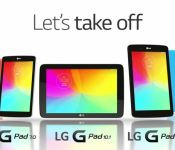
LG G Pad 10.1 begins global roll-out this month

LG’s G-Pad 8.3 Google Play Edition tablet from LG was a pretty kick-butt tablet. Too bad it is no longer available on the Play Store for purchase. LG continues to bring more G-Pads to market though. They announced a trio of tablets would become available and the talk was surrounding similar specs in all three sizes with the screensize being the variable. LG’s next big tablet adventure has been formally announced by LG with the release of the LG G Pad 10.1. The latest G Pad in the LG line of tablets is the largest to date and brings some of the LG G3 features and functions to the larger tablet side of things.
Spec wise you are looking at a 10.1-inch 1280 x 800 display that is powered by a 1.2GHz quad-core Qualcomm snapdragon processor and 1GB or RAM. It packs in 16GB of on-board storage with a removable miscro SD card slot for added storage. The rear camera is 5MP and the front facer pulls off 1.3MP. The tablet launches with Android 4.4.2 KitKat and is powered by a 8,000 mAh battery. While the over all specs aren’t high-end, top grade, need a credit card and a mortgage to purchase, the LG G Pad 10.1 has some interesting things about it. It will use the newer LG UX overlay, supports the Knockcode security options as well as QPair 2.0, which is probably one of the cooler features in my book. QPair is an app that pairs your phone to your tablet so you answer calls and texts from your tablet.
“Consumers use tablets differently from smartphones and we wanted to highlight the important role of entertainment in the new LG G Pad 10.1,” said Dr. Jong-seok Park, president and CEO of the LG Electronics Mobile Communications Company. “Tablets are increasingly being used as companion devices, which is why we made connecting the LG G Pad 10.1 to other devices so easy and convenient and why LG G Pad 10.1 offers the best core technologies of our G series smartphones.”
LG states the G Pad 10.1 will be available in the United States first, followed by other markets in Europe, Asia and Latin America this month. No price is mentioned as each retailer will be announcing pricing and specific dates on their own.
Via LG News Room
//<![CDATA[
ord = window.ord || Math.floor(Math.random()*1E16);
document.write('’);
//]]>
The post LG G Pad 10.1 begins global roll-out this month appeared first on AndroidSPIN.
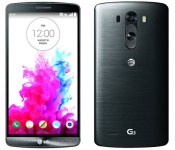
LG’s G3 and G Watch are coming to AT&T on July 11th

Sprint and T-Mobile may have been the first big US carriers to announce launch plans for LG’s G3 smartphone, but they won’t be the first to actually carry it. AT&T has revealed that both the G3 and the Android Wear-based G Watch will reach its stores on July 11th, with online orders beginning on the 8th. In both cases, pricing is par for the course. You’ll pay $199 on contract for the G3, or $29 per month in one year’s worth of Next installments; the G Watch will cost you $229 up front. The AT&T-native G3 doesn’t particularly stand out (unless you really, really like Big Blue’s logo), but it may be your best bet if you just have to get a quad HD-capable Android phone as quickly as possible.
Filed under: Cellphones, Wearables, Mobile, AT&T, LG
Source: AT&T
LG releases the G Pad 10.1 worldwide

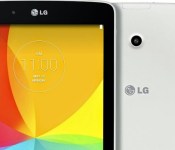
LG have today announced the worldwide availability of the G Pad 10.1, which will be made available initially in the United States, closely followed by Asia, Latin America, and Europe later this month.
Following on from their LG G3 handset, the G Pad 10.1 takes popular features such as Knock Code, Touch & Shoot, and QPair and brings them to a bigger tablet screen.
The LG G Pad 10.1 features a 10.1-inch screen (obviously) which is running at a rather disappointing 1280 x 800 resolution, and is powered by a 1.2GHz quad-core Snapdragon CPU. That’s coupled with 1GB of RAM, 16GB of internal storage, and a microSD card slot.
Whilst pricing hasn’t yet been announced for the LG G Pad 10.1, the company have said it will be announced for individual markets ahead of the launch dates in the respective countries.
Does the LG G Pad 10.1 appeal to you?
The post LG releases the G Pad 10.1 worldwide appeared first on AndroidGuys.

Verizon bound LG G3 Vista leaks

About a month ago we came across a report which said that Verizon will start selling LG G3 on July 17. Well, now we have some new info regarding Verizon and LG G3, at least in some form.
Let me explain, a new report came in containing an image of a phone which looks like an LG G3, but the leaker calls it LG G3 Vista. This image comes from a known leaker @evleaks and it resembles the G3, but there are some differences. The phone seems to lack a metallic look-alike finish on the back, this looks way different. That’s not the only odd thing when it comes to this leak though, the phone seems to lack dual LED flash on the back as well. Original LG G3 has it, this one on the other hand has only one flash on the back. Everything else seems to be in place though.
The question remains, is this going to be LG G3 under a new moniker with a different pattern on the back and with only one LED flash, or are they going to change the insides of the phone as well. Who knows, I guess we’re just going to have to wait for Verizon to release the thing and then we’ll see, if we don’t get more reports in the meantime that is.
Source: @evleaks
Via: TechnoBuffalo
The post Verizon bound LG G3 Vista leaks appeared first on AndroidGuys.
Android Wear review: Taking smartwatches in the right direction

When I was a tiny tot, I watched Knight Rider and pretended I was Michael Knight, talking to KITT on my watch. Yet now that there are real-life watches that can do even more things, I don’t find myself quite as excited as my 5-year-old self was. Smartwatches have been around for over a decade already (remember Microsoft SPOT?), but the category hasn’t evolved at the same pace as smartphones. It’s not because there’s a shortage of digital wrist-worn timepieces. The problem is that there’s no common platform for third-party apps, which means there’s little potential for growth.
There also doesn’t seem to be any vision. Some watches act as Android phones with SIM cards and tiny touchscreens, while others try to establish their own platform to entice developers. Still others have even tried to put fitness bands and smartwatches into one device, to limited success. Even worse, most of the watches on the market today are what you might call “fashionably challenged” — they simply aren’t attractive enough to entice the masses. Google’s solution is to extend its Android platform — which has very strong market share and developer support — to the wearables genre with Android Wear.
Why Android Wear?
Manufacturers don’t have to waste precious resources on developing a watch ecosystem from scratch. Android Wear provides a low-cost launchpad for more companies to come out with a smartwatch of their own. Take Fossil: It has little to no experience developing software, so the introduction of Wear opens up more doors for the company to produce fashionable smartwatches without pouring quite so much money into R&D. Meanwhile, other manufacturers are reportedly attacking the lower end of the market with cheap Android Wear watches.
In any case, that’s precisely what Wear promises: a wide variety of options in price, form and (we hope) fashion sense. But flooding the market won’t magically make smartwatches a success. So what will? They have to look good and make life easier.
Functionality

Android Wear wasn’t designed to replace your smartphone; it’s just meant to reduce the number of times you have to pull out your phone. With Wear, you can change your music, send and view emails and texts, dictate notes and reminders, answer or reject calls, keep track of a few fitness stats, look at your calendar appointments and ask a number of different questions.
Wear isn’t meant to replace your smartphone.
Wear treats your watch as a wrist-worn version of your phone’s notification bar. By scrolling down through the various cards displayed on my watch, I can see my most recent emails, Facebook messages, Google+ alerts, missed calls, number of steps I’ve taken today and how much time it’ll take me to commute home. Swiping to the left of these cards reveals actionable items (replying to emails, marking a text as read, looking at my fitness history and so on), while swiping to the right allows you to dismiss the notification entirely.

The watches also use Google Now. Cards will pop up with information about stocks, time to my next destination, a friend’s birthday, upcoming hotel reservations and when I need to leave for my upcoming flight. It’ll even show me my boarding pass. (This is through Google Now, but Delta and American Airlines just came out with apps that do the same thing.) The latter case is actually one of the best arguments I’ve heard yet for Android Wear — it’s easier to scan a boarding pass on your watch if your hands are full with luggage and you don’t want to take out your phone.

Wear also has voice search and Knowledge Graph access built in. Saying, “OK Google,” will prompt me to make a voice command. I can ask it to do a variety of tasks — send messages, set alarms and timers, show how many steps I’ve taken, pull up my calendar agenda for any given date, navigate a route and so on. I can also ask Wear random questions: When is the next Giants game? How tall is Mark Wahlberg? When was Chris Rock born? What’s the tallest building in the world? Essentially, this is all the same type of stuff you can do with Google Now on the phone; it’s just now accessible hands-free on your watch. If it can’t find the answer, it’ll pull up the top three search results for you to look up on your phone. Not quite as handy, but I suppose it’s better than nothing.
If a third-party app uses notifications, it’s technically going to show up on Wear, but its functionality will be limited unless the developer puts in some extra effort. The number of potential use cases will expand over time as more developers come out with apps of their own. Indeed, that’s one of the most exciting parts of the platform: It’s very basic at the moment, but its usefulness will grow as developer interest increases.
Even so, there are already some clever things you can do with Android Wear. You can check your finances, share your location with a friend through Glympse, take and read notes via Evernote, respond to tweet mentions with Tweetings, browse through a recipe on Allthecooks, activate your Phillips Hue light setup and get updated on the latest World Cup scores. I’ll stop there, but you get the point: These are just a few examples from the first wave of Wear-ready apps.

The number of Wear apps is steadily growing (you can find a comprehensive list here), but one of my favorites is Lyft. I told my watch to “call a cab” and it not only requested a driver for me, it also added a card that told me the driver’s name and estimated time of arrival, and gave me the option to tell the driver my destination before she picked me up. After the ride was over, I got a card showing me how much it cost and asking me to rate my driver.
Fortunately, fragmentation shouldn’t be as huge an issue with Wear as it’s been on smartphones. Excepting some manufacturer-specific clock faces, Google won’t allow the use of custom skins or user interfaces. If a company wants to build a Wear watch, it’ll need to follow Google’s rules. In theory, this should reduce the number of obstacles when pushing updates to the watch (which can be done in the About screen deep in the settings menu), and it’ll make for a consistent user experience across the board. It’s ironic, then, that Wear’s reach is limited because of fragmentation — the system is only compatible with devices running Android 4.3 or higher, which means 76 percent of current Android users won’t even be able to use Wear.
User experience

So far, we’ve seen Wear watches that are square (think: the LG G Watch and Samsung Gear Live) or circular (like the Moto 360, seen above). This is really a matter of personal preference; the user experience is the same either way. Since most watches will have small screens, Google knows it doesn’t have a lot of real estate to work with; thus, it’s tried to make the user interface as simple as possible. That’s why there’s typically only one card per screen, and when you swipe to the left, you’re only presented with one option per screen. Easy enough, right?
As minimal as the UI might be, it’s hard to come up with an intuitive user experience on a touchscreen watch, and Wear doesn’t do much to address that. There’s a significant learning curve, and even though there’s a tutorial the first time you use it, it’ll take a while to get accustomed to the layout. The use of voice commands is a massive improvement for the smartwatch experience because it reduces the amount of times you need to touch it, but it’s still impossible to get around your watch without doing a lot of swiping.
It’s hard to come up with an intuitive user experience on a touchscreen watch, and Wear doesn’t do much to address that.
Before anything else, you need to know this: You turn on the Wear screen by lifting up your arm. The watch interprets this act as a sure sign that you’re ready to look at something. (The Wear display is always on by default, which means you can look at the time whenever you want without activating voice commands by accident.) As you’d expect, you’re presented with a clock face. There are currently about a dozen faces to choose from; just long-press the face to look at all of your options.
You’ll first be greeted by the Context Stream. This is your vertical-scrolling list of notification cards. You can’t change the order in which these cards appear, and it seems as though many of them get put in a random order each time you scroll through the list. Cards that appeared near the top of the list would often sink farther down the next time I checked my watch, even though no new notifications had popped up.

If a notification has more information than a single card can manage, its corresponding card can be expanded. You’ll have to be careful with long emails — touch the card to expand it and you’ll find yourself scrolling down for an eternity before you get to the next card. (This is one of those times in which it’s just easier to whip out your phone and read it on the larger screen.) Some apps, such as Gmail and Calendar, will stack cards on top of each other; if you have six events coming up, Wear will show you the first and then feature a small button underneath that indicates you have five more. Touch this button and you’ll see all six events laid out vertically. If you need to take action on one of them, you’ll have to tap the individual event again before scrolling. You can’t swipe to dismiss individual events, however — just as on your phone, one swipe will dismiss all notifications for that particular app.
Saying, “OK Google,” or tapping the open space at the top of the Context Stream will prompt you to give a voice command. I explained earlier this feature can do, but if you need help figuring out what to say in the heat of the moment, there’s a handy set of examples in a scrollable list. (And yes, scrolling defeats the purpose of being hands-free, but your reliance on this cheat sheet will decrease as you get used to Wear.) You can even tap on each example and Wear will ask follow-up questions; for instance, if you tap the option to send a text, it’ll ask you to whom you want to send it and what you want to say.
Oddly, apps and settings are hidden away at the very bottom of this list. If Google is trying to encourage developers to create apps for Wear, it sure has a weird way of expressing its gratitude. Granted, a lot of apps don’t do much when you access them this way, but it’s still confusing at first; if you’re looking for a specific app, you’re better off searching for it with voice commands (e.g., “open Evernote”).
If you rely heavily on your phone for notifications, be prepared for some good and bad news. The good news is that you have access to all of those notifications on your wrist, so you don’t have to take your phone out. The bad news is that while you can filter out certain apps from sending you notifications (bye-bye, Candy Crush Saga invites), you can’t pick and choose which notifications you receive from within a particular app — in other words, the watch can’t decide which emails make it to your watch and which ones don’t, so you have to see all of them.
When I pull down from the top of the screen, I see a shade with battery percentage and today’s date; I can also mute my notifications if I continue pulling. This is handy when I don’t want to be distracted or am trying to sleep, but I wish Wear offered quiet hours during which it would automatically turn off notifications when I go to bed. (That’s if my battery lasts through the day and night, which wasn’t always the case with the early Wear watches I’ve played with.)
The Samsung Gear Live comes with a button on the side that lets you turn the display off, but covering the screen with your palm will do the same thing on every Wear device.
Companion app

To pair the watch with your phone, you’ll need to download the Wear companion app through the Play Store. It’s essential for setting up your watch, but you’ll find little use for it otherwise. The main screen shows a link to Wear-compatible apps in the Play Store and a list of eight voice actions. You can choose which app to use for each particular command, which will come in handy as more apps start showing up. So, let’s say Uber adds the same ability to call a car as Lyft does, and I want to use that service instead; I’d have to select the “call a car” voice action and choose Uber from the list of possible apps, so that Wear doesn’t keep defaulting to Lyft.
The companion app also has a list of settings tucked in the top-right section of the app. You can mute specific apps, as mentioned earlier; turn off the always-on display; silence notifications on your phone when the Wear is connected (why get vibrations on your wrist and in your pocket?); show calendar events; and keep the top card from showing up when your display is dimmed. Finally, you can use the app to pair a different Wear watch if necessary.
The app doesn’t have an option to manage watch apps, which seems odd since there isn’t a way to do this on the watch either. Perhaps it’s because Wear-compatible apps automatically get installed on your watch once you’ve downloaded them onto your phone. This seems like an oversight. There may be certain apps that you barely use on your handset and have no interest in using on your watch; why not give users the option to get rid of the unnecessary clutter?
Challenges

Essentially, Wear is a version 1.0 product, which means there’s still a lot of work to be done. It’s been a good experience thus far, but there are plenty of ways that Wear simply doesn’t fit the bill, and you’ll need to be aware of them if you’re going to plunk down $200-plus for a smartwatch.
First, there’s the excessive touching. If users have to go through the effort of tapping or swiping the screen on a regular basis, there’s little incentive to use the watch instead of simply pulling out a phone. Most activities on Wear eventually point back to your handset anyway: Nearly every card in the Context Stream (excepting the step tracker) has an option to open on your phone, as if it’s somehow faster to swipe down to the card, swipe across to that button, tap on it and then pull out your phone to access it. If you’re going to use your phone, you might as well just whip it out from the start. What’s more, if you give a voice command that isn’t included in the supported list, or if you ask a question that can’t be found in the Knowledge Graph, the watch provides you with a series of three cards, each one representing a different website that — shocker — you can tap and open up directly on your phone. Congratulations, you just wasted a minute by using your watch.
If you’re going to use your phone, you might as well just whip it out from the start.
I’ll discuss this more in the next section, but battery life is a big challenge here. There’s a huge amount of computing and processing going on behind the scenes, on a colorful, capacitive touchscreen that by default doesn’t turn off. Throw in voice commands, keyword detection and a tiny battery, and it makes sense: Of course the battery life is going to suffer. The problem is, users aren’t going to want to plug in their watch as often as their phone. Until Google can find a way to extend the battery life by a few days, Android Wear will struggle to be anything more than a niche product.

Navigation is also an issue. Google Maps is technically compatible with Wear, but it only shows one step at a time. Given that card-stacking is an option on other apps, it’d make sense to use this style to display upcoming steps along your route so you could plan ahead. Swipe to the left to reveal a high-level map of the entire route that’s void of any useful details; my brain comprehends visual maps more quickly than text, so I’d find this screen more useful if I could zoom in closer.
Additionally, voice commands for navigation will automatically default to driving directions. You can specify if you want biking or walking. Oddly, if the phone can’t find a route, it doesn’t bother telling the watch — you simply get taken back to your clock face as if nothing even happened. And when I asked Wear for walking directions from my office to the Golden Gate Bridge, it presented me with a card with Google search results for three unrelated websites. (OurSausalito.com? Really?) Unfortunately, transit directions aren’t supported either.
I’ve already mentioned the problem of excess notifications. The longer my Context Stream, the more inconvenient the watch experience becomes. Not only am I wasting time with countless swipes, but my anxiety increases when my wrist is vibrating a hundred times a day (this is actually a low estimate for me). There’s no VIP list and no way to block out unimportant emails. It’s possible to mute specific apps, but that’s of little help when you’re getting a flood of messages that don’t require your immediate attention. At least when you do dismiss a notification, it disappears from both the watch and the phone.
Hardware: Samsung Gear Live and LG G Watch

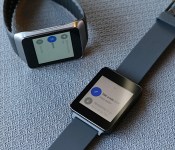
LG and Samsung are the first companies to produce Wear watches, and both are available in the Play Store (LG’s G Watch is $229 and Samsung’s Gear Live is $199). A third watch, the Moto 360, was shown off at Google I/O last week and will be released later this summer. I’ll touch briefly on the G Watch and Gear Live; since Google won’t allow custom firmware or user interfaces, you’ll essentially get the same Wear experience on both watches.
When it comes to firmware, the only differences you’ll see between the two are in the clock faces. That said, Samsung’s found a loophole by adding its own stopwatch and compass, so you can choose to use either those or the stock versions. In any case, those are minor alterations, so the important points of differentiation are in the hardware, with each offering a unique personality.
The Gear Live is definitely your best looking option. At least, until the Moto 360 comes out.
Which one is better? Suffice to say, the two watches each have trade-offs you’ll need to weigh, but the Gear Live is definitely the best looking (at least, until the Moto 360 comes out). Their internals are similar too:
| Samsung Gear Live | LG G Watch | |
|---|---|---|
| Display | 1.63-inch sAMOLED, 320×320 pixels | 1.65-inch IPS LCD, 280×280 |
| Battery | 300mAh | 400mAh |
| Processor/RAM | 1.2GHz dual-core Snapdragon 400; 512MB RAM | 1.2GHz dual-core Snapdragon 400, 512MB RAM |
| Water resistance | Yes, IP67-certified | Yes, IP67-certified |
| Dimensions | 37.9 x 56.4 x 8.9mm, 59g | 37.9 x 46.5 x 9.95mm, 63g |
| Storage | 4GB internal storage | 4GB internal storage |
Both have the same dual-core 1.2GHz Snapdragon 400 processor, 512MB of RAM and 4GB internal storage. They each offer interchangeable wrist straps — I especially appreciate this on the Gear Live — and both feature a square shape. They’re also IP67-certified, which means they have the same water and dust resistance as the Samsung Galaxy S5. I wouldn’t take either one scuba diving, but you’ll be fine wearing them while washing dishes or taking a shower.
Because both watches have the same engine underneath the hood, I didn’t notice any difference in performance. They both smoothly, with only the occasional frame skip. In my comparisons, apps loaded in the same amount of time, and each one processed voice commands quickly.
I’ve already alluded to battery issues, but let’s get specific. The Gear Live’s battery is a mere 300mAh, while the G Watch has a capacity of 400mAh. That sounds small, and it is small. I strapped both watches on my wrist and used them during a full workday. My to-do list included four navigation routes, at least a hundred emails, hailing a Lyft driver and countless voice commands. When I finally got home 12 hours later, the G Watch had 20 percent life remaining, while the Gear Live had 15. After leaving them on mute overnight — a seven-hour event — I woke up to find the G Watch at 5 percent and the Gear Live at 2 percent. All told, LG’s watch lasted around 90 minutes longer than Samsung’s. The G Watch almost made it a full 24 hours, while the Live came in at roughly 22.
On weekend days with lighter use, I was able to push the life of both watches another eight hours or so, at best. There are a few ways to extend your battery life further, but since they significantly reduce how useful the device is, it completely defeats the point of using a smartwatch. You can turn off the always-on display setting so you’re just staring at a black screen whenever the watch sits idle. You can turn down the brightness (I tested the watch at about 60 percent), limit the number of routes you navigate, mute notification-heavy apps and so on. But if you’re constantly worrying about battery life, you’re basically chained to yet another device.
Samsung Gear Live

You might confuse the Gear Live for one of its Tizen-based siblings, the Gear 2. It has a chrome band around all sides of the display, but it’s all for show; you won’t find any cameras or buttons here. There is, however, a button on the right-hand side, which powers off the active display with a quick press and brings up the settings menu when you hold it down for a few seconds. (I’d love the option to map this button to other actions.) Just like the latest Gear watches, the Live comes with a heart rate sensor on its belly, along with some pogo pins to connect a charging cradle.
It has a 1.63-inch Super AMOLED display, with a resolution of 320 x 320. Breaking out my trusty pixel-density calculator (or cheating by looking at Google’s product page), this translates to 278 ppi, which is actually good for a smartwatch. Of the two watches, the Live is easily the sharpest and most color-saturated, but it’s also a fingerprint magnet and hard to see in direct sunlight.
Because the back of the Gear Live has a slight curve on the top and bottom, it’s more comfortable to wear than the G Watch. That is, as long as you don’t count the miserable wristband that feels like you need five hands and divine intervention to snap together. It’s a mere four grams lighter than LG’s watch, but a full millimeter thinner.
The charging cradle is nothing new for Samsung, but it’s just as annoying. For a device that you’ll need to charge once a day, it’s not so easy to manage. It’s a tiny cradle that has to be fitted just right onto your watch, and then you have to make sure it’s snapped in securely before plugging the charger in.
LG G Watch

The G Watch has many redeeming qualities, but attractiveness isn’t one of them. Featuring Gorilla Glass 3, stainless steel on the sides and a polycarbonate back, it’s very solidly built, but it’s also a boring square with no stand-out features. In fact, though, this was very much done on purpose: According to LG’s design team, the G Watch is designed to help content look like it’s floating above the screen. Extra tweaks often distract from the point of the product. I get the concept, but unfortunately it also works the other way — the lack of any design whatsoever can often be just as distracting. It’s a stark contrast to the gorgeous LG G3, which successfully found the middle ground between too flashy and not flashy enough. This watch falls in the latter category, and it’s going to struggle to stand out from the Moto 360 when it launches. (Admittedly, the white option is a little more aesthetically pleasing than the black one.)
The IPS LCD screen is slightly bigger than the Gear Live — 1.65 inch versus 1.63. The difference in resolution, however, is much more noticeable. At 280 x 280, it’s easier to see pixelation without squinting. On the upside, it’s more readable in bright sunlight than the Gear Live, and the screen has brighter whites. Then again, the darks aren’t as dark as the Gear, and the colors aren’t nearly as saturated.
Like the Gear Live, the G Watch also requires a separate cradle to charge up, but LG smartly uses a magnetic base that’s much easier to attach the watch to than that of its Korean rival. The magnets do a great job of holding the watch in place.
The company’s pricing strategy is a little confusing. It’s $30 more than the Gear Live, even though it doesn’t add any features or performance benefits (aside from a meager increase in battery life). I’d be surprised if this cost doesn’t come down quickly — especially once it has even more competition from the Moto 360 — but in the meantime, LG is facing an uphill battle by selling its premier smartwatch at a higher price.
Wrap-up

Android Wear has me more excited about the future of smartwatches than any other platform or device. It’s more solid than I expected in a first-gen product, and of the options on the market, it has the most opportunity for growth. Wear enjoys a universal user experience; it’s backed by a robust operating system with tons of user and developer support; and there’s buy-in from manufacturers.
Still, there are plenty of issues that need to be fixed. Few users will be content charging their watch on a daily basis or wasting time scrolling through endless cards and unwanted notifications. A smartwatch should make life simpler, more productive and more efficient, and at the present time, it’s just as easy — if not more so — to do most things on a phone. The platform will blossom as more apps come out, but it still has a long way to go before shoppers will be willing to spend hundreds of dollars on accessories.
For now, Wear is the best OS for Android users who are in the market for a smartwatch, but since these devices aren’t necessities, they’ll need to be more stylish and add more convenience to your life if they’re going to attract the average consumer. Unfortunately, the Gear Live and G Watch just don’t have what it takes for Wear to go mainstream, although I’m holding out hope for the Moto 360.
Filed under: Wearables, Wireless, Mobile, Samsung, Google, LG

Sprint circles July 18 for LG G3 launch

Sprint on Thursday announced that its version of the LG G3 will arrive on July 18. Priced at $600 outright, customers can purchase it with 24 equal payments of $25 each. Pre-orders for the device begin as soon as July; Sprint will give you $150 gift card if you do so before July 24. Order one from July 25 to August 14 and you can still earn $100 reward for yourself. Note that you’ll need to register for the gift card and have to wait a few weeks.
To help kick things off Sprint is giving away 20 of the LG G3s. If you’re interested in the smartphone and want to try your luck, head to Sprint’s website now.
The post Sprint circles July 18 for LG G3 launch appeared first on AndroidGuys.

Sprint launching the LG G3 on July 18th, pre-orders July 11th
The LG G3 is a pretty hot device since its announcement. Slowly, but surely, the G3 is getting release dates and launch times on the various carriers. T-Mobile has it pegged for July 16th and Verizon only has a sign-up page available. Now Sprint has jumped in and is offering up a release date and the pricing for the new LG flagship.
 On July 18th new and existing Sprint customers will have their chance to pick up the Quad HD screen toting marvel. If you can’t wait to spend your money, they will also be offering up pre-orders on July 11th. With Sprint Easy Pay you are looking at $0 down and $25 a month to pay it off over 24 months. You will have two color options according to their press release, an exclusive Shine Gold or Metallica black. We should also probably mention that it is also Sprint Spark enabled, if you happen to live in one of the few locations that it works in.
Now we just need to know what Verizon and AT&T are doing with it. Both are going to stock the device, we just don’t know on what date. A rumor pegs Verizon for July 17th. That would land right in the middle of T-Mobile and Sprint. Hopefully AT&T is right in there somewhere too.
Via Sprint
//<![CDATA[
ord = window.ord || Math.floor(Math.random()*1E16);
document.write('’);
//]]>
The post Sprint launching the LG G3 on July 18th, pre-orders July 11th appeared first on AndroidSPIN.
 AIVAnet