



Lenovo’s new flagship features Quad HD screen, metal body and huge battery

Lenovo isn’t exactly well-known for its smartphones this side of the Pacific, but it’s got a solid following in Asia. Now, Motorola’s soon-to-be parent company is showing off more of its mobile chops with a six-inch Quad HD (2,560×1,440) flagship device called the Vibe Z2 Pro. Besides the super high-res display, the Pro’s not lacking in other features: For starters, it’ll come with a metallic brushed-weave unibody frame and 4,000mAh battery, which is more than generous even with the phone’s large chassis (to compare, the Samsung Galaxy Note 3 is 3,200mAh and the HTC One Max is 3,300).
At 7.7mm, the Pro is reasonably thin (and hopefully not so thin that it’s difficult to hold, like on the Sony Xperia Z Ultra), and it weighs 179 grams (6.31 ounces), which isn’t out of the ordinary for a metallic phone of this size. The Android 4.4 device will pack a 2.5GHz quad-core Snapdragon 801 chipset, along with 3GB RAM and a 16MP rear camera with dual LED flash and optical image stabilization. It comes with dual-SIM capabilities, but doesn’t offer a microSD slot; 32GB internal storage is all you get here.
The pro will come in titanium, gold and black color options and will be available starting in September. Lenovo hasn’t specified pricing or availability, but we’re guessing that the flagship won’t wander too far away from Asia.
Filed under: Cellphones, Wireless, Mobile, Google, Lenovo
Via: GSMArena
Source: Lenovo (G+)
.CPlase_panel display:none;

Lenovo Vibe Z2 Pro announced with 2KHD 6-Inch Display
Lenovo has been one of my favorite manufacturers for a quite a while. We don’t see much in terms of their phones here in the states, but they are quite large overseas. I always hope that one day they will hit it big over here, which I assume will start to happen once all the Motorola dealings are officially completed. Until then, I can keep an eye on what they are doing and be excited from a distance. Lenovo has just announced their next flagship device and I think it has some great potential. Meet the Levono Vibe Z2 Pro.

She looks pretty hot. The Vibe Z2 Pro has a 6-inch QHD 2560 x 1440 IPS display with a 490 ppi (pixel per inch). It is utilizing a Qualcomm Snapdragon 801 processor clocked at 2.5GHz, 3GB of RAM and 32GB on-board storage. It does skip the constantly debated Micro SD card slot though.
The Vibe Z2 Pro also brings a 16MP rear camera with dual LED flashes that is capably of recording 4K video. It runs Android 4.4.2 out of the box and is powered by a built-in 4,000 mAh battery. All of that is packed inside a device that is a metallic brushed -weave unibody that is only 7.7mm thin and weighs 179 grams. It will come in three color variations; Titanium, Gold or black.
The device will be a dual-sim sporting variety and is scheduled for launch in September with a price tag in Russia of about $834 USD.
I would certainly sport that monster if it ever made it stateside at a traditional high-end device price tag. Would you?
Via GoAndroid
//<![CDATA[
ord = window.ord || Math.floor(Math.random()*1E16);
document.write('’);
//]]>
The post Lenovo Vibe Z2 Pro announced with 2KHD 6-Inch Display appeared first on AndroidSPIN.
.CPlase_panel display:none;

Xiaomi, not Samsung, makes China’s smartphone of choice

Xiaomi has been a significant contender in the phone world for a while, but it’s now safe to say that the Chinese device maker has joined the big leagues. Canalys estimates that Xiaomi shipped more smartphones Samsung in China during the second quarter of the year, making it the top vendor in its home country. Simply put, Xiaomi is a champ at making cheap yet desirable handsets — its budget Redmi series has done a lot to boost sales, and even range-topping devices like the Mi3 (and now Mi4) are much more affordable than alternatives from the likes of Apple and Samsung.
The surge might have even been enough to make Xiaomi one of the biggest phone builders on the global stage. While IDC’s data still doesn’t include Xiaomi in the top five, Strategy Analytics believes that the company jumped into fourth place ahead of LG. Whichever study is on the mark, the data makes it easier to understand why Samsung’s profit took such a big hit in the spring — the Korean firm is up against at least one Chinese rival that’s firing on all cylinders.

Filed under: Cellphones, Mobile, Samsung
Via: Wall Street Journal
Source: Canalys
.CPlase_panel display:none;

Samsung’s phone market share takes a bruising as Chinese rivals surge

Samsung warned that its smartphone sales weren’t that great this spring, and now we have the numbers to show just what the company meant. IDC estimates that Samsung’s smartphone shipments saw a rare year-over-year drop in the second quarter, taking it from a lofty 32.3 percent market share down to 25.2 percent. That’s still enough to give it a comfortable lead, but a shock for a company which is used to growth. The cause, analysts say, is the rapid rise of Chinese brands that cut directly into Samsung’s low-end business. Huawei claimed 6.9 percent of the smartphone space after doubling its shipments, thanks in part to heavy discounts on phones like the Ascend P7; Lenovo jumped to 5.4 percent on the back of both budget phones at home as well as rapid expansion abroad.
Both Apple (11.9 percent) and LG (4.9 percent) lost share, although IDC notes that their shipments were up. Also, neither firm was expected to have a stellar season. LG only just launched its hot-selling G3 flagship at the tail end of the spring, while many expect Apple to jumpstart sales with at least one new iPhone in September. It may be trickier for Samsung to bounce back, however. The spring was supposed to represent a big spike in sales as the Galaxy S5 arrived, but that didn’t materialize. The company is pinning its hopes on both a new Galaxy Note and a mountain of budget phones. However, historically, neither has sold as well as the Galaxy S series.

Filed under: Cellphones, Mobile, Apple, Samsung, LG, Lenovo
Via: AppleInsider
Source: IDC
.CPlase_panel display:none;

High-end Lenovo K920 expected in early August

Lenovo is up to something big, and we should expect it to launch around August 5th. We’ve seen images and heard countless rumors of the Lenovo K920 in the past, and now we have an (almost) official launch date. For those who aren’t familiar, the Lenovo K920 is a rumored high-end smartphone that will push… Read more »
The post High-end Lenovo K920 expected in early August appeared first on AndroidGuys.
Lenovo Yoga Tablet 10 HD+ Review

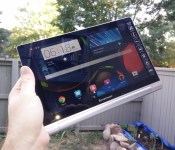
Lenovo is back again with another addition to the Yoga tablet line. It’s safe to say that Lenovo’s top-of-the-line Android tablet is better than ever. As we mentioned with our review of the Yoga Tablet 10, Lenovo is pushing the envelope of design, which could be good or bad depending on which way you look at it. The new Yoga Tablet 10 HD+ has some nice upgrades from the previous model, but still falls short in some of the same places.
Hardware
As with the previous 10-inch Yoga tablet, the build quality in the HD+ is excellent. The device features a 10-inch 1920×1080 display, a 1.6 GHz quad-core Qualcomm Snapdragon 400 processor, 2 GB of RAM, 8 MP rear-facing camera and 1.6 MP front-facing camera.  The display is pretty sharp and bright, but one thing that could be annoying to some is its glossiness. I didn’t find it a problem when using it inside or in shaded area. It also has some decent viewing angles, which is always a plus. One of the best features, which also could be considered its worst, is the tablet’s design and like the previous model, it’s extremely thin at its thinnest point and up to about 3/4-inches at its thickest. The thickest part of the device is sort of a cylinder with the power button on one end and the 3.5 mm headphone jack at the other, which it’s also a handle for the device. This is a good idea theoretically in my opinion and great comes in handy when holding the device or transporting it, but it’s a slightly awkward feeling if you’re holding the device and using it in portrait mode. The thick side also houses the built in kickstand that is still a bit hard to engage, as with the previous model. If you are using the device on a table or to have it sit up on your lap, it’s perfect, but if you wanted to have it in a position that you could type on it, it’s a bit too tall in my opinion with the kickstand out. If you were using it the same way but without the kickstand engaged, it’s seems to be too small of an angle. To give you an idea of how these angles differ, think of an iPad with its Smart Cover as a happy medium just about in-between both of these angles which seem either slightly too large or small for completely comfortable typing.
  The tablet comes with 32 GB of built-in storage that is more than enough, plus hidden behind the stand is a compartment where you can add additional storage with up to a 64 GB MicroSD card. I mentioned above that the HD+ has a Snapdragon 400 processor and 2 GB RAM, which is more than enough to satisfy the standard user. Just about any app I used on the device ran with no issues, including games like The Dark Knight Rises. Comparing TDKR running on this with it running on my OnePlus One with a Snapdragon 801 processor, it’s clear which is the winner, so as you can imagine, the graphics on high-end games are reduced and it’s just slightly choppy. Games that aren’t as graphics intense like Leo’s Fortune and even Horn ran beautifully. The cameras on the device are fairly decent for a tablet cameras. I didn’t test them extensively, but the photos I took turned out pretty clear and were decent in lower light. You should have no problems video chatting with the front-facing camera either.
  Two of the last things I want to mention about the device is that the 9,000 mAh battery is fantastic as well as the fact that it has front-facing speakers. In use, the tablet gets about 18 hours of battery life, but I’ve seen the tablet display that it had about 38 hours of battery life when I didn’t use it a lot. There were times when I didn’t use it for a week or more and barely any power was lost, so it works great in standby mode. The speakers on the device are loud and were great for tablet speakers, especially when I tested it out watching Transformers: Dark Side of the Moon.
Software
On the software side of things, the device is running Android 4.4.2. For most of the review, it was running Android 4.3 Jelly Bean then right when I was finishing writing this up, it got updated to Android 4.4.2 KitKat. Lenovo had mentioned that the device would be receiving the KitKat update at the end July, which was about an 866 MB update One nice thing about the software on the tablet, although not the absolute latest version of Android KitKat, is that it’s pretty close to a stock experience, Before the update, it had tablet style menus in Settings but the upgrade brought a Nexus experience to the Settings, only with a slightly different color scheme .The desktop and even on-screen navigation buttons are also Nexus-style as well, so you’ll be right at home. The only downfall with the launcher is that it’s not great if you have a ton of apps or aren’t very good at organizing them since there is no app drawer, much like on the iPad or MIUI. Don’t forget, you can always install a third-party launcher so it’s not the end of the world. The notification drawer and Quick Settings are stock as well, with slightly different icons. Some nice additions that Lenovo added to the software is the Smart Side Bar that can be accessed by swiping from the bezel onto the screen on either side as well as the Dolby app that allows you to adjust sound settings for numerous modes such as for movies, music, games and voice, plus you can make custom configurations as well. The Smart Side Bar gives quick access to your videos, photos and books, recently used apps and sound and visual modes. The KitKat update appears to have made the sidebar work much better than previously as there were times when I couldn’t get it to come out when it was running Jelly Bean. Also, before the update you could double tap while on your homescreen and recent apps would appear, but that appears to have been taken out of the software, unless there is a setting somewhere that I couldn’t find to turn it back on.  Another thing that Lenovo added to the software is the ability to run multiple apps at once by having one open then opening the recent apps and sliding it to the window.pane. I had no trouble watching a movie and surfing a webpage a the same time.
Accessories
Along with the tablet for review, I also received a green and grey sleeve. While it won’t really protect the tablet from huge falls, it will protect it from scratches. The HD+ fits in the sleeve nicely, even with its “unique” design. It also closes magnetically so you don’t have to worry about the flap opening. 
Overall
Looking at both the hardware and software together, it’s not a bad tablet for $369. The Lenovo Yoga Tablet 10 HD+ is a worthy upgrade from the previous model, but still has some of the same shortcomings with the stand and software. As we said with the Yoga Tablet review, if you favor battery life over raw power, then this is worth considering. There also aren’t many tablets with an included stand, front-facing speakers and Android 4.4 KitKat.
The post Lenovo Yoga Tablet 10 HD+ Review appeared first on AndroidGuys.

You can now unlock your Motorola phone with a ‘digital tattoo’

Hate unlocking your Android smartphone so much that even Face Unlock or Skip feels like too much of a hassle? Motorola just came to your rescue. The company has partnered with VivaLnk to launch the previously teased Digital Tattoo, an NFC-based skin tag that unlocks your phone (currently limited to the Moto X) with a quick tap. The tattoo can stay on your body for up to five days, and it should survive abuses like showers and sweat-laden runs. It’s a clever approach that might be appealing if you’re fed up with PIN codes and patterns, although the back-of-a-napkin math suggests that you’re paying a lot just to save a couple of seconds when checking your email. VivaLnk is asking $10 for packs of 10 tattoos, or enough to last 50 days — you’ll have to spend $80 to get through a whole year. It could be useful for those busy days when you’re constantly waking up your handset, but you might be better off rolling that money into a Moto 360 or your next big phone upgrade.
Filed under: Cellphones, Wearables, Mobile, Google, Lenovo
Source: Official Motorola Blog

PC giant Lenovo halts US sales of small Windows tablets

Lenovo has pulled all 10-inch and smaller Windows tablets from US shelves, citing a lack of demand. The world’s largest Windows computer maker had two models on the market: the 8-inch, stylus-equipped Miix 2 and the ThinkPad 8. A spokesman told PC World that it’ll shuttle remaining stock of both of those models over to developing countries where “demand has been much stronger.” Lenovo will continue to sell all its other Windows-based tablets stateside, like the 10-inch Miix 2 convertible and ThinkPad 10, saying those models are selling well stateside. It’s fair to say consumers won’t miss the ThinkPad 8 anyway, as the model was saddled with terrible battery life and other issues. Ironically, Microsoft recently made Windows free for devices 9-inches in size or smaller — but clearly the price was just one issue consumers had with small Windows tablets.
Source: PC World
 AIVAnet