


Best Buy Offering Free 16GB iPhone 5s With Trade-In of iPhone 4s or 5 [iOS Blog]
Best Buy is introducing another special deal this weekend, offering a minimum of $150 for trade-ins of working iPhone 4s and iPhone 5 smartphones. Customers must buy a new smartphone with two-year contract on AT&T, Sprint or Verizon, however. The offer is good through the end of the day tomorrow, March 1. The chain has also reduced the price of the base 16GB iPhone 5s to $150 to match the buyback.

With a number of carriers moving away from two-year contracts for its customers — instead focusing on non-subsidized, but cheaper, monthly plans — it may be affecting the bottom line of retailers like Best Buy because plans like AT&T Next do not, in many cases, require customers to pay money up front.
For upgrade-eligible iPhone-owners looking to move to the iPhone 5s, this promotion could be an inexpensive way to do that.
     |

Instapaper update for iOS lets you send media to your Kindle and TV

Instapaper’s already broad device support has just grown a little bit broader. The service’s updated iOS app lets you send articles to Kindle for reading on one of Amazon’s devices, and you can push videos to your big-screen TV through AirPlay. Even if you’re happy with catching up from your iPad or iPhone, you may also like a new option to auto-renew your Instapaper subscription. It’s not the most life-changing Instapaper update we’ve seen. Stay tuned, though — the developers promise that their next release will be the biggest since Betaworks acquired the app last year.
Filed under: Cellphones, Tablets, Mobile
Via: The Next Web
Source: App Store, Instapaper Blog
FCC Speed Test app for iOS lets the government track your iPhone’s network performance

Downloading an app from the federal government might not top your list of priorities at the moment, but if you’re looking to tick that public service box without a need to worry about measly pay, background checks and furloughs, the FCC could sure use your help. That org’s latest venture, the FCC Speed Test app for iOS, delivers yet another connectivity benchmark tool to iPhone and iPad users. This free download also benefits the government’s Measuring Broadband America program, however, enabling the FCC to build out a public database of network performance across the country. Unlike its Android counterpart, this iOS app doesn’t test performance in the background, so you’ll need to fire it up to see how well your cellular or WiFi connection is doing. It’s available from the App Store today.
Source: FCC

Oral-B Shows Off iPhone-Compatible Smart Toothbrush at Mobile World Congress [iOS Blog]
Proctor and Gamble first introduced its smartphone-connected Oral-B toothbrush earlier this month, but the company is on hand at the Mobile World Congress conference in Spain to give attendees a look at the upcoming device.

The Oral-B SmartSeries 7000 connects to the Oral Blue iPhone app using Bluetooth 4.0, allowing the app to provide real-time guidance on brushing habits. It records brushing activity on a chart that can be shared with dental professionals to create personalized brushing routines and because the Bluetooth connectivity works both ways, the app can also be used to program the toothbrush.
Engadget went hands-on with the Oral-B SmartSeries 7000 to show off how the app interacts with the brush itself. While brushing, the iPhone app runs a timer in real-time to keep track of how long a user has brushed and it also includes a stream of news articles to keep users entertained while brushing.
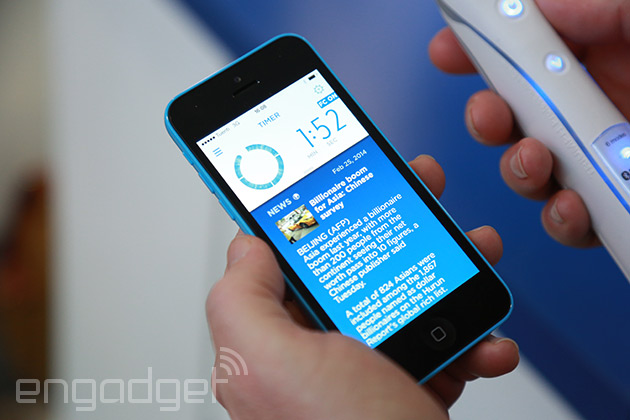
In case the sheer boredom of brushing your teeth for that long is too much to bear, you can also thumb through a stream of news articles or local weather reports (no, really) to help you hang in there. Turns out, just furiously mashing those bristles into your teeth isn’t great either, so the timer will blink red if you’re pressing too hard.
In addition to Bluetooth connectivity, the SmartSeries 7000 features oscillating-rotating-pulsating technology, six different cleaning modes (Daily Cleaning, Deep Clean, Whitening, Gum Care, Sensitive, and Tongue Cleaning), a pressure sensor to prevent users from brushing too hard, and several different travel accessories.
Oral B’s Bluetooth 4.0 smart toothbrush technology will be available in several of its toothbrushes, beginning with the Oral B SmartSeries 7000, which is expected to launch later this year for $220.
| |

Apple’s iBeacon Gains ‘Made For iPhone’ Specification
Apple has implemented a new iBeacon specification and has begun certifying Bluetooth LE devices that utilize its iBeacon API under its Made For iPhone (MFi) program, according to a new report from Beekn.
iBeacons are physical Bluetooth low-energy transmitters that use Apple’s iBeacon API to provide micro-location information to nearby apps and devices, with an accuracy range of a few feet. iBeacons are compatible with Apple’s iPhones and iPads, as well as other devices that use Bluetooth LE, and have thus far been used primarily by retailers and other venues to provide location-specific information.
 An Estimote Bluetooth LE Beacon
In order to use the iBeacon name, manufacturers now need to have their devices approved by Apple as part of the MFi program, similar to accessories and hardware for iOS devices. Using the term iBeacon requires manufacturers to meet specific criteria, which are only available after a non-disclosure agreement has been signed.
The new specification gives Apple more control over the iBeacon trademark, which has previously been used by several different manufacturers for various Bluetooth LE devices since iBeacons were introduced in June of 2013. It is no longer possible to use the iBeacon brand without consent from Apple.
As we’ve noted elsewhere, beacons that carry the iBeacon name are conforming to two things:
– They broadcast Bluetooth LE ‘signals’ in a way that conforms to the Apple standard for what those signals should contain
– They have use of the iBeacon trademark
Since being introduced last year, iBeacons have been used by multiple retailers and venues in order to enhance visitor experiences in retail outlets, sports arenas, and other locations. Apple has rolled out iBeacons to its own stores as well, providing location-based product information to customers.
| |
Apple quietly issues iOS update to patch faulty SSL authentication

Is that an iPhone in your pocket? Then you’d better pull it out, dive into the settings menu and check for updates: there may be an important patch waiting for you. Apple has quietly pushed out iOS 7.0.6 and 6.1.6 — small updates that addresses a hitherto unknown security issue with its mobile OS. According to the company’s security notes, the previous versions of iOS was missing key SSL validation steps that kept Secure Transport from validating authentic connections, making it possible for “attackers with a privileged network position” to “capture or modify data in sessions protected by SSL/TLS.” In other words, iOS devices were failing to protect themselves on shady networks, unbeknownst to the user. It’s not clear if this security flaw was known outside of Cupertino, but it certainly is now. Lucky you, then, that Apple has already issued the fix. Well, what are you waiting for? Update your phone/tablet/Apple TV, already.
Apple brings two-step verification for Apple ID to more countries

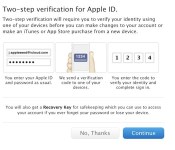
After discovering a huge security hole last year, Apple added an extra layer of protection for Apple ID and iCloud users in the form of two-step verification. Today it’s making the important security feature available in more countries: Canada, France, Germany, Japan, Italy and Spain. With two-step verification, Apple sends a special code to a trusted device like your iPhone whenever someone attempts to make changes to your account or log in for the first time on a new device. Similar to what Google does with Gmail, the extra step prevents malicious changes happening without your knowledge. It’s a simple thing to set up, and something that can save you from a whirlwind of pain should your Apple ID ever fall into the wrong hands. Those in the mentioned countries can register now on Apple’s website.
Filed under: Cellphones, Wireless
Via: 9to5Mac
[OP-ED] Smartphone Focus 2014: The race for the best camera on Android Begins

Original image courtesy of Android3DVideos
With the biggest week of the smartphone calendar still to come at MWC 2014 in just a week’s time, we’ve already had a taste of things to come this year with the launch of the LG G Pro 2 with its 4K capable camera. It’s clear that in the early going in 2014, manufacturers are going to be trying to keep up with each other in the video recording domain, aiming for that elusive 4K status. However, I don’t think this is where the real battle will be waged, nor will this necessarily win over us consumers either. While it will be influenced by video recording capabilities, I think the real battle between smartphones in 2014 will be determined by who can produce the best quality photos.
 This was especially telling at the end of 2013 with the release of two of the best budget devices we’ve ever seen. The LG-manufactured, Google-mandated Nexus 5 was fantastic value for flagship level performance with none of the premium cost, and Motorola’s last hurrah under Google, the Moto G, brought surprising performance and a very impressive screen in a package that may as well have costed pocket change. However, one resounding criticism of both these phones is that the camera performance was less than stellar. To be sure, other flagship devices like the Galaxy Note 3 and Xperia Z1 have much better cameras, but despite even the Xperia Z1 having a monstrous 20.7MP camera, there hasn’t quite been an outpouring of love for its abilities.
Across the figurative pond, we have the Apple iPhone 5S and the Nokia 1020, both with their share of toys. The iPhone of course has its 8MP camera, but perhaps crucially, that camera has an aperture of 2.2 which gives it some incredible light sensitivity, and is the source of many determined photographers to show off exactly how special the iPhone’s camera is.

Courtesy of Austin Mann
There is, of course, also the Nokia 1020 with its insanely impressive 41MP PureView camera which gives it unprecedented quality and zoom capabilities that aren’t available in any other phone. Likewise, the Nokia 1020 has its staunch supporters who continually show their approval of the phone through projects which highlight exactly how brilliant the camera is.

Courtesy of ArtPhotoFeature
Several professional photographers have asserted that they would replace their secondary cameras, normally of the point-and-shoot variety, with either of these phones, some even going as far to say replacing their DSLR as a primary photography device. While certainly, some photographers may prefer Android devices for their cameras as well, they are far and few between and from what I’ve seen, produce far less impressive results. Perhaps it does not matter to the average joe, but the fact that it is widely understood that despite the fact the iPhone has “less megapixels”, but still results in superior photo quality should be most telling. Android manufacturers take note: those ever-inflating camera numbers are fooling no one.
 There are, of course, examples of Android manufacturers making an effort to subvert this fruitless pursuit of ever-increasing megapixel count: HTC is of course the prime exponent of this with their UltraPixel technology which in my opinion took canyon-sized steps to narrowing the divide between Android and its platform competitors. HTC is rumoured to be taking their improvements to the next level in their next flagship device, the ethereal HTC M8, which allegedly utilizes a dual-sensor camera configuration to give it unprecedented photo quality capabilities; for exactly why this dual-sensor camera is going to rock, check out our explanation here.
I think that Android manufacturers need to follow HTC’s lead and really invest in developing new and innovative ways to improve camera quality because I think that we’ve already seen what we’ve needed to see performance-wise in 2014. Of course, we’re going to see new processors that push the limits of what should be possible from a device that fits in your hand, and batteries will continue to increase in capacity despite staying the same size, but through all these advancements, the progression of camera and photo quality has stagnated. However, with the increasing popularity of image based social networks like Instagram, Snapchat, and Pinterest, Android can’t just concede all these users to Apple and Nokia while they bicker within the Android market; they need to compete in a meaningful way.
Furthermore, I predict that by mid-2014, or even the end of 2014, pretty well all Android flagship smartphones will be rocking a Qualcomm Snapdragon 800 or 805, 3GB RAM, and a 2K display; so what will the differentiating factor be then? I say it will be the camera, and not some novel ability to film 4K videos that you aren’t able to output to its full potential on your non-4K TV or device; it will be the ability to take pictures that rival the abilities of the iPhone, Nokia 1020, maybe commercial cameras, and definitely its Android competitors. That will, and should be, the race that Android manufacturers strive to win in 2014.
Source: Austin Mann, ArtPhotoFeature

Your iPhone can now help you find your way around MLB ballparks

iPhone owners should have an easier time getting around the ballpark this season. Following a trial run last year, Major League Baseball is now deploying Bluetooth-based iBeacons at its stadiums. If you use the MLB At the Ballpark app, your iOS 7-equipped device will receive notifications as you visit different points at a given venue. MLB isn’t yet saying just what those notices will involve, although the pilot project helped fans find their seats, score discounts and queue up videos. Only Los Angeles’ Dodger Stadium and San Diego’s Petco Park have the iBeacons so far. However, the league promises that more than 20 parks will have iBeacons when the season starts — odds are that your home team will be ready on opening day.
[Image credit: Brendan C, Flickr]
Filed under: Cellphones, Mobile
Via: Recode
BBM Channels and Voice come to Android and iPhone

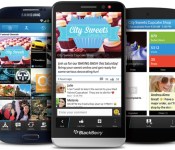
BBM is about to become considerably more useful to Android and iPhone users — even if they don’t have many people on their contact lists. BlackBerry now says that its promised Channels and Voice support should reach the BBM apps for both platforms later today. As on BlackBerry 10, Channels lets you chat about hot topics with fellow users, whether or not they’re already friends. Voice, meanwhile, does exactly what it says on the tin: you can make internet-based calls to your BBM buddies. Whether or not you find much use from these two biggest features, you may still appreciate other significant additions like Dropbox file sharing integration, Glympse location sharing and expanded BBM Groups. We’ll let you know when we see the Android and iOS upgrades reach their respective app stores.
Filed under: Cellphones, Mobile, Blackberry
Source: BlackBerry, App Store, Google Play
 AIVAnet