



Garmin’s new app lowers the price of premium navigation

While Garmin is no stranger to mobile navigation apps, it has continued charging $30 or more for its StreetPilot software even after breaking out some components as in-app purchases. That’s a hard bargain in an era when phones offer GPS tricks like lane assistance for free. Clearly, the company is aware of this discrepancy — it just unveiled Viago, an app for Android and iPhones that tries to bridge the pricing gap. Fork over $2 ($1 until July 13th) and you’ll get worldwide maps alongside lane assistance, realistic junction views, speed limits, weather and traffic. You only pay more for the features you want, and some of them are unique — Real Directions gives you directions based on landmarks rather than street names, while Active Lane Guidance simplifies taking that next off-ramp.
Viago is likely to be a better deal than earlier releases, especially now that the interface is simpler and less focused on replicating dedicated nav units. However, Garmin still faces an uphill battle. Some of the features the company wants you to buy, such as offline maps and mass transit directions, are available for no charge on both Android and iOS. With upgrade prices typically ranging between $5 and $20, you may have to shell out a lot more than $2 to equal or beat what your handset can already do. If you’re eager for a do-it-all mapping tool, however, Viago is ready and waiting.
Filed under: Cellphones, GPS, Mobile
Source: Garmin

Parallels’ new remote desktop apps let you control your PC like a phone

Remote desktop apps have an easier time working on tablets, where you have a lot of display area to work with, but they’re frequently awkward on smartphones. Wouldn’t it be nice if you could control a PC at home like it was just another phone app? Parallels is tackling that challenge head-on with smartphone-friendly versions of its Access app for both Android and the iPhone. Much like the earlier iPad release, the new titles give you a remote view of your Mac or Windows PC that’s optimized for your mobile platform of choice. You can launch programs, select text and type almost as if the computer’s software were built for a small screen. On the Android client (which also handles tablets), Parallels will even let you create shortcuts to jump directly into favorite desktop apps.
The wider support comes alongside a bundle of fairly hefty upgrades. It’s now possible to wake up your computer in some circumstances, so you won’t have to always leave it running for Access to work. You can also choose from extra screen resolutions if you need to see more of your desktop at a glance, and apps can borrow your device microphone for speech recognition or a quick voice chat. Those on iOS have the added perk of a file browser that makes it easier to track down that all-important presentation.
For some, the biggest change may be the cost of entry. Parallels has cut its personal subscription price from $80 to $20 for one year, and $35 for two years ($30 if you sign up by the end of June). That’s obviously a much better value, particularly if you only occasionally need to reach your PC. There’s also a new business tier that lets companies hook up five people for $50 per year. All the new apps are free to try for a couple of weeks, so it won’t hurt to give them a shakedown. Who knows — they might save your bacon the next time you leave your laptop at home.
Filed under: Cellphones, Tablets, Software, Mobile
Source: Parallels

Skybox Can Predict iPhone Launch Using Satellite Imagery

The Wall Street Journal profiles one of Google’s recent acquisitions which has implications on mapping, competitive intelligence and even privacy. Skybox Imaging is an intelligence company that by the year 2018 will be able to take satellite imaging to the next level:
By the time its entire fleet of 24 satellites has launched in 2018, Skybox will be imaging the entire Earth at a resolution sufficient to capture, for example, real-time video of cars driving down the highway. And it will be doing it three times a day.
The ability to take such frequent imaging will certainly aid Google’s Maps product, but it also opens up a market for competitive intelligence. Skybox says they are already looking at Foxconn every week and are able to pinpoint the next iPhone release based on the density of trucks outside their manufacturing facilities.
Google plans on initially using the technology to improve their Maps product, potentially providing more up-to-date satellite images, but Skybox executives have long term plans for offering their data to outside developers for a fee.

Photos of 4.7-Inch and 5.5-Inch iPhone 6 Model
A couple of new model photos of the rumored iPhone 6 have been posted to Twitter by SonnyDickson. The new images depict the 4.7″ and 5.5″ iPhone 6 side by side — both front and back.


The images show what we have already seen about the iPhone 6, including the rounded case edges and larger form factors. Apple is expected to release the 4.7-inch iPhone 6 around September of 2014, while the 5.5-inch version may come later.
Photos of iPhone 6 dummy models have been floating around for months, making even more frequent appearances in recent weeks.

Taiwanese Star Jimmy Lin Gaining Attention for iPhone 6 Mockup Photos
Taiwanese media star and race car driver Jimmy Lin has once again surfaced showing what he seems to be passing off as a legitimate iPhone 6, although the device is more likely to be one of many physical mockups seen in recent months.

Lin has a history of such postings, having shared what he claimed was a mini iPad back in 2010 two years before the real iPad mini debuted, what was clearly an iPhone 5 mockup, and what appears to have been a knockoff iPhone 5c shell or dummy unit based on accurate design specs that were circulating ahead of the device’s release last year.

In his latest “iPhone 6″ photos, Lin shows the device next to the iPhone 5 and 5s, comparisons that have been seen in a number of different settings already. Among the suspect aspects of his unit are what appears to be a nonfunctional yellow blank in place of the rear flash, a larger than expected FaceTime camera hole, and a lack of any photos with the unit turned on.

Lin’s unit appears very similar to one we’ve seen in photos sent by a supplier to screen protector and stylus firm Halo-Direct, although this unit lacks the Apple logo seen on Lin’s.

The 4.7-inch iPhone 6 is expected to debut around the September timeframe, with an even larger 5.5-inch model reportedly also in the works. It is unclear, however, where that larger model will debut alongside or up to several months later than the smaller version.

MakerBot app lets you remotely check 3D prints in case they go all wrong

We love 3D printing, but let’s face it: it’s slow. Luckily, MakerBot has just given you a new way to track the progress of a printout from afar with its new iPhone app. Using the camera from any fifth-generation printer, MakerBot Mobile for iOS can show you an image of the build area every three seconds (from a local network) and ensure that Celtic skull isn’t a beautiful failure. You can also use it to pause or cancel a job and get notifications when a 3D model is ready, for instance. It’s also baked in its Thingiverse app, letting you browse thousands of models via the cloud and add them to your collections, or share your work on Thingiverse or social networks. Future updates include remote monitoring over a cellular network and more notifications (there’s no Android app yet), but meanwhile, you can grab the iOS app right here.
Filed under: Misc, Peripherals
Source: MakerBot

Skype’s redesigned iPhone app is all about sharing things faster

Skype has been lavishing attention on its Android and Windows Phone messaging apps as of late, but it’s now time for the iPhone client to get a makeover — and it’s one of the company’s biggest overhauls in recent memory. The new software brings a much fresher-looking interface that’s both in step with other platforms (chiefly Windows Phone) and lets you accomplish many common tasks faster. You can now start group chats right from the hub, and you don’t have to wait until someone hops online to send a message.
There are a lot of subtler tweaks that should go a long way toward improving the experience, too. The app’s overall performance is up to five times faster, and it’s much better at syncing message statuses as you move from device to device. So what’s the catch? Simply put, the app isn’t ready yet; Skype is launching the new iPhone version in about a week. Until it’s available, you’ll just have to make do with the teaser video below.
Filed under: Cellphones, Mobile, Apple, Microsoft
Source: Skype

Alleged iPhone 6 Rear Shell Shown From Multiple Angles in New Photos
Back in late May, a single photo of an alleged rear shell from the iPhone 6 surfaced, showing what appeared to be a thin metal part with cutouts on the rear for not only the camera, microphone, and flash, but also the iconic Apple logo.
A new photo set shared by Nowhereelse.fr [Google Translate] now shows a similar part from various angles, with its apparent high quality bolstering speculation that this may indeed be a genuine iPhone 6 shell.
 Interior (left) and exterior (right) of alleged iPhone 6 rear shell
Side views of the shell show the now familiar cutouts expected for the iPhone 6, including the standard mute switch and elongated volume buttons along the left side. The right side features a SIM tray toward the middle and what has been reported to be a relocated power button, with Apple perhaps moving the button from the top edge to the side to make it more accessible on the larger device.
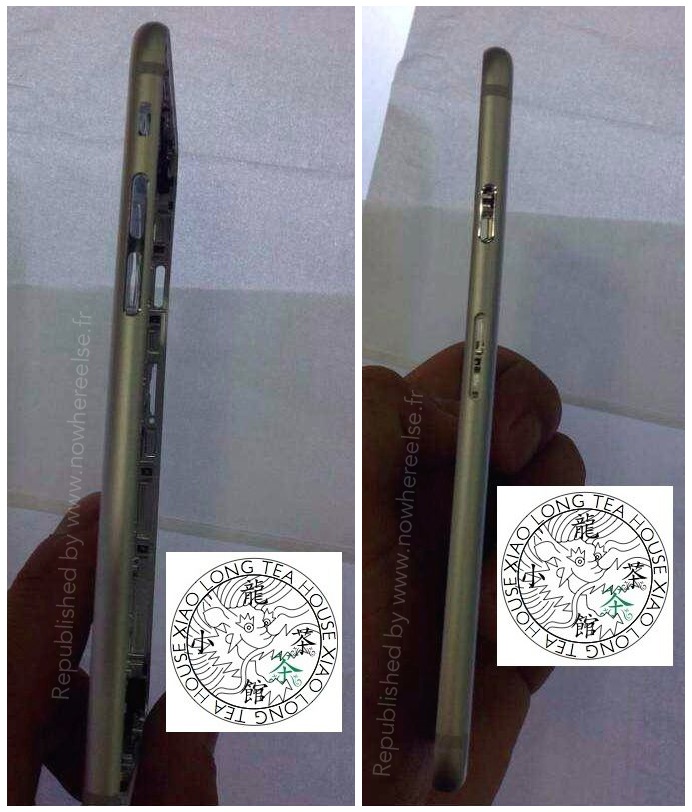 Left and right sides of alleged iPhone 6 rear shell
The report mentions that the cutout for the Apple logo points to the possibility of a lighted logo that could be used for notifications, but we believe this to be unlikely. Shell cutouts for the Apple logo are not uncommon for iOS devices, although they have not been seen on the iPhone before. But for iPad models, Apple has traditionally preferred to use a shell cutout with an embedded Apple logo rather than printing the Apple logo on the shell, in some cases such as in the original iPad placing antennas in the region to help overcome the shielding effects of the metal casing.
For the iPad mini, the Apple logo was printed on the first-generation models, but for the current generation the company has shifted to an embedded logo. As a result, we expect an embedded iPhone 6 logo to similarly be for aesthetic or perhaps antenna reasons rather than for illuminating the logo itself.
The iPhone 6 is expected to debut around the September timeframe, perhaps initially with the rumored 4.7-inch model while an even larger 5.5-inch model arrives up to several months later. Apple should also be releasing iOS 8 to the public at around the same time based on past patterns, and Apple’s iWatch is tentatively targeted for an October unveiling.

Route-tracing robot shows where bike lanes should be

Tired of having to share the road with cars while you’re biking? You’re not alone. The marketers at Radwende have built a route-tracing art robot to make a case for more bike lanes in Wiesbaden, a German city frequently considered hostile to pedal pushers. The machine draws the paths of riders who use Android and iPhone tracking apps during their journeys, creating a crowdsourced cycling map whose lines get bolder based on traffic. The more people travel down a given street, the clearer it is that a bike lane is necessary.
The robot is currently sitting inside of Wiesbaden’s Museum of Fine Art, where it will be drawing until July 2nd. There isn’t any word of Radwende taking its project on tour, but there is a way to get a map for posterity. If you’re in Wiesbaden, you can buy a print for €150 ($204) or less — the price goes down one euro for every kilometer you ride while using the app, so you have a strong motivation to get some exercise before you show up. Even if the city doesn’t pay much attention to the artwork, it’s visual proof that technology can solve urban planning problems.
Filed under: Transportation, Internet
Via: Fast Company
Source: Radewende (translated)
Apple’s new Lightning spec allows for smarter, better-sounding headphones

When Apple first unveiled its Lightning connector, there was a debate about whether or not it was needed at all: what can this proprietary tech do that standard micro-USB can’t? Well, it looks like we’re going to find out soon. Sources for 9to5 Mac understand that Apple has published a new specification that lets headphone makers use an iOS device’s Lightning port for audio instead of the normal 3.5mm jack. On a basic level, this allows headsets to launch apps and carry more than just the usual playback controls. However, there’s reportedly an advanced spec that permits a lot more — headphones could include digital-to-analog converters and other processing that overrides what’s in the device. If you’re not happy with the fidelity of the built-in hardware, a new pair of cans could provide an upgrade.
Since Lightning can also supply power in both directions, either new spec could eliminate a number of electricity-related problems. External audio processing wouldn’t always need a separate energy source; you could do active noise cancellation that draws only on the host device for power. You could alternately charge an Apple gadget through batteries that are built into the headphones or attached with a pass-through cable.
Whether or not manufacturers take up the spec is another matter. To support Lightning without abandoning listeners on other platforms, companies would have to either bundle extra cabling or else sell multiple versions of the same gear. Those feats are easy for higher-end brands, but may be tougher for newer or more budget-conscious outfits. Even if others are skittish, though, the tech could come in handy now that Apple owns Beats — future official headphones could both sound better and integrate well with your iPhone.
Filed under: Cellphones, Home Entertainment, Peripherals, HD, Mobile, Apple
Source: 9to5 Mac
 AIVAnet