


The best places to buy and sell a used iPhone
By Jackie Dove
With a new iPhone arriving soon, many people will look to sell their old iPhone for some quick cash. But which places offer the best return and the smoothest process? To find out, Tom’s Guide tested seven services that buy and sell used iPhones.
To find out where you can expect the best return on your dollar, we bought an iPhone from each reseller service and then turned around and re-sold that phone to same service where it came from. We also rated each service on their convenience, ease of use and responsiveness to come up with our rankings.
The key takeaways from our testing:
- Glyde and Swappa top our rankings of the best places to buy and sell a used phone.
- Walmart and Best Buy finished at the bottom.
- We resold our iPhones for an average of 52 percent of what we had paid for them.
- We got the highest rate of return from marketplace services that connect smartphone buyers with sellers; the worst return came from big-box retailers.
How we tested
To best measure how much return you can expect from iPhone resellers, we selected services that both buy and sell used iPhones, evaluating seven. In addition to Glyde and Swappa, we also looked at Amazon, Best Buy, GameStop, Gazelle and Walmart. We bought a used iPhone from each service, and then — without activating or using our newly purchased phone — sold the same model back to the seller where we purchased it.
From most resellers, we bought a 16GB iPhone 6. We purchased a 16GB iPhone 6 Plus from Amazon and GameStop due to availability issues, though we stuck with iPhones released in 2014 to get comparable quotes from resellers. Also, due to availability, some of the iPhones we purchased were tied to specific carriers, which we’ve noted below. In our experience, unlocked phones not tied to any one carrier generally fetch higher prices (though AT&T and Verizon phones have a high resale value, too).
MORE: The Best iOS Apps You’re Not Using
As you might expect, there’s a gap between what resellers will charge you for an iPhone and what they’re willing to pay out when you try selling that same phone back. Just like with cars that depreciate the moment you drive them off the lot, that iPhone you’re hoping to unload will never recoup its value. In our testing, resellers make their money by buying low and selling high.
When ranking these seven services, in addition to measuring how much we got back when reselling an iPhone, we also took the entire process into account. Were the instructions easy to follow? How quickly did it take to get a quote on our iPhone? Did the reseller offer cash or store credit? And how promptly did we receive that cash or credit after completing the sale?
Glyde: Our top pick
What we bought: Space Gray iPhone 6 (AT&T)
What we paid: $359.50
What we got back: $265.60
Rate of return: 74 percent
Cash or credit: Cash and bitcoin
Pros: Best rate of return; Clear explanation of policies with explicit breakdown of fees; Option to wait for a better price; Can verify your identity via PayPal; Flexible payment options
Cons: You’re not required to post a verification photo, a step that can help weed out scammers.

Glyde offers a straightforward, colorful and easy-to-navigate website where you can find an assortment of second-hand iPhones as well as Android models from Samsung, HTC, LG and others. To sell my iPhone 6, all I needed to do was select the website’s Sell tab and type in the phone’s model number, carrier, color and condition. Several questions from Glyde covered details about physical appearance and scratches, personalization, and whether I had included accessories like a power adapter and cable.
Note that prices can change, often from day to day. After trying a dry run, I went back to Glyde to re-enter information about the phone I was trying to sell, and the market price had dropped to $316 from $326.
The market price is what the buyer is going to pay, not the amount I would pocket. Glyde charges a 15-percent transaction fee, while a kit with packaging to ship off your phone will cost you $3. Glyde was the most transparent service when it came to spelling out fees. I wound up collecting $265.60. (That amount would have been $274.10 if I had stuck with the quote from my dry run.) That’s still the highest percentage of return from any vendor we tested, as we got back 74 percent of what we paid for the iPhone.
MORE: Upgrading to the iPhone 7? Read This Before You Do
While I was disappointed with the price drop over two days, I decided to take my profit immediately and hit the List for Sale button. From there, you type in information about the phone, enter your email and Glyde account password, and verify your identity with your credit card or PayPal account. Click the button, and your item is listed. You can post your listing on Facebook, Twitter and Google + right from Glyde’s page.
Two days after I listed my phone for sale, a buyer bit and then reneged within an hour; Glyde notified me via email about both events. The next day, another person offered to buy, which I quickly confirmed. A packing box arrived in the mail, with a prepaid label; all I had to do was drop the package into the nearest mailbox. Three days after the buyer receives and accepts the phone, Glyde posts the money into your account. From there, you can transfer the cash to your bank account, opt for Bitcoin payment or have a check mailed to you for a $2 fee.
Swappa: Runner-Up
What we bought: Space Gray iPhone 6 (Verizon)
What we paid: $465
What we got back: $325
Rate of return: 70 percent
Cash or credit: Cash
Pros: Posted items are approved quickly by Swappa; Ability to adjust listing; Solid rate of return; Added protection via PayPal purchases
Cons: Time-consuming process required for shooting photos of your phone; Agreeing to an immediate trade will lower your rate of return; Mandatory $10 PayPal transaction fee.

Swappa — as in “you wanna swappa?” — is an electronics website that features a fun interface for selling several dozen brands of phones, including Android devices as well as the iPhone. Just type in the specific search term to find the model you want to sell, and if it appears, you get an immediate idea of how much cash you’ll get.
My Verizon-tied iPhone cost $465, and from the site’s initial offer, I would have pocketed up to $307 in cash, which came to 66 percent of the total I paid for the device. Swappa also gave me the choice of selling my phone for from $340 to $559 if I wanted to wait for a better deal. I opted for a better return — and to take the deal, I had to register, either through Facebook or Google+ or via email and password.
It took longer to get my listing up on Swappa than it did with other sites. The process requires you to shoot a verification photo of the phone and its accessories using a specific, rather low-tech approach. You have to set up your shots with the site’s verification number handwritten on a piece of paper next to the phone, and then powerup the phone you’re reselling, so the screen is lit when you take your picture. You repeat the process with any included accessories. The idea is to prevent scams, and Swappa at least offers ample instruction on how to take your picture.
MORE: The Best iPhone 7 Carrier Deals
After I took the photos, Swappa took 15 minutes to verify and approve my entry. From there, it’s a matter of waiting for someone to buy your phone. If you’ve tried to get a higher price, you can revise your listing to Swappa’s lower price, which I did after waiting three days. The phone sold only after I settled on a new price: $335, which netted me $325 once I took into account a mandatory PayPal transaction fee.
That PayPal fee is the only cost — there’s no fee to sell on Swappa — and using PayPal to handle transactions felt safer than having to punch in credit card information. Swappa reviews and approves all listings before buyers can see them. Swappy promptly answered my questions about my listing when I sent queries via email and posted them to Swappa’s Facebook page. When my phone sold, I was notified that money had been deposited in my PayPal account, after which I had two days to mail out the phone.
As an extra added layer of protection, anyone who sells a stolen phone, or one with a damaged screen or water damage violates Swappa’s terms of use, giving buyers recourse through PayPal.
Gazelle
What we bought: Space Gray iPhone 6 (Verizon)
What we paid: $406
What we got back: $210
Rate of return: 52 percent
Cash or credit: Both
Pros: Quick and easy resale process; Multiple options for getting paid for your device; Inspection processensures quality selection of phones on sale.
Cons: Middle-of-the-road payment for trade-ins, compared to other resellers.

Gazelle has an attractive site that makes it easy to get started with your sale: The company trades in iPhones and Samsung Galaxy models as well as Android devices from HTC, Nokia, LG and others that cover the four major carriers.
If you take Gazelle’s offer on your phone, you have a choice of payment via Amazon gift card (which adds an extra 5 percent to your total), PayPal, charitable donation or standard check delivered within 10 days of Gazelle verifying the phone’s condition. Customers buy your phone from Gazelle, not you directly, and the company inspects the device before selling it as certified pre-owned to guarantee the condition. To ensure buyers are satisfied, there is a 30-day return policy.
After you enter your email address and a minimum amount of information about the phone’s brand, capacity and physical condition, you do not have to wait for a buyer — just accept the Gazelle offer, box up the phone and choose how you want to be paid.
As a reseller, Gazelle will appeal most if you want to unload your phone quickly and would like some options for how you’ll be reimbursed. We got back only half of the value of the iPhone we had bought, though.
Amazon
What we bought: Space Gray iPhone 6 Plus (unlocked)
What we paid: $549.99
What we got back: $265
Rate of return: 48 percent
Cash or credit: Amazon gift card
Pros: Process is clearly explained; Trade-in offer is immediate; Amazon offers free mailing label for sending in your phone.
Cons: Prices paid are fairly low; You’re restricted to store credit; Trade-in links can be hard to find.

To sell your old smartphone on Amazon’s massive website — which appears to sell a huge variety of almost every brand imaginable — requires an eagle eye and some clicking around to find the right path. In the end, typing the exact item into Amazon’s search box, clicking on a result and finding the trade-in link on the page was the quickest way to get an estimate.
For an iPhone 6 Plus that we bought for $549.99 from the e-commerce giant, Amazon offered $265 in trade — less than half of what we paid. While your phone’s appearance and condition may be acceptable to you, Amazon reserves the right to inspect the device and asks straightaway if you will accept a lower price or if you want the phone sent back if your price and Amazon’s don’t match. After my phone passed inspection, Amazon deposited the proceeds of my gift card directly into my account.
The company’s trade-in program offers an Amazon gift card in exchange for your used phone. If you don’t mind registering as an Amazon seller — which involves entering credit card and tax info — you can sell your phone on Amazon’s individual seller marketplace. But that’s a lot of hoops to jump through for a one-time sale, especially when the gift card can be used to buy any of the hundreds of thousands of things Amazon sells on its site.
GameStop
What we bought: Space Gray iPhone 6 Plus (AT&T)
What we paid: $459.99
What we got back: $240
Rate of return: 52 percent
Cash or credit: Both
Pros: Choice between cash or store credit; Simple process; In-store staff were helpful and professional during our testing.
Cons: Middling return on the value of our phone; Requires a visit to a brick-and-mortar store to complete your sale.
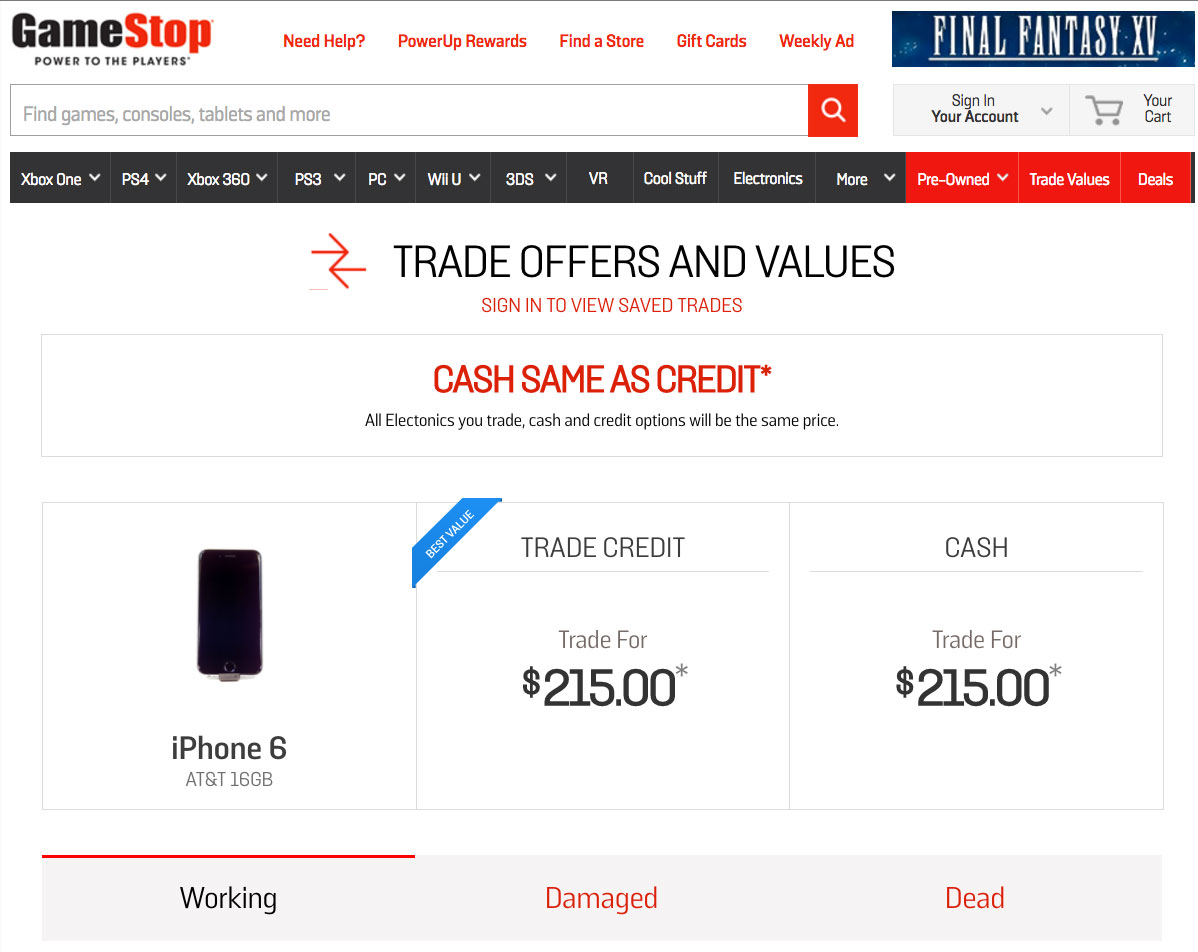
GameStop takes a different approach than other resellers because of its focus on games. While some resellers offer a mix of cash and credit, GameStop customers may be more inclined to trade in their phones for store credit in games, VR headsets and gaming systems, in addition to the refurbished iPhones and Samsung Galaxy models available on the GameStop site. The transaction is straightforward except for one thing: The final turnover of your phone for cash or gift cards must be done in person.
The website offers a list of the phone types GameStop accepts for trade. A working iPhone 6 Plus that has no missing parts, cracks or dents will trade or get cash totaling $240. That’s a little more than 52 percent of the $459.99 we had paid GameStop for the same phone the previous month. A damaged phone will trade for $95, while a dead phone gets $25.
My trade-in experience took just 15 minutes, as the pleasant and efficient clerk behind the counter tested the phone and looked up records. I walked out with a $240 gift card.
GameStop lets you search for stores within a 15-mile radius of your zip code. If there’s no retail outlet near you, you’ll want to turn to a different reseller.
Walmart
What we bought: Space Gray iPhone 6 (Straight Talk)
What we paid: $369
What we got back: $125
Rate of return: 34 percent
Cash or credit: Credit
Pros: Simple transaction requiring little information; Free shipping label supplied.
Cons: Very low return on resales; Limited to in-store credit.

You’ll find plenty of phones available for sale at Walmart, including contract, unlocked and refurbished phones available for the major carriers as well as the retailer’s in-house Straight Talk network. What you won’t find is the option to get cash back for your phone. It’s store credit and no negotiating.
It’s easy enough to go through the process, using the Gadgets for Gift Cards link. The used iPhone 6 we bought from Walmart netted a $125 offer, 34 percent of what we paid, which was the lowest return from any reseller. Interestingly, the phone was tied to Straight Talk. Had we tried selling back an unlocked phone or one tied to AT&T or Verizon, Walmart would have given us $160 in credit.
Once you approve Walmart’s appraisal, just log in to your account or create a new account with your email and mailing address. Walmart offers a printed label that you can use to pack up your phone and send it in. After that, just wait for your gift card to arrive via email, which it did within three days of receiving my phone.
Best Buy
What we bought: Space Gray iPhone 6 (AT&T)
What we paid: $599.99
What we got back: $208
Rate of return: 35 percent
Cash or credit: Gift Card
Pros: Trade-in process is simple, if you have no questions; Trade-ins at the store are handled efficiently by friendly staff.
Cons: Long wait times for answering questions on Best Buy’s 800-number; Low rate of return.

Best Buy has a busy website that features a vast variety of iPhones and flavors of Android phones for sale. But it’s still fairly easy to find the place to trade in your older iPhone. If you do, be prepared to accept payment in credit. Like Walmart and Amazon, Best Buy doesn’t deal in cash for phone trade-ins.
We paid $599.99 for an iPhone 6 that arrived in a sealed box (for an iPhone 6s oddly) but with no earbuds included, the only used phone we bought that was missing an item. That didn’t affect my trade-in price; when I turned in my iPhone for resale, the Best Buy clerk said I didn’t need to include accessories. But Best Buy’s offer was the second-lowest return from any reseller: just a $208 gift card, or 35 percent of what we paid for the iPhone.
MORE: Best Cellphone Plans for Your Money
Getting a quote from Best Buy’s website is simple enough. All I had to do was list the phone’s color, carrier and condition to get a trade-in value that I could redeem in person or by mail. Getting answers to questions proved more difficult. I called Best Buy’s toll-free number to ask about the missing earbuds and an issue with the phone’s IMEI number, and waited 20 minutes and through three transfers before I was told it would be a better idea to do my trade-in at a store. That took a much more efficient 15 minutes.
Other options
You don’t necessarily need to go through a reseller or e-commerce marketplace to unload your aging iPhone. Certainly, Craigslist offers the opportunity to find a willing buyer, and depending on your negotiating skills, you may be able to get a bigger return than you would from a reseller who’s going to offer you a set price.

That said, handling a sale on your own can be a hassle, and there’s always the risk of running into scammers. A reseller or reputable marketplace removes a lot of the headaches and potential risks.
If you’re planning on using the money you get from trading in your phone to finance the purchase of a new phone and you’re committed to a specific wireless carrier, you may want to see what that carrier will offer you for your old phone. Verizon offered us the best quote on an iPhone 6, with a $265 trade-in value. AT&T quoted us a price of $200 for a 16GB iPhone 6, while T-Mobile and Sprint offered $191 and $159, respectively. Those quotes assume a phone is in excellent condition, and the amounts can vary based on which carrier your old phone is tied to. You receive the trade-in value in the form of credit or a gift card.
Where to buy a used phone
Our testing of reseller services focused primarily on selling a used iPhone, because that’s where you’re likely to experience the greatest amount of variance, from the money you get back for your phone to the simplicity of the resale process. In contrast, shopping for a used iPhone from these sites is a pretty similar experience, though there are a few differences worth noting.

In terms of selection, you’ll generally find each service offers a wide degree of smartphone models and capacities. In our search for a used iPhone 6, we found that models tied to AT&T and Verizon were plentiful while T-Mobile and Sprint devices were in shorter supply. Amazon, Glyde and Swappa offered the widest range of phones in terms of carriers and capacities.
Used iPhone shoppers will find the best range of prices at Swappa, though lower-priced phones are likely to have been well-used. Glyde, Gazelle, GameStop and Amazon also offer attractive pricing on used phones depending on what model you’re looking for.
We found it easiest to shop for a used iPhone at Glyde and Swappa, which conveniently group iPhone models together, allowing you to drill down to the version you want. Despite its wide selection, Amazon offers very cluttered search results; type in iPhone 6, and you’re just as likely to get entries for the 6s, 6s Plus and 6 Plus as you are for the model you want. Walmart and Best Buy feature helpful filters for removing superfluous search results.
We should note that we ran into one quirk when buying our phones from Glyde and GameStop, though that’s likely a result of how we ordered our iPhones. Because we bought our phones through our corporate office and shipped them to an editor at another location, both Glyde and GameStop flagged our initial purchases, requiring us to set up a PayPal account to complete the deals. Most shoppers won’t run into that problem, though it could flare up if you’re buying a used phone as a gift for someone who has a different address than yours.
More from Tom’s Guide:
- Walmart, Best Buy Offer Worst iPhone Trade-in Deals
- The Best and Worst iPhone Trade-In Deals
- iPhone 7 vs iPhone 7 Plus: What Should You Buy?
- Why You Shouldn’t Get the iPhone 7
- iPhone 7 Camera Tech: Can Apple Be the Best Again?
The Engadget Podcast Ep 5: Applesauce
Editor in Chief Michael Gorman, executive editor Christopher Trout and managing editor Dana Wollman join host Terrence O’Brien for a special all Apple edition of the podcast from San Francisco. On the show they’ll search for the definition of courage, tell you what it’s really like on the floor of a major press event and give a state of the Apple union.
The Flame Wars Leaderboard
Wins
Loses
Winning %
Chris Velazco
3
1
.750
Christopher Trout
2
1
.666
Devindra Hardawar
6
4
.600
Nathan Ingraham
3
4
.429
Cherlynn Low
3
4
.429
Michael Gorman
1
2
.333
Relevant links:
- The new Apple Watch mostly looks like the old one
- The Apple Watch Nike+ is a running watch I might actually use
- Two years later, Apple has figured out what its watch is good for
- Apple announces the water-resistant iPhone 7 and 7 Plus
- The iPhone 7 and 7 Plus are all about subtle, powerful changes
- Apple’s AirPods are smart wireless earbuds with a new W1 chip
- Apple’s AirPods toe the line between usefulness and gimmickry
- Apple adds real-time collaboration to iWork
- What happened at the iPhone event
- Courage is not how you sell iPhones
- Nintendo loses a little piece of its identity with ‘Super Mario Run’
You can check out every episode on The Engadget Podcast page in audio, video and text form for the hearing impaired.
Watch on YouTube
Subscribe on Google Play Music
Subscribe on iTunes
Subscribe on Stitcher
Subscribe on Pocket Casts
iPhone 7 and iPhone 7 Plus Now Available for Pre-Order
Apple is now accepting pre-orders for the iPhone 7 and iPhone 7 Plus through its online storefront and through the Apple Store app. Pre-orders are being accepted in all first wave launch countries: Australia, Austria, Belgium, Canada, China, Denmark, Finland, France, Germany, Hong Kong, Ireland, Italy, Japan, Luxembourg, Mexico, Netherlands, New Zealand, Norway, Portugal, Puerto Rico, Singapore, Spain, Sweden, Switzerland, Taiwan, UAE, the UK, US Virgin Islands and the US.
All of the major U.S. carriers, Verizon, AT&T, Sprint, and T-Mobile, are accepting pre-orders for the new devices. Major online retailers including Best Buy and Target are also accepting pre-orders starting on September 9.
Apple has said supplies of the iPhone 7 and 7 Plus will be constrained, so it’s a good idea to pre-order a device right away if you’re hoping to for a launch-day delivery. Jet Black iPhone 7 Pluses had a delivery date of September 26 to October 3 right when pre-orders launched.
The iPhone 7 and iPhone 7 Plus come in 32, 128, and 256GB configurations, with five color options: Silver, Gold, Rose Gold, Black, and Jet Black, the new glossy shade. Jet Black is only available in 128 and 258GB.
In the United States, iPhone 7 pricing starts at $649 for the 32GB model. The 128 and 256GB models are priced at $749 and $849, respectively.
iPhone 7 Plus starts at $769 for the 32GB model. The 128GB and 256GB models are priced at $869 and $969, respectively.
With the iPhone Upgrade Program, which allows users to get a new iPhone each year with AppleCare+ support, iPhone 7 pricing starts at $32.41 per month and iPhone 7 Plus pricing starts at $37.41 per month.
The earliest pre-orders will likely be delivered to customers on September 16, which is the official launch date for the two devices.
Related Roundups: iPhone 6s, iPhone 7
Buyer’s Guide: iPhone (Buy Now)
Discuss this article in our forums
The iPhone 7 Plus packs 3GB of RAM for extreme multitasking
Besides that extra camera lens, the iPhone 7 Plus is packing additional hardware. Specifically, an extra gigabyte of RAM according to 9to5Mac. That brings the total amount up to 3GB if you’re keeping track at home. More than that, this is the iPhone with the most RAM yet which should make multitasking with a bunch of resource intensive apps a much smoother experience. It’s just 1GB shy of what’s available in the 9.7-inch iPad Pro. Now all you have to do is wait until midnight tonight to decide if that extra memory is worth the up-charge.
Source: 9to5Mac
The iPhone 7’s best new feature is water resistance
Once again, Apple has dropped a new phone with a whole array of improvements that make it a must-buy. But the iPhone maker buried the lead with its launch by barely touching on the next-gen phones’ actual best feature: water resistance.
I know it’s going to be difficult to justify this. but hear me out. The iPhone 7’s water resistance is awesome because it not only solves an age-old problem for a whole lot of people, but could mean a better future for everyone.
A lot of people will point to the new dual camera (which by the way is only on the pricier Plus) or iOS 10 as better choices. But a lack of emoji, inadequate 3DTouch integration or poorly taken picture hasn’t actually ruined someone’s day or cost anyone money. Those are nice things to have, but not absolutely necessary.
On the other hand, water damage is such a big problem it’s spawned a whole subculture of people that find unique ways to fix wet phones. A 2012 study by device warranty provider SquareTrade found that water damage was the second leading cause of destroyed phones, just behind drops.
While the iPhone 7 probably still isn’t rugged enough to survive a fall down the stairs, its ability to withstand some splashes, specifically up to 1 meter (3.2 feet) of water, will bring some of us klutzes peace of mind. Because let’s be real — who doesn’t bring their phone into the bathroom to while away some throne time?
The water resistance has some other outside-the-loo benefits as well, protecting the new phones from accidental spills at the dinner table or drops into puddles. Plus, built-in water protection means we can say goodbye to bulky waterproof cases that jut out of our pockets. But Apple could also stand to gain.

Pictured above: The water-resistant Galaxy S7 Active.
With their IP67 rating, the iPhone 7s are just slightly less water-friendly than rival Samsung’s latest Galaxy S7 and S7 Edge (both rated IP68). The Korean company’s handsets can survive for up to 30 minutes under up to 1.5 meters of water. That’s one aspect in which Samsung has been ahead of Apple for three years now (water resistance made its way to the Galaxy S line on the S4 Active).
Other companies, such as Sony and Motorola, have already acknowledged the importance of the feature, and have implemented it in their flagships for years now. But even though more than a handful of companies have made watertight smartphones, the rest of the industry hasn’t followed suit. And here’s where Apple joining the fray could mean good things for everyone.
The Cupertino company has long pioneered features that are now ubiquitous, such as apps, fingerprint sensors and a home button. But when Apple follows its rivals on something, as it did on NFC implementation for mobile payments and, now, water resistance, the rest of the industry tends to jump wholeheartedly on the bandwagon. This could mean a future where a watertight phone is the norm rather than the exception.
Apple knows that the new iPhones will sell out
Apple has traditionally opened iPhone pre-orders on a Friday and then reported on how many people laid down cash the following Monday. The company issues a press release saying that it’s seen unprecedented demand and that the latest device is the biggest selling iPhone ever. But that trend won’t continue into 2016 because, guys, it’s the iPhone, and it’s gonna sell out, no matter what.
The company told CNBC that it now knows, before taking a single order, that the iPhones 7 and 7 Plus will sell out. As such, revealing how many people pre-order the devices is “no longer a representative metric” for investors. Instead, the number of device sales will now be discussed only during the firm’s quarterly earnings releases.
In one way, this makes perfect sense, since the pre-order window is no longer the only time in which people buy new iPhones. As people are on contracts of varying lengths, the picture is no longer limited to the folks who’ve lined up to get a new device on the first day. After all, people are holding on to their devices for longer than the average two-year cycle, so there are people coming off the iPhone 5 who might choose to upgrade between now and the holidays.
JUST IN: Apple says it will not be releasing iPhone pre-order numbers as it traditionally has in the past. pic.twitter.com/kGXfPcUkKB
— CNBC Now (@CNBCnow) September 8, 2016
In addition, Apple can avoid any negative headlines and commentary should the quantity of pre-orders not reach the stellar heights of previous years. For instance, the iPhone 6S and 6S Plus sold around 10 million devices in its opening weekend, a blockbuster 48-hours for any company. But if the 7 and 7 Plus sold that many, it’d spur a legion of “Apple Sales Flatten” and “Apple is Doomed”-style headlines.
Source: CNBC (Twitter)
‘Animal Crossing’ and ‘Fire Emblem’ mobile apps delayed to 2017
Nintendo’s Super Mario Run for iPhone, iPad and Android made big news during Apple’s event yesterday in San Francisco, but in all the fanfare it seems two additional planned Nintendo properties were pushed back.
Previously, it was announced that apps based on two fairly hot Nintendo franchises, Animal Crossing and Fire Emblem, would be due out on smartphones in fall 2016. Now, with Super Mario Run on the horizon for December, that date has been moved to the end of March 2017.
According to Polygon, Nintendo confirmed that the delays are indeed related to Super Mario Run’s impending holiday release.
“Based on a variety of factors, we felt it was most appropriate for Super Mario Run to launch ahead of these other two apps,” the company said in a statement. “Our Animal Crossing and Fire Emblem titles for mobile will launch before the end of our fiscal year, which ends on March 31, 2017.”
Super Mario Run is an endless runner featuring familiar Mario stages, characters and mechanics in which players attempt to clear stages while collecting as many coins as possible. Rather than adopting a free-to-play model it’ll be be “one set price,” as Shigeru Miyamoto attested on stage yesterday during the Apple event.
It remains to be seen what sort of pricing models we can expect from either Animal Crossing or Fire Emblem games.
Via: Polygon
Apple Updates iPhone 6s Storage Tiers With New Options and Pricing
Along with the reveal of the iPhone 7 and iPhone 7 Plus, Apple yesterday briefly mentioned that the previous generation of iPhone — the 6s and 6s Plus — have both gotten updates to storage capacities and price drops. In solidarity with the iPhone 7’s omission of the low-tier 16GB option, anyone interested in the iPhone 6s and iPhone 6s Plus will now have two storage tiers to choose from: 32GB and 128GB. The iPhone 7 has an additional 256GB option.
New storage tiers for the iPhone 6s
With the new storage options come new, lower prices as well. For the iPhone 6s, the 32GB tier is priced at $549.00 while the 128GB tier is priced at $649.00. Previously, the 4.7-inch iPhone 6s ran for $650 (16GB), $750 (64GB), and $850 (128GB), so the barrier for entry has been noticeably lowered this year.
Although slightly higher in price thanks to its size and camera features, the iPhone 6s Plus has received a discount in price as well. The 32GB tier will cost those interested $649.00 and the 128GB tier costs $749.00. For the larger iPhone, that’s a big difference from the $750 (16GB), $850 (64GB), and $950 (128GB) options that launched last year.
 New storage tiers for the iPhone 6s Plus
The 32GB storage option for iPhone 6s and iPhone 6s Plus will go on sale tomorrow, September 9, alongside the pre-orders for iPhone 7, iPhone 7 Plus, and Apple Watch Series 2. Since 128GB was an existing capacity, users can purchase it now. To look more in-depth at all of the iPhone models, Apple offers a comparison chart on its website, with all of the various colors, pricing, storage options, and tech specs for each iPhone.
Related Roundup: iPhone 6s
Buyer’s Guide: iPhone (Don’t Buy)
Discuss this article in our forums
What happened at the iPhone event
If you’re still reeling from the loss of the headphone jack and need to catch up with all of today’s Apple news, Engadget’s own Michael Gorman breaks down the new iPhone 7 and Apple Watch Series 2 introduced at the Bill Graham Civic Auditorium this morning.
Click here to catch all the latest news from Apple’s “See You” event.
Watch Apple’s iPhone 7 event in 15 minutes
Today’s Apple event was jam packed with new gear, new features and more. If you missed any of the details on the new iPhone 7 and 7s, including all of the info on the new camera tech, we’ve got a quick recap for you. Catch up on all of today’s announcements from the stage in just 15 minutes. We’ve done all of the hard work, so if you don’t have time to re-watch the two-hour event, you can still get the low down on Apple Watch Series 2, AirPods and more.
Click here to catch all the latest news from the Apple’s “See You” event.
 AIVAnet