



Weekends with Engadget: the future of Oculus Rift, new HTC One review and more!

Welcome to Weekends with Engadget, a quick peek back at the top headlines from the past seven days — all handpicked by the editors here at the site. For even more news, subscribe to our Flipboard magazine!

Can Oculus survive the Facebook effect?
Earlier this week, the internet responded to Facebook’s $2 billion acquisition of Oculus VR with a swift fury. But it’s not all bad news. Our own Marc Perton points out, the deal doesn’t change the essence of the Oculus Rift, or its potential for non-gaming applications.

HTC One review (2014): a great phone, but no longer a game-changer
HTC’s new One is official, and it’s quite the looker. With a sleek unibody chassis reminiscent of last year’s model, the new One packs a larger 5-inch screen, and a brand new version of its Sense UI. What’s more, the handset is one sale in the US today, starting at $199 for the 16GB version.

iTunes Radio now streams the news, thanks to NPR
Last week, NPR announced that it joined iTunes Radio as the music streaming service’s first news channel. It may be the exclusive station for iDevice users at the moment, but we expect that won’t last for long.

Lenovo ThinkPad X1 Carbon review (2014): new, but not necessarily improved
The new ThinkPad X1 Carbon brings everything Lenovo fans loved about the original X1 Carbon, just in a lighter, slimmer package. Some users, however, may not enjoy its new “adaptive panel,” which replaces the traditional Fn keys. You can pick one up for $1,259, but be warned: the X1 Carbon has the shortest battery life in its class.

Turkish government bans YouTube following attempt to remove corruption videos
The Turkish government has struck again, this time banning YouTube in what appears to be an attempt to remove videos that contain evidence of political corruption. At this point, the restriction is active on several ISPs and continues to roll out.

San Francisco Giants (and most of MLB) adopt Apple’s iBeacon for an enhanced ballpark experience
The iBeacon is a small Apple device that boosts iPhone location services through Bluetooth — and the San Francisco Giants are outfitting their entire stadium with the tech. For the Giants, as well as 19 other MLB teams following suit, the iBeacon is yet another way to bring mobile interaction with fans to the next level.

Facebook: A visual history
Mark Zuckerberg’s social network turned 10 this year, so we took a look back at its design changes over the course of the decade. From profile redesigns to quarterly News Feed tweaks and open betas, constantly adapting aesthetics to catering to user habits has been a driving force for Facebook for quite some time.

Office for iPad review: three beautiful apps, each with strong competition
After quite a few leaks, Microsoft officially outed its Office for iPad offering. Those curious to try it out will need an Office 365 subscription in order to opt in and OneDrive for cloud accessibility, making it an optimal choice for those already invested in Redmond’s wares. Click through for all of the details in our full review.

This is what Facebook could look like on Oculus Rift (video)
As you’re probably aware, Facebook dropped $2 billion on Oculus VR with the intent to bring “completely new kinds of experiences” to us all. And while that leaves much to the imagination, Chaotic Moon studios has an idea of what that could look like.

NSA spied on Huawei founder’s emails to implicate him as a Communist Party insider
The New York Times managed to get a glimpse of documents suggesting that the NSA was hacking into the email account of Huawei founder, Ren Zhengfei. Apparently the government has been creating “back doors” in the company’s systems since 2009.
Subscribe to Weekends with Engadget on Flipboard today!
Filed under: Misc
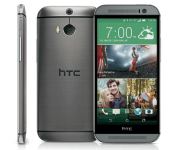
Caught red-handed: HTC has been boosting HTC One M8 benchmark Scores
 You might recall that late last year, it was found that Samsung had been boosting the benchmark scores of several of its flagship devices, not least of all the Galaxy Note 3 (read about those accusations here). This definitely isn’t the first time that it has been revealed that Samsung had been tweaking its device’s performance in benchmarking apps, however it appears that HTC may have been caught doing exactly the same thing with its brand-new smartphone, as shown in a HTC One M8 benchmark.
 As the story goes, the HTC One M8 was benchmarked in the slightly older AnTuTu 4 benchmarking app and scored 38815, far above the 34898 the Samsung Galaxy S5 got and the 32768 the Sony Xperia Z2 was able to achieve. Interestingly, when tested on the newer AnTuTu X benchmarking app, which is designed to eliminate performance boosted scores, the One M8 only scored 27171 whereas the Galaxy S5 and Xperia Z2 scored very nearly the same scores as they did on AnTuTu 4. It was later discovered that HTC has implemented a “High Performance Mode” on its Asian variant of the One M8, soon to be updated on the American version.
What do you think about HTC’s efforts to try and get better looking benchmarking scores? Let us know what your opinion is in the comments.
Source: ePrice via Phone Arena
//<![CDATA[
ord = window.ord || Math.floor(Math.random()*1E16);
document.write('’);
//]]>

Swedish carrier hints at an HTC One M8 Mini, we feign surprise

HTC has just released a new One smartphone, so it stands to reason that the company would give the One Mini a similar upgrade, wouldn’t it? Sure enough, there’s now a hint that such an update might be in the cards. Swedroid has spotted an “M8 mini” lurking in Swedish carrier Telia’s list of HD Voice-capable phones. While the entry has vanished (as have other HTC models), the provider explains that it changed the list to reflect the phones it has “right now” — not a confirmation of the tiny M8, but not exactly a denial, either. The listing didn’t include any details of the phone, and there’s no guarantee that it will launch soon, if it launches at all. However, HTC recently told us that its existing “product family strategy” has been working well; it would be shocking if the firm didn’t have something like a One M8 Mini in development.
Filed under: Cellphones, Mobile, HTC
Via: Phandroid
Source: Swedroid (translated), Telia (translated)

HTC reveals octa-core Desire 616 in China
HTC just released the all new HTC One, a device that created an excitement in the world of Android. But they are not stopping there; as the company just revealed yet another Android powered phone in China; which is known as the Desire 616. It is HTC’s first ever phone with octa-core processor, but it will be limited to Asia.
 Desire 616 comes with a 5-inch 720p display, MediaTek’s 1.7GHz octa-core processor, 1GB of RAM, 8 megapixel camera and Android 4.4.2, topped with HTC Sense 5. The design of the device is not that outstanding, but I guess HTC is just planning to target small markets with this phone, and also it might come with an affordable price tag. More details will be revealed when HTC will officially launch it.
Are you planning to grab it? Let us know in the comment box below.
Via: Phandroid
The post HTC reveals octa-core Desire 616 in China appeared first on AndroidGuys.
HTC One (M8) Unlocked and Developer Editions available for order
Amazon and HTC have made available the HTC One M8 Unlocked and Developer edition devices for pre-order through their respective websites for $649.
Oddly, that’s $50 cheaper than the HTC One M8 Google Play Edition, but HTC are stating they will be shipping the device in 1-2 weeks.
The HTC One M8 Developer Edition is available in gunmetal gray and amber gold, while the Unlocked version is available in gunmetal grey, amber gold and glacial silver.
For a full roundup of the HTC One M8, check out our featured post, otherwise hit up the link for either Amazon or HTC to order your HTC One M8.
The post HTC One (M8) Unlocked and Developer Editions available for order appeared first on AndroidGuys.

HTC CEO Peter Chou was heavily involved in the One’s design

Led by CEO Peter Chou, HTC has developed a reputation for making phones that are just as visually appealing as they are functional. The company’s latest flagship device, the One (M8), is another in a long lineup of beautifully crafted smartphones, and we had a chance to sit down with Chou to discuss the handset and some of the process behind how it came to be. “Our challenge was how do we break through from M7 to M8?” Chou told us. “I decided last year that I’m going to spend most of my time in product to help break through. Make it premium, like watches or jewelry. We want to stand out.”
Chou was definitely deeply invested in the success of the M8, and was directly involved in its development — he lost 5kg testing out the Fitbit integration, and even spent several weeks walking around with an M8-shaped block of wood in his pocket. “I tried to simulate when I take it out, how it feels when I put it on my ear, and when I talk.” In other words, Chou wanted to see it through the lens of any other consumer. During this process, he provided feedback to his design team on which areas needed to be tweaked. “We were working back and forth on fine-tuning it; ‘I don’t like this curve, I want it to be more natural in the hands, I want this completely metal, completely pure.’”
Chou has a background in product management, so it’s no surprise that he doesn’t simply sit back and let the design team do all the heavy lifting. “I give them direction, what we want to achieve. They go think about that and then we start the process.” He says that HTC goes through roughly 30-50 prototypes before finally settling on the final version; with each iteration, the team changed things like the shape, color, finish and battery shape and size.
Additionally, Chou told us that the process of developing the Duo Camera took HTC around 18 months. For a little more context, we spoke with Tim McDonough, VP of Marketing at Qualcomm, who said that the chipset manufacturer began collaborating with HTC very early on. Qualcomm needed to build several new features into its roadmap to ensure that it could keep up with the M8′s hefty imaging requirements. According to McDonough, there were a lot of challenges in making sure the Snapdragon 801 could handle the load of the new One’s complex post-processing features; he confirmed to us that the dual ISPs inside the 801 are 45 percent faster than the Snapdragon 800, which is a huge performance boost that opens the door for even more imaging possibilities down the road (whether from HTC or other manufacturers).
On a final note, Chou once again emphasized that premium watches and jewelry were behind the inspiration for the M8. Given what we’ve seen, it certainly appears that the company dedicated plenty of time and energy to making that happen. Of course, such a statement only makes us even more curious to see if Chou & Co. use the same model of inspiration for HTC’s upcoming smartwatch; unfortunately, if he has a block of wood strapped to his wrist right now, he’s doing a good job keeping it hidden. Regardless, take a look at the full interview above to hear more about how Peter Chou’s vision has taken a major role in the design of HTC’s products.
Edgar Alvarez contributed to this report.
Filed under: Cellphones, Wireless, Mobile, HTC
HTC One 2013 Google Play Edition Discounted by $100
Following the launch of the new HTC One M8 Google Play Edition, Google have decided to discount the 2013 HTC One Google Play Edition device by $100, bringing the price down to $499.
The 2013 HTC One has a 4.7-inch display, 1080p display, a Quad-Core 1.7 GHz Snapdragon 600 chipset, 2GB of RAM, and 32GB of Internal Storage.
Google is showing a shipping time for the original HTC One Google Play Edition device as 1-2 days, so if you have your heart set on the earlier generation device then head on over to the Google Play Store now to make it yours.
The post HTC One 2013 Google Play Edition Discounted by $100 appeared first on AndroidGuys.
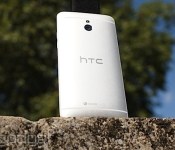
HTC One Mini to get Android 4.4 KitKat update starting today

Now that the brand new HTC One is out, it’s high time the rest of HTC’s siblings get updated to Android’s latest, especially if they want to remain relevant. The previous HTC One got the KitKat bump back in February, so now it’s the little brother’s turn at the firmware upgrade. Yep, if you have a HTC One Mini, you’ll likely get your Android 4.4 KitKat with HTC Senses 5.5 update starting today if this post by carrier AT&T is to be believed. The update will bring a number of improvements, like an enhanced dialer app, new navigation bars, a full-screen immersive mode, a new BlinkFeed app and more. So go on, head into Settings and download the latest System Update to get with the times. That is, if you’re not tempted to get a whole new phone altogether.
Source: AT&T

BlinkFeed coming to non-HTC Android devices ‘soon’

It was easy to miss in the fine print of yesterday’s HTC One press release, but it appears that BlinkFeed will be coming to the Play Store for non-HTC devices. We knew that a number of Sense apps were being broken free of their firmware chains, in particular Zoe, but it wasn’t clear just how fare the company was going to take that initiative. Now we know that the company plans to offer its own branded experience to any Android user. And it’s even putting BlinkFeed, which is arguably the centerpiece of Sense, up in the app store for use on devices running TouchWiz or even vanilla Android. For now it’s only listed as being compatible with the M8, but press materials state that:
Following its popularity with HTC users, HTC will now make HTC BlinkFeed available to other Android devices, launching on the Google Play store soon.
While we’ve never been huge fans of companies messing with the pure Android experience around here, we’re certainly in favor of more consumer options. With the Google Now Launcher in the app store and BlinkFeed coming soon it might not be long before you can buy whatever high-end handset your little heart desires then slap the launcher of your choice on top of it — be it HTC, Google, Samsung or Sony.
Filed under: Software, Mobile, HTC
Via: Android Central
Benchmarking the new HTC One: less cheating, better performance

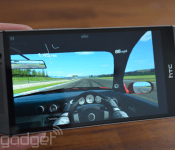
There are actually two “Ones” that launched this week. The star attraction is undoubtedly the HTC One, but let’s not forget the brand-new Snapdragon 801 running under its hood: a cutting-edge processor that will also power the Sony Xperia Z2 and the Samsung Galaxy S5, but which happens to have reached the market first in HTC’s flagship phone. This chip represents a significant upgrade over the Snapdragon 600 in the old One, promising a hat trick of better all-round performance, more fluid gaming and longer battery life, and these are precisely the claims we’re about to explore using a combo of benchmarking apps and real-world tests. At the same time, HTC has suddenly decided to come clean on the issue of benchmark cheating, which makes it a bit easier for us to trust what the numbers are telling us.
Honest cheating

There’s no room here to go back over the whole cheating controversy, but let’s just say it’s been a pretty depressing affair. In fact, if HTC hadn’t made a significant change to the way the new One handles benchmarks, we probably wouldn’t have bothered with this article at all, for fear of leading you astray. Fortunately though, that change has been made.
HTC has acknowledged to us that, in the past, it has forced its devices to run in a so-called High Performance Mode (HPM) whenever a well-known benchmarking app was launched. This mode boosted the processor’s clock speeds to levels that weren’t available to other apps, causing excessive battery drain and temperature increases solely for the purpose of achieving unrealistically high benchmark scores. The company could (and probably should) have put an end to this practice, but instead it has gone the other way: High Performance Mode on the new One is available to anyone who wants it, in any app they like, by means of a tickbox in the Developer Options screen.
High Performance Mode on the new One is available to anyone who wants it
Let’s be clear: There’s still some cheating going on here because you cannot disable High Performance Mode in a benchmarking app in order to measure the One’s regular, non-accelerated behavior. That’s why the numbers in the HPM column below mostly look the same as the non-HPM column. But by making HPM available to everyone, HTC has at least sidestepped the worst allegations against it and made things a little more open.
General performance
| HTC One (2014) |
HTC One (2014) HPM |
HTC One (2013) | Galaxy Note 3 | |
|---|---|---|---|---|
| Quadrant 2.0 | 25,548 | 23,555 | 11,952 | 23,278 |
| Vellamo 2.0 | 1,804 | 1,668 | 1,435 | 2,501 |
| Vellamo 2.0 Metal | 1,280 | 1,269 | 749 | 1,194 |
| AnTuTu 3.2 | 30,100 | 30,613 | 26,081 | 35,340 |
| SunSpider 1.0, stock browser | 570 | 577 | 940 | 537 |
| Geekbench 3 single-core | 941 | 989 | 626 | 934 |
| Geekbench 3 multi-core | 2,595 | 2,990 | 1,968 | 2,928 |
| CF-Bench | 38,526 | 38,489 | 27,601 | 33,785 |
If the table above tells us anything, it’s that a person upgrading to the new One from an old One, or from a 2012 phone like the One X or One X+, should see a solid and noticeable jump in general performance. SunSpider reveals that browser page rendering is almost twice as quick, whether you use the stock browser or Chrome. Benchmarks that test the CPU, memory and a range of other components, such as CF-Bench and AnTuTu, show improvements of between 10 and 50 percent, with Quadrant’s score being around double.
On the other hand, there’s much less to shout about when we stack the HTC phone up against last year’s Samsung Galaxy Note 3, which was one of the most popular implementations of the Snapdragon 800. Here we see only marginal gains in the region of 5 to 20 percent, with a couple of tests still putting the older device in the lead. This tallies with the fact that HTC has opted for a 2.3GHz version of the 801, which matches the CPU clock speed of the 800 and only offers a slight boost in memory and GPU speeds.
Graphics and gaming tests
| HTC One (2014) |
HTC One (2014) HPM |
HTC One (2013) | Galaxy Note 3 | |
|---|---|---|---|---|
| GFX Bench TRex Offscreen | 28.2 | 28.3 | N/A | 26.3 |
| GFX Bench Manhattan Offscreen | 11.1 | 11.1 | N/A | 9.3 |
| 3DMark Ice Storm Unlimited | 20,440 | 20,433 | 10,238 | 18,828 |
|
GameBench fps (Minion Rush)* |
28 | 29 | 27 | 28 |
| GameBench % drain per hour (Minion Rush)* | 22 | 25 | 32 | 20 |
| *Scores achieved using GameBench beta app, not certified by GameBench itself. | ||||
In terms of graphics, based on GFXBench and 3DMark, we’re looking at even bigger gains compared to the old One, as well as a significant step up from the Note 3. The only real-world test in our arsenal, GameBench, shows a small gain of 1 fps in regular mode, or 2 fps in High Performance Mode, which doesn’t seem so impressive. However, this test involves measuring a phone’s performance while an Android game is being played, and in this instance it probably tells us more about the game (Despicable Me: Minion Rush) than it does about the phone. After all, most mainstream Android games are designed to run on a wide range of devices, rather than to exploit the extra power offered by top-end phones.

Even if GameBench doesn’t reveal much change in terms of frame rates, it does show a very healthy improvement in the new One’s gaming stamina. Whereas the Snapdragon 600 was constantly under pressure in Minion Rush, draining a third of its battery each hour, the Snapdragon 801 proved to be capable of delivering slightly smoother graphics alongside a much lower drain rate. This drain rate was almost as low as the Note 3′s, despite the fact that Samsung’s phablet contains a much larger battery (3,200mAh vs. 2,600mAh).
For reference, the new One also produced a great result in the standard battery rundown test for our main review, lasting 11.5 hours (vs. 6.5 hours on the old One and 9.5 hours on the Note 3). So, we can safely say that this phone is very efficient, regardless of whether it’s being stressed or doing something less taxing, like playing a video.
Wrap-up

The conclusion here is simple: The HTC One has a very solid processor, and if you compare it to the old One, then you should see major improvements in both speed and battery life — which is exactly what we all want. But if you stack it up against current Snapdragon 800 phones, the One is only a small step forward — it’s better in a lot of tests, but if you own something like a Galaxy Note 3, then you probably wouldn’t notice much difference. When the Galaxy S5 and Xperia Z2 arrive, both with bigger batteries and, in Samsung’s case, with even higher clock speeds, the One will likely be edged out of the top spot on any benchmarking table. Nevertheless, so long as we don’t pay too much attention to what else lies on the horizon, we reckon HTC has given its latest phone more than enough grunt to satisfy even the most demanding of power users in 2014 and beyond.
Filed under: Cellphones, Mobile, HTC
 AIVAnet