


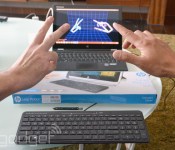
HP’s Leap Motion keyboard to be sold separately for $99

The Leap Motion controller is currently present in three forms: a $74.99 standalone dongle, inside the special edition HP Envy 17 laptop and inside an HP keyboard. The dongle — with almost half a million units sold since launch — and the keyboard are obviously the only ways to add this hand motion sensor externally, but the latter option was limited to select HP computers to begin with. Well, not any more. At Computex, Leap Motion told Engadget that as of this month, you’ll be able to purchase said keyboard for about $99, and it’ll work on any Windows 7 or Windows 8 PC as long as you have the software installed — be it the current version or the free V2 update with skeletal tracking coming this summer.
Filed under: Peripherals, HP
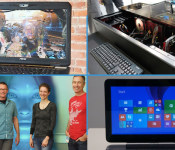
Engadget Daily: inside the mind of Cortana, a desk/PC hybrid and more!

Today, we give Microsoft’s Cortana a psych eval, take a closer look at Lian Li’s desk/PC hybrid, go hands-on with the MSI GT70 Dominator and learn about the HP’s latest slate, the Pro x2 612. Read on for Engadget’s news highlights from the last 24 hours.

Her name is Cortana. Her attitude is almost human.
Confident, caring, competent: these are just a few of the terms Microsoft’s Susan Hendrich uses to describe Cortana, the personal assistant with attitude. Read on as our own Brad Molen investigates the lovable AI’s development and the real-life personal assistants behind her demeanor.

MSI GT70 Dominator review: everything it’s supposed to be, not much else
MSI’s GT70 Dominator gaming laptop is built for power, and it shows. It may have a bulky, old-school frame, but this machine packs a full-sized keyboard and a killer sound system, complete with its own subwoofer.

HP’s Pro x2 612 laptop-tablet hybrid brings pen support, a sturdy keyboard
If you’re intrigued by the Surface Pro 3, but need a 2-in-1 with a sturdy keyboard, then HP’s new Pro x2 612 might be just the device for you. This hybrid shares many features and specs with Microsoft’s premier tablet, but also packs a backlit, spill-resistant keyboard dock.

An up close look at the giant gaming PC that’s also a desk
What you’re looking at is Lian Li’s DX-01: a sleek, glass-faced office desk that happens to have a high-powered PC stuffed inside. What’s more, you can buy it right now, starting at $990. That’s just for the empty case, though — you’ll have to get all the computer bits yourself.
You also might like:
Filed under: Misc

HP’s Pro x2 612 laptop-tablet hybrid brings pen support, a sturdy keyboard

If you read our Surface Pro 3 review, you know we recommend it, but only for a certain kind of person: someone who needs both a laptop and a tablet, preferably one that allows for pen input. Even then, is Microsoft’s approach the smartest one? Can you really call something a laptop replacement if it’s not as comfortable to use in the lap, or if the keyboard isn’t as sturdy? For all of you skeptics out there, there’s an alternative incoming: HP has just announced the Pro x2 612, a laptop-tablet hybrid that offers many of the same features as the Surface Pro 3. Like the Surface, this is a 12-inch tablet that supports pen input and runs on Ultrabook-caliber Intel Core processors. The main difference is that rather than use a flat, click-in keyboard, the Pro x2 612 comes with a backlit, spill-resistant keyboard dock. As a bonus, that dock also includes a spare battery that brings the total runtime to about 14 hours.
As for the tablet itself, it uses a Wacom pen digitizer, which is what the Surface Pro had before Microsoft switched to N-Trig. As a quick refresher, Wacom’s chief benefit has always been its precision, with 1,024 levels of pressure sensitivity. The downside, though, is that Wacom tablets tend to be thicker than N-Trig ones, which is the primary reason Microsoft made the switch. Indeed, that seems to be the biggest drawback here: the tablet and keyboard dock combined weigh around four pounds, compared with two or so for the Surface Pro 3. In exchange, you get a bunch of ports on the dock, including VGA, DisplayPort and Ethernet sockets; an SD slot; and two USB 3.0 ports. The tablet, meanwhile, has a microSD slot, along with a slot to stow the pen — something you won’t find on the Surface. In effect, then, the Pro x2 612 is a laptop first and a tablet sometimes, whereas the Surface Pro 3 tries to be both in equal measure. Again, different approach here.
Given that HP plans on selling this to businesses and government agencies, you can bet it has all sorts of security measures in places. These include TPM and a Smart Card reader, as well as an optional fingerprint scanner. Spec-wise, it’ll start with a Celeron processor, with options for Pentium, Core i3 and Core i5 (the Surface Pro 3 goes up to i7). Storage capacity ranges from 64GB to 512GB; screen resolution starts at 1,366 x 768 but goes up to full HD. A built-in 4G radio will be an option too, as will Windows 7. HP says it will retail ship in September, with the power keyboard included. You can also buy the standalone tablet, in which case it’s just called the Pro Tablet 612 (no “x2″). Oh, and if you’re put off by the weight, there’ll be a lighter-weight “travel” keyboard too. Until then, check out our hands-on photos above — and take our word for it when we say the keyboard is pretty good.

HP announces Android 4.3 powered 14-inch Slatebook

HP is known in the world of technology for their laptops and desktop computers, and if you are one of the people who are looking forward to a laptop with Android, then HP have something for you. HP officially announced the HP Slatebook – a notebook in a yellow and black color with a 14-inch display. Last year in July, HP released the Slatebook x2 but the new Slatebook comes with a lot of new specs and features.
 it comes with a 14-inch FHD (1080p), quad-core NVIDIA Tegra 4 under the hood. It will feature Android 4.3 Jelly Bean with slight customization made by HP – it will run HP’s apps as well as the Google Play app store, as well as the NVIDIA TegraZone for games. It has a 16mm ultra-slim design and weighs in at a tiny 3.71lbs. It has a battery life of up to 9 hours, which is good enough for a tablet.
It will be available starting August 6th, and it will cost $399. Are you planning to grab it? Let us know in the comment box below.
Source: HP
The post HP announces Android 4.3 powered 14-inch Slatebook appeared first on AndroidGuys.
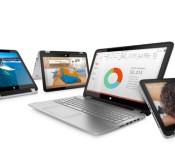
HP’s back-to-school lineup includes lots of convertibles (and Beats products, too)

This week is Computex, a huge computer show happening in Taiwan, which means lots of PC makers will be unveiling their back-to-school lineups, if they haven’t already. HP, for instance, just unveiled a boatload of PCs, including budget and mid-range laptops, a handful of convertibles, and even some Beats products — the first we’ve seen from HP since the Apple deal was announced. Rather than inundate you with specs, we’ve got a neat summary laid out below. We promise to make sense of it all — even if HP does have a penchant for similar-sounding product names.
- Pavilion x360. Confusing product names? May we present Exhibit A: HP just announced a laptop called the Pavilion x360, even though it already sells something with the same name. The original x360 is a cheap, 11-inch machine with a screen that folds all the way back into tablet mode, à la Lenovo’s Yoga line. This new model has a similar design, except it rocks a larger 13.3-inch screen and is more powerful. Whereas the 11-inch version makes do with an Intel Bay Trail processor, the 13-incher starts with AMD A6/A8/A10 chips, going all the way up to Intel Core i3 and i5 CPUs. It also has up to 1TB of storage, not 500GB, with battery life rated between 6.25 and 8.25 hours, depending on whether you go with AMD or Intel (the 11-inch x360 tops out at 4.5 hours). Look for it in July, starting at $600.
- Envy x360. It’s a similar story with the Envy x360, except it has a bigger 15.6-inch screen, and also belongs to HP’s mid-range Envy line, which means the design will be nicer than what you find in the Pavilion range. As a higher-end machine, it also offers higher-end specs, including a range of Core i3 to Core i7 processors and up to 1TB of storage, with the option of a hybrid hard drive for faster boot-ups. This one starts at $680.
- Split x2. Also known as the Pavilion x2 outside the US, the Split x2 is a refresh of an earlier HP Split x2, which came out last year. Like the original, this is a 13.3-inch Windows tablet with a keyboard dock that packs a spare battery. Whereas the original was only offered with Core i3 and i5 processors, though, this new one will also be available with Bay Trail CPUs, allowing HP to sell it at a lower price ($600 and up). Another tradeoff: the new edition has a 500GB spinning hard drive in the tablet, whereas the old one had SSDs inside the slate and an optional HDD inside the dock. In that case, we don’t performance to be quite as fast.
- HP All-in-One PC Beats. You’re going to have to pry the Beats-branded PCs out of HP’s cold, dead hands. The company has said it plans to release products with Beats through the end of 2015, presumably even after the Apple acquisition closes, and indeed, it appears the company is wasting no time. The Envy All-in-One Beats is, uh, exactly what it sounds like: a 23-inch all-in-one desktop whose very being centers around the Beats brand. (Which is to say, it’s very red, and comes armed with both four speakers and four subwoofers.) Design and audio quality aside, the system also has a hinge allowing it to tilt to a 60-degree angle. On the spec front, you’re looking at Core i3, i5 and i7 processors, with up to 16GB of RAM and up to 1TB of storage. Expect it to start at $999.
- Envy notebooks. HP’s mid-range “Envy” laptops come in three sizes (14, 15.6 and 17.3 inches), each with a metal-accented design and an extra-wide trackpad with “touch zones” on the end to help with Windows 8 gestures. (N.B.: Most modern touchpads handle Windows 8 swipes just fine.) Across the board, these come with touch or non-touch screens, Core i5 and i7 processors, up to 16GB of RAM and up to 1TB of storage, with hybrid hard drives offered on the 14- and 17-inch models. Expect the 14, 15- and 17-inch versions to start at $599, $749 and $699, respectively.
- Pavilion notebooks. It’s all about the color, folks. HP’s budget notebooks (available in 14-, 15- and 17-inch sizes) have a polycarbonate shell with colors like silver, red, blue, white and purple. They also have Beats Audio, which isn’t exactly surprising to us, though HP is making a big deal out of the fact that it’s included even on lower-end notebooks. Speaking of, though this is technically HP’s lower-tier range, you’ll still have lots of flexibility when it comes to configurations; each starts with an AMD E2 chip, moving up to AMD’s A4/A6/A8/A10 APUs and culminating with Intel’s Core i3, i5 and i7 series. Other specs include up to 12GB of RAM and up to 1TB of storage — again, not bad for a so-called low-end machine. Look for the 14- and 15-inch models to start at $429, while the 17-incher is slated to sell for $449.

HP hedges its bets, unveils a 14-inch laptop running Android

If you thought this year’s Computex show would be dominated entirely by Windows machines, you’re in for a little twist. HP has just revealed the SlateBook, that 14-inch Android laptop we saw in a leaked video earlier this year. In addition, HP refreshed its 11-inch Chromebook with a slightly better batter, and dropped the price from $279 to $249. And that’s not even counting all the Windows systems the company just launched. Some might call this strategy “throwing spaghetti at the wall and seeing what sticks”; HP would probably just say it’s hedging its bets. Either way, we’ve got the skinny — but we’ll leave it to you to decide which operating system makes the most sense.
The SlateBook isn’t the first Android clamshell we’ve seen. Normally, though, once we get this far up in screen size, we expect a machine to be running Windows or OS X. You know, a “real” desktop OS. Heck, we’ve even seen Android running on various all-in-ones. But Android on a laptop? Especially one this large? That’s a horse of a different color.
What’s interesting is that with these specs (an NVIDIA Tegra 4 processor, a 1080p touchscreen and a nine-hour battery), the 3.7-pound SlateBook is poised to compete against Chrome OS devices, including HP’s own Chromebook 14, which costs a hundred dollars less. In particular, it matches up well against Samsung’s new Chromebook 2, which also has a full HD screen and long battery life, and which costs the same as the SlateBook.
The difference, of course, comes down to which operating system functions better on a laptop. At first blush, it would seem Chrome OS is more mouse-and-keyboard friendly, but that Android has a much wider selection of apps, meaning you might be able to do more with it. The SlateBook will be available August 6th, starting at $399, at which point we’d love to get one in to review so that we can live with an Android laptop and see what it’s like. Until, then, though, it would appear this is your shopping dilemma, if you choose to go with either OS at all.

Apple owns Beats, but the brand is still alive at HP

Beats Audio may be moving to Cupertino, but that doesn’t mean it’s giving up on the PC market. Well, at least not yet — HP says it still has rights to use the brand’s audio technology for the foreseeable future. It’s part of the company’s pre-existing contract with Beats: HP can develop new Beats-bundled products through 2014, and it’s allowed to sell those products through the end of the 2015. In other words, we’ll be seeing HP laptops, desktops and tablets with beats branding for the next year and a half. That’s a lot of leeway. According to CNET, HP isn’t wasting time: it says it’s building an aggressive line-up of Beats enabled devices for 2014.
Filed under: Portable Audio/Video, Apple, HP
Source: CNET
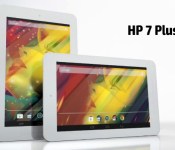
HP’s 7 Plus is a $100 Jelly Bean tablet

Cheap Android tablets are a dime a dozen these days, but HP’s targeting the budget market with its own $100 slate. The 7 Plus, a low-end 7-inch tablet, isn’t going to blow you away with performance, but it should be perfectly sufficient for email, web browsing and basic apps. There’s a quad-core ARM Cortex-A7 processor, 1GB of RAM, 8 gigs of internal storage and expandability via a microSD slot. You also get a 1024 x 600 IPS display, low-res front and rear-facing cameras, WiFi and 25 gigs of lifetime cloud storage, courtesy of Box. It’s available in the US now for $99.99, with free shipping to boot.
Source: HP

HP cuts 16,000 jobs, up to 5 percent of its workforce

It looks like HP’s layoff estimates were off again — according to the company’s latest financial report, it needs to cut an additional 11,000 to 16,000 employees from its payroll to make ends meet. This is the third (and largest) adjustment the company has made to its layoff numbers; HP originally planned to axe 27,000 employees in May of 2012, but increased the estimate to 29,000 the following september and to 34,000 in 2013. Now the restructuring plan could eliminate as many as 50,000 jobs in total. Harsh news for HP employees, particularly after CEO Meg Whitman said that the company was done eliminating positions. The president makes no such promises this time, but she’s at least optimistic about the restructuring. “I’m pleased to report that HP’s turnaround remains on track,” and said that increased layoffs “make sense in a turnaround of this scale.”
Filed under: HP
Source: HP
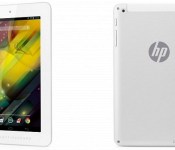
HP 7 Plus gets an official launch, bezels overload

Earlier this month we’ve seen a leak of a tablet with too much bezel on it, that tablet didn’t have a name, up until now that is. HP launched that bezel-heavy tablet under the “HP 7 Plus” name. This is now the most affordable tablet in the HP line, going for just $99, we have to admit it looks cheap and quite frankly rather ugly, but the price is low so we can’t complain much.
Regarding the hardware we’re looking at a quad-core tablet featuring Allwinner Technology A31 chip with four Cortex A7 cores clocked at 1 GHz, alongside it we have a Power VR SGX544MP2 GPU. Allwinner chips are mainly used for budget devices in China. HP 7 Plus has a 7″ (as the name states) display 1024×600 in resolution. The device has 1GB of RAM, 8GB storage expandable via microSD card (up to 32GB), 2MP back and 0.3MP front cameras and it is powered by 2800mAh battery. As far as software goes, Android 4.2.2 is powering the tablet and it is a near stock version of it, which is a good thing.
You can’t expect much from a tablet priced at $99, now can you. You get what you pay for and for that price we can’t complain much, it’s not the fastest tablet in the world, far from it actually but you’re not going to spend much either. If you’re interested you can buy it directly from HP via link below.
SOURCE: HP
The post HP 7 Plus gets an official launch, bezels overload appeared first on AndroidGuys.
 AIVAnet