


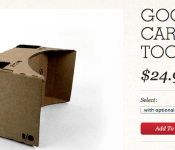
Get your own Cardboard VR on the cheap

Google made tons of announcements at I/O Wednesday, but one of the most puzzling was right before the keynote ended when all attendees were told they were also receiving “Cardboard,” which no one understood until opening the box.
Cardboard is a virtual reality viewer made from a pre-cut cardboard, lenses, magnet, velcro, rubberband and NFC tag, which works with your smartphone and an Android app.
While the Oculus Rift is defining VR today, with this strange, yet interesting device, Google showed that it can actually be done quite cheaply, although this will probably never become a top competitor in the market.
 If you weren’t at the conference, you can ether pay $100+ on Ebay for one of the kits from the conference, which we wouldn’t recommend, make one with things you can find in your home (Google offers full-instructions) or you can buy one for either $19.95 or $24.95 from DODOcase.
Over at their site, DODOcase said that they did the math and it costs over $45 for all the bits and pieces Google suggested and that doesn’t include shipping from four different vendors.
“Well lucky for you we are nerds who know a thing or two about making stuff and we want to help get VR goggles in your hands!”
DODOcase gathered all the pieces and pre-cut the cardboard so you can have a kit that can be assembled in “under 5 minutes.”
You have a choice of either the $19.95 model without the NFC tag or the $24.95 model with it. The NFC is optional and Google says that it is used to trigger the launch of the Cardboard Android app automatically, but if you didn’t have it, you can just launch the app before putting your phone inside the viewer.
With such a high demand, you should get your order in soon if you’re interested. You may not have it for about month to a month and a half.
VIA DODOcase
The post Get your own Cardboard VR on the cheap appeared first on AndroidGuys.
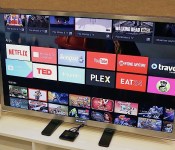
Android TV is Google’s latest shot at entertainment glory (hands-on)

For Android, smartphones and tablets are only the beginning. Google believes that there are so many other categories of hardware that could benefit from its mobile OS, so it announced that it’s building extensions of Android onto the TV, car and smartwatch. Each genre will require special hardware to be truly beneficial, but the former may have the greatest potential in terms of reach — after all, more people are looking for a solid television-watching experience than putting a “computer” on their wrist, and it’s going to be a long time before Android Auto goes mainstream.
Sadly, TV is also an area that Google has struggled with in the past (see Google TV), so it’s hoping that lightning will strike with its latest effort, called Android TV. We had a chance to check out the company’s first official piece of hardware, simply called the ADT-1. Since it’s a developer kit, you won’t be able to buy it — but that won’t be an issue once manufacturers begin selling their consumer-facing devices later this fall. Naturally, the version we checked out is considered pre-production, so a lot of things will likely change between now and its final release, but at least we have a good idea of what to expect from the experience.
The idea behind Android TV is pretty simple: It gives you an internet-powered smart TV with plenty of entertainment and gaming options. Media-streaming apps, Play Movies and TV support, gaming and second-screen/screen-mirroring functionality make the service incredibly tempting. The Android ecosystem is already pretty strong, and the company says it’s easy to adapt existing apps to make them compatible with the platform. With proper hardware and developer support, Android TV may have the legs it needs to stand on.
What can Android TV actually run on? According to Google, the OS will be available for smart TVs (Sony and Sharp have signed on to build televisions with the OS built in), media streamers (like a Roku), set-top boxes, cable boxes and micro consoles. The platform is ideal for any manufacturers that are interested in getting into the smart TV business, but don’t have the resources to develop their own ecosystem; it’s a good opportunity for smaller companies and startups to cook up Android TV hardware.
There are a few hardware requirements to ensure that Android TV doesn’t offer an inconsistent (or miserable) user experience: 2GB of RAM, 8GB of flash storage, WiFi and/or Ethernet, Bluetooth 4, Play-ready DRM and Widevine level one. Companies are also recommended to add mics for voice input, and standardized controller button mapping. These guidelines make a lot of sense because the system needs to be powerful enough to handle graphics-intensive games, entertainment apps and handoffs between the TV and mobile devices via Google Cast — nobody wants a sluggish TV experience, so it’s crucial that Google gets this aspect of its product right. The experience also needs to be as universal as possible so users don’t have to worry about drastically different learning curves.

Sluggishness fortunately doesn’t show up, even on early hardware and firmware. With a Nexus 5 equipped with the Android L Developer Preview, we used a virtual controller to navigate through the TV’s UI, and the system didn’t skip a beat (or a frame, for that matter). We didn’t have to wait for anything that we pulled up, so there were no interruptions to our experience.
The card-based user interface is simple enough. Recently played movies and TV shows, as well as recommended titles, are neatly displayed on the top. Scroll down a level and you’ll see a listing of your apps, including access to Google Play Games and Play Movies. Below that, games. Finally, at the very bottom of the screen you’ll find all of your necessary display and network settings. As you might expect, most apps have setups that are very similar to each other; they use a dual-pane UI with more cards on the right and a large slide-out menu on the left.
As mentioned earlier, Android TV also comes with voice-input options. You can speak to it through your remote controller, and it doesn’t matter what kind of request you have — whether or not it’s related to entertainment, it’ll still answer you the same way it would in Google Now. On one request, you can ask it to pull up movies from 1984, and on the next you can tell it to convert gallons into cups. Mentioning Tom Selleck will not only bring up a queue of the actor’s movies, but it’ll also have an information card about the actor and a list of other people that are somehow connected to him.

The usual entertainment suspects already have apps on Android TV — Netflix, Songza, YouTube, PBS Kids, Showtime and more were featured in our demo — but there should be plenty more options from other third-party developers before the service is ready to go this fall. (As an aside, reps told us that Google TV v4 apps will be compatible with Android TV.) Unsurprisingly, we noticed a slight bias toward Play Store products, but it’s not over the top; we didn’t feel like we were watching a nonstop Google ad, and as more apps become widely available and easily accessible on the platform, those influences will likely be toned down even more.
For the most part, the gaming experience was pretty smooth. We didn’t see as much latency between the game controller and the screen as we expected. There were some games that looked as though they needed a bump in resolution support, as they looked fuzzier than we’d like, but most titles (Need for Speed: Most Wanted, for instance) appeared as sharp on TV as they do on a high-res phone or tablet.
Finally, we’ll briefly touch upon the NVIDIA Tegra 4-powered dev kit, because there isn’t much to it cosmetically. From the top and sides, it’s nothing but a thin set-top box about the same size as two hands, if not slightly smaller. It’s more visually interesting on the bottom because it features four pointy nodules that raise the box up from whatever surface it’s resting on. On the back you’ll find power, HDMI and Ethernet ports.
We can’t make a final judgment on Android TV just yet, and the company’s got a rough path ahead. While the association with the Android ecosystem will be a nice draw for prospective buyers, the platform will be nothing if manufacturers and developers don’t jump on board the bandwagon and produce high-quality hardware at competitive prices. To see how well that works out for all parties involved, we’ll have to wait until this fall to get a verdict.
Filed under: Home Entertainment, Software, Google
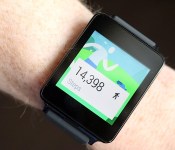
Meet the G Watch, LG’s first Android Wear smartwatch

LG believes it’s hip to be square, and it created a smartwatch to prove it. The G Watch was announced alongside Android Wear, Google’s new wearables platform, and the circular Moto 360 this March. After three months, LG and Google are finally ready to let me slip one on my wrist. The watch is going to be available for pre-order for $229 on the Play Store alongside the Samsung Gear Live (and Moto 360, once it comes out later this summer), and will ship out in both black and white to eager users on July 7th.
With a 1.65-inch display at a resolution of 280 x 280 and sizable bezel, the G Watch is a little bigger than the Pebble Steel, which is the smartwatch I’ve been using up until this point. It looks like it swallows up my wrist, so it’s not going to be a go-to fashion statement for everybody. Just like the Gear Live, LG chose to go with a square shape, rather than circular, mainly to ensure the user will enjoy as much screen real estate as possible. The product managers we talked to also left the door open for future Wear devices with other shapes, so there’s certainly a chance we’ll see more options down the road — especially if the G Watch is considered a success.
The display is covered with Gorilla Glass 3; the sides are constructed with stainless steel; and the back is polycarbonate to allow for attenuation and wireless charging (the watch comes with a charging pad that makes this possible). The straps are interchangeable because it uses a 22mm size, but the wristband that comes with the device is made of silicone and offered me a comfortable fit.
Underneath the back sits a 400mAh battery that LG claims is high-density and optimized for wearable use. When asked about battery life, reps told me that it should last 36 hours in always-on state, and even longer if you opt to turn the screen off — there’s a companion app that you can download onto your Android device, and it gives you a few settings. Additionally, the G Watch boasts an ambient mode when idle, which theoretically helps extend the life of the battery.
In terms of power performance, the 63g timepiece features a 1.2GHz Snapdragon 400 processor, coupled with 512MB RAM and 4GB internal storage. I couldn’t fully test out the watch’s performance in real life because the watch itself was in a special demo mode that only gave me a few cards to play with, but I’ll give it a full whirl in my upcoming review.
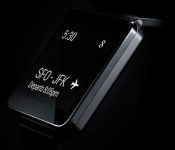
LG’s G Watch has a smartphone processor inside and goes on preorder today

Google thinks it’s finally time for smartwatches. Its Android Wear collaboration with LG goes on preorder today in 12 countries, including the US, Canada, UK, Germany, South Korea and Japan. The G Watch might only be a wearable, but inside beats the heart of a smartphone… processor. Behind the 1.65-inch (280 x 280) IPS display, there’s a substantial Snapdragon 400 chip — the same Qualcomm processor found inside the Galaxy S4 Mini. Below, we’ve got the whole spec rundown, although we’d really love to hear that all-important price tag.
LG is hyped about the voice recognition and Google Now integration. Speech-to-text will substitute for tapping texts out your smartphone screen, while sensors encompass a nine-axis gyro, accelerometer and compass — a few of those are probably going to come in handy for fitness apps. Storage weighs in at 4GB, with 512MB of memory for support, although we’re not quite sure what we’ll use those four gigs for, given that the Android Wear device doesn’t seem to record or store anything. There’s a 400mAh battery (making it bigger than Samsung’s Android Wear device) and it’s all IP67 dust and water resistant, hewn from stainless steel and paired with matching silicone bands — black for the Black Titan model and white for the White Gold one. If you’ve got a fancy leather band that’s aching for a taste of the future, however, any 22mm strap will work, and LG says it’s launching its own collection of bands in the near future.
Filed under: Wearables, Mobile, Google, LG
Source: LG
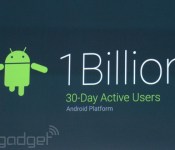
Android still the dominant mobile OS with 1 billion active users

Free-falling product demos and Rube Goldberg multimedia installations aside, there’s always a level of predictability to an opening day keynote. And Google I/O 2014 is no exception. Like clockwork, SVP Sundar Pichai took to the stage in San Francisco this morning to tick off the company’s latest accomplishments. He started off by touting one of the company’s biggest strengths: Android. According to Pichai, Google now has over 1 billion active users (that’s as of the last 30 days) on the OS.
Developing …
Google’s apparently opted to track 30-day usage as opposed to year-over-year numbers as in the past. That said, last year, the company boasted 900 million Android activations, up from 400 million the year before. We likely won’t get a direct comparison due to the change in tracking, but even with the numbers we have, it’s clear Android is still the dominant mobile platform. During its WWDC 2014 keynote earlier this month, Apple’s Tim Cook announced the company had reached 800 million iOS devices to date, fewer than Google’s Android activation numbers from the year prior.
Continuing the theme of unconventional stat tracking, Pichai championed the strength of the platform saying Android users send 20 billion text messages each day and 93 million selfies. What’s more, those self-absorbed phone holders apparently take 1.5 trillion steps each day, and check their handsets a total of 100 billion times every 24 hours.
Filed under: Cellphones, Tablets, Wearables, Internet, Software, Mobile, Google

Watch Google’s opening keynote at I/O 2014 here!

Although we’ll be liveblogging the opening keynote of Google’s annual developer conference in just about an hour, we don’t want to dismiss the fact that many of you like to follow along when a livestream is available. Google’s got you covered: keep a tab open at this page for live video footage of the keynote. We expect a lot of news this morning at San Francisco’s Moscone Center, and we’ll keep you posted on all of the latest announcements and developments as it happens.
[Image credit: Getty Images]
Filed under: Announcements, Google
Source: Google
Live from Google I/O’s 2014 opening keynote!

Get ready for two crazy hours of Google awesomeness: I/O’s opening keynote is about to begin. This is typically the time for the company to unveil some of its biggest projects and set the tone for the following year. Just two years ago, for instance, co-founder Sergey Brin skydived onto the roof of the venue and biked into the keynote while wearing Google Glass. Whether we’ll see anything as adventurous this year remains to be seen, but that’s why we liveblog these things — so you, dear reader, can experience every second of the madness right along with us. So join us right back here at noon (EDT), okay?


Filed under: Announcements, Cellphones, Mobile, Google

Google will show off the new ‘L’ version of Android tomorrow

You can move one more item into the confirmed list for tomorrow’s Google I/O keynote: a new version of Android. Your guess is as good as ours as to which L-word treat Google plans to name its next iteration of the mobile OS, but as part of a lengthy profile for Bloomberg, senior VP Sundar Pichai reveals he will offer a “preview” at the developer event. It’s a new approach for Google, in publicly revealing the new version (which may have momentarily surfaced on its issue tracker yesterday) well ahead of its planned release later this year, but similar to the way Apple, for example, is rolling out iOS 8. Also confirmed is Android Wear, complete with manufacturing partners and new devices, while the plans for Android TV are still shrouded in rumor.
[Image credit: David Paul Morris/Bloomberg via Getty Images]
Filed under: Cellphones, Home Entertainment, Software, HD, Mobile, Google
Source: Bloomberg

Tune in to our liveblog of the Google I/O keynote tomorrow!

Google’s developer conference is but an annual affair, and it’s kicking off in 24 hours with its traditional keynote. We’ll be liveblogging it as it happens, and if it’s anything like past years, expect it to be incredibly long (last year’s went on for 3.5 hours, and we’re hearing this one will be around 2 hours) and packed with plenty of news for developers and consumers alike. So if you’re into anything Google-related, you’d best virtually skydive into the Moscone Center with us as we cover all of the company’s crazy antics. Bookmark the link below and meet us there tomorrow!
Google I/O 2014 keynote liveblog
[Image credit: Getty Images]
Filed under: Announcements, Mobile, Google

What’s on tap for Google at I/O 2014

Don’t let its DevCon facade fool you: Google I/O has plenty of interesting stuff for everyone. Most of the company’s big announcements come during the day one keynote, which we’ll be liveblogging tomorrow morning. This year’s theme is “Design, Develop, Distribute,” a slogan that doesn’t reveal any major clues about what we can expect (aside from the fact that Google is focused on new design, which we’ll cover in more detail later). But that’s what we’re here for — to figure it out! We’ve compiled a handy guide that discusses what to expect — and not expect — to see at San Francisco’s Moscone Center this week.
Android Wear

We’re not exactly taking a shot in the dark by predicting that Google’s new wearables platform will get a lot of attention at the company’s developer conference. Ever since it was officially announced three months ago, Google has given devs access to the platform via emulators and fed them with videos on the subject. Two of its hardware partners, LG and Motorola, also showed off their first Wear-enabled smartwatches, and all three companies have hinted that we should expect more details near the end of June.
While we feel safe placing bets on the chance that Wear will get plenty of face time during Wednesday morning’s keynote, we’re less sure of which hardware we’ll see — aside from the LG G Watch and Moto 360, that is. A Samsung-built Wear device is a solid guess, but what about the handful of other companies committed to supporting Google’s new platform (Fossil, HTC and ASUS)? Those camps have been pretty quiet of late, so it’s unlikely we’ll see a smartwatch from those manufacturers this soon.
Android redesign
Quantum Paper. Sounds like something straight out of science fiction, but it’s actually the rumored code name for a new design framework Google’s been working on for some time. First detailed by Android Police, this project is intended to offer a consistent user experience on the company’s products over multiple platforms, such as Android, iOS and the web. (We wouldn’t be surprised if this extended to Chrome OS as well.) We expect to hear more of this project at I/O, and it would make sense to see the new design elements implemented in a fresh version of Android. It’s been 2.5 years since Android 4.0 Ice Cream Sandwich introduced a completely different user experience; even if we don’t see a full upgrade, we’ll at least come out of I/O with a much better idea of what the next version of Android should look like when it’s ready.
Google Fit
Health monitoring is trendy this year, it seems. In 2014, Apple and Samsung have already introduced platforms that give users the opportunity to gather data about their personal health and provides them with advice on how to improve it. Now it’s Google’s turn to crank out a similar platform, according to Forbes. Known as Google Fit, the service is expected to collect and aggregate health data from apps and fitness trackers. While it’s unclear if this will be baked into Android or just available as a standalone app of some sort, it makes sense for Google to offer a health-related platform for developers and wearables companies. In fact, Fit may encourage more manufacturers to give Android Wear a shot, if Google makes it easy to tie the two platforms together.
Android TV
Television is a tough nut for Google to crack, so the company’s next effort in the space is Android TV. It’s rumored to be a platform that offers a simple user interface (known internally as Pano) focused on helping you find new entertainment options through recommendations. It’ll be similar to the company’s failed Google TV in a few ways, but it’s supposed to feature online media services and games. Developers will be able to create TV apps that have access to voice input and notifications, and content suggestions will sit on the home screen. Netflix and Hulu Plus are expected to be included, as are several other unnamed services.
Google will face the challenge of courting hardware manufacturers to the platform, especially those who may have had lackluster experiences with Google TV or are currently committed to other platforms (such as LG, which uses webOS on its televisions). Still, any company eager to take on Amazon, Apple, Roku and other set-top boxes may adopt Google’s new platform in the hopes of grabbing market share.
ATAP

Google’s Advanced Technology and Projects division is hard at work on two publicly known initiatives: Project Ara, which is focused on building a modular smartphone, and Project Tango, centered on 3D mapping and gaming using phones and tablets. At least one of the I/O sessions is dedicated to the group, so there’s a solid chance we’ll get some more details about one or both projects during the conference — and who knows, maybe the company will even reveal something completely new that we haven’t seen before, but we won’t hold our collective breath for that.
Wild cards

Now, we’ll go over a few of Google’s other projects that may show up at I/O. First up is the connected-car experience. Earlier this year at CES, Google announced the Open Automotive Alliance. The coalition, which consists of partners like Audi, Hyundai, GM and Honda, was formed to create an Apple CarPlay-esque platform that would let you use your car’s dashboard as a control center for your Android phone. It’s possible that we’ll hear some more details about the project, which is currently rumored to be known as Auto Link.
But what about Nexus? Over recent months, we’ve heard buzz about a new HTC-built tablet called the Nexus 9, but we’ve also heard the same thing about a Nexus 8 as well. Regardless, we don’t expect to hear much about either device this week, but we won’t rule it completely out of the picture either.
Speaking of which, there likely won’t be any details about the rumored Android Silver program. With Silver, Google reportedly wants to offer a premium Nexus-like experience with multiple manufacturers in which Google itself will volunteer to help with marketing and development costs; these phone and tablet makers would also get preferential treatment when it comes to getting updated with new versions of Android.

Nest’s recent acquisition of Dropcam is still too fresh for Google to discuss strategy or plans of any sort, but don’t count the thermostat maker completely out of the picture. The company announced yesterday that third-party devs can now build apps and devices capable of talking to the hardware, so there’s a very good possibility that we’ll hear more about this from Nest this week. We’d also love to hear more from Google’s home automation group known as Android@home. It was announced in 2011, but has gone largely untouched since it initially began. Could Nest help tie it in with some of Google’s other products? Perhaps.
Lastly, Google Glass has opened up to UK developers (as well as the public) recently, but it’s still technically not a consumer-facing product yet. Google’s mentioned that it’ll arrive for consumers sometime this year, so there’s a possibility that we’ll see the next version of the wearable and get more details on public availability and pricing.
[Image credit: Getty Images]
Filed under: Announcements, HD, Mobile, Google
 AIVAnet