



Google could face heavy fines after EU rejects latest antitrust settlement offer

More than three years after it opened its investigation into Google’s search practices, the European Commission has warned the company that time to settle the case has all but run out. According to Reuters, Commission antitrust chief Joaquin Almunia said today that Google’s latest proposals are “not acceptable” and don’t do enough to “eliminate [its] concerns regarding competition.” The regulator opened its antitrust investigation in 2010 after a number of price comparison companies accused Google of unfairly downranking competitors in search results.
To escape a potential fine of up to $5 billion, the company previously offered to include more labelling of links that promote its own services (like Shopping) to indicate that they were promoted placements, but they were rejected. While it was suggested that Google’s most recent concessions, which included giving competitors the chance to bid on second-place search rankings behind Google’s own, had done enough to get the Commission’s stamp of approval, today’s announcement confirms that’s not the case. Almunia told the AP that he has yet to decide if he will file charges against the search giant, but did say that there is “little time left” for a settlement. As it stands, the “ball is in Google’s court,” but the Commission will be the one to decide when the buzzer sounds.
[Image Credit: european_parliament, Flickr]
Source: Reuters, Associated Press

[OP-ED] Dear Google, Where Are My Google Play Edition Devices? Sincerely, The Rest Of The World
 The Google Play Edition devices are an intriguing prospect for Android purists everywhere. Marrying the power and quality of OEM (original equipment manufacturer) created hardware with a stock Android operating system is a drool-worthy affair for some, and the recent releases of the LG G Pad 8.3 GPE and Sony Z Ultra GPE have further filled out Google‘s impressive line of stock Android devices to the point where they now have a device offering at almost every major screen-size for both smartphones and tablets. Like the previous GPE devices, the HTC One and Galaxy S4, the G Pad and Z Ultra are only available on the American Google Play Store, which has once again revived the question: why aren’t the Google Play Edition devices available in countries other than America?
Part of the reason these devices aren’t available anywhere else would intuitively be rooted in supply and demand; Google must suspect (or have researched) that demand outside of America is high enough for them to make any sort of an impact or turn any profit.
 In terms of supply, I’m not going to pretend to know how Google’s unique and intricate supply lines work, but I would have expected that these supply lines would be very similar to the ones Google uses to distribute its Nexus devices to the entire world. If Google itself doesn’t handle the distribution and it is instead the manufacturers’ responsibility, surely they could supply them to the regions that they already sell products in. Again, I don’t know how these operations actually work as the mere existence of GPE devices already blurs the lines between responsibility and liability for the companies involved, but it’s food for thought as to why exactly Google doesn’t offer these devices worldwide or even just a service to ship them around the globe.
If Google is worried about demand, they just need to spend a few minutes reading comments on any Android news site to see that people do want these devices. I won’t say that these people are a majority, but they are definitely the target demographic of these kinds of devices, and a lot of them don’t live in America. You may argue that these people would have gone to extreme lengths to get these devices anyway, and a lot will have, but that’s not what we’re talking about here.
 It’s mainly a matter of convenience and it’s times like these when we wonder what’s actually motivating these decisions; perhaps Google doesn’t earn any money from Google Play edition devices, or manufacturers have only agreed to sell a certain number of these devices. Whatever the reason, it would be nice to know why the rest of the world has been left out to dry again.
What do you think about the Google Play Edition devices: would you like the see them available away from America? Let us know what you think in the comments.
Note: There is a poll embedded within this post, please visit the site to participate in this post’s poll.
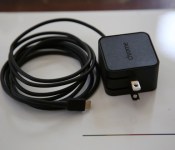
HP Chromebook 11 now ships with an all-new charger after official recall

A month after HP and Google put the kibosh on Chromebook 11 sales due to overheating chargers, and the laptop is now available with a brand new power adapter. According to 9to5Google, it looks like a smaller version of the one for the Pixel except it has a micro-USB tip instead. If you already have a Chromebook 11, do remember that you should be sending yours back in exchange for a new one due to a company recall issued a couple days ago. But if you haven’t already pulled the trigger, now is definitely a safer time to do so for one of the best Chromebooks we’ve seen so far.
[Image credit: 9to5Google]
Filed under: Laptops, Google, HP
Source: 9to5Google

Spain fines Google $1.2 million for allegedly violating privacy laws

Google triggered investigations in six European countries when it revealed its unified privacy policy last year, but Spain is the first of the bunch to draw blood. The country just fined Google a total of €900,000 ($1.2 million) for allegedly violating data protection laws through its current approach. The firm isn’t properly explaining why it’s collecting personal information, the Spanish Data Protection Agency claims; it also isn’t saying how long it will keep that content, and it isn’t giving Spaniards enough control over who sees what. For its part, Mountain View tells Reuters that it will read the full report before deciding on its next steps. However, there’s a real chance that Google will have to make at least some concessions when the Dutch (and possibly other European nations) also believe that it broke the law.
[Image credit: Contando Estrelas, Flickr]
Via: Reuters
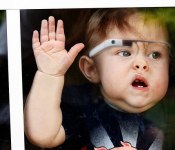
Google Glass collision detection could one day save you from yourself

Once upon a not so distant time, a woman took a long walk off a short pier while checking her Facebook page. True story. Then there was the time the San Diego police department ticketed a woman for driving while under the influence of Glass. Clearly, we’ve fallen victim to our technological dependence, not just literally, but also legally and it requires a solution. It’s unsurprising then that Google had the foresight to come up with a way to save us from ourselves, at least where its Glass eyewear is concerned.
A recently surfaced patent application, dated October 2011, references a “collision-avoidance action” that could help reduce Glass-related mishaps. The technique detailed in the filing doesn’t set off any alarms or alerts for Glass users, but it will “[de-emphasize] at least one of the displayed virtual objects” in the HUD to keep you from smashing into glass or walls or telephone polls or other people. You get the point. It does this by gathering data from Glass’ sensors and calculating the distance between you, the oblivious party, and potential obstacles in your way. Go ahead and laugh at the absurdity of this all now, but in five year’s time when we’re all rockin’ Glass-like eyewear, you’ll be thankful for the heads-up (pun intended).
[Original Image credit: RuthMarie/Flickr]
Filed under: Wearables, Google
Source: USPTO
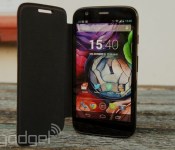
Moto G gets KitKat, improved camera features in the US

Given that Motorola’s budget-friendly Moto G launched just last month, you would have figured the mid-range smartphone would have packed some KitKat. Sadly, it did not, but Mountain View’s hardware arm began rolling out Android 4.4.2 to select owners today. If you purchased your Moto G from Amazon or on Motorola.com in the US, it’s time to snag that update. Devices sold through carriers and in other regions will get some love “soon.” The company’s also offering up the same camera update that hit Moto X devices last week, enabling tap to focus and expose, locked exposure for panoramas and support for additional languages. Those camera enhancements will also be making their way to Droid Mini, Maxx and Ultra.
Filed under: Cellphones, Google
Source: Motorola
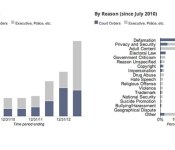
Google Transparency Report: government takedown requests are on the rise

Google’s Transparency Reports shed light on how often governments across the globe request the removal of content, and the company’s latest is especially interesting given the intense focus on the NSA’s data-snooping policies and the government(s) behind them. You see, it appears that countries don’t like coming under scrutiny online — how else could you explain the 68-percent increase in removal requests in the first half of 2013 compared to the second half of 2012? That number comes courtesy of Google’s latest report, its eighth since the first was released in 2010.
Unsurprisingly, much of the content targeted for takedown is political in nature: Google says governments continually want to scrape unflattering coverage, from video footage that reflects badly on police departments to criticism of judges. Both Russia and Turkey, in particular, increased their removal requests in the first half of the year, both in response to online criticism of national laws. Mountain View hasn’t rolled over completely, though; it says it removed less than one third of content targeted in these requests. There’s plenty of other data to dig through, if you’re interested — check out the source link below.
Source: Google Transparency Report
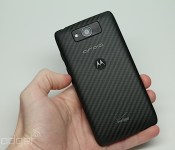
Verizon’s 2013 Droid line now does KitKat

Maybe it was the marketing or the battery life, or just an aggressively convincing Verizon rep — but whatever the reason, you chose a 2013 Droid over Motorola’s fine Moto X. And then, maybe you kicked yourself as you watched Verizon update the Moto X to KitKat while your handset sat neglected like the red-eyed stepchild it is. Oh chin up, because KitKat’s finally coming to the Droid line as of today. Yes, that means owners of the Droid Ultra, Maxx and Mini should start seeing that Android 4.4 update hit their devices. Although cool your jets on the System Update refreshes because it’s “being pushed out in phases.” We know the wait can be painful, but take comfort in knowing you’re almost in the clear.
Filed under: Cellphones, Wireless, Software, Mobile, Google, Verizon
Source: Verizon Wireless (Twitter)
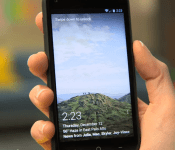
Facebook Home update to bring new lockscreen and gestures to select Android phones

Facebook hasn’t forgotten Home, the Android launcher that originally came out this past April and has trickled out to a few select handsets since. The social network just posted a video showing an upcoming update to Home, although it still hasn’t shown up in the Play Store yet. According to the video, the new update will feature a new lockscreen which lets you use your own wallpaper, rather than being surprised with a random picture and status update every time you wake up your phone; at the bottom you’ll also see details on which of your friends has recently posted a status update, as well as the current weather and quick access to your Home settings. A swipe down from the top will now unlock the phone and take you to your apps, and each status update will have a menu in which you can hide posts from that particular friend. There’s no word from Facebook on when we can expect to see this update, but we’ve reached out to the company for more details and will update the post as soon as we get more details. In the meantime, check out the video below to see if this makes you want Home any more than you did (or did not) before.
Filed under: Cellphones, Wireless, Mobile, Google, Facebook
Source: YouTube

Cyanogen gets serious about its OS aspirations, ponders a future in TV and wearables

It’s been three months since Cyanogen announced it was stepping out as a profit-seeking business. Flush with $7 million in funding, the company has been pushing harder than ever to achieve its goal of making CyanogenMod the third major mobile ecosystem, after iOS and Google’s Android. Now with “tens of millions” of installs, the company announced today that with help from VC firm Andreessen Horowitz it’s added further $23 million to its funding pot, and with this investment it believes has everything in place to bring in more talent and expand CyanogenMod to other devices like TVs, wearables and even cars.
Cyanogen’s mission is to refine the Android experience while still giving consumers (and pro users) the things that made it stand out in the past: freedom from manufacturer and carrier update cycles, and the ability to customize their device just how they like it. That focus is evident in its open-source software, which is now based on Google’s Android 4.4 KitKat and has recently gained encrypted text message support and built-in screencast video recording.
“We feel that the existing devices you can currently buy aren’t really designed for the end user. They’re essentially designed as cash registers for the companies that make them,” says CTO Steve Kondik, who created CyanogenMod back in 2009. “A lot of people are starting to mistrust the software and devices that they use because of that fact. It’s an opportunity for us to make really good software.”
“We intend to hit the mass market in late 2014 or early 2015 with a new brand.”
Right now, Cyanogen operates as a small company with 22 employees. That’s set to change in the next six months as the company looks to bring in fresh talent. Kirk McMaster, the CEO, sees Cyanogen hiring between 30 and 50 new employees during that time, helping to evolve its mobile platform and deliver new products even quicker.
“We intend to hit the mass market in late 2014 or early 2015 with a new brand, complete focus on the mass market and a new design language,” says McMaster. “We’ll bring to the market some new signature experiences that differentiate Cyanogen and any other brands we create.”
Cyanogen’s software is already available on Oppo’s N1 smartphone, but we could see the software appear on future smartphone models with a new, friendlier brand name in the coming months.
In the past, installing CyanogenMod was far from simple. That all changed when the team made switching from a phone’s original Android setup to its own flavor of the OS much easier, with automatic mobile and desktop installer apps. The presence of a Cyanogen installer on the Play Store made Google a little uneasy, however, and the search giant politely asked the team to pull the app, citing violation of its terms of service. Looking back, Kondik understands why Google had concerns: Cyanogen had made installation almost too easy.
“Google was very civil, its concern was that we made things too easy.”
“Google was very civil,” notes Kondik, “its concern was that we made things too easy — users could download an app, connect their device to a computer, type in a URL and boom, they had CyanogenMod.” Having spoken with the support teams at Google, Cyanogen recognized that users could blindly use its tool, overwrite the data already on the device and be left with new software that they weren’t familiar with.
The team had experimented with including a backup option it is first version of the app, but its backup process, which cached a copy of the user’s original ROM and settings, would take as long as 20 minutes to complete. The feature didn’t resonate with usability testers, so it didn’t make the cut. Cyanogen intends to restore backup options in a new release and will include more how-to guides for new users — or “putting on the training wheels” as Kondik likes to say — in the hope it will gain the necessary clearance to return to the Play Store, which is planned for the new year.
Developing an open-source platform can make it harder to make money. So how does Cyanogen intend to provide a return for its investors? Kondik thinks the key lies in building Cyanogen’s userbase, with a little help from consumers in China, the US or Europe, based on a freemium model that will see a mixture of free and paid-for apps, services and add-ons launching in the next 8-12 months. The company believes that if it can reach 100 million-plus users, interest in its app store will bring developers to the platform and, in turn, allow it to explore wearables, cars, TVs and other form factors further into the future.
Filed under: Cellphones, Software, Mobile, Google

