


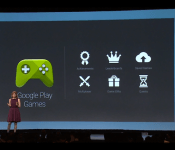
Google Play Games gets new features at Google I/O

Last year Google Play Games was announced at Google I/O and this year, just as expected, they touched on it a bit more and provided a few updates. The updates, or new features really, aren’t massive in amounts, but the couple Google has provided are definitely something to take note of for all of you gamers out there.

First let’s talk about the amount of users that Google Play Games has since it was introduced a year ago. We all knew this would be pretty large because there are a TON of mobile users who play games on their devices, day in and day out. In just the past 6 months alone, Google Play Games has added 100 million new users to its database.
Now that figure is just over the past 6 months. You can only imagine how many users it has in total with the amount of games and developers putting games out there each and every day for our beloved Android devices. But 100 million in just 6 months is pretty amazing to me personally.
That may sound like big news, however, that wasn’t really the main focus. While Google is proud of that, no doubt, we all know they are proud of the new features and such they work hard at adding into their apps and services. And today Google didn’t fail us, just as we expected them not to.

Now, for you gamers out there, the big news is that you will now have a Game Profile. How this works is that it will change based on games you’re playing, in-game achievements and various other things. Unfortunately, Ellie Powers didn’t go into a lot of detail, but I’m sure as the next couple of days pass by we’ll get a bit more information on exactly how this will work and what we’ll see.
The other new feature that really sounds awesome is the introduction of Quests. How this works is that the game developer can add quests at any time for you, the gamer, to accomplish and to to gain special achievements. This is something they can do with the new API’s Google announced today allowing them to run online time-based events inside the games without requiring an update to be pushed out. This will be available to developers and gamers in the next update to Google Play Services and Google Play Games.

To me, the quests is a really cool thing and something that game developers could really capitalize on to make their games more interesting to play. They can entice people to accomplish certain things to boost their hit points, gold pieces, or anything similar that you might require within a game to improve your chance of continuing the play or even solving the game. Something I really look forward to and being one who doesn’t play a lot of games on mobile devices, this alone could entice me to play more.
There was also one other little feature Ellie mentioned, and that’s Saved Games. This will allow you to save all game state across all of your devices. And this is really huge because it’s frustrating to play on one device then pick up another and realize you have to start over or not from the exact place or time you left off.
As well, Saved Games will also tell you the amount of time in which you have spent playing a certain game that has the saved games feature when developers include it. It’ll show you a thumbnail or cover image of the game with a few stats. Something we’ve needed for a while.
The last little bit of news is for the developers themselves. They will be getting some classy new tools to play around with, which you know in turn means we’ll be seeing some cooler stuff game wise. They will be getting game stats that they can view which will help them look at different aspects of the game and see what’s working best for them, so they can improve their work from that.
They will also be getting a brand new C++ SDK, which is more for the coding side of things. And to top it all off, with the upcoming Android L Preview, which will be available tomorrow, games will also be able to support Open GL ES 3.1, the Android Extension Pack (for improved graphics), and a standard for gamepad controllers, such as Moga Controllers.
All in all, a great day for gamers and game developers at Google I/O today. Much rejoicing was done and it will continue as these new features and tools start to roll out. Unfortunately Google didn’t announce when we’d see the new Google Game Services update, but rest assured it won’t be long and game developers all over the world are already working hard to incorporate the new stuff into your favorite game as we speak.
The post Google Play Games gets new features at Google I/O appeared first on AndroidGuys.
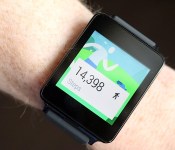
Meet the G Watch, LG’s first Android Wear smartwatch

LG believes it’s hip to be square, and it created a smartwatch to prove it. The G Watch was announced alongside Android Wear, Google’s new wearables platform, and the circular Moto 360 this March. After three months, LG and Google are finally ready to let me slip one on my wrist. The watch is going to be available for pre-order for $229 on the Play Store alongside the Samsung Gear Live (and Moto 360, once it comes out later this summer), and will ship out in both black and white to eager users on July 7th.
With a 1.65-inch display at a resolution of 280 x 280 and sizable bezel, the G Watch is a little bigger than the Pebble Steel, which is the smartwatch I’ve been using up until this point. It looks like it swallows up my wrist, so it’s not going to be a go-to fashion statement for everybody. Just like the Gear Live, LG chose to go with a square shape, rather than circular, mainly to ensure the user will enjoy as much screen real estate as possible. The product managers we talked to also left the door open for future Wear devices with other shapes, so there’s certainly a chance we’ll see more options down the road — especially if the G Watch is considered a success.
The display is covered with Gorilla Glass 3; the sides are constructed with stainless steel; and the back is polycarbonate to allow for attenuation and wireless charging (the watch comes with a charging pad that makes this possible). The straps are interchangeable because it uses a 22mm size, but the wristband that comes with the device is made of silicone and offered me a comfortable fit.
Underneath the back sits a 400mAh battery that LG claims is high-density and optimized for wearable use. When asked about battery life, reps told me that it should last 36 hours in always-on state, and even longer if you opt to turn the screen off — there’s a companion app that you can download onto your Android device, and it gives you a few settings. Additionally, the G Watch boasts an ambient mode when idle, which theoretically helps extend the life of the battery.
In terms of power performance, the 63g timepiece features a 1.2GHz Snapdragon 400 processor, coupled with 512MB RAM and 4GB internal storage. I couldn’t fully test out the watch’s performance in real life because the watch itself was in a special demo mode that only gave me a few cards to play with, but I’ll give it a full whirl in my upcoming review.
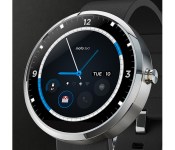
Contest-winning Moto 360 watch face blends classic looks with modern tech

Motorola has been running a watch face design contest to spark interest in developing for its upcoming Moto 360 wristwear, and it looks like the company’s efforts have hit the jackpot. The winning design from David Pascual is a clever blend between a traditional timekeeper and the at-a-glance alerts you’d expect from Android Wear. On top of basic status info, the watch face also has customizable notification widgets; you’ll know right away if you have new Gmail or a low battery. Pascual’s effort is just eye candy right now, but that may change soon. Winning the competition could get his design featured on the Moto 360, so you may have a chance to check it out first-hand before long.
Filed under: Wearables, Mobile, Google
Source: Official Motorola Blog, Motorola (Google+)
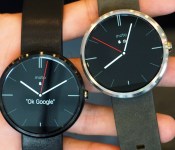
Moto 360 smartwatch makes an appearance at Google I/O

Samsung’s Gear Live and LG’s G Watch have already been manhandled today at Google I/O 2014, and now it’s time to do the same to the third inaugural Android Wear device, the Moto 360. We’ve already heard much about the watch’s unique circular design and have gotten some sneak peeks at the various watch faces that are coming to take advantage of it. Today, however, I finally got my mitts on one, and I can assure you it’s as well put together in person as the press shots have shown previously.
The Moto 360 strikes a stunning pose on your wrist, particularly in its stainless steel (as opposed to black) garb. Fit and finish of the devices we saw was top notch. The chamfered edges of both the glass covering the screen and that metal housing lend it a luxurious look and feel, and the thick, split leather strap is premium, too. We thought it odd that the company chose to have the glass extend beyond the watch’s metal housing, when the trend in mobile screens is for there to be zero gap between the surface of the glass and the pixels beneath them.
So, we asked Lior Ron, Motorola’s wearable products lead, why his watch design went the other way. He informed us that it’s a “nod to the premium watch aesthetic” he wanted to achieve with the 360, as many regular watches have chamfered glass, too. That bit of design flair has the added benefit of showing off the circular display to the fullest — looking closely reveals that pixels are packed from edge to edge, no cutting corners.
For now, that’s really all we can tell you about the 360 — that it’s a beautiful and sizable smartwatch. Like LG and Samsung, Motorola had the 360 running a demo mode of Android Wear, so we couldn’t get a feel for how the watch actually will work. That said, Motorola’s on its way to proving that sometimes, it’s not hip to be a square.
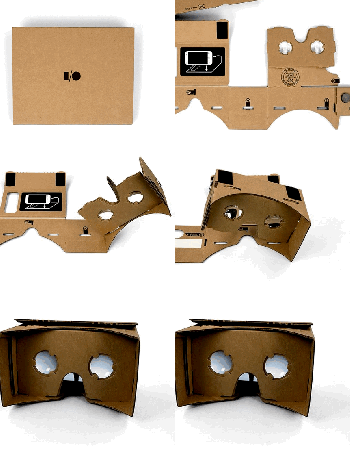
‘Cardboard’ is Google’s attempt at an inexpensive VR headset
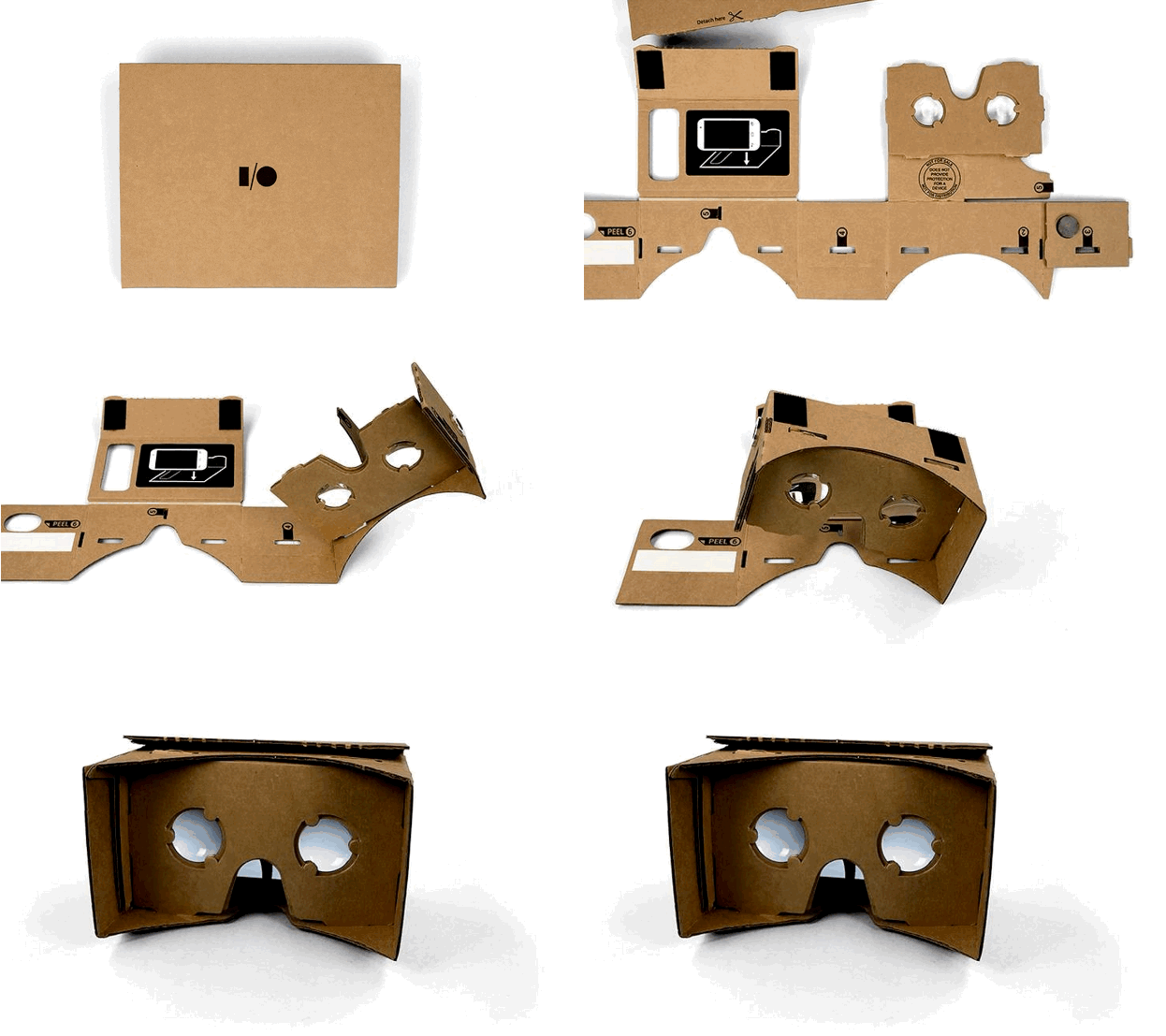
Even Google is getting in on the virtual reality game. At the end of the search giant’s I/O 2014 keynote, Sundar Pichai announced that everyone in attendance would get a nondescript cardboard package but was coy about its contents. Turns out, it’s the firm’s attempt at a do-it-yourself VR headset. You can use household materials to build one, and a rubber-band to hold your smartphone in place on the front of the device. Assembly instructions, plans and links for where to source the needed parts (like lenses) — as well as an SDK — are available on the project’s website. Have a few pizza boxes laying around? So long as they’re from an extra-large pie, Google says they’ll work, too. Mountain View hopes that by making the tech inexpensive (unlike offerings from, say, Oculus), developers will be able to make VR apps that hit a wider audience. For now, the list of fully supported phones includes the Google Nexus 4 and 5, the Moto X, Samsung Galaxy S4 and S5 and, oddly enough, the original Samsung Galaxy Nexus.
Cardboard pairs with your handset via NFC, and there’s already a handful of demos for the app. How the project works with Google Earth, YouTube and Photo Sphere seems pretty self explanatory (the standard experiences for those, but on your face), but Exhibit, Street Vue and Windy Day are a little more intriguing. Exhibit allows you to gawk at cultural artifacts form every angle, according to its description, while Street Vue consists of a drive through Paris and Windy Day is an interactive animated short.
Sure, this seems like little more than a novelty compared to the likes of the Oculus Rift, but even with that influx of cash from Facebook, Oculus still needs to charge for each headset. With Cardboard, Google has probably undercut everyone in the field on one of the most important aspects: price.
Filed under: Cellphones, Mobile, Google
Source: Google Cardboard, Google Play, Chrome Experiments

You can now relive the Google I/O 2014 opening keynote

Did you nod off a few times during the last half hour of Google’s opening keynote of I/O 2014 earlier today? No worries! The full video has been archived for your post-event viewing pleasure on YouTube. Hop down past the break to take a good long look at the nearly three-hour event spanning Android “L,” Auto, Wear and more.
Filed under: Internet, Software, Google
Source: Google I/O
LG G Watch specifications released, they’re rather solid for a smartwatch

Google announced LG G Watch’s availability at Google I/O today and now we have official specs of said smartwatch.
It turns out LG G Watch is rather powerful considering we’re talking about a smartwatch here. It is powered by a Snapdragon 400 chip and has 512MB of RAM, which we could categorize as a low to mid-range Android smartphone. It has 4GB of internal storage is powered by a 400mAh battery. On the front you’ll find a 1.65″ 280×280 LCD IPS panel. As far as sensors go, the watch carries 3 of them, Gyro, Accelerometer and a Compass and supports Bluetooth 4.0 connectivity. The watch itself weights 63 grams is available in White Gold and Black Titan colors. LG G Watch is water and dust resistant and is compatible with smartphones running Android 4.3 and above.
The watch will be available from Google Play later today.
Via: Pocketnow
The post LG G Watch specifications released, they’re rather solid for a smartwatch appeared first on AndroidGuys.
Android L can squeeze out 90 extra minutes of battery life with a new mode

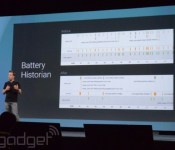
Even as smartphones are getting bigger and better, battery life is often an issue. Google announced today at I/O that it’s upcoming version of Android includes “Project Volta” to take the problem head-on. A “battery historian” gives more info on exactly what’s draining energy, while a battery saver mode lets users squeeze up to an extra 90 minutes out of each charge by doing things like lowering the screen refresh rate. Following Project Butter to make the OS more responsive and Project Svelte to optimize it for cheaper phones, Volta could quickly have a very tangible effect on how we use our smartphones (and other Android devices). Developers can make their apps much smarter about battery usage, by avoiding updates or holding off on energy intensive tasks when energy is running out. If you want ot try out the new modes immediately, keep an eye out for the L Developer Preview arriving tomorow for the Nexus 5 and Nexus 7.
Filed under: Cellphones, Mobile, Google
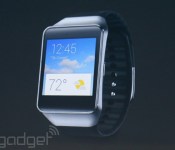
Samsung unveils Gear Live, its first smartwatch using Android Wear

So the rumors were true: Samsung has revealed its first Android Wear-powered smartwatch, the Gear Live. The device mates a familiar, squared-off design (much like the Tizen-powered Gear 2) with Google’s wrist-worn interface. It includes the Gear 2′s 1.63-inch Super AMOLED screen, 300mAh battery and 4GB of storage; fitness gurus will be glad to hear that the heart rate monitor has also carried over. You’ll get to pre-order both Gear Live and its LG-made counterpart, the G Watch, later today; Samsung’s hardware will sell for $200 and ship on July 7th through Amazon, Best Buy and Google Play.
Filed under: Wearables, Samsung, Google
Source: Samsung
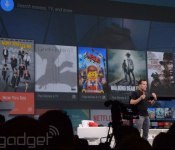
Google targets Amazon and Apple’s set-top boxes with Android TV platform

Google’s already well acquainted with the living room, having launched its Google TV platform at the I/O conference four years ago. It’s safe to say the set-top box software has fallen out of favor (with all but Sony, anyway), and Google’s been experiencing more success of late with its simpler Chromecast dongle. Well, today the search giant’s revealing its next play in home entertainment with Android TV, a brand new platform that’s part of Android L, and it’s bringing Google’s OS back to the big screen.
Much like on Apple’s set-top box or Amazon’s Fire TV, Google’s platform is a convenient front-end for it to plug video content from its own collection, in this case the Play store. It runs apps from other content providers like Netflix, of course, and allows you to pump live TV through the interface as well. Anything running Android TV will have the same functionality as a Chromecast, so you’ll be able to push content from your other devices to the TV exactly as you do with the dongle. Google Cast itself is being updated with direct screen mirroring, among other things.
Even closer to Amazon’s effort, Google intends Android TV not to be just for passive media consumption, but gaming as well. Different Android devices can be connected to your TV simultaneously to act as controllers. If your watching rather than gaming, then any Android phone, or smartwatch running the Wear platform, can be used as a remote.
Android TV features a simple and familiar card-based UI that naturally focuses on visual information (displaying movie posters, for example). The home screen floats on top of the content you’re currently playing, bringing that feeling of depth that’s key to Google’s new Material Design language. Google’s services and personalized recommendations are prominent, and voice search and navigation is included to make finding consumables, or anything else, as easy as saying it from the sofa. Apps and content can organize themselves across your home screen dynamically, based on your recent usage patterns.
With a special Play store experience just for the big screen, Android TV will be launching later this year alongside the Android L release, and various hardware partners are already on board. Next year’s smart TV ranges from the likes of Sharp and Sony, among others, will have the Android TV platform built-in. And, if you don’t fancy buying a whole new set, Razer, ASUS and others will be making set-top boxes-slash-consoles. Google’s also got a dev kit for those eager to get working with the SDK right away, which in Android L is the same one for tablet and smartphone form factors, too.
Filed under: Home Entertainment, Software, HD, Google
Source: Google Android TV
 AIVAnet