


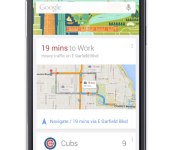
Google Now Launcher available for most Android phones

The trusty Google Now launcher that debuted on the Nexus 5 had already made its way to the rest of that family and Play Edition devices. Now, folks wielding any handset running Android 4.1 (Jelly Bean) and later can grab the feature, even if it’s absent one of the aforementioned monikers. The software add-on makes Google’s card-based repository accessible by swiping to the right of the home screen or speaking an “OK Google” voice command from that main UI. Gadgets that weren’t officially stamped by Google hadn’t been privy to the functionality, but now even if OEMs drape the OS with their own look and features (looking at you, Samsung), you can still get a taste of stock Android.
Upgrade your home screen with the #GoogleNowLauncher – launching today for all #Android 4.1+ devices http://t.co/2blmlJE0Vh
– Android (@Android) August 1, 2014
Filed under: Cellphones, Software, Mobile, Google
Via: Android (Twitter)
Source: Google Play
.CPlase_panel display:none;
El Salvador, Libya, Nicaragua, Paraguay, and Tunisia get Google Maps Navigation

Slowly but surely Google services make their way across the globe. For those visiting other parts of the world, or those living in them who have navigational dilemmas, Google Maps Navigation can be a modern marvel. More locals have recently been introduced in Google Maps Navigation that many might find useful. The new locales include El Salvador, Libya, Nicaragua, Paraguay, and Tunisia.
If you happen to be in one of the mentioned locations, give it a go and let us know how it works out for you.
Pick up Google Maps in the Play Store
Source: Google Via: AndroidPolice
//<![CDATA[
ord = window.ord || Math.floor(Math.random()*1E16);
document.write('’);
//]]>
The post El Salvador, Libya, Nicaragua, Paraguay, and Tunisia get Google Maps Navigation appeared first on AndroidSPIN.
.CPlase_panel display:none;
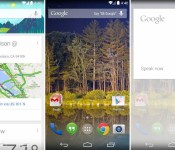
Google Now Launcher is no longer exclusive to Nexus and Google Play Edition devices

Many people like Google Now Launcher, mainly because of its nice design, big icons, “OK Google” hotword which makes the service very accessible and a very handy feature which makes Google Now only 1 swipe away. There’s much more to like when it comes to this launcher though, but not many people were able to… Read more »
The post Google Now Launcher is no longer exclusive to Nexus and Google Play Edition devices appeared first on AndroidGuys.
.CPlase_panel display:none;

Google Workshop will reportedly wrap your Nexus with custom cases

Let’s face it: options for outfitting the Nexus line with covers and cases have been rather limited (and pricey) coming directly from Mountain View. That could be about to change though, as Android Police reports that a new option could offer a major boost in custom accessories. The so-called Google Workshop will allow you to create your own case for the Nexus 5 based on either a location map or an uploaded photo of your choice. A live wallpaper is said to accompany that latter option too, so you can keep a consistent theme for every customizable spot on that handset. Right now, it appears that the fifth Nexus phone is the only device privy to the treatment, so we’ll have to wait and see if that popular 7-inch tablet gets its own new digs.
Filed under: Cellphones, Mobile, Google
Source: Android Police
.CPlase_panel display:none;

Google’s peculiar floating barge meets its maker

Remember Google’s mysterious floating barge? Well, you probably won’t for much longer, because it’s met an untimely end. According to the Portland Press Herald, the search giant no longer has a use for the iconic four-story structure, so it’s been sold to an anonymous “international barging company” and will be broken down for scrap. It’s a rather damp end for the barge, which was set to become a high-tech showroom for inventions like Glass, self-driving cars and other top-secret inventions from Google’s X lab, after it first appeared in Portland Harbor late last year. Google’s yet to comment on why it’s no longer interested in hosting tech-centric cocktail parties, but cost is likely the ultimate factor. It paid $400,000 in property taxes alone to moor the barge on the city’s waterfront — then there’s also the small matter of retrofitting its 63 shipping containers into something that Californians would actually want to visit.
[Image credit: Tom Hilton, Flickr]
Filed under: Transportation, Google
Source: Portland Press Herald
.CPlase_panel display:none;

Google Fiber hardware is being streamlined: fewer boxes, same functionality

Remember that new Google Fiber box we spotted in the FCC last month? It’s almost here. According to Kansas City residents in Google’s beta program, a new router is on the way that combines the service’s existing network and storage boxes into a single unit. The unit is also reported to be ushering in a Google Fiber Android app. There aren’t too many other details (though forum users did confirm the WiFi upgrade we saw in the FCC) but Dave Zats did find a new image lurking on Google’s servers, pictured above.
Filed under: Internet, HD, Google
Source: ZatsNotFunny, KCrag
.CPlase_panel display:none;
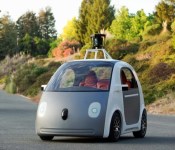
Get a behind the scenes look at Google’s self-driving car this Friday

If you’ve been itchin’ for more info on Mountain View’s compact self-driving car, you’re in luck. At 11AM PT/2PM ET this Friday (August 1st), Google is hosting a live Hangout as the folks from Make take a behind the scenes look at the project for its summer camp series. The so-called Field Trip is said to have a gander at how the vehicles work and provide an update on recent developments. Those who plan on tuning in can submit specific queries in advance for the Q&A session, but even if you don’t plan on posing a question, taking an early (or late) lunch seems like a solid choice.
Filed under: Transportation, Google
Source: Google+
.CPlase_panel display:none;
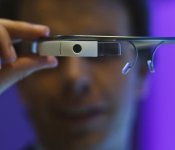
Stanford medical students learn to operate with Google Glass

Like their fellow future doctors down the road in Irvine, medical students at Stanford University will learn surgical methods with a hand from Google Glass. Those studying cardiothoracic techniques are set use Mountain View’s high-tech spectacles to stream their views in real-time to instructors with the help of CrowdOptic — a company that’s part of the Glass at Work initiative. The aforementioned California-based schools aren’t the first use the gadget in surgery, as it has already streamed full procedures. Privacy concerns immediately arise when discussing the use of a hackable device in medical settings, but CrowdOptic knows how it will secure the data and comply with the Health Insurance Portability and Accountability Act (HIPAA). It also won’t have access to the captured video as they’re set to remain Stanford’s property. The streaming outfit has also locked down its own spectrum, so it doesn’t have to keep tabs on steady WiFi to stay connected. With more universities and physicians opting for Glass on the regular, it seems medicine is one place the wearable fits in nicely.
[Photo credit: Angel Navarrete/Bloomberg via Getty Images]
Filed under: Wearables, Google
.CPlase_panel display:none;

Google’s 64-bit Chrome browser for Windows is available in beta

If you’ve wanted to try the 64-bit version of Chrome for Windows 7 and 8 but have been skittish about the flakiness of very early builds, your moment has come — Google has released a beta of its beefed-up browser. As with the Canary and developer editions, this more reliable software makes full use of modern computing power to both speed up web page rendering and tighten security. The code still isn’t complete, so don’t be surprised if there are a few hiccups. However, a beta means that a truly stable 64-bit browser is likely just weeks away. Even if you’re not willing to throw caution to the wind, it won’t be long before you can give Chrome’s big upgrade a spin.
Filed under: Internet, Software, Google
Source: Google Chrome Releases
.CPlase_panel display:none;
Movidius wants to change the way your smartphone sees the world

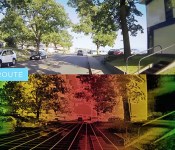
Despite the promise of Google’s Movidius-equipped Project Tango, there are still no depth-sensing, SLR-stomping smartphones on the market. But Movidius thinks that could change soon, thanks to its brand new chip: the Myriad 2 vision processor unit (VPU). “The Myriad 2 is going to provide more than 20x the power efficiency of the Myriad 1, and enable camera features that were not possible before in mobile devices,” CEO Remi El-Ouazzane tells me. If you’ll recall, Tango‘s original tech brought faster focus, improved depth of field, near-optical zooming and higher light sensitivity to smartphone cameras (and now, tablets). It also let researchers scan a room in 3D to provide interior navigation, among other cool tricks.
However, processing a Teraflop of image data a per second burned a lot of power with the project’s original Myriad 1 chip. The Myriad 2 consumes 500mW of power while processing up 2 Teraflops per second of data — a twentyfold gain in processing efficiency. (For reference, the Snapdragon 805 reportedly uses 3-4 watts.) With 12 “lanes” or cores, it also supports 6 HD cameras at once and can process 600-megapixels per second. With significantly more horsepower and much less battery draw, that means the new VPU could be installed in most smartphones, not just purpose-built devices like the Tango smartphone or tablet. Movidius says that the Myriad 2 could function as a standalone processor in certain devices, or act as a co-processor to a mobile CPU.

As far as Google’s Project Tango goes, there’s no word yet if it will switch from the Myriad 1 to the new chip. But Google has already announced a partnership with LG for a consumer Tango device next year, and will likely want the improved technology. Though El-Ouazzane wouldn’t confirm the new processor for Tango, he pointed out that Movidius had a “very strong relationship with the Project Tango team.”
Depth sensors, lenses and a vision chip will improve picture taking without making smartphones huge, but the benefits don’t stop there. Wearable and panorama cameras like the Centr camera (another Movidius partner) are other potential product categories. The Myriad 2 excels in stitching 360 degree images from multiple lenses, and the extra battery efficiency would be particularly useful in small wearable devices.
Consumer versions of Tango-like devices would also open up a lot of far-out applications. On top of the scary realistic Matterport scanner (above), Movidius also pointed to the zSpace 3D display, a device that uses high speed gesture recognition to let you manipulate virtual objects in 3D (below). Your smartphone could also become as adept as a Kinect at motion and gesture sensing, opening up richer and deeper gaming and virtual reality applications. El-Ouazzane brought up Amazon’s Fire Phone with Firefly as another example of the type of consumer-leaning object recognition apps we could see with the Myriad 2 (though he added that Movidius is not working with Amazon). To enable such apps, the company created a new SDK that makes it much easier for developers to access the Myriad 2′s bag of tricks.
For now, it’s just a hunk of silicon until devices start to arrive. But El-Ouazzane is confident with the Myriad 2 and how it will change smartphone cameras and vision processing. “A lot of money was invested to get to this point. It’s going to be a dramatic departure from where we are today.” But we’ve heard that before: Nokia’s camera-centric phones didn’t set the world on fire, 3D camera phones never flew, and the multi-sensored Fire phone remains a huge question mark. But of course we’d all like to take much better photos and even scan our cat — smartphone tech is getting a bit dull.
Filed under: Cellphones, Mobile, Google
Source: Movidius
.CPlase_panel display:none;

