



Next year’s Hondas will have Tegra and Android inside

Curious as to just which Honda models you’d see Android pop up in first? If you had money on the 2015 Civic, Civic Tourer and CRV it’s time to collect your prize from the pool. Google’s mobile OS will appear as standard equipment in those vehicles with a little help from Nvidia, naturally, and as the GPU giant tells it, Honda Connect will be the first infotainment system to run embedded Android on a Tegra chipset. Nvidia says that Connect will sport a 7-inch customizable touch-screen display that acts a lot like what you’d expect from a smartphone or a slate. Naturally that means there are swipe, pinch and zoom gestures along with an app store for the Ice Cream Sandwich-based system. How this will all play with Android Auto, though, remains to be seen.
Filed under: Transportation, Mobile, Google, NVIDIA
Source: Nvidia Blog
.CPlase_panel display:none;

Motorola Nexus 6 spotted in the wild

We recently published a gallery of photos for the upcoming Motorola Nexus 6; however, all of these were renders because there has not been a quality photo of the actual device itself. That is, until today. The team over at Android Police has received some photos from an anonymous tipster that claim to show someone using the Nexus 6 out in public.


There is a view from both the left and right side of the device. These pictures give us a good idea of how large this 5.9″ behemoth will be, and it does not appear to be that large. For such a large phone, the user seems to be handling it relatively easily with just one hand. Since there is nothing to compare the phone to, this does not mean that the Nexus 6 will be small as the user could just have very large hands. However, it does give us hope that Motorola has been able to squeeze a 5.9″ display into a reasonable form factor. Although the majority of the phone is obscured by a hand or the case, we can still compare some features to what we have seen in leaks. The headphone jack appears in the middle of the phone and the navigation buttons appear smaller which both line up with the earlier photos and renders. The power and volume buttons are also located at the middle of the phone which shows just how large this phone will be. The front-facing speakers are also visible in both photos. While there is no way to verify the device, all signs say that you are looking at the next Nexus 6 from Motorola. Hopefully we will see the entire phone sometime within the next month or so.
What do you think of these new pictures of the Nexus 6? Tell us in the comments!
Via: Android Police
Deals, Discounts, Freebies, and More! Click here to save today!
The post Motorola Nexus 6 spotted in the wild appeared first on AndroidGuys.
.CPlase_panel display:none;

Google to offer unlimited storage to schools and students in coming weeks
In coming weeks Google will be put another notch in their belt on their quest to enrich and simplify lives for educators and students. In an effort to continue helping students have use and access to the tools the need Google will be making a pretty significant change to their education suite of services with the introduction of Drive for Education.

As it sits right now Google Apps for Education customers, which includes students, are given 30GB of free online Drive storage for their papers, photos, slides, projects and everything else. They have the option to spend a small amount, $5 a month, to move up to 100GB of storage at anytime. That is about to change to completely unlimited storage for free. There is more of course:
Drive for Education will be available to all Google Apps for Education customers at no charge and will include:
- Unlimited storage: No more worrying about how much space you have left or about which user needs more gigabytes. Drive for Education supports individual files up to 5TB in size and will be available in coming weeks.
- Vault: Google Apps Vault, our solution for search and discovery for compliance needs, will be coming free to all Apps for Education users by the end of the year.
- Enhanced Auditing: Reporting and auditing tools and an Audit API easily let you see the activity of a file, are also on the way.
Combine this with another recent offering of being able to “borrow a Chromebook” and you have quite the suit of tools available to get your homework and projects done.
Source: Google for Education Via CNet
//<![CDATA[
ord = window.ord || Math.floor(Math.random()*1E16);
document.write('‘);
//]]>
The post Google to offer unlimited storage to schools and students in coming weeks appeared first on AndroidSPIN.
.CPlase_panel display:none;
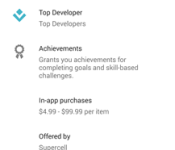
Google Play Store now shows in-app purchase prices and developers address

Recently there’s been quite a stir going on regarding Google’s new requirement for developers to provide an address for any paid apps to be displayed on the app page in the Play Store. Now it seems app pages have been updated to display the developer’s address, along with a price range for in-app purchases.
The issue with displaying developer’s addresses isn’t big until you get to the developers that are just a single person working out of their home. While you’ve always had access to these addresses in Google Wallet after purchasing said app, it was not out in the open for the whole world to see. So now, John Smith who created a new paid game in the Play Store has to provide his home address for it to be displayed on his app’s page.
However, the range of in-app purchase prices is a nice touch. Now you can be ready for whatever temptation may arise after downloading that free game, but with in-app purchases costing $15. No more excuses.
What do you think about the address debacle? And are you glad you can now see in-app purchases?
via Android Police
Deals, Discounts, Freebies, and More! Click here to save today!
The post Google Play Store now shows in-app purchase prices and developers address appeared first on AndroidGuys.
.CPlase_panel display:none;

Google+ now lets you lock down posts based on age and location

So, making your Google+ posts available for viewing only to people in your circles isn’t enough. Maybe you routinely post risque stuff you don’t want minors to see, or things you’d rather share only with your countrymen. It doesn’t matter what your reason is for wanting tighter restrictions — what matters is that you can now do so, thanks to the latest Google+ update. All you need to do is go to Profile Settings and find a new section called Audience. Within that section, you can put an age limit (say, make your posts available to people older than 18 or 21 only) on your content or show it only to folks from select countries. You can even set different age restrictions for each country, if you want to be extra thorough, whether you have a personal profile or run a business page. Couple this with an update from July that lets you use almost any name you want on the social network, and Google+ is looking mighty customizable these days.

Via: Android Central
Source: Yonathan Zunger
.CPlase_panel display:none;

Comcast’s cloud DVR starts serving up recordings you can watch anywhere

In the midst of attempting to gobble up its largest counterpart, battle Netflix on net neutrality and face down customer service scandals, Comcast is still slowly extending its new TV platform. The latest addition to its X1 setup is enhancing the cloud DVR feature that CEO Brian Roberts showed off at the beginning of the year. While the 500GB cloud DVR and in-home streaming are already a part of the system in several areas, in the Bay Area and Houston viewers can stream or download recordings to their mobile devices (iOS or Android, PCs can only stream) starting today. Inside the house, the X1 app fulfills Roberts promise of turning any mobile device into a television, with access to live TV streaming, recordings and video on-demand.
http://player.theplatform.com/p/JC9BHC/MIpcoEWjAl2r/embed/select/xpaNierjipP4

Of course others like Sling and TiVo have been way ahead in bringing TV shows, live or recorded, to small screens, and providers like Dish Network, AT&T and DirecTV have also pushed multiscreen viewing including recordings and downloads. If you don’t have one of those though, it’s good to see Comcast rolling out the technology — especially since more of us could end up under its umbrella if the merger goes through — although we’ll need to try it out to see how well it actually works in practice. The cable giant recently decommissioned / downsized its Netflix competitor Streampix, but the option of offline viewing could put X1 in places streams don’t fit like airplanes or hotels with weak WiFi. Hopefully this is a sign of things picking up for X1. Next on the hitlist (after hiring a new exec to head up customer service) should be no more national outages, 4K, full streaming video access for devices like Roku, TiVo or the Xbox One and some useful apps for those new set-top boxes — oh and just for laughs, we’ll throw in that fabled Apple TV partnership, lower prices and HBO Go everywhere / for everyone.
Filed under: Home Entertainment, HD, Mobile, Apple, Google
Source: Comcast, X1 Cloud DVR FAQ
.CPlase_panel display:none;

Google triples max bounty for Chrome bugs to make the browser safer for users

Google has long been rewarding anyone who can dig up Chrome browser bugs with a nice amount of cash, but the longer the reward program runs, the harder it is to find vulnerabilities. Thus, Mountain View’s upping the max reward a dedicated bounty hunter can get to $15,000 for each high-quality report — not as big as the $110,000 reward it offered for Chrome OS security bugs in January, but still 10 grand more than the previous $5,000 max. Also, recipients can now prove to their doubtful friends that they’ve indeed made Chrome a safer browser for them, as they’ll now be listed in the program’s new Hall of Fame page.
Anyone who expects to earn $15K will have to really work for it, though: they’ll have to provide an exploit that demonstrates how the bug can affect users. But in order to minimize duplicate entries, bug hunters can first submit reports to claim the vulnerability and then just follow up with the exploit later on. Interested in getting some of Google’s dollars for yourself? Check out the different types of vulnerabilities and their corresponding reward amounts on the program’s page to see which ones will net you the most cash.
Source: Google Online Security
.CPlase_panel display:none;

More to expect at our free Engadget Expand event in NYC!

If you’re keeping score, we’ve announced a bunch of great speakers heading to this year’s Engadget Expand (such as RJD2 and the head of DARPA, Arati Prabhakar). Of course there’s plenty more where that came from and we’re excited to announce what else you’ll see at the Javits Center on November 7-8 in New York City!
Today we’re adding 5 speakers to our already awesome slate of technology leaders coming to Engadget Expand:
- Michael McAlpine, Assistant Professor of Mechanical Engineering, Princeton University
- Paul Eremenko, Technical Project Lead, Project Ara, Google ATAP
- Alexander Reben, President & CEO at BlabDroid Inc.
- Bas Lansdorp, CEO & Co-founder, Mars One
- Alex Gruzen, CEO, WiTricity
You can flip through the gallery above to see who we’ve already announced and there’s much more to come soon. But Expand isn’t just about speakers, it’s about letting you get hands-on with the future of technology and for that, we’ve got a few awesome exhibitors to announce.
OnePlus

Our friends at OnePlus will let Expand attendees go hands-on with the elusive OnePlus One smartphone. The company’s mission is to never settle and deliver a premium-looking smartphone with top of the line specs. The flagship One starts at $299, unlocked and free of contract.
Suitable Technologies

Suitable Technologies has a lot planned for Expand, not least of which is letting attendees move around and experience the show floor from the comfort of, say, their Santa Monica beach bungalow. The company’s Beam device makes the typical conference call experience much less lame.
GizmoSphere

We met GizmoSphere and its Gizmo development board at Engadget Live in Boston this summer. The company is bringing its experience down to Expand, where you can battle your friend for victory in the ultimate, “immersive” deathmatch. No, no, there won’t be blood, but still — this isn’t your typical game, either.
There’s much more to announce soon, but in the meantime — grab your free tickets right here. Also, our ‘In The City‘ sweepstakes runs through 11:59PM ET on October 7th, the winner of which will score themselves and a guest a free trip to Expand on our dime!
.CPlase_panel display:none;

Moto Nexus 6 leaks with slew of details

A few days ago we reported about some details of the upcoming Motorola Nexus 6 from 9to5Google. This morning we reported on a leaked picture of the Nexus 6 next to a LG G3. Now, we have details confirming some of the specs we had before, while also learning some new ones from Android Police.
Android Police says they can confirm that the next device from Google will be a 5.9″ screen device called the Nexus 6. It will have a 3,200 mAh battery, with a QHD screen bringing a whopping 496 ppi, a 13 MP camera with OIS and the dual-flash ring that’s on the new Moto X, and a 2 MP camera on the front, as we reported before.
What’s new, however, is confirmation of a few things. It will indeed be a larger Moto X (2014) confirming the leaked photo from this morning. It will have an aluminum frame as well, and will have the new Moto X’s fast charging capabilities (15 minutes of charging gives 8 hours battery life). Also, it will have front facing stereo speakers. The version of Android will be 5.0 (if there was still any doubt), and it seems there will be some refreshed icons, along with a different messaging app icon (different from hangouts?), and new Wi-Fi, battery, and signal icons at the top that are now solid rather than with breaks.
They give this rumor a 9/10, which is solid for a rumor from Android Police. Along with these details, they can’t necessarily confirm the existence of another, smaller Nexus device.
What do you think? Sound like some great specs, or still too large to even consider?
via Android Police
Deals, Discounts, Freebies, and More! Click here to save today!
The post Moto Nexus 6 leaks with slew of details appeared first on AndroidGuys.
.CPlase_panel display:none;

Google gives students unlimited cloud storage

Google’s invasion of our classrooms (and its war on paper) continues unabated. Back in August in the search giant released an online education tool for teachers who wanted to digitally manage their classes, and now it’s launched an improved version of Google Drive that’s free for folks toiling away in academia. The company’s new Drive for Education is basically the same thing as its enterprise-based Drive for Work, which means you’re looking at unlimited storage space (albeit with a 5TB file size limit) and access to Google Vault for message archiving.
To put that in perspective, Google’s education users only used to get 30GB of free space — that’s more than enough for most, but dropping storage costs mean Google is trying to replace your paper-laden bookbag with the cloud. Itching for your turn to try the improved Drive? If your school is a current Google Apps for Education user, you’ll see the unlimited space appear over the next few weeks… though you’ll have to wait a bit for some of the other bells and whistles to go live. Vault, for instance, is second on the list of priorities after making sure everyone gets their unlimited storage, and auditing support (yawn) is due to come sometime after that.
Via: TechCrunch
Source: Google for Education
.CPlase_panel display:none;

