


‘Iron Man’ director’s VR game lands on September 8th
On top of trying to outdo a beloved Disney classic, director Jon Favreau achieved a fascinating feat with his film adaption of The Jungle Book: Aside from its young actor portraying Mowgli, every other character and setting were built with CGI. But it seems he’s still eager to make computer-created immersion. The first part of the filmmaker’s next project, the fantasy VR experience Gnomes & Goblins, will be digitally released for free on September 8th.
From screenshots, the game looks lush, haunting and whimsical. Players quickly meet a titular goblin and roam around, but G&G seems to hinge more on exploration and experience rather than compelling gameplay. This will be the first tease of the world, Favreau explained in a New York Times interview, with a narrative emerging in content released later.
Late in The Jungle Book’s post-production, Favreau told NYT, he went to see a demonstration of VR company Wevr’s underwater exploration experience theBlu. The filmmaker was captivated by the technology’s immersive capacity and noted how this entertainment genre sits between films and contemporary video games, feeling it to be “closest to lucid dreaming.” He partnered with Wevr and media production company Reality One to make G&G.
Gnomes & Goblins will be available for the HTC Vive on September 8th on Steam, Viveport and Wevr’s Transport network. Releases on Oculus Rift and PlayStation VR are planned for later in the year.
Source: The New York Times
PewDiePie’s Twitter temporarily suspended after ISIS joke
Yesterday, popular YouTube personality PewDiePie made minor headlines for losing his Twitter verification checkmark. Today, he was briefly suspended for the service. “I did this yesterday as a joke,” he explained on Youtube, teasing users who view Twitter verification as a status symbol. “But then America woke up and that’s when shit got stupid.” Overnight, Kjellberg says an account parodying Sky News posted a fake news story claiming he lost his verification status for having “suspected relations with ISIS.” Later, the YouTuber referenced the article on Twitter, joking that both he and JackSepticEye had joined the terrorist organization. Later, his account Twitter account was suspended.
We reached out for Twitter for details, but got back the usual: “We don’t comment on individual accounts for privacy and security reasons.” Since then, PewDiePie’s Twitter presence has been restored — albeit in a reduced capacity. At the time of this writing, the account’s million followers has been reduced to mere hundreds, and Kjellberg’s timelines is missing thousands of Tweets. Maybe it can be taken as a lesson: Don’t Tweet about being a terrorist. Even in jest.
Via: We The Unicorns
‘Second Life’ studio invites VR players to try ‘Project Sansar’
Linden Lab, the creative minds behind the bizarre social game Second Life, is unveiling its latest project, planted firmly within the roots of the virtual world.
It’s called Project Sansar, and invites are being sent out to creators this week. After this sneak peek, the public should get their first glimpse at the upcoming game early next year in 2017.
Project Sansar is meant to be an expansive 3D world that’ll work with the likes of the Oculus Rift or HTC Vive, but there are scant details surrounding its impending release so far. Players will be able to interact with the world much like they currently do in Second Life, though in a relatively more scalable manner than they current do in that game, allowing for multiple instances of areas to exist in tandem with each other.
Interestingly enough, Linden Lab CEO Ebbe Altberg has likened the project to “WordPress” for virtual reality, where Project Sansar acts as a blank base or slate for others to create their own virtual reality experiences on top of.
If it’s truly as expansive and adaptable as, say, Second Life or any of the other virtual reality hangouts out there, Project Sansar could be capable of some very interesting things.
Via: Variety
NVIDIA’s ‘Vault 1080’ is a gloomy ‘Fallout 4’ mod
NVIDIA and LightSpeed Studio have teamed up to create Vault 1080, a special add-on level mod for Fallout 4.
The mod, which is free to download and play, will add on a side quest that offers an extra hour of gameplay within the confines of Vault 1080, sending players through an area described as a “foggy, murky marsh” to the ruins of an old church where previously the congregation embraced “darkness and sickness” to survive.
There’s no telling what kind of twisted goings-on happened within, but it’s up to you to uncover it in this horror-based mod that took over 6 months to develop. It’ll require the same system requirements as Fallout 4 and utilizes the same NVIDIA GameWorks tech like volumetric lighting and FleX-powered weapon debris. Sounds perfect for the gloomy Vault 1080, doesn’t it?
If you’re interested in trying it out, you can grab the mod via Bethesda or read about it further at the official NVIDIA blog.
Source: NVIDIA
Free-to-play is coming to the space MMO ‘EVE Online’
After over a decade with a straight subscription model, the massively multiplayer space RPG EVE: Online is adding a free-to-play tier. While paid accounts will still exist for new and old players alike, the new free accounts will give gamers basic access to the vast EVE universe, “New Eden.”
It’s been surprising how long EVE developer CCP has held out on free-to-play. New Eden may have been home to some of the most famous conflicts in video game history, but that hasn’t stopped subscribers leaving in droves. Introduced in 2003, the game peaked with 500,000 subscribers in 2013 (the last time CCP gave official figures). From comparing activity logs and historical player figures, the current subscriber count is likely less than half of that peak.
Dwindling player counts are a problem for many MMOs, but it’s perhaps tougher on EVE than most. Rather than having tens or hundreds of servers running independently like, for example, World of Warcraft, EVE offers a single persistent universe in which all players participate (excluding the Chinese server). When half as many players are online in WoW, you can just visit a server that’s fully populated. When the same happens in EVE, it’s half as busy as it used to be.
CCP has been trying to increase its EVE player counts in many ways. Broad changes to the game, such as wormhole expeditions, faction warfare and incursions kept gameplay fresh to a point, and regular expansions since have added new things to do. Then there was the 2013 free-to-play shooter Dust 514, which tied in heavily and, as well as being a money-maker on its own, was supposed to attract fresh blood to the main game. More recently, it’s invested heavily in VR, with EVE Valkyrie and EVE Gunjack offering action-oriented spins on New Eden. None of the changes are likely to be as significant as the switch to free-to-play.
CCP Games says it’s been planning to make the switch for a while, but it’s only recently been possible to do so. “Part of our vision for the future of EVE has included more open access for some time, but with the interconnected nature of the game comes vulnerability,” it said in the announcement post. “We knew that if the flood gates were opened in the wrong way, we could see anything from server meltdowns to the collapse of the EVE economy. Over time, our hardware has improved, code has been untangled (mostly!) and we’ve found a design we believe in.”
The big influx of new free-to-play accounts should breathe fresh life into the game, and CCP hopes many gamers who have left EVE over the years will come back as free players. In the universe’s lore, these free-to-play accounts will be known as “Alpha clones.” Free players can trade, mine and fight just like regular subscribers, but skill progression will be slower, and limited to certain fields. Outwardly, there will be no indicators as to a player’s subscription status, but their ship will give you a clue: Alpha clones will be stuck with the game’s starter spacecrafts: Tech one Frigates, Destroyers and Cruisers.
Existing players’ accounts will behave as they always have, except if their subscription lapses they’ll be dropped down to Alpha clone status. To be clear, any progression made won’t be lost, it’s just as a free-to-play account those skills will be locked. CCP is actively encouraging existing players to court the Alpha clone accounts, bring them under their wing and boost the strength of their factions and alliances. The spin is that this will make existing players’ games fresh and exciting by bringing thousands of new players into the world. Of course, new and old players alike will be able to upgrade to full accounts (or “Omega clones,” under the new nomenclature) by paying a subscription fee (typically around $10 per month).
The changes raise plenty of questions about how EVE will function following the shift. The free-to-play subscriptions will open up in November as part of a feature update called Clone States, and we suspect there’ll be a lot more detail on how the newer New Eden will work. From the initial announcement, though, this seems like a carefully considered way to bring new players into the EVE universe without annoying fans that have sunk thousands of hours and dollars into the game.
If you’re one of those players, or interested in joining, you can read all about the upcoming changes here. If this is the first time you’ve ever heard of EVE, CCP made this video a couple of years back from player submissions. I love it, and I’ll use any excuse to post it:
Source: CCP Games
Virgin Media has a broadband plan just for gamers
When most people shop for a new broadband package, they’re focused on download speeds. What can I expect when everyone in my home is trying to stream Netflix? Or downloading a game like Inside to their PlayStation 4? But, now more than ever before, customers are interested in upload speeds too. It can affect your performance in a game like Overwatch, as well as Twitch-style streaming and video uploads to sites like YouTube. Virgin Media is catering for this group with “VIVID 200 Gamer,” an optional upgrade for its VIVID 200 tariff. If you’re willing to spend an extra £5 per month, you’ll have your upload speeds increased from 12 to 20Mbps.
While Virgin Media is targeting “gamers” (some cringeworthy advertising is no doubt in the pipeline), the plan could appeal to anyone that deals with large files and demanding services. Professional filmers who regularly upload footage, for instance. Or wedding photographers that need to quickly upload large image libraries. Of course, video games are a popular past-time, so it’s easy for Virgin Media to market the new tariff this way. Anyone that’s played a fast-paced shooter in the last few years, like Titanfall or Battlefield 4, will understand the frustration when it’s your internet connection, rather than your thumbs, that result in a loss.
Acer’s latest PCs include the first curved screen laptop
You no longer have to stick to your desk to enjoy a flashy curved display. Acer is unveiling flood of new laptops at Germany’s IFA show, and the highlight by far is the Predator 21 X — according to Acer, the world’s first curved screen laptop. As the name suggests, opening up this gigantic gaming portable reveals a 21-inch curved, ultra-wide display that promises more immersion than you’re used to with portable gaming. It ‘only’ touts a 2,560 x 1,080 resolution, but NVIDIA G-Sync support should give you smoother, game-friendly output.
That’s not the only party trick, either. It includes Tobii eye tracking to help you aim and look around paths, a 4.2-channel audio system, and a full-size illuminated keyboard with both Cherry MX mechanical switches (for improved feel) and a trackpad hidden under the number pad. The system is a performance beast, too, between its 7th-generation Core processors and dual GeForce GTX 1080 graphics. Acer hasn’t said how much the Predator 21 X will cost. This rig won’t ship until sometime in the first quarter of 2017, however, so you’ll at least have some time to save up.

There’s more. Acer is unveiling a new Swift line of thin-and-light laptops, led by the 13.3-inch Swift 7 you see above. It’s reportedly the world’s thinnest laptop at just 0.39 inches thick — take that, LG. Between that and its 2.5-pound weight, you might not notice it in your bag. It’s even reasonably powerful between its 7th-gen Core i5, 256GB SSD, 9-hour claimed battery life and dual USB-C 3.1 ports. There’s even a high dynamic range webcam to bring out more color and details in video chats. It’ll sell for $999 when it ships in October. The lower-end Swift 1, 3 and 5 models all tout 14-inch screens, thicker bodies and and slower processors. They’ll arrive between October and November, with respective prices starting at $249, $499 and $749.

And no, Acer hasn’t forgotten about the hybrid PC crowd. It’s launching four Spin laptops with “360-degree” hinges that, like many rivals, turn your computer into an impromptu tablet, presentation monitor or tent display. The Spin 7 you see here is the portability champ of the bunch through its 14-inch screen (in a 13-inch aluminum chassis), 0.43-inch thickness, 7th-gen Core i7, 8GB of maximum RAM and 256GB SSD. The remaining Spin 1, Spin 3 and Spin 5 systems aren’t always steps down, though. While the Spin 1 is an entry-level model with 11.6- and 13.3-inch screens, the Spin 3 carries a larger 15.6-inch screen and two storage drives; opt for the 13.3-inch Spin 5 and you get more RAM (up to 16GB), up to a 512GB SSD and support for an optional pen.
Just when you can get the Spin series varies. The 3, 5 and 7 will all show up in October, with beginning prices of $499, $599 and $1,199. You’ll have to wait until December to get the Spin 1, although its $249 price could be worth your patience.
We’re live all week from Berlin, Germany, for IFA 2016. Click here to catch up on all the news from the show.
Source: Acer
‘TowerFall’ ups the mayhem with eight-person local multiplayer
The developers behind TowerFall are working on more than just a game about climbing a mountain. That’s right: Matt Thorson has also released an official mod that brings support for up to eight players to the charming, retro (and possibly violent, depending on your friends) local multiplayer component of TowerFall. It’ll run you a fitting $8.88 to download from the game’s itch.io page. Thorson is quick to note, however, that this isn’t TowerFall proper.
“This is not an expansion for TowerFall, but a stand-alone game,” Thorson writes. “This package does not contain the core TowerFall experience. This is an official mod for TowerFall that only includes Versus mode, and is heavily modified specifically for 5 to 8 player matches. it is also still possible to play with 2 to 4 players on the new levels.”
But, this is strictly a PC release for now. Eurogamer writes that this includes every arena from the Dark World expansion and that it’s running in widescreen. You’ll need Xbox 360 gamepads or PlayStation 4 controllers to jump into the fracas though, and Thorson recommends connecting everything to a USB hub prior to firing the game up.
If that leaves you with a hankering to play the game on console and you don’t own a PS4 (or an Ouya), Thorson recently tweeted that he’s working on an Xbox One version that’ll include Ascension and Dark World. When that will land isn’t clear, but Thorson says he’s playing it and that it’s awesome. Fair enough.
TowerFall news 3/3: TowerFall Ascension and Dark World are coming to XBox One! No release date yet, but I’m playing it and it’s awesome 🙂
— Matt Thorson (@MattThorson) August 26, 2016
Via: Eurogamer
Source: Itch.io
More of Sierra’s classic adventure games come to Steam
Sure, Sierra’s biggest adventure game titles (such as King’s Quest and Space Quest) have been around in their original forms on Steam for a while, but many gamers remember playing a lot more than that. What about arresting perps in Police Quest, or saving the day in Quest for Glory (aka Hero’s Quest)? You’re set from now on. Sierra and Activision have released a wave of further classics on Steam, including the Police Quest Collection, the original Gabriel Knight trilogy and the two Phantasmagoria games. You’ll get a handful of non-adventure titles published under Sierra’s wing, too, such as Arcanum and Caesar 4.
As a rule, the adventure franchises are worth a look. Police Quest was a police procedural at a time when cops in video games were cartoonish at best. Quest for Glory merged adventure and role-playing game elements, and Gabriel Knight had a novel-like quality. And did we mention that the first Phantasmagoria broke ground in both live-action video and pushing the boundaries of mature content in games? There’s a good reason that Sierra founders Ken and Roberta Williams received honors at the Game Awards.
This definitely isn’t a comprehensive expansion of the Sierra roster. Where are The Black Cauldron, Freddy Pharkas and Gold Rush, dammit? Still, it’s a good way to either revisit the Sierra hits of your youth or see how far adventure games have progressed over the years.
Via: Wired, The Verge
Source: Steam
The resurrection of ‘Allison Road’
When Chris Kesler was six years old, he sat just outside his cousin’s room and peered at the flickering TV through a crack in the doorway. On-screen, in grainy VHS quality, a murderous red-haired doll in Cabbage Patch overalls laughed as it attempted to murder anyone in its path. Kesler was enraptured. He technically wasn’t allowed to watch Child’s Play, but he was drawn to its terror the way other kids gravitated toward Saturday morning cartoons.
“I was scared for days, but there was something really fascinating about it,” Kesler recalls. “I think one of the major draws of horror is that there’s a whole range of emotions that you can experience from the comfort and safety of your home.”
Kesler’s fascination with terror followed him into adulthood. He’s the creator and lead developer of Allison Road, a first-person horror game that fans have been looking forward to since its reveal in late 2015. Allison Road gained early traction largely because of its similarities to P.T., a high-profile mini-game from Hideo Kojima and Guillermo del Toro that served as the prequel to Silent Hills. The Silent Hill franchise is revered among horror fans, and at the time, its resurrection from two masters of storytelling was exciting news.
However, Silent Hills was canceled shortly after P.T.’s popularity crescendoed in mid-2015, leaving fans hungry for more.
Here’s where Allison Road comes in. It expands on the format laid out by P.T., which is a first-person horror game set solely in a tidy suburban house. In P.T., players loop around and around the same series of hallways as they become distorted with blood, bugs and a demonic presence, the story dripping in as new clues appear. Similarly, Allison Road is a first-person game set in a single house, but it takes advantage of the full floor plan, allowing players to explore every room in any order as a sinister, otherworldly being slowly consumes everything.
Aside from the setting and perspective, Allison Road and Silent Hills have one more thing in common: They’ve both been canned.
Allison Road hit Kickstarter in September 2015 and was immediately heralded by horror fans as P.T.’s second coming. In Allison Road, players wake up alone in a British townhouse and have to figure out what happened to their family, investigating all of the creepy noises, unsettling visuals and demonic specters that pop up along the way. Early trailers showed a polished and robust 3D environment packed with dark hallways and accessories to interact with, complete with spine-tingling audio direction.
The Kickstarter campaign raised £146,000 ($226,000) before Kesler canceled it in October. This was good news: Allison Road had picked up a publisher, Worms developer Team17, which meant funding was handled. It seemed like an ideal situation, and Kesler celebrated it as such in the game’s final Kickstarter update.
However, by June 2016, the deal had fallen apart and Kesler shut down development on Allison Road altogether.
“We have reached a mutual agreement to end our collaboration on publishing Allison Road under Team17’s Games label,” Kesler wrote in a Facebook post. “Sometime [sic] things pan out differently than expected as game development and publishing have so many layers of complexity.”
Kesler took a few months’ break from the public eye. Allison Road was his passion project, and its cancellation wasn’t bittersweet — it was only bitter.
“I was really sad about it, to be honest,” Kesler says.
He picked up his day job as a concept artist once again and continued quietly working on Allison Road in his spare time. Kesler tweaked the story and figured out how big the game could realistically be if he continued working on it with limited resources.
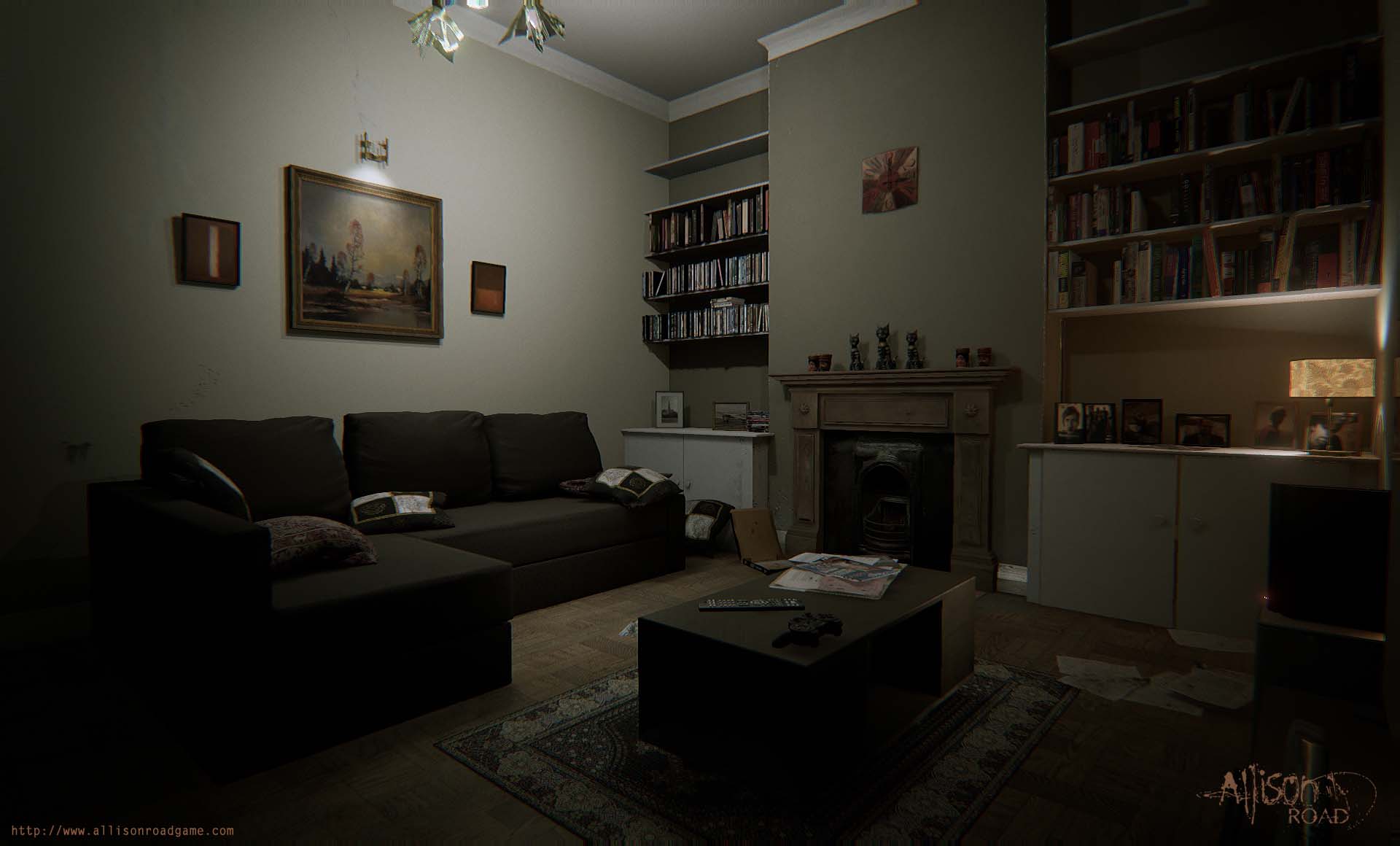
And then, on August 22nd, he felt confident enough to bring Allison Road back from the dead. The game is in development again with Kesler’s new studio, Far From Home, which he co-founded with his wife.
“Because this game started as a hobby project, I feel quite attached to it,” Kesler says. “The thing with personal projects is that you don’t really do them because you have to, so to speak. You do them because you want to. That makes a huge difference when it comes to pushing through slightly more challenging times.”
Without Team17’s backing, Allison Road has to be smaller in scope, but Kesler doesn’t see that as a downside.
“Better to have something shortish but high-quality and tight, rather than artificially long and then in the end low-quality and boring,” he says.
Allison Road has come full circle, in a weird way. Kesler is now working on it in his free time, just like he was before the Kickstarter campaign went live. It’s a comfortable situation.
“Since I already worked on Allison Road for quite a long time that same way in the past, it wasn’t much of an issue, really,” he says.

In a few months Kesler plans to start actively searching for funding or support, and down the line he might revisit some of the funding tiers that were promised in the original Kickstarter campaign, specifically ones that gave fans a chance to be in the game. However, there won’t be another full-blown Kickstarter for Allison Road.
“Kickstarter is really all about trusting someone with your hard-earned money to deliver a good product and support its creation,” Kesler says. “Without a track record, it’s a tough sell, and there are a lot of Kickstarter projects that never see the light of day or go south in some other way.”
He doesn’t have any regrets, even though Allison Road has taken a long and winding path through development so far. There’s no release window for the game just yet, but Kesler is steadily working away, trying to ensure Allison Road will be the most horrifying experience possible.
“It’s really easy to dwell on the past, but the important thing now is to look forward and keep going,” he says.
 AIVAnet