


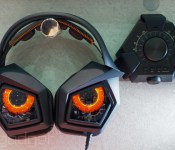
Angry owl is angry: ASUS does a badass gaming headset

When ASUS announced its new mainstream gaming sub-brand Strix two weeks ago, it also unveiled the Strix Pro gaming headset which, to be frank, didn’t look that good in the official renders. Luckily, we stumbled across the real deal at Computex, and its glowing orange owl eyes immediately got us fixated on them. These cans feature a “thunderous” 60mm neodymium-magnet driver in each side, and they’re further enhanced by noise cancellation — enabled by the USB control box — that’s apparently over 90 percent effective. Conveniently, the microphone boom is detachable, so that you can use the headset as a normal pair of headphones.
Alas, we weren’t able to test the headset properly at the booth, but it did feel comfortable thanks to the hexagonal ear cushions and the top cushioned elastic band. If you want one, we’ve been told that the Strix Pro will be priced around $100 when it gradually rolls out globally starting in July.
Hands-on photos by Zach Honig.

New Kinect for Windows is now available for pre-order, costs $199

If you’ve been jonesing to snag the new Kinect sensor for Windows, you can now get one — well, almost. Microsoft has just made its latest Kinect for Windows available for pre-order for only $199.99 with the promise of shipment by July 2014 if you do so while supplies last. The idea behind the early release is to give developers a head start on building applications for the latest v2 technology, though there’s nothing stopping regular consumers from getting in on the action as well. As a reminder, the new Kinect for Windows promises improved depth sensing, a wider field of view, 1080p resolution and more. So if you’re tired of the Xbox One getting all the Kinect love, feel free to see what the Windows version has to offer at the source link below.
Filed under: Gaming, Microsoft
Source: Microsoft
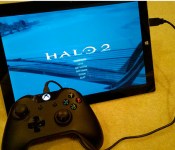
Xbox One controllers now work with your PC

The Xbox One controller is a wonderful piece of gear, so it’s natural that people would want to use it with PC games, too. Right on schedule, but perhaps a year too late, Microsoft is now offering the drivers that’ll let the hardware work on desktops, laptops and suitably-equipped tablets. Such compatibility will be baked into a forthcoming Windows update, but if you can’t wait that long, you can pull down the software from Major Nelson’s website right now. The Xbone controllers will work with any game that supports the Xbox 360′s handset, but if you’d prefer to test it for yourself, you can always call your boss and tell them that you’re ill… or something.
[Image credit: Major Nelson]
Filed under: Gaming, Microsoft
Source: Major Nelson

Microsoft admits the Xbox One performs better without Kinect

Prepare to be confused: Despite everything we’ve heard about the Xbox One’s Kinect sensor containing its own onboard processor, so that it doesn’t weigh down the main console with voice- and image-recognition tasks, it’s now clear that the add-on imposes quite a significant burden. Microsoft has admitted to Eurogamer that the new, cheaper Kinectless Xbox One has “up to 10 percent additional GPU performance,” simply by virtue of system resources that no longer have to be reserved for the motion-sensing peripheral. Does this mean that owners of the original Xbox One can get less screen-tearing in Titanfall simply by unplugging Kinect? Actually it probably could, because a future SDK will enable a boost for game developers who are happy to sacrifice access to the “natural interface” in favor of better performance. In any case, Microsoft’s initial justification for regarding Kinect as an “essential and integrated” part of Xbox One is starting to wear pretty thin.
Filed under: Gaming, HD, Microsoft
Via: Polygon
Source: Eurogamer

IN BRIEF: 5 Android related things you might have missed [June 4th]

It’s that time again my Android friends. Today were going to take a look at some gaming related news. Here are 4 games you may want to try out plus some big news from a well known developer.
If all that Game of Thrones watching this weekend has put you in a medieval mood you may want to check out Gamelofts new game “Rival Knights”. “Rival Knights” is an epic jousting simulation and is free to play. Check it out now via the link below.
Rival Knights
Sticking with the gaming, a big congratulations goes out to Imangi Studios for reaching a truly epic milestone. Imangi Studios is responsible for the fan favorite Temple Run franchise and today has announced that they have reached over one billion downloads! That’s only the second mobile game to ever reach that milestone. The studio is hard at work on their next project but here are some interesting stats
- Players have collectively spent over 216,018 years playing Temple Run
- Over 32 billion games have been played
- Temple Run players have run a total of 50 trillion miles

After your done running from crazed monkeys you might want to give Cie Games “Racing Rivals” a chance. “Racing Rivals” was a hit on the iPhone with over 5 million downloads and counting. The game was recently brought over to our favorite OS and is available for free from the link below.


This next app is for you young andrioid fans (Very Young), or for those of you like me who have toddlers. The game is “Kids Shuffle” and it helps children learn the alphabet and numbers. “Kids Shuffle” has 3 difficulty levels and offers some slick animations. Available free from developer Greensparkers at the link below.


Lastly we have a very nice looking game for all of you action fanatics. “Ninja Time Pirates” brought to you by developer HappyGiant lets you travel back in time uncovering an epic conspiracy while saving the planet from an alien invasion (YES!). This game offers awesome graphics and is actually one of my favorite games at the moment. Its free to play and available at the link below.

The post IN BRIEF: 5 Android related things you might have missed [June 4th] appeared first on AndroidGuys.
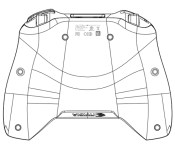
Is this NVIDIA’s next Shield handheld console?

A while back, NVIDIA’s CEO gave us a not-so-subtle hint that the next Shield handheld was close to release. The picture above goes a long way to backing that up. It’s from an official FCC filing for a Shield-shaped game controller called the “P2570.” It’s impossible to be certain with these things, and NVIDIA hasn’t so far responded to our queries, but the model number does sound like a hardware refresh, since the the existing Android console is the “P2450.” That said, the physical changes seem subtle, with the Shield’s stubby bumper buttons apparently lengthened slightly, perhaps to make them more twitch-friendly, and with the manufacturing joints and screws moved to different positions. A side-by-side comparison between the two models (shown below) also suggests the new version may be slightly more slender, and therefore hopefully lighter too, given the 580-gram (1.27-pound) heft of the original.

Even if this really is the Shield 2 (as opposed to some other NVIDIA-related controller), however, the major technical advances are likely to be things we can’t make out from the diagram. For example, we know that the new device will run off a Tegra K1 chip, with its enhanced graphics and Unreal Engine 4 skills. We also suspect that the LCD display could get a resolution bump for 720p. In any case, now that this “P2570″ is finished and ready for certification, it’s only right to expect some solid improvements to what is already an excellent piece of Android gaming kit.
Filed under: Gaming, HD, Mobile, NVIDIA
Source: FCC

Engadget Daily: inside the mind of Cortana, a desk/PC hybrid and more!

Today, we give Microsoft’s Cortana a psych eval, take a closer look at Lian Li’s desk/PC hybrid, go hands-on with the MSI GT70 Dominator and learn about the HP’s latest slate, the Pro x2 612. Read on for Engadget’s news highlights from the last 24 hours.

Her name is Cortana. Her attitude is almost human.
Confident, caring, competent: these are just a few of the terms Microsoft’s Susan Hendrich uses to describe Cortana, the personal assistant with attitude. Read on as our own Brad Molen investigates the lovable AI’s development and the real-life personal assistants behind her demeanor.

MSI GT70 Dominator review: everything it’s supposed to be, not much else
MSI’s GT70 Dominator gaming laptop is built for power, and it shows. It may have a bulky, old-school frame, but this machine packs a full-sized keyboard and a killer sound system, complete with its own subwoofer.

HP’s Pro x2 612 laptop-tablet hybrid brings pen support, a sturdy keyboard
If you’re intrigued by the Surface Pro 3, but need a 2-in-1 with a sturdy keyboard, then HP’s new Pro x2 612 might be just the device for you. This hybrid shares many features and specs with Microsoft’s premier tablet, but also packs a backlit, spill-resistant keyboard dock.

An up close look at the giant gaming PC that’s also a desk
What you’re looking at is Lian Li’s DX-01: a sleek, glass-faced office desk that happens to have a high-powered PC stuffed inside. What’s more, you can buy it right now, starting at $990. That’s just for the empty case, though — you’ll have to get all the computer bits yourself.
You also might like:
Filed under: Misc

The man behind Words with Friends is creating a VR game, partnering with Oculus

It looks like dogfighting in spaceships isn’t the only virtual reality experience being co-published by Oculus VR. The creative lead behind mobile hit Words with Friends, Paul Bettner, has a new studio, and that studio is creating a “made-only-for-VR game” named Lucky’s Tale. No, not “Luckey’s Tale,” like the last name of Oculus founder Palmer Luckey, but some other Lucky. Besides, Palmer’s already living his tale, right? Very little info about the game exists thus far; it’s a third-person platforming game, apparently, which the PR (adorably) describes as, “unconventional for a VR title.” Fact! We’re gonna check it out next week at E3 in person, but there isn’t even a single screenshot to share of the game in action.
Bettner’s new game studio, Playful Corp., is “comprised of the core team of developers that created the highly successful game Words With Friends.” Bettner and co. are no doubt using some of that Zynga money they earned back in 2010 when their last studio, Newtoy, was purchased by Zynga (thus forming “Zynga with Friends”). The Bettner pedigree beyond Words with Friends goes back far further, to Microsoft-owned Ensemble Studios, the company behind Age of Empires. Post-Ensemble, Bettner’s had a history of exploring new formats. Newtoy struck it big with mobile gaming, and his new company took a chance last year on the OUYA. Now, virtual reality.
This isn’t Oculus VR’s first publishing deal with a third-party game studio. EVE Online creators CCP are working with Oculus on EVE Valkyrie, the aforementioned dogfighting game. Unlike Valkyrie, which is also headed to Sony’s VR headset, Lucky’s Tale is supposedly “developed exclusively for the Oculus Rift platform.”
Correction: The post originally had Playful’s game as, “Lucky’s Dream,” though it’s called, “Lucky’s Tale.” Sorry about that!
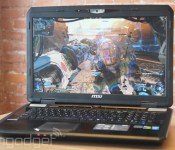
MSI GT70 Dominator review: everything it’s supposed to be, not much else

Thin and light gaming notebooks may be a new trend, but they’re by and large the exception. Traditional gaming rigs look more like MSI’s GT70 Dominator: large, heavy and questionably portable. It’s an old-school gaming laptop, one that truly fits the term “desktop replacement.” It’s also the complete antithesis to the sleek gaming notebooks that have swept the market in recent years. Is bigger still better? Let’s find out.
Look and feel

Some things never change: war, the protagonist of Lynyrd Skynyrd’s “Freebird” and the chassis of MSI’s GT70 Dominator. If you’ve seen last year’s GT70, you’ve seen this year’s model too. Weighing in at 8.6 pounds and measuring 16.85 inches long x 11.34 inches wide and 2.17 inches thick, it’s undeniably huge. And it’s supposed to be — the Dominator is built for power (more on that soon), not portability. That said, the rig’s enormous frame feels a little less forgivable every time I see it.
It’s true that the most powerful gaming machines need to be larger than life to support their high-performance internals, but matters of fact don’t make these devices feel any less unwieldy. Pitted against the Razer Blade or MSI’s own GS60 Ghost, the GT70′s size is a little off-putting. Those slimmer notebooks can’t rival the GT70 in performance, of course, but I can’t help wonder if Moore’s Law could have helped slim the beast down just a little. On the other hand, there’s an old adage at play that’s hard to argue with: If it ain’t broke, don’t fix it.
The extra room afforded by the GT70′s oversized chassis is the very thing that grants it a luxurious, full-sized keyboard, two stellar stereo speakers (with a subwoofer!), a six-action media bar and a generous assortment of ports, plugs and connectivity options. Specifically, it has three USB 3.0 ports, four audio jacks and a multi-format card reader running down the left side; two USB 2.0 plugs and an optical drive on the right; and Ethernet, VGA, HDMI and Mini DisplayPort connectors on the back edge. Like I said, it’s practically identical to last year’s model.
Keyboard and trackpad

The GT70′s keyboard and mouse inputs haven’t changed much either, but that doesn’t mean they haven’t improved. The laptop’s island-style keys are the same well-spaced, slightly concave squares featured on the last two incarnations of the Dominator, except now they’re backed by a more advanced software suite: the SteelSeries Engine. It’s the same software that made the GS60 Ghost’s keyboard more versatile than your average typewriter, and it’s no less impressive here: It can assign complex macros, remap any key function to any other key function and even analyze what keys you use the most. It controls the keyboard’s backlight, too, which can be color-coordinated to identify custom profiles. Overall, it’s a minor change, but big enough to make the new GT70′s keyboard slightly better than the technically identical input we found on last year’s model. That’s not a bad thing, either: The GT70′s SteelSeries keyboard still feels great.
No surprises hide under the Dominator’s mouser, though: It’s the same trackpad MSI’s GT70 has had for years — not that there’s anything wrong with that. It’s still a well-sized, lightly textured touch surface with large buttons that respond with a satisfying “pop.” It’s not a unique or spectacular mousepad, but it’s a good one nonetheless. There isn’t much else to say.
Display and audio

MSI’s GT70 is huge, it’s true, but at least it makes the most of its gargantuan size. The machine’s enormous chassis is topped with a 17-inch, 1,920 x 1,080 LED display panel. This stunningly large display almost justifies the machine’s size, offering a view into your digital world that just can’t be matched by lighter laptops. Games, movies and web content look great on the vibrant display, but it isn’t perfect — colors and contrast tend to fade at sharper viewing angles, particularly those of the vertical persuasion. Still, that’s consistent with last year’s GT70 display: It’s great, as long as you look at it head-on.
There’s nothing to complain about when it comes to the Dominator’s sound: Its Dynaudio-sourced speakers are loud, clear and excellent. The GT70′s audio has always been among the best I’ve heard on a gaming rig, and that hasn’t changed. That said, they do carry the same caveat as they always have: Half of their excellent output comes from the machine’s Sound Blaster Cinema software. Disabling the equalizer gives the drivers a more muted, duller sound — but the software is enabled by default. You have to try to make these speakers sound bad.
Performance and battery life
| PCMark7 | PCMark Vantage | 3DMark06 | 3DMark11 | ATTO (top disk speeds) | |
|---|---|---|---|---|---|
| GT70 Dominator (2.7GHz Core i7-4800MQ CPU, NVIDIA GTX 880M 8GB) | 6,308 | 23,431 | 27,775 |
E11,433 / P8,344 / X2,877 |
1.4 GB/s (reads); 498 MB/s (writes) |
| Razer Blade 14-inch (2.2GHz Core i7-4702HQ, NVIDIA GTX 870M 3GB) | 5,664 | 19,994 | 24,255 |
E9,533 / P6,541 / X2,236 |
542 MB/s (reads); 257 MB/s (writes) |
| MSI GS60 Ghost (2.4GHz Core i7-4700HQ, NVIDIA GTX 860M 2GB) | 5,909 | 22,602 | 22,898 |
E7,908, / P5,152 / X1,519 |
537 MB/s (reads); 495 MB/s (writes) |
| Alienware 14 (2.4GHz Core i7-4700MQ, NVIDIA GTX 765M 2GB) | 5,310 | 21,502 | 20,868 |
E6,529 / P4,211 |
507 MB/s (reads); 418 MB/s (writes) |
| Alienware 17 (2.7GHz Core i7-4800MQ, NVIDIA GeForce GTX 780M 4GB) | 5,647 | 22,114 | 27,137 |
E10,638 / P7,246 |
509 MB/s (reads); 420 MB/s (writes) |
| Digital Storm Veloce (2.7GHz Core i7-4800MQ, GeForce GTX 765M 2GB) | 6,107 | 21,379 | 20,340 |
E6,696 / P4,353 |
506 MB/s (reads); 196 MB/s (writes) |
| 2013 Razer Blade 14-inch (2.2GHz Core i7-4702HQ, GeForce GTX 765M) | 5,837 | 19,505 | 19,815 |
E6,364 / P4,161 |
546 MB/s (reads); 253 MB/s (writes) |
| MSI GT70 Dragon Edition (2013) (2.4GHz Core i7-4700MQ, GeForce GTX 780M) | 6,111 | 20,250 | N/A |
E10,519 / P7,416 |
1.19 GB/s (reads); 806 MB/s (writes) |
| Razer Edge Pro (1.9GHz Core i7-3517U, NVIDIA GT 640M LE 2GB) | 4,949 | 13,536 | 10,260 |
E2,507 / P1,576 |
409 MB/s (reads); 496 MB/s (writes) |
| Samsung Series 7 Gamer (2.30GHz Core i7-3610QM, GeForce GTX 675M) | N/A | 11,515 | 21,131 |
N/A |
N/A |
The GT70′s chassis is bulky, unsightly and absolutely enormous, but inside that frame — oh boy. An Intel Core i7-4800MQ CPU, NVIDIA GeForce GTX 880M graphics and 32GB of RAM lurk under the machine’s thick skin. MSI affectionately calls it “the Dominator,” and it certainly conquered everything I threw at it. The GT70 hardly flinched at high-performance games like Crysis 3 or The Witcher 2, running both at ultra high graphics settings (with ubersampling disabled in the latter title) at 40 and 62 frames per second, respectively. The mechanized warfare of Titanfall pushed 80 fps at maximum fidelity, followed closely by BioShock Infinite’s theocratic skyscape, which shined at 76 fps. Running at 58 fps, the darker streets of Thief took a little more out of the machine, but there wasn’t a single title in my library that the Dominator couldn’t dress to the nines.

Still, looking good isn’t easy: The Dominator grunts under the strain of its performance, and burns with the heat of a taxed graphics processor. Benchmarking games from my couch was an initially painful experience — at least until I remembered MSI’s cooler boost feature. A subtle button on the laptop’s media bar switches its internal fans into overdrive; the feature is horrendously loud, but it’s absolutely necessary. Turn it on if you don’t want to light your pants on fire.
|
Battery life |
|
|---|---|
| MSI GT70 Dominator (2014) | 3:21 |
| Razer Blade 14-inch | 6:24 |
| MSI GT70 Dragon Edition | 4:34 |
| Razer Blade (2014) | 4:27 |
| Razer Edge Pro | 3:40 |
| Razer Blade 2.0 | 3:29 |
| MSI GS60 Ghost | 3:13 |
| Alienware 14 | 3:07 |
| Alienware 17 | 2:55 |
| Digital Storm Veloce | 2:53 |
| MSI GT70 | 2:49 |
| MSI GT683DXR | 2:40 |
| Samsung Series 7 Gamer | 2:11 |
| 2011 Sony VAIO F Series | 2:07 |
| Qosmio X775-3DV78 | 1:26 |
Unfortunately, screaming performance always comes at a price, and that toll is usually paid in longevity. MSI’s latest GT70 lasted a mere three and a half hours in our standard battery test, which involves looping a video at fixed brightness with WiFi on. It’s not the worst runtime I’ve seen on a 17-inch gaming PC, but last year’s model lasted about an hour longer on the same task. I hate to see performance get worse year over year.
Software

Open almost any new gaming laptop, and you’ll find the same thing: Norton Internet Security and NVIDIA’s GeForce Experience software. Naturally, they’re installed on MSI’s GT70 too, but the laptop’s other software bundles are a little less expected. This mostly consists of redundant MSI-branded settings managers and the aforementioned SteelSeries keyboard engine suite, but what really caught me off guard lurked on the Windows 8 Start Screen: Wild Tangent. This brand of packaged games has been around for ages, but it’s not a platform favored by the target market here. Hidden away in the OS’ new UI, it’s inoffensive and easy to ignore, but it’s still weird: Nobody is buying this laptop to play Facebook-quality mini-games. MSI has also included a six-month trial of XSplit Gamecaster too, a boon for gamers who want to join the Twitch streaming revolution.
Configuration options and the competition

The review model MSI lent me isn’t cheap, but it still isn’t the most powerful configuration available. Running a 2.7GHz (3.7GHz with Turbo Boost) Intel Core i7-4800MQ CPU with NVIDIA GeForce GTX 880M graphics, 32GB of RAM, a 1TB HDD and three 128GB SSDs in RAID 0 configuration, the $2,800 machine is no slacker — but gamers who demand the best available specifications have options. For an extra $1,300, MSI will swap out that Core i7-4800MQ for an Intel Core i7-4930MX and… well, that’s it. Every other specification remains the same. It seems like a minor change for the price, but the granular differences are significant: the new processor idles at 3.0GHz, and can reach 3.9GHz with Turbo Boost. If you’re dying to future-proof your next behemoth laptop, you go ahead and pay for it — MSI will reward you with an pair of headphones, a mouse and a backpack for the extra cash.
Seeking out the baseline model will save $800, but it replaces the graphics processor with a less powerful GTX 870M and cuts the machine’s RAM to 16GB. The baseline model only has a single SSD too, cutting back the main drive’s storage space significantly. Trimming the RAM in half again and tossing out that final SSD (leaving you with just the 1TB HDD) will save you an additional $500.
Love the idea of a 17-inch gaming monster with the above specs, but aren’t into MSI? You’ve got a problem: NVIDIA’s GeForce GTX 880M just isn’t in that many large-size gaming notebooks — at least not with matching specs. The Alienware 17 passes over the GPU in all but its most expensive model, pairing it with an Intel Core i7-4940MX processor and 32GB of RAM for $4,049. Digital Storm’s Behemoth laptop features the GPU at all price points (and in dual-GPU configurations in some builds), but falls short of the Dominator’s 32GB RAM capacity by maxing out at 16GB. The 17-inch category just isn’t that diverse — gamers looking for more options will have to settle for a smaller screen.
Wrap-up

MSI’s GT70 Dominator is everything a 17-inch gaming laptop is supposed to be, but it’s nothing more than that. It’s a powerhouse in every sense of the word: a monster in both performance and size. Sure, it shrugged off everything I threw at it, but so did last year’s build. It’s a low-risk machine, a mere spec upgrade on a previous model. There’s nothing wrong with that, but the world of gaming laptops is slowly evolving. In a market where thin, powerful and gorgeous gaming portables exist, MSI’s GT70 is decidedly old-school.
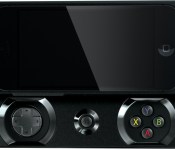
Razer Unveils ‘Junglecat’ Gaming Controller with Slide-Out Design, Companion App [iOS Blog]
Razer has unveiled its Junglecat iOS gaming controller for the iPhone 5s and iPhone 5, bringing a number of hardware features that attempt to make games easier and more natural to play on a mobile device.

The accessory features a slide-out unibody design that contains a Lightning connected upper enclosure for the iPhone, and boasts console-style controls such as a D-Pad, ABXY face buttons, and shoulder bumpers. The Junglecat includes open access to the iPhone’s hardware features including the sleep/wake button, volume buttons, home button, headphone jack, and front/rear cameras.
Razer is also shipping a companion app with the Junglecat, allowing users to remap face buttons and adjust sensitivity on the controller. The app will also include a list of games optimized for controller play, as the app’s interface displays both purchased apps and featured games.

It is unknown if Razer’s Junglecat is a more final version of the company’s “Kazuyo” controller that was leaked earlier this year, however the latter featured a slim hard-shell case design and was rumored to come with full-sized analog sticks. A previous report also indicated that Razer would be shipping a companion app for the Kazuyo as well, perhaps indicating that the company chose a different design for its first iOS controller.
The Razer Junglecat joins a growing market of iOS game controllers, which includes the SteelSeries Stratus, Logitech PowerShell, MOGA Ace Power and Mad Catz’s C.T.R.L.i controller. While all current controllers have attempted to impress consumers with unique designs and buttons, it has been reported that Apple’s strict guidelines have hampered product quality.
Currently, an increasing number of games are offering iOS 7 controller support, including titles like 2K Drive, Dead Trigger 2, and Grand Theft Auto: San Andreas. The number of iOS games supporting controllers is expected to grow as more accessories become available to consumers.
Razer’s Junglecat controller will be available in white and black for $99 when it ships this summer.

