


Microsoft flashes its ‘Halo 2’ remake and Atari documentary at Comic-Con

What do Halo: The Master Chief Collection and the Atari landfill-dig have to do with comic books? Not much, really, but that doesn’t mean that Microsoft isn’t at this year’s San Diego Comic Con (SDCC) trotting them out to those in attendance. Let’s start with Master Chief. The big green galoot has a boxed set of the games he starred in coming out this November, Redmond has seen fit to drop a trailer for the collection’s gorgeously overhauled Halo 2 cinematics and we’ve embedded it below. What’s more, MCC‘s developer Certain Affinity announced that the map that introduced the world to Halo 2‘s multiplayer, “Zanzibar,” is getting the remake treatment alongside “Lockout,” “Ivory Tower,” “Coagulation” and “Ascension.” The final of the six remastered maps will be revealed at Gamescom in Germany next month. If that isn’t enough Halo news, we’ve also embedded video from the Halo: Nightfall panel that recently took place at SDCC.
Elsewhere in the San Diego Convention Center, Microsoft also has debuted the trailer for its doc chronicling the downfall of Atari, Game Over. If you need something to tide you over until that actually releases at some nebulous point this fall, though, we’ve got you covered.
Filed under: Gaming, Home Entertainment, HD, Microsoft
Source: Xbox Wire (1), (2)

Playdate: We’re livestreaming the ‘Destiny’ beta on Xbox One!
 Welcome, ladygeeks and gentlenerds, to the new era of gaming. The one where you get to watch, and comment, as other people livestream gameplay from next-gen consoles. Because games! They’re fun!
Sure, you’ve seen us stream various versions of former Halo-house Bungie’s latest shooter recently, but those previous Playdates were always on Sony-branded consoles. Don’t let the PlayStation marketing department fool you, because Destiny is totally coming to the Xbox One this September as well. It’s almost a bit of a homecoming considering Bungie’s history with the Xbox platform, actually. How does the sci-fi-RPG-MMO-FPS-BBQ look in its fancy green-tinted dress? Join us at 7 p.m. Eastern / 4 p.m. Pacific and find out! I’ll be streaming for two hours and dropping wicked Warlock melee attacks and supremely awesome Hunter headshots all for you.
Filed under: Gaming, Home Entertainment, HD
Source: Twitch

Microsoft unleashes ‘Settlers of Catan’ on the web

Microsoft has something of an extracurricular activity: When it’s not releasing Office for iPad or updating Windows, it has a habit of helping other companies build websites. That’s mostly because it wants to show how smoothly everything works in Internet Explorer, but there’s another reason too. The company has co-developed a web version of Settlers of Catan, the popular board game, making this the only way Windows Phone and Windows tablet users can play online. While the existing Android and iOS apps are of course reserved for people using those platforms, Microsoft’s web version will run in any browser that supports HTML5 — in other words, not just IE.
The game’s in beta for now, and Microsoft says more features and improvements are on the way. For now, the game can’t set you up with computer opponents, nor will it pair with you some random online player. Instead, you’ll have to find at least two other friends, who you can invite through either email or Facebook. (Obviously, since the game runs in any modern browser, it doesn’t matter what kind of device your friends are carrying.) Once you get a game going, you take turns asynchronously, with time limits to keep the game going. You can also opt into email notifications, so you’ll know when someone’s taken a turn. Throughout, you can talk to them using built-in voice chat — powered by Skype, of course.
Microsoft introduced other features too, including auto-trade and auto-roll — again, to help keep things moving. Lastly the dice you’d normally use with the physical board game has been replaced with an on-screen button. Ultimately, the company says it plans to announce a complete rule set at GamesCon in August, including development cards, points and achievements, bringing the web game fully in line with the board game version. In the meantime, you can play the beta game here. Enjoy — and do be patient if you encounter any performance hiccups. It’s clear the site isn’t fully polished yet.
Filed under: Gaming, Internet, Microsoft
Via: GigaOm
Source: Catan Anytime, Microsoft

The battle for virtual reality: Google, Samsung, Sony and Oculus VR

Back in June, Google revealed Cardboard: an open-source attempt at mobile virtual reality. Heck, even the “hardware” is open source –here are instructions to make your own, right now!
But the concept is more than a low-tech solution to mobile VR. It’s emblematic of Google’s approach to virtual reality: use the phone that’s already in your pocket. Samsung’s taking the same approach later this year with Gear VR, only it’s also partnering with Oculus VR on the software side.
This stands in stark contrast to the PC-dependent, ultra-high-res experience Oculus VR and Facebook are aiming to achieve. The Oculus Rift headset both literally and figuratively kickstarted the re-birth of virtual reality in modern technology. It remains the peak of technological achievement in virtual reality. And now, the medium is splintering into two distinct futures: one of entertainment, the other of immersion.
“PRESENCE”

That word — “presence” — is at the heart of virtual reality. Game industry veteran Michael Abrash — formerly of Valve, where he worked on research and development; currently of Oculus VR, where he serves as “Chief Scientist” — described this ideal for VR during a talk in January 2014:
“It’s the sense of being someplace else while in virtual reality; many people feel as if they’ve been teleported. Presence is an incredibly powerful sensation, and it’s unique to VR; there’s no way to create it in any other medium.”
The medium’s history is littered with failed attempts, even from gaming’s biggest players (Nintendo’s Virtual Boy, anyone?).
Indeed, that’s the “magic” of virtual reality: being whisked away, instantly, to another world. You’re not looking at another world on a screen — you’re there. At least, that’s when VR works. The medium’s history is littered with failed attempts, even from gaming’s biggest players (Nintendo’s Virtual Boy, anyone?). But with Oculus Rift, even the first demos shown on a duct-taped, slapdash prototype were incredibly impressive. It just worked, even if it was clearly rough around the edges. And even with those early demos, a PC was required to power them. The same can be said for Sony’s Project Morpheus, powered by a $400 game console.
One early demo, dubbed “Tuscany” for its visual nods to the Italian region, wasn’t much to look at. The art was low-resolution; the in-world lighting was barely there; the level of detail in general was pretty low. But even with bare bones demos like Tuscany, the world was believable because the demo’s framerate was high enough and the headset was capable of refreshing video fast enough for it to seem real. Those demos seem rough now by contrast, but they’re still far ahead of what we’ve seen running on VR headsets powered by mobile phone processors.
MOBILE VR AS IT STANDS TODAY

We’ve heard very positive things from folks who’ve tried Samsung’s VR headset. The so-called “Gear VR” is still a development kit, and it’s powered by a Galaxy S4; we’re told that the consumer version will use a newer phone (maybe the Note 4?) with more horsepower. Though our sources only experienced a few demos, they repeatedly described them as “impressive,” specifically with the caveat “for a phone.”
Samsung still hasn’t officially acknowledged that its VR headset exists (that’s a real render of it above). Gear VR is said to be be unveiled in Germany at IFA, just a few weeks from now.
Google’s Cardboard has received similarly positive, though guarded, responses. TechCrunch‘s Greg Kumparak wrote back in June, “It’s actually kind of freaking wonderful. Is it an Oculus Rift killer? Hah – of course not. It’s made of cardboard. But it’s still awesome.” As he demonstrated in a video (above), a handful of apps — including major known quantities like YouTube and Google Earth — can be used in Cardboard right now, employing phones that already exist (there’s a Nexus 5 in the demonstration).
It’s certainly a different take. Rather than aim to provide “presence,” Google’s approach to VR seeks to provide an alternate viewing experience for existing content. YouTube, for instance, is simply an interactive VR app for viewing non-VR content. That’s not a bad thing, necessarily — it could act as an intro to VR for the mass market — but it’s not the same as providing “presence.”
Another VR device powered by mobile tech, GameFace Labs’ “GameFace” prototype, further highlights this difference. The same Tuscany demo running on the GameFace headset, scaled down for a mobile processor, provided a markedly different experience than what we’ve tried on the Oculus Rift. Are you still “in” Tuscany? Sure! But it looks an awful lot like Virtual Tuscany, rather than “Oh man, I’m in Tuscany!”
Though GameFace is impressive, the second Oculus Rift dev kit is an order of magnitude more adept. Beyond a much higher resolution screen, the second Rift dev kit comes with an additional camera for depth-tracking (just to barely scratch the surface of technical differences). That’s not meant as a slight at GFL, but to highlight how different these two approaches are to virtual reality. Simply put, they’re intended to deliver different experiences.
WHERE CASUAL AND BLEEDING EDGE VR DIVERGE
Unlike film or video games, where technical prowess can be trumped by other factors, major VR leaders argue that it’s a worthless medium without “presence.” To create presence, Oculus VR founder and Rift creator Palmer Luckey says that the tech has to be of a certain quality — specs that exceed the most advanced smartphones. Even the Rift’s second dev kit, which is far more technologically capable than the competition, is far from what he thinks is required for “good consumer virtual reality.” That means super high-res screens, high refresh rates (“90 Hz or higher”), and fast processors (read: actual computers, with dedicated graphics processing) to make all that happen. Luckey’s told me in interview after interview that standalone, untethered VR is the future of the medium (see above). But 10 years from now “future,” not 2014.
Google argues that the best time to get VR going — regardless of technological capability — is right now.
“We could theoretically plunk down a Titan in there. There’s nothing stopping us. But people will say, ‘This is hot! It only lasts for five minutes!’,” NVIDIA product manager Mithun Chandrasekhar told us in a recent interview. We asked about the limitations around mobile VR, and he joked that NVIDIA could — theoretically — put an expensive, high-powered GPU in a VR headset.
Of course, it’d be incredibly hot, heavy, and would require immense battery power.
Even if NVIDIA could shrink the GPU down in size and weight, power issues would overcome horsepower limitations. Battery technology simply isn’t keeping up with processor technology. “Battery is probably the biggest limitation,” Chandrasekhar said.
Google argues that the best time to get VR going — regardless of technological capability — is right now. “We want everyone to experience virtual reality in a simple, fun, and inexpensive way. That’s the goal of the Cardboard project,” the Cardboard website reads. Beyond expanding the reach of virtual reality, Google specifically calls out developers that it hopes will, “build the next generation of immersive digital experiences.” Silly as it might look, Google Cardboard and other mobile VR solutions look to offer a foundational experience for both the development community — you know, the folks who make this stuff really amazing — and for mainstream, non-technophiles.
TWO PATHS, ONE RESULT

Chances are, you don’t have a 4K screen on your smartphone. You might soon, but you probably don’t just yet. When you do — when we all do — the concept of mobile VR will seem a bit less gimmicky and a bit more like a real product. When processors are more capable, when batteries last longer, and the line between PC and mobile phone blurs just a bit more, mobile VR won’t feel like such a foundational step on the way to the promise of “presence.”
For now, mobile VR can serve as a taste of the medium. An amuse-bouche to the medium. A gateway drug to the presence you’ll find on devices like the Oculus Rift and Project Morpheus. And that’s not a bad thing! Before long, devices like Rift and Morpheus will be rudimentary, their abilities easily accomplished on mobile, and the two virtual reality paths will (at least in part) rejoin.
Whether the goal is growing the medium, getting to market early, providing “presence,” or something else entirely, the result is the same: we all get to play with a bunch of rad VR headsets. Oh, and hopefully witness the birth of a major new medium. No big.
[Image credit: Valve (Steam Dev Days 2014 slide), SamMobile (Gear VR)]
Filed under: Cellphones, Gaming, Wearables, Software, HD, Mobile, Samsung, Sony, Google, Facebook

Google Play gets a section for offline games

In an ideal world, your smartphone and tablet would always be online (and you’d still have an unlimited data plan), but that’s just not the case. Problem is, some Android games require a connection even after you’ve completed your download, but others do not. It’s that latter list that Google’s breaking out into its own section in Play, called “Offline Games.” There you’ll find Asphalt 8, Dots, Jetpack Joyride, Assassin’s Creed Pirates and a few others — 54 games in all. That’s a shockingly slim selection, so this list is hardly all-inclusive, but if you’re in the market for a game to play on your next flight or subway ride, it’s a good place to start.
Filed under: Gaming, Internet, Google
Via: Android Community
Source: Google Play

Gamer discovers deceased father’s ghost car, gets to race him again

YouTube comments typically fill one with shame and disappointment in the human race, but here’s one that just might make you cry. Below a video from PBS about video games as spiritual experiences, a user going by the online handle 00WARTHERAPY00 has written a touching story about the time they spent gaming with their dad. ‘THERAPY00 says that when he or she was four years old, they’d play Xbox with his or her father and had tons of fun up until a few years later when their dad passed away. It was ten years before the commenter could bring him/herself to boot Microsoft’s first game console and when they did, there was a surprise waiting for them. Rally racer Rallisport Challenge features a function that records the best lap-time for a given circuit with an apparition-like version of the car used. Meaning that, quite literally, there was a ghost of 00WARTHERAPY00′s father waiting to compete against him or her.
“and so i played and played, and played, untill [sic] i was almost able to beat the ghost. until one day i got ahead of it, i surpassed it, and…
i stopped right in front of the finish line, just to ensure i wouldnt [sic] delete it.
Bliss.”
The story has since gone viral, and we couldn’t help but be reminded of this one about a gamer that discovered a stack of mail and presents from their departed mom in Animal Crossing. That’s it; no snark here. Now, if you don’t mind, we’re going to grab a Kleenex or two.
Filed under: Gaming, Home Entertainment, HD
Via: Yahoo! Autos
Source: YouTube

The ‘Destiny’ beta is now open to everyone
 Let’s say you wanted to give Bungie’s latest shooter, Destiny, a go before the game comes out in September, but the idea of pre-ordering video games goes against the very core of your being. Well, Bungie’s just announced that it’s opening the floodgates on the test-phase for the game and is letting everyone get in on the fun. At 7 p.m. Eastern / 4 p.m. Pacific, you’ll be able to head to the digital marketplace on your gaming platform of choice (PlayStation 3, PlayStation 4, Xbox 360 and Xbox One) and grab the multi-gigabyte file for yourself and see what everyone’s been raving about. And remember, on Saturday at 5 p.m. Eastern, 2 p.m. Pacific, Bungie is promising a special reward for whoever is playing, and that it’ll carry over to the game’s final version come September.
If you've wanted to play Destiny, but didn't have a code, you're invited to the party now. http://t.co/z8CbAGU47K pic.twitter.com/z4UQDj4T0e
– Bungie (@Bungie) July 24, 2014
Filed under: Gaming, Home Entertainment, HD
Source: Bungie (1), (2)

Here’s the first look at Ridley Scott’s live-action ‘Halo’ project

Back at this year’s E3 we learned that Halo: Nightfall would tell the origin story for a new character in Halo‘s sci-fi universe, and we’re finally getting to see some of the show in motion. And, well, there are a couple of instances where it looks pretty similar to the Alien not-a-prequel, Prometheus. That almost assuredly isn’t a coincidence given the fact that Prometheus‘ director Ridley Scott is serving as executive producer for the show. It’s hard to tell exactly how the episodic series is going to turn out based on a teaser trailer (embedded after the break), but we can tell you that in its 74 seconds there’s a distinct lack of Master Chief and a whole lot of talk about an element that “selectively kills humans.” How’s that for mystery? You’ll be able to check out the exploits of Agent Locke and his crew after Halo: The Master Chief Collection releases this November.
Filed under: Gaming, Home Entertainment, HD, Microsoft

New Apple TV game brings the ‘Dance Party’ to your living room

Apple’s set-top hobby has come a long way since its major refresh in 2010, thanks largely to a variety of services bringing different content to the platform. When it comes to gaming, however, the Apple TV isn’t exactly a powerhouse, despite being able to support it through AirPlay features — something similar to what Real Racing has done in the past. Another developer that’s made use of this particular second-screen kind of experience is Rolocule Games, and it just announced a new free title (with in-app purchases) dubbed Dance Party.
The game, which clearly takes a cue from Dance Central, comes in the form of an app and uses an iOS device as a motion controller, allowing players to see their virtual, groovy moves on the bigger screen by way of Apple TV. Dance Party also lets you challenge other people who have the application, even if they’re not in the same location as you. It may not be the best way to play games on the tiny box, but that doesn’t mean it couldn’t be fun.
Filed under: Misc, Gaming, Home Entertainment, Software, HD, Mobile, Apple
Source: App Store
Google is reportedly buying Twitch for $1 billion

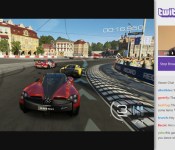
What’s the internet’s most popular game-streaming service worth? About $1 billion, if VentureBeat sources have their story straight. Earlier this year, Variety and the Wall Street Journal reported that Google was in talks to acquire Twitch, but conceded that the two companies were only just starting negotiations. Now, sources familiar with the deal say an agreement has been reached, though its unclear when the reported acquisition will be officially announced. Naturally, there are some concerns that a Google acquisition of Twitch would stifle competition for rival services, but the tried and true platform could certainly bolster Mountain View’s own streaming efforts. If nothing else, perhaps the deal will validate emerging market shared gameplay in the eyes of its doubters.
Filed under: Gaming, Internet, HD, Google
Source: VentureBeat

