


The portable pop-up gaming room is here

Privacy. Sometimes we all crave a little. ‘Bocchi tent’: a 1.3 meter by 1.3 meter soft-cornered cube that makers Bibi Lab reckons offers the “ultimate gaming space”. With a slender gossamer wall between you and the rest of humanity, there’s a degree of sensorial blockage, but we could — obviously still hear the din of the Tokyo Game Show floors — headphones will be necessary if you’re looking to block out Other People. (The computer inside didn’t even have any games! What a waste.)
With all the space-age science of a popup tent, open up the storage pouch and the temporary gaming den makes itself – you’ll just have to add the furniture (and well, gaming hardware), yourself. The tent is set to retails for 5000 yen in Japan – and if you’re particularly taken with the idea of your own flatpack Internet Cafe, at least it should fit in your suitcase.

Filed under: Gaming
.CPlase_panel display:none;

Love is in the air at the Tokyo Game Show

Dating simulation games are nothing new in Japan; and in fact, there’s something for both boys and girls. This particular booth at the Tokyo Game Show was chiefly promoting Voltage Inc.’s romance mobile apps to the ladies, but with a twist: The company brought in some “attractive models” to let attendees “experience the world of romance apps in real life.” Japanese girls (and some guys) were actually lining up to try a scene from one of the three games, and needless to say, it’s rather entertaining to watch their reactions — which were unsurprisingly consistent in general — as the male characters wooed them with a “kabe don.” And if you don’t know what that is, educate yourselves with our video after the break.
Filed under: Gaming
.CPlase_panel display:none;

Not all of Samsung’s curved displays are gigantic

Want a curved display from Samsung but don’t quite have the scratch to bring one of its gigantic models home? Maybe try the 27-inch S27D590C monitor on for size when it releases at some ambiguous point in the future. The firm seems to be targeting gamers specifically with the monitor, saying that the curve creates a wider field of view (178 degrees horizontally and vertically, if you’re curious) and gives the screen a “3D-like” effect when you’re playing shooters and racing games, among other genres. There’s even a one-button game mode that makes a few adjustments to compensate for motion blur, color and contrast too. Unlike Dell’s not-flat display, however, this one’s limited to a paltry 1,920 x 1,080 lines of resolution and a 16:9 aspect ratio. This’ll probably be fine for us commoners, sure, but it might not be enough for the PC Master Race.
Filed under: Desktops, Gaming, Home Entertainment, HD, Samsung
.CPlase_panel display:none;

NVIDIA’s latest GPU crams 4K images on 1080p displays

Back in February, NVIDIA trotted out the very first desktop GPUs to feature its new Maxwell architecture: the GeForce GTX 750 and 750i. These entry level cards were paragons of efficiency, but they were hardly strong examples of what the company’s latest graphics technology was truly capable of. No, NVIDIA revealed those graphics cards today — the GeForce GTX 980 and 970 desktop GPUs. The new flagship GPUs still benefit from the efficiency gains made by the first generation Maxwell cards, but lean far more heavily on performance. If you’re a PC gamer with a GTX 680 or 560 in your tower, these are the cards NVIDIA wants you to upgrade to.
On paper, there’s reason enough to appreciate these cards’ power: the $549 GTX 980 boasts a 1.1Ghz base clock speed (1.2 with boost), 2048 CUDA cores and 4GB of GDDR5 video memory. The $329 GTX 970 sheds a few of those CUDA cores (totaling 1664) and clocks down to 1Ghz (1.1 with boost), but it consumes a little less power for the downsizing: 145W to the 980’s 165W. In NVIDIA’s tests (viewable in the gallery above), these stats reportedly outperformed AMD’s kit with almost half the power draw. Still, even NVIDIA knows stats and core count mean bupkis to the general consumer — gamers want to know what all these specifications are going to do for them. We met up with Scott Herkelman, NVIDIA’s general manager of GeForce, to learn about Maxwell’s new tricks.

“One of the things that we thought about when we wanted to launch Maxwell is this dichotomy that gamers are running into today,” Herkelman told Engadget. NVIDIA found that gamers either wanted to increase visuals past a game’s prescribed performance settings or maximize framerate without sacrificing image quality. Surprise, surprise: Maxwell’s second generation GPUs introduce two new technologies that can help.
Dynamic Super Resolution, for instance, lies to your game to make it output a higher resolution than your display expects. “We render a 4K image in the background and then put it through a 13 gaussian filter,” he explained. “Then we bring that down to a 1080p monitor.” As far as the game is concerned, its piping out a ultra high resolution image to a 4K monitor, but Maxwell is forcing it to run on you 1080p display. This feature is designed to improve picture quality on a game that is already tuned to its best visual settings. Basically, it makes downsampling easy. It looks pretty good in action too, but it isn’t perfect: some 4K UI elements don’t scale well on smaller monitors. Herkelman says NVIDIA is continuing to improve and tweak the feature.

“The other new technology we have is called MFAA, or Multi-Frame Sample Anti-Aliasing,” Herkelman said. “This is for those games where you already have great image quality but you want more performance.” Like traditional anti-aliasing, it can sample a pixel multiple times, but MFAA splits the work up over multiple frames. Herkleman says this can improve performance by as much as 30-percent.
Finally, high-end maxwell cards will be able to take advantage of games that use Voxel Global Illumination, a new dynamic lighting technology that promises to promises to enable destructive environments with active, realistic lighting. How realistic is it? Realistic enough to debunk moon-landing conspiracy theories, actually. NVIDIA says the new lighting solution will be available for UE4 and other major engines later this year.
Not the bells and whistles you’re looking for? Fine — Maxwell has a few more features hidden away, but you won’t be able to use them until the consumer virtual reality market takes off. NVIDIA’s VR Direct program is working to bring low latency graphics to consumer VR headsets like the Oculus Rift. Herkleman showed off a Maxwell-powered Eve: Valkyrie demo as an example. Indeed, the demo was smooth, but VR Direct’s future impact on GeForce Experience really caught our attention. In addition to supporting SLI, DSR and MFAA, NVIDIA’s VR Direct promises “auto stereo,” a feature designed to bend a game not intended for virtual reality into the Oculus Rift’s stereoscopic perspective. Herkleman told us that the feature would probably have a whitelist of compatible games, not unlike how the company implements NVIDIA 3D Vision.

So, when can consumers get their hands on the new Maxwell? Soon. NVIDIA CEO Jen-Hsun Huang officially announced the new GeForce GTX cards at Game24 this evening, and they should be available for sale tomorrow morning from NVIDIA’s usual hardware partners: EVGA, ASUS, Gigabyte, MSI and PNY, among others. Are you planning to upgrade, or will you wait to see what AMD cooks up in competition? Let us know what you think in the comments section below.
.CPlase_panel display:none;

Xbox One’s newest Kinect game is a comic-book styled murder mystery

Lets say you’re already burned out on Destiny and are looking for something a bit, well, different than what the Xbox One currently has on offer. That might just mean that D4 (short for Dark Dreams Don’t Die), the latest game from the creator of cult-hit Deadly Premonition, could be the relief you didn’t even know you were looking for. It’s one of the scant few Kinect-enabled games releasing soon, too. The episodic title was first teased during Microsoft’s E3 event last year and has gone largely unheard from since. That’s recently changed, as Xbox Wire has an interview with its developer Hidetaka Suehiro, better known as Swery65, ahead of the first installment hitting the Xbox Marketplace today.
What’re you in for? A sort of noir murder-mystery where you can interact with the cel-shaded surroundings either with a controller or Microsoft’s do-all sensor. The latter of which apparently has you “grabbing” one of the characters by her shoulders and pulling her off a kitchen table. If you’ve sold off your old consoles, this’ll have to do for your adventure fix until Telltale’s The Wolf Among Us hits Xbox One.
Filed under: Gaming, Home Entertainment, HD, Microsoft
Source: Xbox Wire
.CPlase_panel display:none;

Retro? Modern? This home-brew NES game is both

Retro gaming projects on Kickstarter are pretty common, but here’s one that’s a bit different: a game cartridge that, when plugged into the original Nintendo Entertainment System, plays an 8-bit game, and when plugged into a Mac or PC (via USB) plays a modern version of the same game. Perhaps the coolest aspect is that the two versions will interact with each other; an ability or weapon unlocked in one is available to futz with in its cousin. That is, if the project’s Kickstarter is funded, of course. As Mystic Searches‘ project lead Joe Granato IV tells it, the concept comes from a design document he drew up, quite literally, as a seven year-old back in the ’80s.
The crowdfunding campaign is a bit more ambitious than just releasing the game, however, as Granato is flexing his muscles as a filmmaker to chronicle the campaign and development process too. He’s secured a few high-profile names from the homebrew and retro-gaming community to appear as well, including Shovel Knight developer Yacht Club Games. As of this writing, Mystic Searches is about a third of the way toward its funding goal with 30 days left. Ten bucks gets you a digital copy of the game, but, if you’re feeling particularly spendy, the team will bring your game idea to life for a cool $10,000. Now, if you’ll excuse me, I have some couch cushions to dig through.
Filed under: Gaming, Home Entertainment, HD
Source: Kickstarter
.CPlase_panel display:none;

We just played with Nintendo’s New 3DS: Finally, an extra analog stick

You might have heard: Nintendo’s refreshing its 3DS family with two new models. Both the New 3DS as well as the larger New 3DS XL will arrive with a diddly analog stick just above the action buttons. (Throw away your Circle Pad Pros!) Plus, there’s built-in NFC for those incoming Nintendo figurines and a new microSD card reader. Unfortunately, in my fly-by Monster Hunter 4G gaming test, I didn’t have the chance to try either of those features — readers love SD slot close-ups — but it does offer an estimation of what Japanese gamers will get in less than a month when both handhelds launch. There’s still no word on an overseas release for either model, but for now, watch me prove how poor I am at Monster Hunter in our video after the break. No, far worse than that.
http://www.engadget.com/embed-5min/?sid=577&playList=518421120&responsive=false&ratio=1
This time, I was handling the big-screened New 3DS LL (That’s the Japanese version of the 3DS XL), and if we’re honest, there really wasn’t much difference from my now-obsolete 3DS XL at home on initial handling: the corners are still curved, making it, once again, far more comfortable than the OG 3DS, while both screens are bright and vivid — perfect for the palette of Nintendo’s gaming oeuvre. Now, there’s no games that appropriately make the most of the analog stick (at least, not yet). Here at TGS 2014, with Monster Hunter 4G , the right stick was assigned to camera duties, a role it shared with the d-pad and, er, about a third of the touchscreen too. Understandably, the tiny stick was the better option, as it was easier to access and offered a better degree of control.
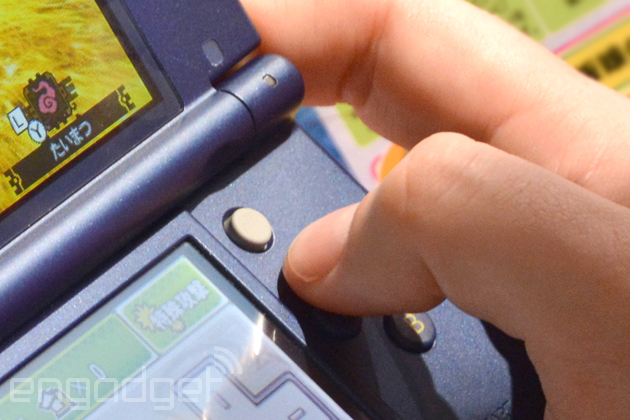
That’s because the new stick has a rubbery finish, while its location means it’s easy to nudge a little and then swiftly return to the X, Y, A and B buttons. Then there’s those secondary shoulder trigger buttons (which should work nicely with that stick once games arrive): they’re a little smaller but they’re appropriately spaced enough that you’re not going to hit ZR instead of the primary R trigger. It’ll be interesting to see how Nintendo handles transitioning between existing 3DS hardware and these new models, which will likely require completely different controller layouts to make those new buttons worthwhile. Both models launch in Japan on October 11th — and I bravely vow to waste hours and hours on Smash Bros. in the ensuing days to bring you Engadget’s official verdict. (You’re welcome.)
.CPlase_panel display:none;
You can now tinker with the code of ‘Commander Keen’s’ lost episode

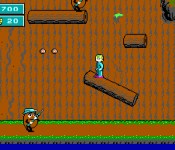
It’s easy to indulge your Commander Keen nostalgia with most of the game series, but the “lost” Keen Dreams episode has proven elusive outside of less-than-official copies. As of now, though, you can do something about recreating those adventures through Tuberia — Javier Chavez and team have fulfilled a crowdfunding promise by publishing legal source code for Keen Dreams‘ original DOS version. If you want, you can now port the game to newer platforms and otherwise tweak the code to your heart’s content. Chavez and crew have yet to get their own ready-to-play edition going, but it’s already up for consideration on Steam Greenlight. Consider giving it a thumbs-up if you want to resume your fight against the spud soldiers.
[Image credit: Steve Hall, MobyGames]
Via: Hacker News
.CPlase_panel display:none;

You’ll be able to drive a car in ‘Final Fantasy XV’

Timed perfectly for this year’s Tokyo Game Show, Square-Enix’s unveiled a new teaser for its next (long in development) Final Fantasy. There’s boyband hairstyles, broody protagonists, big-ass swords… and a fancy car you drive around in. Watch, and wait — FFXV‘s still coming.
Filed under: Gaming, Sony, Microsoft
.CPlase_panel display:none;

GDC award for culture critic Anita Sarkeesian led to bomb threat

A bomb threat was made regarding a speaker and award recipient at the Game Developer’s Choice Awards (part of the annual Game Developer’s Conference) in San Francisco this past March. Anita Sarkeesian (pictured above), host of Tropes vs. Women in Video Games, a YouTube series that naturally examines the way women are depicted in video games, was the intended target. As Kotaku reports, an anonymous email was sent to around 25 of GDC’s organizers stating the following:
“A bomb will be detonated at the Game Developer’s Choice award ceremony tonight unless Anita Sarkeesian’s Ambassador Award is revoked. We estimate the bomb will kill at least a dozen people and injure dozens more. It would be in your best interest to accept our simple request. This is not a joke. You have been warned.”
Sarkeesian’s acceptance speech
The San Francisco police department scoured the Moscone Center’s grounds (where the show is held) but came up with nothing. Any further details regarding the investigation weren’t disclosed to Kotaku. Meanwhile, GDC’s organizers didn’t alert any of the attendees of the threat, but apparently upped security and increased random bag checks as people entered the award ceremony.
This isn’t the most recent threat against Sarkeesian, and sadly will likely not be the last we hear of, either. She’s been harassed since her wildly successful Kickstarter for the Tropes series (the project’s modest $6,000 goal was fully funded in 24 hours and went on to amass over $158,000 in pledges) made its debut. Her website was hit with distributed denial of service attacks, her email and social media accounts have come under hacking attempts and she’s been threatened that her personal contact info would be distributed to hate sites online. All before the first episode was made. Why? Because some people on the internet aren’t okay with her shedding light on the fact that women are often portrayed as little more than background dressing in video games.
[Image credit: Infomastern/Flickr]
Filed under: Gaming, Home Entertainment, Internet, HD
Source: Kotaku
.CPlase_panel display:none;

