


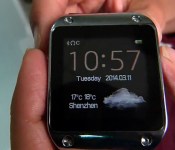
Someone (finally) made a Galaxy Gear clone

At first glance this beauty might look like the Galaxy Gear, but it’s actually the PW305. Apparently the guys at Podoor didn’t get the memo from CNN that people weren’t counterfeiting smartwatches, and made this stylish number. The company tells us that the watch is based on Linux and “performs stably and practically,” two features we’re definitely looking for in a wearable. Check out a demo video of the PW305 in all its KIRF glory after the break.
Filed under: Wearables, Mobile
Source: Podoor

Samsung announces Gear Fit aimed at fitness-minded individuals
This year at Mobile World Congress, Samsung announced not one or two, but three new smartwatches.
Joining the Gear 2 and Gear 2 Neo is the Samsung Gear Fit, designed for those “striving to live more fit and active lives” while still being stylish and connected. As with Samsung’s other new smartwatches, the Gear Fit also has no “Galaxy” moniker, running Samsung’s Tizen OS and not Android.

The Gear Fit, a fitness band with expanded features, offers a “vivid” 1.84-inch Curved Super AMOLED display, a 210mAh battery that gets three to four days of “typical usage” and up to five days of “low usage,” pedometer, exercise, heart rate, sleep, stopwatch and time functions and instant notifications from Galaxy smartphones such as incoming calls, emails, text messages, alarms, S-planner and third party apps.

It weighs just 27g, is dust and water resistant, plus has changeable straps available in black, orange and “mocha grey,” so it can match any “outfit or mood.”
The Gear Fit will be available globally in April.
via Samsung
The post Samsung announces Gear Fit aimed at fitness-minded individuals appeared first on AndroidGuys.

NYT: Samsung Galaxy S5 and Galaxy Gear 2 will be announced in three weeks

As Mobile World Congress approaches, it appears to become more and more evident that Samsung has chosen the Barcelona event later this month as the venue to launch the Galaxy S 5. This morning, the New York Times has confirmed through its sources that this will indeed be the case, and it’s going to be quite a bit different from last year’s Galaxy S flagship launch. Whereas last year’s controversial show featured Broadway-style antics and blatant stereotyping, the NYT reports that “Unpacked 2014 Episode 1,” the launch event, will be much more low-key.
The publication also mentions a few details about the device itself. The GS5 will reportedly feature some design enhancements and spec improvements, such as a fancier camera and better processor (we’d wager that we’ll see a 16MP camera and a choice of Exynos 6 or Snapdragon 805), but it sounds like Samsung plans to dial back the number of new firmware features. Curiously, the same sources tell the Times that the S5 oddly won’t come with a bump in display resolution to Quad HD (2,560 x 1,440); if this is indeed the case, it likely means we’ll be seeing a 1080p screen on two Galaxy S flagships in a row. We find this a bit surprising, but we wonder if supply constraints could be a reason why Samsung is holding off for now. The report also claims that we won’t see an eye scanner this time around.
Finally, the Times reports that Samsung isn’t going to wait for its usual yearly product cycle to launch a new Galaxy Gear — apparently, the second version of the smartwatch is also on the Unpacked agenda just a few months after its predecessor arrived. The product’s quick turnaround would certainly be a huge surprise, but given its relatively poor reception and reportedly low sales, it’s not unreasonable to suggest that the company wants to push out a new and improved version as soon as possible.
Filed under: Cellphones, Wearables, Wireless, Mobile, Samsung
Source: NYT
Galaxy Gear 2 rumored with bendable display
Despite being the leader in its space, the Samsung Galaxy Gear has had quite a rough year. Limited functionality, incompatibility with current flagships at launch, bugs, and more have proved difficult for mainstream success. According to an unnamed industry insider, Samsung is working on a total redesign of the Galaxy Gear. Will this be Samsung’s chance to redeem itself?
The so-called Galaxy Gear 2 is said to have a flexible OLED display roughly the same size (1.63inches) with a redesign which removes unfavorable aspects of the current model.
Many are wondering if Samsung will allow compatibility with devices other than their own smartphones. How much does that matter; do you think Apple would make an “iWatch” that played well with other brands or OSes?
With 2014 set to give way to many wearable devices, Samsung’s next-gen Galaxy Gear will need to be considerably better than the current iteration. Another misstep here could be costly.
The post Galaxy Gear 2 rumored with bendable display appeared first on AndroidGuys.
Watch-out, Archos launching $50 smartwatch by summer
Smartwatchs are a new category and there are only a options available on the market today, but Archos is hoping to change that with its new smartwatch line launching this summer.
Unlike the Samsung Galaxy Gear that carries many of the features of a smartphone, Archos’ devices will be (sort-of) competing with the Pebble directly since its $50 model will feature a 1.55-inch non-capacitive e-ink display and the ability to receive text, email and social media notifications and control media playback, in addition to displaying the time, of course. The unnamed Archos watch is said to get between one and two weeks of battery life.
The smartwatch can’t reply to messages (the Pebble can actually send simple replies thanks to the app Glance), and there is no mention of it being open source or there being any type of app store.
In addition to its cheapest $50 model, two others will be available in the line, but not at launch. The first will be $100 and come with a 1.8-inch color capacitive display and a 36 to 48 hour battery life. The second is the same as the color model, but will feature an aluminum-encased curved display for $130.
via Engadget
The post Watch-out, Archos launching $50 smartwatch by summer appeared first on AndroidGuys.
Samsung: “We will go back to the basics” for Galaxy S5
Due by April, the next-gen flagship will debut with a new Galaxy Gear
Samsung, speaking with Bloomberg this week, confirmed that the Galaxy S5 will debut by either March or April. Also due at the same time is a new version of the Galaxy Gear smartwatch.
According to Samsung, the handset maker is taking a “back to basics” approach for the Galaxy S5. Conceding that most customers could not discern the differences between the Galaxy S3 and the Galaxy S4, this year’s model will be more obvious.
Mostly, it’s about the display and the feel of the cover
Additional features that may or may not make the cut for the Galaxy S5 are said to include a fingerprint reader or eye scanner.
As for the wearable tech, Samsung says the Galaxy Gear refresh will feature more advanced functions and will have a less bulky design.
The next-generation Galaxy Note (4) could offer customers a wraparound display when it debuts in the second half of 2014.
“We are targeting consumers who want more professional use and tend to be willing to pay more for handsets”
Brace yourself, we are about to run face-first into the buzzsaw that is the Galaxy S5 rumor mill. As if it weren’t already the subject of much speculation and conjecture, the next two months could crank things up a notch.
The post Samsung: “We will go back to the basics” for Galaxy S5 appeared first on AndroidGuys.
Samsung Galaxy Gear 2 rumored for Mobile World Congress
A Galaxy Band is also expected in the new year
That Samsung is already working on a successor to the Galaxy Gear smartwatch shouldn’t come as much of a surprise. We actually heard a few months back that such an animal was already in the works. But, as to when it’s going to be released has not been made clear. According to the Korea Herald, the next-gen wearable should debut at Mobile World Congress.
Another device expected from Samsung for the MWC is the Galaxy Band, which is reportedly a health and fitness wristband with which can monitor physical conditions such as pulse and blood pressure.
In addition to the Galaxy Gear 2, we are advised to look for a Galaxy Band fitness tracker in the new year. As you might expect, the device would track and sync your workouts, steps, and other health-related details.
Samsung has historically held an Unpacked event around the annual February event so we expect that for 2014. With rumors suggesting that Samsung has a bunch of smartphones, tablets, and other devices due in the first half of the year we should look for a big introduction at one, maybe two, events.
The post Samsung Galaxy Gear 2 rumored for Mobile World Congress appeared first on AndroidGuys.

Time Machines: Casio gets smart at CES 2000
Welcome to Time Machines, where we offer up a selection of mechanical oddities, milestone gadgets and unique inventions to test out your tech-history skills. In the week’s leading up to the biggest gadget show on Earth, we’ll be offering a special look at relics from CES’ past.

Smart devices have infiltrated our outfits in many ways, but one in particular has been a staple of our ensembles for centuries. From pockets to wrists, its accessibility has also tempted inventors to add camera optics, dating as far back as the 1800s. Although we’ve refined these devices for years, advancements beyond timekeeping tend to come and go. Head past the break for more of the story.

CASIO WQV-1 WRIST CAMERA
There’s been a great deal of traction in the tech-enabled timepiece market lately, from the crowdfunded success of Pebble to the recent launch of Samsung’s Galaxy Gear. Not only can the latter connect wirelessly to select Samsung smartphones, but it can also take photos. And with snapshots becoming one of the main currencies in social media, camera-studded smart devices are on the rise. Thirteen years ago, Casio lead an early wave of wrist-worn camera tech with its launch of the WQV-1 Wrist Camera at the 2000 Winter Consumer Electronics Show (CES) in Las Vegas, but it wasn’t the first to consider such a hybrid.
 UK optics and photography company J. Lancaster & Son patented a telescoping camera that fit into a pocket watch-styled casing back in 1886. Although to fit the photo gear inside, they had to ditch the timekeeping tech entirely. It may have been good for secret selfies and clandestine snapshots, but not much else. Spin the clock ahead nearly a century to the 1970s and watches with LED displays like the Hamilton Pulsar P1 and Sinclair Black Watch began to pop up on the market. They had a futuristic look and backlit watch faces, but often suffered from poor battery life. During that same decade, the liquid crystal display (LCD) was also developed. It appeared in watches like the 1974 Casiotron, and converted electrical signals into illuminated digits that could display both time and date, and were typically more reliable in build quality than LEDs. By the time the ’80s rolled around, watches were getting significantly smarter with the addition of calculator functionality, but it wasn’t long before watches like the 1984 Seiko UC-2000 and its UC-2200 keyboard peripheral allowed users to do actual computing. By 1999, Samsung seemed to find inspiration in the tech-laden detective comic Dick Tracy and introduced its SPH-WP10, a CDMA-based watch that offered wireless phone functionality in a wrist-worn form factor.
When Casio released its WQV-1 Wrist Camera, it stepped up the gimmick game. It even hedged its bets and launched more than one unique watch at CES that year. Alongside the Wrist Camera, it also showed off its MP3 watch called the WMP-1V, which had a headphone jack so users could get their groove on and tell the time.

The WQV-1 Wrist Camera captured snapshots through a lens located just above the timepiece (facing away from the wearer). Images were perhaps best viewed on its 120 x 120 display due to the low image resolution (around 0.03 megapixel). Photos could be taken using three modes: Normal, a 16-shade grayscale monochrome; Art, two-tone only; and Merge, which combined two photos into a single shot. The photos could be exported as BMP or JPEG files, but you’d need a PC running Windows, as well as Casio’s proprietary infrared adapter and Link software. If you had a friend with a Wrist Camera, you could also beam photos directly to their watch. The 1MB of built-in storage could only hold about 100 images, but the monochromatic output and limited resolution likely didn’t provide many “keepers.”
 Although the technology was still young, it was an iterative step forward in consumer wearables and as the years passed, other watch-based devices popped up — with varied results. Around the same time as the WQV-1 launch, IBM teamed up with Citizen and Tokyo Research Lab to work on its Linux-based WatchPad 1.5, exploring the possibilities of high-functioning, wrist-worn computers, but it failed to go beyond the prototype phase. In 2004, Microsoft’s Smart Personal Objects Technology (SPOT) started arriving on watches to deliver MSN Direct services over FM airwaves, only to be discontinued in 2008 (followed by the MSN Direct service itself in 2012). The camera didn’t make a splash in the market again until this year, when Samsung launched the Galaxy Gear smartwatch. It’s an ambitious device, aiming to outdo the relatively simplistic functions of the popular Pebble by adding a full-color touchscreen and a 1.9-megapixel camera. Although watches have bigger brains than ever, the ones that have made it to market often fail to gain enduring success and many seem to rely heavily on companion devices for any significant functionality. If wrist-worn form factors continue to come up short in the camera department, snapshot addicts may have to look elsewhere for photographic convenience.

Check Out Samsung’s New Girl Stealing Galaxy Gear Ad [Video]

What better way to show off the Galaxy Gear’s features then by having two men trying to woo a young lady at a ski resort. The ad below shows us just how you can win a girl’s heart, by utilizing the Galaxy Gear’s features to impress her. You almost feel sorry the guy without the Gear, because the ad stresses on just how useful the watch can be. From dropping your phone of the ski lift, to dropping a drink you just bought to answer your phone, the Galaxy Gear seems very useful, but we all know these commercials make it seem flawless when we know it is not.
The Galaxy Gear didn’t see the sales numbers Samsung was hoping for, but they still have faith in their smartwatch. There has already been talks about a second generation Galaxy Gear releasing alongside the Galaxy S5, but in the mean time, they are going to continue to promote their first stab at it. Check out the ad below, and let us know what you think.
The ManDroid Show: Android 4.4 KitKat for Nexus One! Cyber Monday Motorola Debacle!
Time for some Tuesday ManDroid madness. I hope you guys had a great holiday weekend. Cyber Monday was in full effect, but Motorola had a few problems with all the traffic to the Moto Maker. They are making up for it though. Enjoy the show! News Topics Motorola Cyber Monday debacle Galaxy S5 and…
 AIVAnet