


Facebook Is Developing VR Apps, Because VR
 In a move that should come as little surprise in the wake of last year’s $2 billion acquisition of virtual reality firm Oculus, Facebook head of product Chris Cox admitted that Facebook is “working on apps for VR.” What exactly that will entail is anyone’s guess, as Cox demurred elaborating on the subject, but he does see a world where users can swap environments with other users via an app. And, of course, everyone will do it, including Beyoncé.
Naturally, we shouldn’t expect these apps anytime soon. Cox admits that, “We’re a long way from everyone having [VR] headsets.” Still, Facebook’s initial foray into virtual reality have been impressive, and buying Oculus was clearly not some impulse buy rooted in the tiny VR wave that crested in mid-2014.
So at some point in the next few years, you will likely have the privilege of sitting in your living room, the entire family wearing VR headsets, and enjoying the sense of community and purpose that only comes through VR family time.
Source: The Verge
Come comment on this article: Facebook Is Developing VR Apps, Because VR

Facebook is working on VR apps

Facebook made it pretty clear that it had big plans for virtual reality when it purchased Oculus VR for $2 billion last year. Chris Cox, Chief Product Offer at Facebook, has announced that the company has begun working on apps for VR, but wouldn’t disclose exactly what was being worked on.
Despite a lack of fine details, Cox said that he envisioned apps that would allow users to share their current environment with other people, something that he believes could become the norm for social media in the future. Oculus and Samsung have already shown off some unique narrative VR experiences at the Sundance Film Festival this year, but developing this into a real-time experience is a bigger technological challenge. Furthermore, Facebook’s Mark Zuckerberg already announced plans to integrate Oculus’ VR technology into the core social experience, allowing users to share “entire experiences and adventures” together online.
However, when asked about how long it might be before we can try out Facebook’s virtual reality experiences, Cox replied that it would be “a while” yet. Not to mention that virtual reality handsets aren’t common pieces of technology available in everyone household yet either.
Do you see any potential in virtual reality based social media?

How To: Disable or enable sounds in Facebook app for Android

So you’ve recently installed or updated the Facebook app for Android and now you’re tired of hearing those weird sounds. You know which ones we’re talking about: notifications, refresh, etc. Did you know that you could turn that stuff off? Yes, and it’s really easy, too.
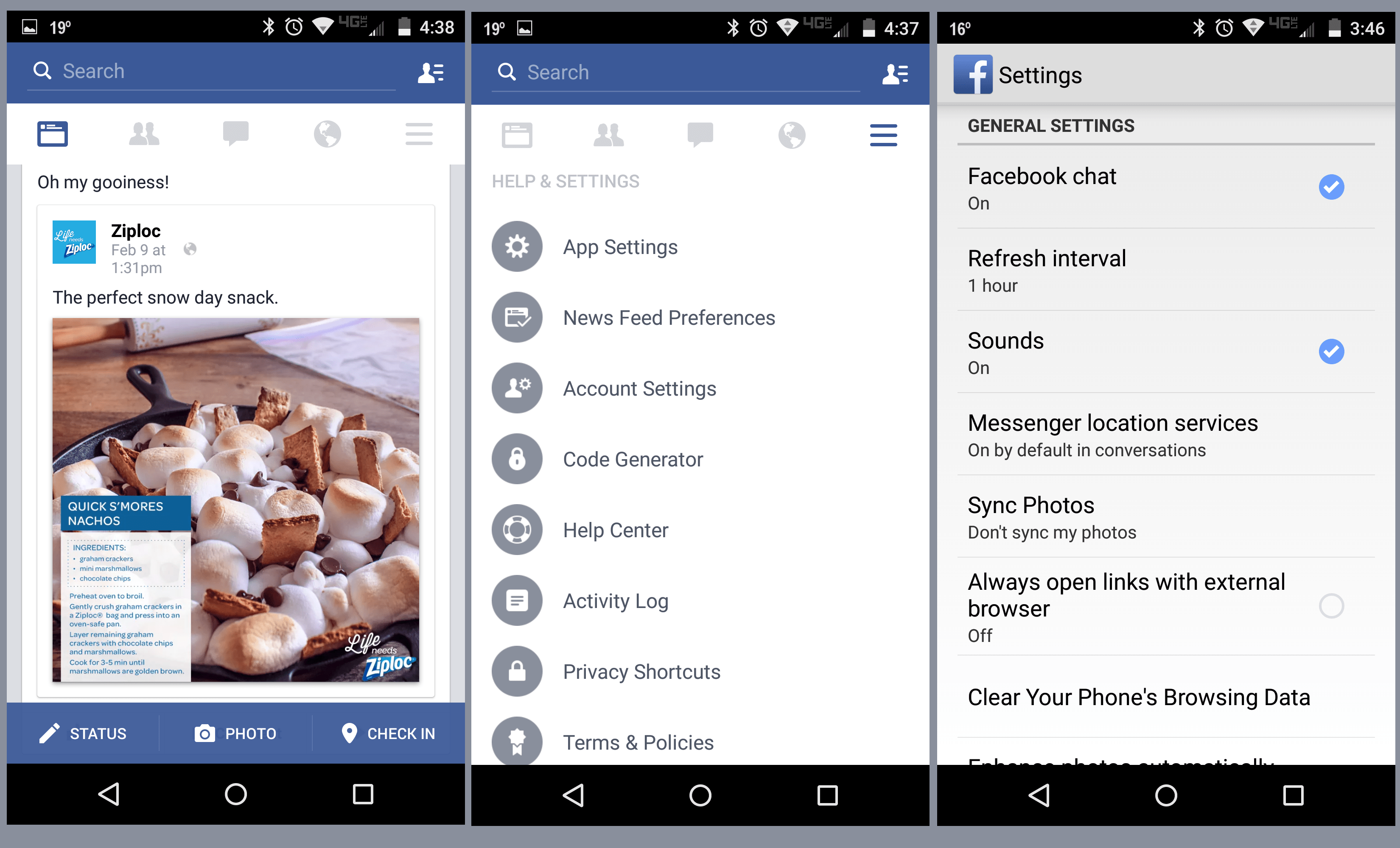
Here’s a quick step-by-step process of how to disable sounds in Facebook for your Android.
- Open the menu icon (top right, looks like three horizontal lines)
- Scroll to app settings
- Tap the button for Sounds
As you would expect, it’s the same process to turn these back on.
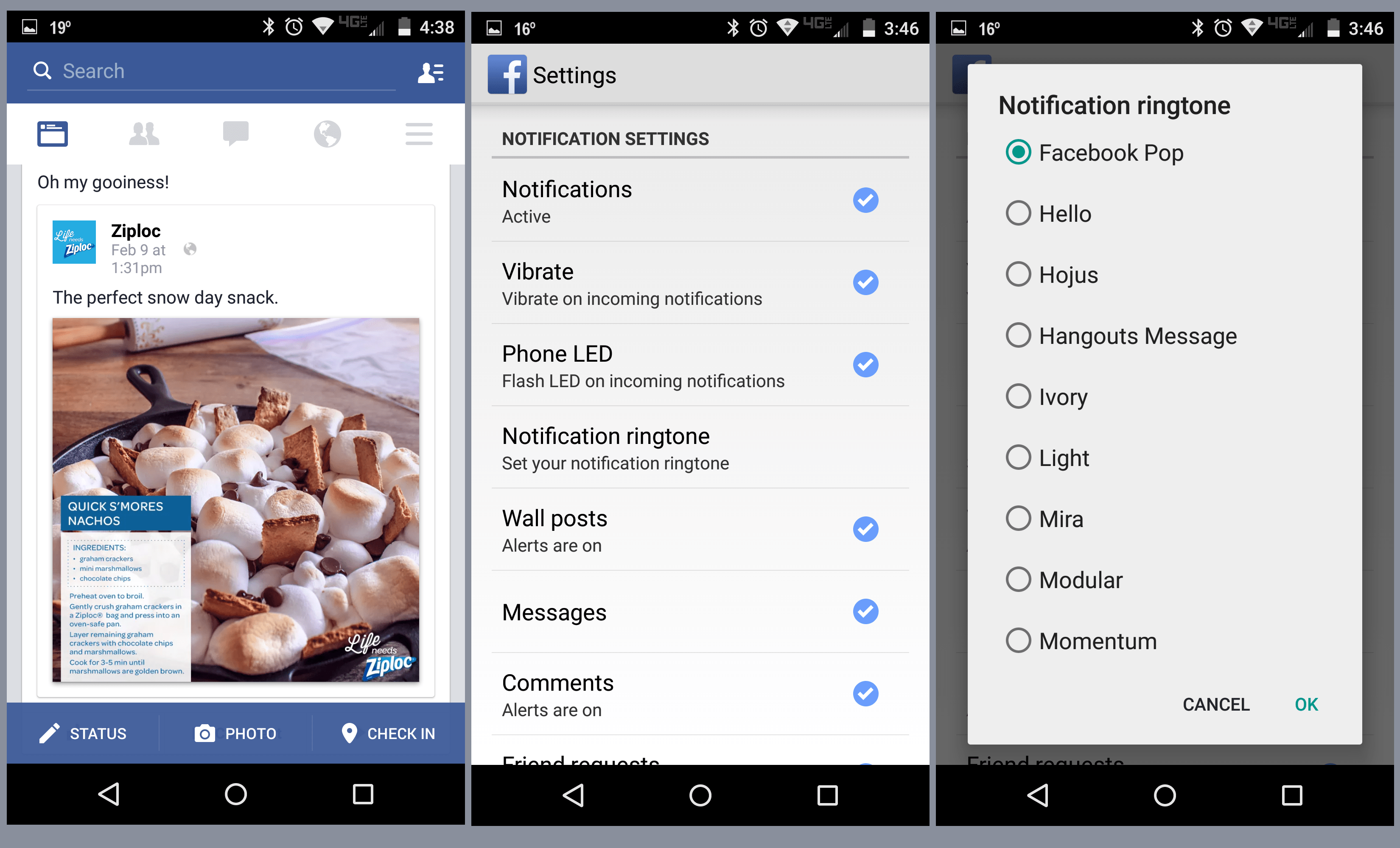
In the event you were simply looking to change the notification sound, you’re nearly there, too.
- Open the menu icon (top right, looks like three horizontal lines)
- Scroll to app settings
- Scroll to Notification ringtone
- Pick the one that you love most
(function() var script = document.createElement(‘script’);script.src = ‘https://stacksocial.com/widget.js?publisher=androidguys&type=editorial_post_widget_preferences’;script.async = true;var entry = document.getElementsByTagName(‘script’)[0];entry.parentNode.insertBefore(script, entry);)();
http://www.androidguys.com/pubgalaxy/728×90.html
The post How To: Disable or enable sounds in Facebook app for Android appeared first on AndroidGuys.

Daily Roundup: New buyer’s guide picks, betting with Cortana and more!

What’s happening in the tech world today? Check out our updated Engadget buyer’s guide to find the latest recommendations on laptops and tablets, then read about placing sports bets with Cortana and learn about Dell’s latest portables. All that and more can be found below.
Engadget’s new buyer’s guide picks: the Dell XPS 13, HP Stream 11 and more!

The Engadget buyer’s guide has been updated! What’s the best laptop that you can buy today? Which tablet do we recommend? Head over and check it out.
Cortana made me a better gambler, but I’m never listening to her again

A recent update to Microsoft’s Cortana allowed the virtual assistant to begin predicting outcomes of various sporting events. What would happen if you were to place bets on the outcomes of these sporting events using nothing but its recommendations?
Dell has a new Chromebook and a tablet that runs your choice of OS

Dell announced a bevy of new products geared toward the classroom and they include a new Chromebook, a Windows laptop and a tablet that runs either Android or Win 8.
Facebook lets you choose what happens to your profile after you die

Have you ever wondered what would happen to your Facebook profile after your pass away? According to The Wall Street Journal, a new group of options will let you pick a digital executor to run your page as a memorial, or elect to have your profile deleted once it’s proven that you’ve passed away.
Fitbit says users can avoid rashes by giving their skin a break

A new, err, rash of problems has cropped up with Fitbit’s latest wristbands. An ABC7 News San Francisco report says the publication discovered over 200 cases on social media of people complaining about getting rashes from wearing the company’s bands.
US carriers make it (somewhat) easier to unlock your phone

At long last, our national nightmare is over. Seven US networks (AT&T, Bluegrass Cellular, Cellcom, Sprint, T-Mobile, US Cellular and Verizon) are now honoring a voluntary code of conduct that, among other things, lets you get your phone unlocked after you’ve paid off your device or service contract.
Heads-up: Apple will pull Aperture once Photos arrives

Apple is warning customers that Aperture, its neglected professional photo-editing app, will be pulled from the Mac App Store this spring in order to make way for Photos. If you’ve already purchased it, you should still have the option of restoring your Aperture copy if you lose it.
Filed under: Misc

Facebook lets you choose what happens to your profile after you’ve died
You can’t take your Facebook friends with you to the afterlife, but at least you can now prevent your snarky comments about Drag Race serving as a poor memorial. The social network has announced that users will be able to designate a legacy contact that can maintain their accounts after they have died. According to the Wall Street Journal, a new group of options will let you pick a digital executor to run your page as a memorial, or elect to have your profile deleted once it’s proven that you’ve passed away.
Currently, if the site learns of your death, your page is frozen, and although no adverts are run, this can sometimes have unfortunate consequences. According to the paper, US users will begin to see the options appearing from today, with other nations coming on shortly afterward. Privacy-conscious users will also be reassured to learn that your nominated Facebook friend will be able to see your photos and public posts, but not your private messages. In addition, Facebook says that if a person hasn’t been nominated on the site, but was asked to do the same job in a will, then the site will respect the deceased’s wishes.
[Image Credit: Ambientideas/Getty]
Filed under: Internet, Facebook
Source: Wall Street Journal

UK makes ‘revenge porn’ illegal with punishment of up to two years in jail

Posting “revenge porn” in England and Wales is becoming a criminal offense. Thanks to an amendment to the Criminal Justice and Courts Bill, passed last year by the House of Lords and due to receive Royal Assent later today, anyone found guilty of distributing explicit images to force victims into sexual activity or to humiliate them will now face up to two years in prison. It’s designed to cover photos and videos that are shared without permission both on and offline, including those posted to Facebook, Twitter, Snapchat and other social networks.
The Bill classifies revenge porn as “photographs or films which show people engaged in sexual activity or depicted in a sexual way or with their genitals exposed, where what is shown would not usually be seen in public.” Before, victims needed to navigate complex copyright laws to get images removed, which many feared because it could often draw more attention to the media in question. In the US, officials are catching people who post or are hosting revenge porn, but they are forced to prosecute based on related offenses. UK prosecutors can now bring specific charges against malicious posters, ensuring they’re met with swift justice.
[Image credit: Maurizio Pesce, Flickr]
Filed under: Internet
Source: BBC News

Facebook helps online services warn each other about security threats

Malware frequently strikes multiple targets, but online services rarely do a great job of warning each other about related threats; your data could be at risk simply because your favorite social network didn’t get a heads-up in time. Facebook is clearly sick and tired of this problem, as it just launched a hub that designed to mount a coordinated defense. Its new ThreatExchange web platform lets services both look up existing threat info and share their discoveries with as many sites as they see fit. If Facebook reels under a botnet attack, it can let others know what to do to protect themselves.
There aren’t many early participants in ThreatExchange, but you’ll likely recognize them: Bit.ly, Dropbox, Pinterest, Twitter and Yahoo (including Tumblr) are all onboard. Facebook is also pushing for more partners, so it won’t be surprising if this alliance grows. The move might not stop rapidly-spreading viruses, and it certainly won’t render them invulnerable. However, it might just help your favorite online destination thwart a data breach that it wouldn’t otherwise catch in time.
[Image credit: AP Photo/Jeff Chiu]
Filed under: Internet, Facebook
Source: Facebook

Facebook’s privacy rules reach new levels of creepiness

Facebook can now gather data from all your activity on any website. In their newest privacy changes, Facebook will know everywhere you visit on the Internet so that they can make more money off personalized ads.
Rather than allowing Facebook users to decide whether they want to opt-in to this lack of privacy, Facebook is simply implementing these changes whenever an existing user signs into Facebook. That’s it.
As one site noted:
If you want to prevent Facebook from tracking your Internet usage altogether, then you’ll have to contact the Digital Advertising Alliance in the US, or its European and Canadian equivalent, which will prevent individual Facebook ad targeting altogether. You can also alter your settings with your mobile device to prevent Facebook tracking you via your smartphone. – CraveOnline
Even though Facebook has been questioned for years about their privacy moves, this latest move to track users who are visiting other websites seems quite extreme. Meanwhile, Facebook seems oblivious to this concern by continuing to act like customers actually care how detailed their ads are rather than simply being honest and stating that businesses are the ones who want more detailed targets.
“When we ask people about our ads, one of the top things they tell us is that they want to see ads that are more relevant to their interests.” – Facebook Statement

On top of this, if you opt-out of this privacy invasion, there are already questions about whether the opt-out will actually stop Facebook from tracking your every move.
Then there is the fact that Facebook’s facial recognition software is already being talked about by advertisers. The hope by advertisers is that can follow and profile you wherever there’s a camera. Considering Facebook already puts in rules stating that they can claim “any photo or media posted” to Facebook, it is clear that Facebook sees many dollar signs with this type of advertising.

Whatsapp gearing up to add voice calling feature

Some Whatsapp users can place voice calls from the app, a feature that has been anticipated for almost a year.
Now boasting more than 700 million users, the wildly popular messaging service owned by Facebook is expanding beyond simple texting. Whatsapp launched its first desktop web client two weeks ago, and voice calling could be the next step.
The feature was first spotted by Reddit user pradnesh07 who posted about it a thread that has since been deleted. The latest version of Whatsapp for Android is required, but the availability of the feature seems to be enabled on a per-user basis, and you will also need to receive a Whatsapp call in order to activate it. In other words, you will need to receive a call from someone who already has the feature in order to be able to do voice calls. Think of it as an invite system.
Over at XDA, folks found a way to activate the feature on rooted phones, but the caveat is you will still need to receive a call first. You can try your luck on the forums, but we don’t recommend posting your phone number in the open.
When the feature is enabled, Whatsapp features three tabs at the top for Calls, Chats, and Contacts. Using the calling feature looks to be very straightforward, as you can see from the screenshots at the top.
Handling voice calls for a 700 million user base requires tons of data center capacity, so Whatsapp will probably roll out this feature in waves. For now, the company has made no official announcement on the expected availability of Whatsapp voice calls.

5 Android apps you shouldn’t miss this week
<!–
By use of this code snippet, I agree to the Brightcove Publisher T and C
found at https://accounts.brightcove.com/en/terms-and-conditions/.
–>
<!–
This script tag will cause the Brightcove Players defined above it to be created as soon
as the line is read by the browser. If you wish to have the player instantiated only after
the rest of the HTML is processed and the page load is complete, remove the line.
–>
brightcove.createExperiences();
 Sponsor: ETheme Launcher
[Price: Free]
Our sponsor this week is ETheme Launcher. It is a launcher that boasts over 2000 themes, 200 fonts, a light feel, and more. It comes with a home screen set up to help you get to your apps quickly with additional home screens available if need be. It also comes with a lock screen and new themes every week. It’s free with no in app purchases if you want to check it out!


Welcome back the newly redesigned Google Play Weekly show, now called Android Apps Weekly! We hope you enjoy the new format. Here are your headlines for this week!
- Google finally addresses WebView security issues and their advice is pretty simple: It’s broken, don’t use it.
- Dish’s SlingTV web TV service is now available via invite with a public release slated in a couple of weeks.
- Law enforcement is asking Google to shut down Waze because it allows people to “stalk police”.
- The Marriott Android app has apparently left credit card info open to hackers for years. It’s now been fixed.
- Former Opera CEO has announced a new web browser called Vivaldi with a lot of features.
- Rolling Stone Magazine is publishing their entire archive to Google Play via the Newsstand app.
- Spotify is running a promo to give people 60 days of free Premium Service. They’re also now partnering with Sony to create PlayStation Music.
- With only a few days left, Humble Bundle 10 has added three new games to the Bundle. Act fast!
Here are some of the big Android app updates that took place this week!
- Google Search on mobile is getting an update to bring us gloriously gorgeous movie information.
- Plex updated with a new UI, casting your camera roll to a Plex client, and a new purchase model.
- Twitter now allows Direct Messages (DMs) with up to 20 people at once and has in-line clip sharing (think Vine).
- Snapchat releases a new feature called Discovery which is essentially a mashup of a news feed and Snapchat.
- Hotspot Shield VPN updated to bring three new protection modes for improved simplicity.
And here are the new Android apps releases this week!
 Microsoft Word, Excel, and PowerPoint for Tablets
[Price: Free]
Microsoft has released Word, Excel, and Powerpoint for Android tablets after a year of hearing us complain about not having it. The basic functionality of each app is free to use but to get the full experience, you’ll need an Office 365 subscription. So far, each app seems to work pretty well but do keep in mind that these are early releases and improvements are likely right around the corner.
You can pick up Microsoft Word by using the button below.
Download Microsoft Excel from Google Play here.
Download Microsoft PowerPoint from Google Play here.
 Facebook Lite
[Price: Free]
Facebook has released a new lite application that is intended for devices with spotty connectivity and lesser specs. The interface is very scaled down although it is noteworthy that the messaging is built back into the main app here. Otherwise, it’s a basic Facebook experience without too many frills. It’s only available in some countries and on some phones but you can get the APK for yourself by clicking here.

Wrap up
If we missed any great Android apps or games news, let us know in the comments!
 AIVAnet
