



Facebook is buying Oculus VR for $2 billion, plans to ‘unlock new worlds for all of us’

Mark Zuckerberg is following up his Whatsapp buy with another big acquisition: virtual reality company Oculus VR for $2 billion in stock and cash (curiously, news of the talks may have leaked on Reddit a month ago). In a post on Facebook, Zuckerberg talks at length about how Facebook plans to make Oculus a platform for “completely new kinds of experiences,” and gaming is only the first one. Examples he suggests include sitting courtside at a big game, studying in a classroom with other students virtually or getting a face to face doctor consultation from anywhere. The idea that virtual reality may be the next big thing gained more credibility last week when Sony showed off a prototype VR headset for developers, Project Morpheus. That also means Oculus is suddenly staring down a massive competitor — with others likely on the way — and now it has the resources of the social network to rely on.
The original Oculus Rift Kickstarter was less than two years ago — remember Project Holodeck? — and ever since founder Palmer Luckey has been publicly pushing it as technology for the masses. The Oculus team has its own statement, promising that “Facebook understands the potential for VR” and gives it the best shot to change the world. There will be a conference call to discuss the announcement in 15 minutes, and we should hear from those directly involved why the same site that hosts your coworker’s farming sim is the best possible home for the future of virtual reality. Previously, Zuckerberg had been vocally opposed to building hardware and with good reason, but by dropping $2 billion on a VR headset maker, it’s clear John Carmack isn’t the only one seeing the $350 Oculus Rift’s potential.
Update: We’re on the call now, and Mark Zuckerberg is already pointing out Facebook’s acquisition of Instagram as an example of how the company is getting experience buying properties and allowing them to continue to operate independently. Zuckerberg called out virtual reality as one of the computing platforms of the future — following desktops and mobile — and yes, talked about building Facebook’s advertising into it. Specifically, he talked about the potential of a virtual communication network, buying virtual goods, and down the line, advertising.
(function(d, s, id) var js, fjs = d.getElementsByTagName(s)[0]; if (d.getElementById(id)) return; js = d.createElement(s); js.id = id; js.src = “//connect.facebook.net/en_US/all.js#xfbml=1”; fjs.parentNode.insertBefore(js, fjs); (document, ‘script’, ‘facebook-jssdk’));
Filed under: Displays, Gaming, Home Entertainment, HD, Facebook
Source: Facebook, Oculus VR blog

Instagram is testing Facebook Places integration for location tagging

It looks like Zuckerberg and Co. may be looking to make a big push for Facebook Places, and an on-going trial indicates that it could start with Instagram. The folks in Menlo Park are testing the social networks’ own service for adding location info, but for now, Foursquare remains an option for sharing inside its popular filter-driven photo editor. In fact, some users have already encountered the tweak. Instagram has long used Foursquare’s API and venue data for attaching snapshots to a particular place, and there’s no guarantee that the trials will even make it to a new version of the app. Of course, in addition to Foursquare, users can beam photos to Twitter, Tumblr and Flickr in addition to the parent social network. We reached out for a comment on the matter and we recieved the following statement from an Instagram spokesperson:
Foursquare is a great partner, and people will continue to be able to share their check-ins to Foursquare from Instagram. We are constantly testing experiences throughout the app to provide the best possible user experience as part of future planning.
Filed under: Software, Mobile, Facebook
Source: Fast Company

Daily Roundup: 2013 Engadget Readers’ Choice Awards, NSA transparency reports and more!

You might say the day is never really done in consumer technology news. Your workday, however, hopefully draws to a close at some point. This is the Daily Roundup on Engadget, a quick peek back at the top headlines for the past 24 hours — all handpicked by the editors here at the site. Click on through the break, and enjoy.

The NSA may release its own transparency reports
Yesterday, NSA general counsel Rajesh De stated that companies like Apple or Google are fully aware of its data collection practices due to its “compulsory legal process.” Now, the agency may take that claim one step further by releasing its own transparency reports.

Twitter’s first tweet tool is a painful reminder that none of us initially ‘got’ this Twitter thing
Remember your first tweet? Probably not. But don’t worry, Twitter’s got your back. To celebrate its eighth birthday, the social giant whipped up a web tool that surfaces your original 140-character entry into the twittersphere. Scary, right?

The winners of the 2013 Engadget Awards — Readers’ Choice
Tech fans across the globe nominated and voted for their favorite gadgets, and now the results of our 2013 Readers’ Choice Awards are in! So, which laptop, smartwatch or offbeat product stood our from the rest? Read on to find out.

Ex-Microsoft employee arrested for leaking company secrets
Ex-Microsoft employee Alex Kibkalo was arrested yesterday for stealing and leaking company secrets regarding the release of Windows 8. Apparently, Kibkalo was out for revenge against Microsoft and emailed screenshots of the OS and bits of code from Microsoft’s Activation Server SDK to an unnamed French blogger. Microsoft has since claimed that it has the right to go through email accounts, but only under “exceptional circumstances.”
You also might like:

Facebook wants to help you write code faster with its ‘Hack’ programming language

Mark Zuckerberg and Facebook often try to assist and provide tools for coders, both current and future ones. With that in mind, the social network today announced Hack, an open-source language for programmers. This new language has been used internally at Facebook for the past year and offers a lot of potential for developers, enabling them to program faster and be able to catch errors more easily, among other things. Hack, which was developed for the HHVM platform, is designed to be extremely friendly with PHP; as Facebook puts it, its new programming language “offers the best of both dynamically typed and statistically typed languages, and that it will be valuable to projects of all sizes.” Essentially, this means you theoretically could have access to websites that are faster and more reliable. Interested in learning more? Head over to Facebook’s Engineering blog, where you’ll find all the nitty-gritty details you’re looking for.
Filed under: Internet, Facebook
Via: GigaOM
Source: Facebook

Facebook adds profile photos to experimental Android notification bar

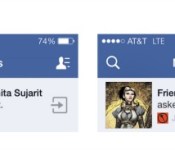
Facebook makes it a habit to test new features before release, and one of them is a permanent notification bar that popped up for some Android users last year. Now, that feature’s back, and it even comes with an upgrade: it shows your profile picture right next to Facebook’s familiar icons. Just like the first time around, the bar stays in Android’s notification tray whether or not you have a new message or friend request. The only difference this time is that your face will stare right back at you every time you access the tray. As is usually the case with Facebook’s experimental releases, only a small pool of users has access to the tool right now. If you happen to be one of them and hate having to look at yourself all the time, don’t worry: simply click the “i” icon to disable the bar via the Settings page.
Filed under: Cellphones, Tablets, Mobile, Facebook
Source: The Next Web
Facebook’s game notifications are getting more detailed, slightly less annoying

Everyone is friends with that one guy who can’t stop playing Facebook games — and who more importantly, can’t stop asking you to join him. Now a request from your BFF can tell you he’s in the market for an extra cow in FarmVille without forcing you to load up your own virtual farm up to see what he wants. At GDC Wednesday Facebook announced it’s giving developers the option to add a little more detail to notifications. So instead of a generic “request” you’ll know specifically what your buddy is hoping for. Facebook is responsible for an astounding 735 million referrals into games every day, and more than 375 million people play Facebook-connected games every month. Detailed notifications are a small change, but one that could make the Facebook gaming experience slightly less annoying for everyone.
Filed under: Gaming
Source: Facebook Developers

NSA claims that technology firms are aware of its data collection

If you ask technology leaders like Apple or Google, the NSA has been snooping on their customers without permission. However, the NSA has a very different story. Agency general counsel Rajesh De tells an oversight board that these companies are fully aware of and assisting data collection under the PRISM surveillance program, whether it targets servers or internet traffic. There’s a “compulsory legal process” for the firms involved, the attorney says. If accurate, the statement at least partly contradicts repeated claims from these companies that the NSA leaves them in the dark. With that said, it’s still possible for both sides to be right. Leaks from last June suggest that company staff handling these government requests are required to keep the details secret, even when speaking to coworkers — higher-ups won’t necessarily hear about cooperation with the intelligence community.
Filed under: Networking, Internet, Apple, Microsoft, Google, Facebook
Via: CNET
Source: The Guardian

10 years of social media’s biggest players and payouts by the numbers

Facebook launched ten years ago in February 2004. A month later, so did this site. Social media hasn’t, doesn’t and won’t stay still. As Myspace rises, Friendster declines. The pattern’s repeated itself a few times already, and even Google hasn’t quite cracked the magic social network formula, at least not yet. The crown currently belongs to Facebook, a company that’s made some big, big startup purchases on the way, although Twitter continues to pack (arguably) more influence. A whole lot has happened in the last decade, but we’ve tried to squeeze the more interesting parts into something a little more visual. Check out the full ‘graphic, right after the break.


Facebook’s face-recognition tech is almost as good at Stallone-spotting as you are

Facebook’s long been interested in facial recognition, as the photo tag-suggestion feature that didn’t go down too well in Europe shows. The Zuck’s social network also gobbled up a face-recognition outfit in 2012, but it’s Facebook’s AI research team that’s made headway recently with technology that’s almost as good as us meatsacks at identifying mugs. Known as DeepFace, the system uses a “nine-layer deep neural network” that’s been taught to pick up on patterns by looking at over 4 million photos of more than 4,000 people. We’re not as up-to-date with complex machine learning techniques as we should be, either, but the main reason DeepFace is so accurate is its method of “frontalization” — or, creating a front-facing portrait from a more dynamic source image.
Like in the Sly storyboard above, the tech maps facial features, combines them with a generic 3D mask, and spits out a model that can be orientated so the subject is now perfectly posed. By doing this, it can simply compare the output with other images generated in the same way, thus silencing troublesome differences in lighting, expression, face position and the like as best it can. And, it does an extremely good job, with 97.25 percent recognition accuracy in a standardized test that humans score just over 97.5 percent in. DeepFace is just an academic endeavor currently, but it would seem like a wasted effort if Facebook didn’t make use of all this work in the future — because we’re all looking forward to being auto-tagged in the background of poorly lit pictures with our best nightclub-faces on, aren’t we?
Filed under: Internet, Facebook
Via: The Verge, MIT Technology Review
Source: Facebook
Facebook Messenger beta lets Android users test new features
Following Facebook‘s introduction of the Beta program for their Android application last year, the company have just announced the Facebook Messenger for Android Beta program which will give users who opt-in the latest versions of the messenger app before general release.
As with the main Facebook application, our goals with this program are to expand our pool of testers and gain feedback across a more diverse set of devices. Simply by using the app and reporting issues, beta testers will be able to help us improve performance and the overall experience on a wide variety of Android devices at scale.
Anyone is able to join the Beta program for Facebook Messenger, but be aware that since the purpose of the app is for testing, Facebook will be closely monitoring user activity. The monitoring will be looking for bugs and how people use the app and the new features, but to do so it means providing increased awareness of your activity within the app, which for something as social and personal as Facebook Messenger may not be entirely desirable.
The beta program will provide us with an early warning system that will help make everyone’s experience with the app better, once we push it more broadly. Also, since Messenger is all about private sharing and small groups communication, the beta program will give us another channel to understand what kinds of sharing tools resonate with people using Messenger.
If you’re not yet put off by Facebook watching your every move, then it’s simple to sign up for the Beta program.
1) Join the Facebook Messenger for Android Beta Testers Google group:
https://groups.google.com/forum/#!forum/messenger-for-android-beta-testers
2) Allow beta downloads by clicking “Become a Tester” in the Play Store (you need to join the Google Group before becoming a tester)
3) Download Facebook Messenger from the Play Store to update your app
4) Turn on automatic updates, as the beta version of Facebook Messenger for Android will be updated multiple times per week
As ever, remember it’s Beta software so is bound to be riddled with bugs and unexpected occurrences, but with the latest Facebook Messenger features at our fingertips who cares, right?
The post Facebook Messenger beta lets Android users test new features appeared first on AndroidGuys.
 AIVAnet