



Facebook pokes the EU to help push through its WhatsApp purchase

Facebook’s $19 billion acquisition of WhatsApp is a done deal in the US, but in Europe, it still has a few more hoops to jump through. In a bid to move things along, the Wall Street Journal reports that the social networking giant is taking the unusual step of actively seeking an investigation into the deal by the European Commission. As it stands, the company will be probed by regulators across Europe, but if the Commission gets involved, Facebook would no longer need to gain approval from each European member state. That could possibly push the deal through a little bit faster. Facebook’s decision to go direct likely stems from opposition it currently faces from European carriers, which are worried that the social network would dominate the text and photo messaging market (read: kill SMS revenues). For the Commission to get involved, Facebook needs proof that it’s already under review in at least three EU countries. It isn’t clear if that’s the case, but if it is, a Facebook-owned WhatsApp would likely become a reality a lot sooner than is currently expected.
Filed under: Internet, Software, Facebook
Source: The Wall Street Journal

After drones, Google and Facebook eye satellites to expand internet access

Google and Facebook already compete on PCs, mobile devices and recently their rivalry has moved to the skies, but a new report from The Information suggests it could move even further from land. Over the last year or so, both looked at drone maker Titan Aerospace before Google acquired it, adding to a portfolio that includes its Project Loon experiments. Not to be outdone, Facebook is said to have acquired a drone maker from the UK called Ascenta. The only thing left? Space. The Information follows up on claims that Google is looking at a satellite company called Skybox Imaging by noting recent hires and investments in companies that deal with satellite-delivered internet. Craig Barratt is named as leading several teams at Google developing wireless internet technology to connect the rest of the world (white spaces, municipal WiFi, community routers for businesses etc.) while Google X teams work on the drones and balloons. Facebook’s interests in (the) space are not as well-documented, but we can only guess that the race will reach low-orbit soon, and collect a few more startups and giants as competitors. Maybe DirecTV made its deal with AT&T too soon?
Filed under: Wireless, Google, Facebook
Source: The Information

Facebook will no longer share all of your activity by default

Facebook revoked Instagram’s auto-posting credentials recently, and it looks like the social network is going a lot further than it’s own properties. After noticing that links and other activity shared by knowingly tapping the blue “F” button garner more interest, Zuckerberg & Co. are scaling back the amount of automatically-posted content that shows up in the News Feed. Facebook will give preference to those items in its regularly updated rundown, which means less stuff from third-party apps will pop up in the days to come. However, as The Verge reports, those auto-posts will still populate areas of your profile dedicated to them — such as track-by-track Spotify activity and the like — and will still be used for targeted ads. The move follows last month’s announcement that the folks in Menlo Park were cracking down on spam in its News Feed, but we’d surmise sponsored posts are staying put.
Filed under: Internet, Facebook
Via: The Verge
Source: Facebook

Iranian court summons Mark Zuckerberg to answer privacy concerns

We’ve got a feeling that Mark Zuckerberg will, regretfully, be unable to accept this particular foreign invitation — especially after all the recent name-calling that’s been coming out of Iran. Nevertheless, a court in the south of that country has reportedly ordered the Facebook CEO to attend a hearing to answer complaints over privacy, specifically regarding Instagram and WhatsApp. There have been calls for both services to be blocked in Tehran, but they’re still operational for now, perhaps partly due to a degree of protection from more moderate forces within the country. The precise details of the court summons are hard to be sure of, because news of it comes not from the court itself, but from an official within the Basij militia — a voluntary paramilitary force that is regularly called upon to protect Iran’s theocracy from dissent. And frankly, that’s exactly the sort of geo-political context that might further dissuade Zuckerberg’s PA from scheduling an appointment.
Filed under: Internet
Source: Sky News

Instagram is the latest social network to hit Iran’s blacklist

Iran’s top officials may use social media, but the country’s general populace isn’t allowed to join them. The nation has already banned Facebook, Twitter and WhatsApp, and yesterday it reportedly added Instagram to the naughty list. According to the AP, a private lawsuit was brought against Iran’s Ministry of Communications, forcing the bureau to restrict access to the Zuckerberg-owned photo-sharing service. There’s no evidence that such filtering is in place right now, and users in Tehran were still able to take some selfies on Friday lunchtime. Still, given that social media is a threat to the country’s conservative establishment, we imagine that someone will keep bringing lawsuits until no-one can utter the phrase “lemme take a selfie.”
Filed under: Cellphones, Internet, Mobile, Facebook
Via: Reviewed
Source: ABC News
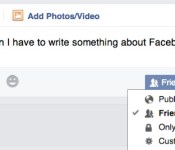
Facebook stops oversharing, defaults status updates to just friends

Previously, when you first joined Facebook, all of your posts would be shared with the world by default. Anyone who stumbled upon your profile could read anything you previously shared, be it a short update or a personal photo, unless you deliberately clicked away from “Public.” Now, the social site’s switched things up for the better, making “Friends” the new default for status updates. You don’t have to do anything to take advantage, but now’s as good a time as any to pay very close attention to your Facebook privacy settings. And maybe be a bit more selective when it comes time to add a new friend.
Filed under: Internet, Facebook
Source: Facebook

Engadget Daily: Ads on your thermostat, eBay’s password breach and more!

You might say the day is never really done in consumer technology news. Your workday, however, hopefully draws to a close at some point. This is the Daily Roundup on Engadget, a quick peek back at the top headlines for the past 24 hours – all handpicked by the editors here at the site. Click on through the break, and enjoy.

Google ads could be coming to thermostats, refrigerators and car dashboards
A Google filing with the SEC hinted that it’s considered displaying ads on a variety of devices that include “refrigerators, car dashboards, thermostats, glasses, and watches.” The company has since commented on the issue, saying that, “Nest, which we acquired after this filing was made, does not have an ads-based model and has never had any such plans.”

eBay asks all users to change their passwords following cyberattack
eBay looks like it’s the latest company to suffer a security breach after it alerted users that an attack had “compromised a database containing encrypted passwords and other non-financial data.” Change those passwords, stat!

Oculus VR and Palmer Luckey being sued by CTO’s former employer
Zenimax Media, owner of id Software, is suing Oculus VR co-founder Palmer Luckey, alleging that Luckey and Oculus VR stole and misappropriated trade secrets related to virtual reality technology. Oculus VR responded and said this lawsuit has no merit.

Old console, new tricks: Getting the most out of your Xbox 360
If you’re still holding on to your Xbox 360 but feel like it’s getting a bit long in the tooth, don’t fear! Engadget’s own Richard Lawler has a few tips that will ensure you’re getting the most out of your favorite game console.
You also might like:

Facebook app will soon identify songs and TV shows just by listening to them

If you’ve ever wanted to tell your Facebook friends what you’re listening to — say, REM’s “It’s The End of The World And We Know it (And I Feel Fine)” — without having to spell the whole thing out, well, now you can. Facebook has just announced a new option in its mobile app that can detect the song, TV show or movie that’s playing in the background just by using the phone’s microphone. Once it names that tune (or show), you can simply insert that info into your post with just a few taps — no typing required.
Songs will appear as 30-second previews linked to Rdio, Spotify or Deezer depending on your preference (if you don’t have a preferred service, Facebook will select one at random), while TV shows will indicate not just the name of the program but also metadata like the season number and episode title. Once you choose to turn the feature on — and yes, it’s opt-in — the microphone will kick in whenever you’re in a compose window. You’ll know it’s working when you see a blue audio bar animation either in the top right corner or over the smiley icon at the bottom.
Having the app listen in to your environment sounds like a rather creepy proposition, but Facebook assures us that the app is only scanning for song and TV info and no sound is ever recorded or stored on its servers. You’ll also always have full control over your posts and can decide not to share what it detects. In other words, you don’t have to reveal that you were just watching My Little Pony if you don’t want to.

Aryeh Selekman, a product manager at Facebook, tells us that the audio recognition feature was born out of the “feelings and activities” selector tool that the company rolled out last year. “We’ve seen over 5 billion feelings and activities posted just in the past year,” he said. “We just wanted to make it faster and easier to do.”
The team at Facebook spent a little over a year dedicated to the project, eventually coming up with a unique audio recognition algorithm built entirely in-house and from scratch. A Facebook spokesperson tells us a lot of that time was spent establishing partnerships with content providers, resulting in millions of songs in its catalog and the ability to recognize programming from 160 TV stations.
When asked how the technology worked, Selekman said that it functions at a millisecond level. “As audio comes into the device, it immediately gets converted into these unique codes that we can use to identify properties that’s specific to the content […] It then looks up the code in the database and finds a match.” The technique appears slightly different from Shazam, another popular audio recognition service. “For every Shazam, the application analyzes the audio and generates a tiny unique fingerprint based on the audio characteristics found within the sample,” said Charles Henrich, Shazam’s Executive Vice President of Engineering. “It then uses this fingerprint to search against our database of tens of millions of audio tracks until it finds a match.”

I had a chance to preview the new song and TV show identification feature a few days ago, and I was overall quite impressed by its speed and accuracy — bearing in mind that I was testing it in a quiet conference room, which is very much an ideal setting. Identifying songs took mere seconds and naming TV shows didn’t take much longer. Indeed, the app only needed the first ten or so seconds of a Game of Thrones clip before nailing down that it was from the sixth episode of the fourth season. The audio recognition even works for live TV — it figured out we were watching CNN within a few seconds. Though we didn’t have a chance to test it, Facebook tells us it’s able to recognize live sporting events as well.
“This lets you add a soundtrack to your posts,” said Selekman, stating that you can use it to bundle photos with songs you heard at an event, like during a wedding or a concert. TV show recognition can also help foster conversation about a certain episode, and maybe help you avoid spoilers. Of course, we had to ask if Facebook’s thinking of using the feature for targeted ads, and the company told us that while that’s certainly a possibility down the road, it probably won’t happen just yet as it continues to test the service. Facebook plans to roll out the update to Android and iOS over the coming weeks, so keep a look out for it. In the meantime, check out a brief preview of it below.
Filed under: Facebook
Source: Facebook

Virtual reality’s biggest enemy is bad virtual reality, says Oculus founder

Palmer Luckey can hardly take a step without being stopped for pictures, questions or just friendly handshakes. I’m not surprised; we’re at the Silicon Valley Virtual Reality Expo, and Luckey just closed a speculative panel on the future of VR. Here, he’s a celebrity, and with good reason — the Expo floor is littered with Oculus headgear, almost without competition. As we make our way to a more quiet area, Luckey tells me that his hardware isn’t enough. “What we have that’s impressing all these hardcore gamers and technology enthusiasts isn’t good enough to be a consumer product.”
“People don’t have experience with this technology,” he explains further. “When it arrives, it has to be good.” Nothing’s a sure thing, Luckey tells us, and a poor consumer launch could spoil the milk. “I think really bad VR is the only thing that can kill off VR. That’s why we’ve been so careful to say that ‘these are devkits, do not buy, do not buy!’” Luckey quickly corrects himself, saying that he doesn’t think that the Oculus DK2 couldn’t be a consumer product; he just wants VR to hit the consumer space with its best foot forward. It’s part of the reason Oculus decided to join Facebook.

“It lets us make the first version really, really good, and use a lot of custom components that wouldn’t have been possible otherwise.” Without Facebook, he continued, Oculus might have been forced to release more expensive iterative headsets to fund the envisioned consumer model. “Maybe it doesn’t sell and we actually hurt the VR market overall because it wasn’t good enough.” Luckey is relieved its a scenario he didn’t have to live. “This [Facebook] lets us have as good of a shot as we’re ever going to have at making consumers believe in virtual reality.”
Staving off the danger of “bad VR” also makes Luckey reluctant to push for virtual reality hardware standards — it might stifle innovation. “If you talk to people who are actually doing things that are very novel and different from what we’re doing, most of them are not very pro-standard,” he explains. “The standard is going to end up being defined by whoever sells the most headsets, and it would not be a good thing for them if the standard is games that don’t include motion control, or games that require a very high field of view or that absolutely require position tracking.” It wouldn’t help Oculus much either. “If we were to lock into a standard now, what happens when we want to make big changes that vastly improve the performance of our device and requires a complete retooling of the SDK?” The hardware isn’t good enough to set a standard, he says, just like it isn’t good enough for consumers yet. Still, he admits that it’s good time to start thinking about what those standards might be. Eventually, the industry is going to need them.

In the meantime, Luckey is thinking about the Rift’s retail launch — if consumers are going to believe in VR, they need to have good experiences. That means games. “The biggest public challenge is going to be software. We’ve been talking a lot about how the Facebook deal gives confidence to content makers of all kinds, but people shouldn’t take that to mean there’s going to be this slam dunk of AAA content that’s going to be available at launch. It doesn’t mean that. Content takes a long time.” While Luckey says he expects a healthy pipeline of innovative software, he admits that making good games in VR is difficult. The platform’s first big hit might not be there at launch.
Before SVVR ended, I caught up with Sony’s Richard Marks — the man behind Project Morpheus. He too had his concerns about bad software hurting VR adoption. “There’s no AAA title yet,” he said “Most of the world asks ‘when will Call of Duty be on VR,’ but that’s not the right answer.” Hopefully, the VR community will figure out what is the right answer soon.

Facebook rumored to introduce Snapchat competitor, Slingshot

According to a recent report from Financial TImes, Facebook has been building its own Snapchat like video messenger. The app otherwise known as “Slingshot”, would do just like Snapchat, by allowing users to send short video messages.
Last year, Facebook tried to acquire Snapchat for $3 billion and that deal fell through leaving Facebook to build its own version. The app hasn’t been released in beta to the public, Facebook is currently testing Slingshot within the company.
Who knows if Facebook will ever release it or if the world needs another Snapchat like app. However, if there was some way that Facebook could integrate its new Slingshot app within your Facebook app, that would be interesting.
Source: FT
The post Facebook rumored to introduce Snapchat competitor, Slingshot appeared first on AndroidGuys.
 AIVAnet