



Google kills Orkut to focus on YouTube, Blogger and Google+

Google’s long suggested that Orkut, its other social network, was living on borrowed time, but today it’s finally confirmed that the end is coming. The search giant said today that it’ll shut down the service on September 30th in order to shift its focus to bigger projects like YouTube, Blogger and Google+. Although users in the US never really took to it, Orkut remained popular in Brazil and India for the better part of a decade (it’s been maintained by Google Brazil since 2008). However, with Facebook and Google+ continuing to enjoy global growth, Google’s decided the time is right to pull the plug on the service that was originally built as a “20 percent” project. While the company is now blocking new signups, current users can continue to contribute to the site until October. Once the deadline passes, they’ll be able to export their profile data, community posts and photos using Google’s Takeout tool for up to a year after it closes its doors.
[Image credit: coletivomambembe, Flickr]
Source: Orkut Blog

Facebook explains why it briefly toyed with users’ emotions

Ever since word got out that Facebook had briefly manipulated some users’ News Feeds to see how their feelings changed, a number of questions have popped up: just why did the company feel compelled to experiment in the first place? How noticeable was it? And was it worth the effort? As of today, we have some answers to those riddles. Study co-author Adam Kramer explains that Facebook was worried people would stop visiting the social network if they saw too many emotional updates — a lot of negative posts could scare some people off, while a surge of positive vibes would leave others feeling left out. That’s not what happened, however, and Kramer stresses that the company “never [meant] to upset anyone.”
He also suggests that Facebook won’t repeat history any time soon. The results of the circa-2012 field test may not have justified the “anxiety” that followed two years later, he says. Also, Facebook has been refining its “internal review practices” ever since, and it’s taking the public’s current response into account. Kramer doesn’t say whether or not similar experiments will take place again, but it’s clear that the company will be treading more carefully if it does. As it stands, there was only just enough of a change to suggest that the altered News Feeds had an effect.
While those are reassuring tidbits, they aren’t going to satisfy everyone. There are calls for Facebook to meet scientific ethics standards when conducting research like this; critics argue that it should at least tell users they were part of an experiment, and ideally offer a chance to opt out ahead of time. Facebook assumed that it had permission because of a basic “research” clause in its Data Use Policy, but that’s supposed to be used for product improvement, not academic papers. While the project did little if any harm, there’s a worry that this lack of explicit consent could cause some real psychological damage should future tests get any more aggressive.
[Image credit: AP Photo/Jeff Chiu]
Filed under: Science, Internet, Facebook
Source: Adam Kramer (Facebook)

Facebook experiment proves that social networks can alter your mood

Before you begin stalking a frenemy’s tragic life on Facebook to feel a sense of schadenfraude, know this: that depression could rub off on you. At least that’s the conclusion Facebook’s researches came up with when they turned 689,000 users into guinea pigs for seven days, gaming what they could see on their News Feeds to see if it influences their moods. According to a paper recently published in PNAS, the social network used software to identify positive and negative words in status updates and to segregate posts into the two categories. Facebook then massaged the subjects’ News Feeds to show mostly positive or negative posts. In the end, the company’s researchers proved that emotions can be contagious even without direct contact on social networks, and even if you’re only reading words on a screen.
By the end of the experiment, those who’d been subjected to positive status updates posted happy ones of their own, and vice versa. Those mostly exposed to posts that were neither positive nor negative in nature, though, were also less emotional (on the social network, anyway) in the following days. If you’re wondering, this experiment took place way back in January 2012 — and yes, it’s perfectly legal, even if it sounds like a huge invasion of privacy. Facebook claims it used machines for the whole process, and none of the researchers actually saw people’s posts themselves. Also, you apparently all agreed to be the social network’s lab rat the moment you accepted the website’s terms of service.
Filed under: Internet, Facebook
Via: AVClub, Animal New York, New Scientist

Facebook now lets UK users choose from over 70 gender options

Four months after it did so in the US, Facebook is now letting UK users choose new gender options. After working with two UK organisations, Press For Change and Gendered Intelligence, the social network added over 70 new terms, allowing you to select one of the new custom genders or add your own. Users can also choose a preferred pronoun: male (he/his), female (she/her) or neutral (they/their), which is reflected in birthday notifications and suchlike. As with all profile information, Facebook lets you hide anything you’re not comfortable with sharing and says it will not disclose gender selections to advertisers. To update your profile, click the ‘About’ tab, then hit “Edit” next to the “Gender” option in the “Contact and Basic Information” section.

[Image credit: Facebook]
Filed under: Internet, Facebook
Source: The Independent

Damon and Affleck revive ‘Project Greenlight’ filmmaker search on HBO

We’re going to bet that everyone has probably daydreamed of making a movie at least once in their life. To help those Scorsese flights of fancy come true, Matt Damon and Ben Affleck are back in the saddle of HBO’s Project Greenlight, the reality series that follows a film project from start to finish. Compared to the show’s initial run (in the early 2000s, before options like Red Digital Cinema or YouTube were popular), though, this will be a bit different. The duo (along with a cadre of production talent) is only looking for directors for this season — scribes need not apply — and wannabe Finchers must submit their three-minute-or-less clip via the show’s Facebook page. Should your sample get accepted, you’ll have to endure the typical day-to-day of a director: dealing with prima donna actors and heat from the studio, staying on schedule and hopefully not deviating from the budget. Sound like the gig for you? Then get cracking: the submission window runs from July 24th to August 8th this year.
Filed under: Home Entertainment, HD
Source: Project Greenlight (1), (2)
The new Facebook Slingshot app has dropped its U.S. exclusivity, today launching Internationally
If you were disappointed that the Facebook Slingshot app that was announced last week was only going to be available in the U.S., you will be happy to know that Facebook has lifted the exclusivity of the app and has made it available internationally. What brought about the change of heart? As people behind Slingshot say: […]
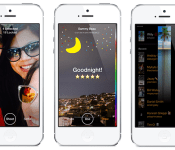
Facebook’s Snapchat rival Slingshot now available worldwide

Facebook launched its not-so-subtle Snapchat competitor Slingshot last week, but only for a US audience. That period of exclusivity has turned out to be quite short-lived, however, as today the new way to socially network is available worldwide. So, to give it a go, all you need is an iOS or Android device, and some friends to “sling” stuff at.
Filed under: Cellphones, Software, Mobile, Facebook
Via: Engadget Spanish
Source: Slingshot

Three NYC filmmakers are creating a ‘TV series’ exclusively for Instagram

Maybe cord-cutting has gone too far: three New York City filmmakers are publishing their new series exclusively on Instagram. On July 1st, seven 15 second episodes of “Artistically Challenged” will appear on the trio’s Instagram account, with 25 additional updates landing every day after July 7th. After 32 episodes (and 8 minutes of footage) the story will be over — but it’s not the only narrative Instagram video has to tell. Earlier this year Adult Swim split an episode of Rick and Morty into 109 bite size chunks and says its building an entire “micro-network” for smartphone audiences.
Artistically Challenged may be making its public debut on Instagram, but it wasn’t shot on a smartphone. Early production stills show the project’s crew working with DSLRs and proper lighting rigs. The series is being shot professionally — with a crew of more than 25 NYU alumni and students — but is being formatted for the small screen in post-production. It’s certainly a novel idea, but this probably isn’t the future of cinema. Even so, you can catch the series on July 1st right here.
Filed under: Cellphones, HD, Facebook
Source: Instagram, ACtheSeries

Facebook’s company trip to Africa leads to more efficient Android app

Facebook recently rolled out an update for Android devices that’s supposed to speed things up for users. If that update delivered on its promise, then you’ve got the company’s trip to Africa to thank — that’s how Facebook’s engineers got a taste of how slow the app can be on low-end phones with developing nations’ internet speeds. One of the social network’s engineers, Alex Sourov, detailed in a blog post how they bought several low-end Android phones in Africa to test out their app, which didn’t only crash repeatedly, but also loaded really slowly. Even worse, they ended up consuming a month’s worth of data plan within 40 just minutes trying to use the app. It became apparent that they needed to give their Android app an overhaul if the social network wants to reach even more people around the globe — so they did.
In order for Facebook to load faster on single-core devices, the engineers tweaked the app so its features don’t load all at once when you launch it, and cached News Feed entries load up much earlier. Then, they decided to move away from JPEG and PNGs and transmit Facebook images using Google’s WebP format, which consumes a lot less data. The app now also only loads images in resolutions and sizes that match the device’s screen size — it doesn’t automatically download a full-size high-res pic, for instance, unless you specifically click on it. Finally, Facebook has reduced its app size by 65 percent in hopes that it’ll play better with phones and tablets with small RAM sizes and limited storage capacities.
[Image credit: Marco Paköeningrat/Flickr]
Filed under: Misc, Mobile, Facebook
Source: Facebook

4SRS: the FBI built a list of Twitter slang to keep up with the kids

Forget passwords: the FBI wants to crack your internet slang. Thanks to a FOI (freedom of information) request published over at Muckrock, we now know that the Bureau is TCOB (taking care of business) when monitoring the nation’s social media use. Bypassing UrbanDictionary or the odd Wikipedia definition, the FBI compiled its own 83-page list of over 2,800 acronyms that range from the well-known, like LMAO, TMI, YOLO and SMH, to the outright ridiculous, including EOTWAWKI (end of the world as we know it) and IITYWTMWYBMAD (if I tell you what this means will you buy me a drink?) The agency says the list will help agents “keep up with your children and/or grandchildren,” and also invites them to add their own. Perhaps that’s why AMOG (alpha male of group) and DTP (disturbing the peace) have made it in, but we secretly hope it was an Engadget reader who added KIRF (keeping it real fake).
[Image credit: neolao, Flickr]
Filed under: Internet
Via: Vice
Source: Muckrock
 AIVAnet