


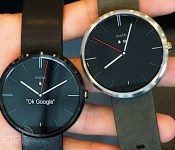
Facebook Messenger sorts notifications and voice replies with Android Wear

Thanks to a recent update, Facebook Messenger is the latest mobile app to play nice with Google’s wrist initiative. Outfitting Android Wear smartwatches with notifications and the ability to respond with voice notes, Android Central reports alerts pop up on the wearable’s screen where you can swipe to respond or tap to “like.” The latest version of the app also allows you to give messages the ol’ thumbs up and mute conversations right from your phone or tablet’s notifications menu — assuming you’re still doing your chatting the old fashioned way.
Filed under: Wearables, Software, Mobile, Facebook
Via: Android Central
Source: Facebook Messenger (Google Play)
.CPlase_panel display:none;

UK regulator proposes crackdown on misleading Facebook and Twitter ads

While Twitter and Facebook are enjoying returns from their native advertising platforms, it’s still not easy to tell if a tweet or status update is actually a company trying to sell you something. It’s a practice that the UK’s Financial Conduct Authority (FCA) has become increasingly aware of, so it’s begun consulting opinion on whether it should enforce stricter rules on promotional messages shared by financial firms. Blogs, social networks and photo and video services are all in the FCA’s crosshairs, as it looks to crack down on companies that rely on misleading messages like “Join us now and we promise you’ll make a 758% profit on your first stock investment” to sign up new users.
As expected, some of them have already kicked up a fuss, arguing that character limits make it hard to warn users about adverts. However, the FCA cites accepted methods, like the use of #ad or embedding additional information inside an image, to show how easy it is for them to comply. Interested parties will have until November to show their support (or voice their concerns), with final rules set to be put into force by the end of next year — great news if you’re tired being spammed with offers that always seem too good to be true.

Filed under: Internet
Source: FCA
.CPlase_panel display:none;

Brits will send 300 billion IMs in 2014, and it’s all down to sexting

The traditional lull in news during the summer seasons means that throughout August, companies pump out swathes of research that would otherwise get ignored or drowned out. Coincidentally, Deloitte is claiming that the UK population is likely to send around 300 billion electronic instant messages this year, up from 160 billion in 2013. What’s the cause of this sudden near-doubling of iMessage, WhatsApp and Facebook Messenger chat? Sexting. At least that’s what Paul Lee, Deloitte’s media and telecoms chief, believes, saying that teenagers sending winky emoticons and Snapchatting pictures of their genitals pets is the biggest contributor to the rise. According to the firm, the average person sends just seven texts, but nearly 50 IMs in a single day, and that if the trend continues, 2014 will be the first year that text messaging numbers fall compared to its free rivals. Just think, it’ll be September soon, so we can all go back to reading about actual developments in the world of technology.
Filed under: Cellphones, Internet
Source: The Guardian
.CPlase_panel display:none;

Facebook’s Slingshot now keeps the convo going with reactions to reactions

It’s been a little over a month since Facebook unleashed Slingshot, its stab at an ephemeral competitor to Snapchat, so it seems about the right time for it to get its first update. Slingshot, if you’ll recall, is a unique messaging app that requires you to reciprocate before you get to see what your friends have sent you. Once you see that photo or video, you have the option of sending a reaction shot, which takes up half the screen and is already unlocked so you don’t need to send a reply to view it. With the latest update, you can now react to those reaction shots — as seen in the third screen shot above — again, without any unlocking necessary.
Other updates to Slingshot include the introduction of My People, which is essentially a section of folks you’re regularly slinging shots with. It’s also now easier to find Slingshot buddies on Facebook and your phone’s contacts. So if you weren’t intrigued enough to try out Slingshot before, perhaps this new update will be enough to convince you to start slinging. You can download the latest version on both iOS and Android starting today.
Filed under: Facebook
Source: Slingshot, App Store, Google Play
.CPlase_panel display:none;

Facebook’s Internet.org app offers free web access in Zambia

We’ve heard quite a bit about Mr. Zuckerberg’s plans to bring low-cost internet access to the otherwise disconnected, and today, his social network announced plans to do just that in Zambia. The new Internet.org app allows users to browse weather, health and employment info at no cost. And that’s not all Google Search, Facebook, Messenger and Wikipedia are available as well. Right now, the option is available to Airtel subscribers in the country, but it will roll out to other parts of the world in the future. Cellular service blankets much of the globe, however the cost of the mobile web deters many from opting in. This will certainly help.
Filed under: Internet, Software, Mobile, Facebook
Source: Facebook
.CPlase_panel display:none;

The perks of being ‘somebody’ online

The web was supposed to be the great equalizer. But, it turns out, the haves and have-nots exist online too. And they’re separated by a mark of distinction: verification.
A month ago, William Shatner got into an unfortunate public spat on Twitter with John Colucci, our social media manager, over why he was verified on Twitter. Shatner argued that recognition should only be given to public figures who are in danger of being impersonated. In Shatner’s words, “nobodies should not be verified because it shows a huge flaw in the Twitter system.” This spiraled into a big kerfuffle involving several other Twitter users. When our Editor-in-Chief Michael Gorman stepped in to defend Colucci by saying he was verified because he’s good at his job, Shatner interpreted that as an abuse of the verification system. Things died down eventually, but Shatner held tight to his belief that verification is a privilege for a select few.
@johncolucci Why are you even @verified? If this guy can get verified I’ll nominate my Social Media guy.
– William Shatner (@WilliamShatner) June 21, 2014
Of course, Twitter isn’t the only social network that offers verification. Facebook, too, has a verification system for certain public figures and popular brands and so does Google+. Facebook even released a Mentions app specifically tailored for verified celebrities such as Shatner, who recently posted a rather thorough review of the app on his Tumblr (in sum: He wasn’t a fan). These social networks are ostensibly open to all members of the public, allowing us to connect with politicians and celebrities directly. But verification is a reminder that just because everyone’s using the same network, that doesn’t mean everyone’s treated in the same way.
In Shatner’s words, “nobodies should not be verified because it shows a huge flaw in the Twitter system.”
The concept of verified accounts is fairly recent. Twitter implemented it in 2009, Google+ in 2011, while Facebook only started it in 2012 with verified pages appearing in 2013. It began initially as a way to curb account impersonations by authenticating certain individuals and brands — essentially a way for people to know that you are who you say you are. And for the most part, it works. For example, I know that @MayorEmanuel is a parody account and not really Chicago Mayor Rahm Emanuel. Not only because he likely would never tweet, “Fuck you, you motherfucking time vortex. I fucking love dancing with my friends,” but also because it doesn’t have an identifiable blue check icon next to his name.
Twitter says it focuses its verification efforts on “highly sought users in music, acting, fashion, government, politics, religion, journalism, media, sports, business and other key interest areas.” Similarly, Facebook and Google+ verify profiles and pages that include celebrities, journalists, government officials and popular brands and businesses. Facebook, Twitter and Google+ don’t accept verification requests from the general public. We’ve asked all three for more information as to the exact requirements for verification, but none were willing to cough up much detail, instead pointing us to their respective FAQ pages.
But being verified is more than just having your identity authenticated — it’s also a status symbol. Verified accounts on Twitter get special “perks,” like the ability to filter their Mentions and access to analytics like how much “engagement” a particular tweet gets. The aforementioned Facebook Mentions app provides the verified “celebrity” more tools to engage with their fans like Q&A posts, for example. Of course, these perks aren’t terribly useful to the average person, but it’s certainly an indicator that verified users are somehow more special than everyone else.
… Being verified is more than just having your identity authenticated — it’s also a status symbol.
“Verified accounts were created to solve a practical matter, especially as people couldn’t tell if celebrities were the celebrity or someone pretending to be the celebrity,” says danah boyd, a social media researcher at Microsoft Research and author of It’s Complicated: The Social Lives of Networked Teens (she prefers her name to be written in lowercase). “Needless to say, this quickly became a status game and people begged to be verified. Unlike followers, which could easily be purchased by third parties running bot networks, verification required Twitter.”
The whole idea of a different tier of Twitter or Facebook reserved just for the elite runs counter to the idea of the internet as a democratizer. Similar to how the printing press enabled the mass dissemination of ideas, so too has the internet, but on a much wider scale. Social media in particular has been upheld as a bastion of democracy, as in the case of the Arab Spring, where ordinary citizens used Twitter and Facebook to organize rallies and spread awareness of government atrocities.
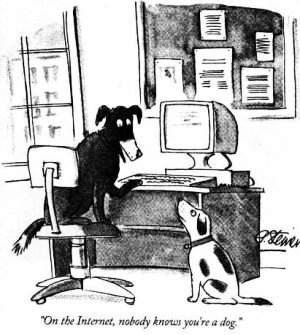
Cartoon by Peter Steiner for The New Yorker
But more than that, the reason the internet is seen as the great equalizer is because no one can see what you look like. There’s a famous cartoon in The New Yorker with a caption that simply states, “On the internet, nobody knows you’re a dog.” It’s emblematic of this idea that the internet breaks down real-world barriers like gender, race and class, so that all of us are on equal footing. Unfortunately, that simply isn’t the case.
“It’s a complete myth,” says boyd. “The internet reinforces many inequalities, hierarchies and existing social divisions. … This technology simply mirrors other aspects of life back at us.” After all, our brains are not separate from our bodies — when we go online, we bring with us a whole host of pre-existing prejudices and preconceived notions of how the world works. In It’s Complicated, boyd writes this about inequality on social media: “Social media magnifies many aspects of daily life, including racism and bigotry. Some people use social media to express insensitive and hateful views, but others use the same technologies to publicly shame, and in some cases threaten, people who they feel are violating social decorum.”
“No site does the work of democracy. It is people who do that through technologies, not technologies in and of themselves.”
When we ask boyd if anonymous forums like Reddit offer a more even playing field than other social networks, she says, “No site does the work of democracy. It is people who do that through technologies, not technologies in and of themselves.” Jen Schradie, a sociologist at UC Berkeley, adds to this, telling us that the poor and working class are much less likely to be online in the first place, so there’s already a built-in class disparity. “What we are left with is a digital production gap,” she says. “The internet in general, and social media in particular, is dominated by the elite. … The verified/non-verified divide is just the tip of the iceberg.”
As is evidenced by Shatner’s reaction to some of us being verified, he certainly believes in that divide — that those who are verified are somehow more privileged than those who are not, and they should be deserving of that privilege. As a verified user on Twitter myself, I’ll admit that it’s nice to be deemed worthy of the status, if only because it adds legitimacy and credibility to what I do.
@DashaPohoral @Numeson @verified @twitter and nobodies should not be verified because it shows a huge flaw in the Twitter system.
– William Shatner (@WilliamShatner) June 22, 2014
But being verified doesn’t make me special. It doesn’t make me better than anyone who’s not verified — I don’t get preferential treatment at restaurants and I don’t get to skip ahead in line at the airport. Further, you don’t need a verified checkmark to have credibility. Dick Costolo, the CEO of Twitter, does not have a verified account. I was unverified on Twitter for years and I’m still unverified on Facebook. Not having that little checkmark did not and does not impact how I do my work. I’m sure the majority of people I interact with on a daily basis have no idea what in the world being verified on Twitter means. As Colucci himself mentioned in a response to Shatner, the verification status is “just for work, and outside of that it really means nothing.”
And yet, the prestige associated with that silly little verification icon persists. At least among the elite few who know what it means.
Filed under: Internet
.CPlase_panel display:none;

The second Oculus Rift headset uses the Samsung Note 3 screen, literally

Back when Oculus VR first showed off its second virtual reality development kit, the Facebook subsidiary wasn’t saying anything specific about the origins of its new, higher-resolution screen. But now that that second dev kit is shipping to pre-order customers, the teardowns have begun and we have a better idea of what it’s using: the screen from Samsung’s Note 3. Not a similar screen, but the screen directly taken from a Note 3 smartphone — an AMOLED pushing 1080 x 960 into each eye. Oculus VR even kept the touch module attached, though we’d strongly suggest against trying to use it while wearing the Rift headset.
As iFixit notes, the screen is being overclocked to run a higher refresh rate (75 Hz), which is important in creating what Oculus calls “low-persistence”. Hilariously, when the headset’s taken apart, you can see the directness of the screen’s use, camera-holes and all. Check out the video below for a full walkthrough of the new Rift dev kit.
Of course, Samsung and Oculus working together is interesting unto itself. We reported in May that Oculus VR and Samsung are collaborating on another VR headset — “Gear VR” — which Oculus is creating the software for while Samsung creates the hardware. That Samsung is providing the screen for Oculus’ new dev kit looks to be another component of the partnership.
Interested in learning more about the second Oculus Rift dev kit? Check out the video below!
Filed under: Cellphones, Gaming, Wearables, Software, HD, Mobile, Samsung, Facebook
Source: iFixit
.CPlase_panel display:none;

Is Snapchat really worth $10 billion?

While competitors are busy cloning Snapchat in an attempt to replicate its success, Evan Spiegel and co. have continued to forge their own path. The company is already experimenting with new features in an attempt to generate revenue, but it’s also apparently talking to some big hitters to ensure it can keep growing until those profits come. According to Bloomberg, Snapchat is currently in talks over a new round of funding with investors, which include Yahoo-backed Alibaba, that if confirmed could value the company at an incredible $10 billion. It’s a significant figure, not only because it puts it on par with both Dropbox and Airbnb, but it’s around three times the amount Mark Zuckerberg’s Facebook is rumored to have offered to acquire the company last year. Not bad for a service that’s known mostly for evaporating text and photo messages. Snapchat is understandably keeping quiet about its latest round of talks, and the figures could well change before its latest round of funding closes. Regardless of what happens, it appears Snapchat’s decision to hold out and grow the service was the right one.
Filed under: Cellphones, Internet, Software, Mobile
Source: Bloomberg
.CPlase_panel display:none;
Facebook is killing its Gifts service, still wants you to buy stuff

Mark Zuckerberg’s experiment in social network retail has finally come to an end: on August 12th, Facebook Gifts will close forever. The company’s gift feature grew from its acquisition of the social gifting app Karma, selling teddy bears, socks and chocolates drop shipped directly to your Facebook friends. Eventually Facebook discovered that gift cards took the lion’s share of sales and discontinued physical gifts altogether. Now the company says it’s refocusing its resources on programs that help businesses increase sales through Facebook, rather than selling product themselves. So, in short, the “Buy” button is here to stay, but you’ll have to enable your friends’ Starbucks habit elsewhere.
Filed under: Networking, Internet, Facebook
.CPlase_panel display:none;
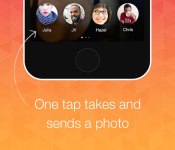
Instagram quietly (and slowly) launches Snapchat rival, Bolt

We knew Instagram’s effort to nab a bit of Snapchat’s thunder was imminent thanks to leaked promo banners, and now, the app has officially arrived… for some. Bolt, the filter-driven photo app’s own ephemeral messenger has hit iTunes and Google Play for folks in Singapore, South Africa and New Zealand. The software’s claim to fame is speed: instead of having to fiddle through a series of options, tapping a contact’s picture both captures and sends a photo — no further swiping required (tap and hold records video). So long as they’re in your favorites list, of course. There’s also an undo feature that allows you to retrieve a message in the first few seconds by shaking your phone. While Bolt doesn’t require a Facebook or Instagram account, you will have to sign up with your phone number for sorting through your contacts. For now though, most of us have to find solace in just reading about it, since a select few locales are privy to the initial rollout. Instagram’s word on that particular strategy is situated after the break.
“Bolt is the fastest way to share an image or a video — just one tap to capture and send. We decided to start small with Bolt, in just a handful of countries, to make sure we can scale while maintaining a great experience. We expect to roll it out more widely soon.“
Filed under: Internet, Software, Mobile, Facebook
Source: TechCrunch
.CPlase_panel display:none;
 AIVAnet