



It only takes $9,000 to join this social network

True or False: You don’t go on Facebook anymore, because it’s such a drag not being able to talk about your private jet’s new upholstery. After all, a few of your old friends post regularly about student debt and (gasp) mortgage payments, and it’ll make you look like an insensitive prick.
If you answered True, this new social network called Netropolitan hopes you’ll be willing to pony up a whopping $9,000 up front to rub virtual elbows with the equally rich. Netropolitan’s website describes it as “an online country club for people with more money than time” and is open to anyone over 21 with cash to throw around. There’s no need to add friends, since you can see everyone else’s post once you get it, but you can form groups around common interests (which, by the way, you can also do on Facebook for free).
This new social network for the elite was created by James Touchi-Peters, a former conductor of the Minnesota Philharmonic Orchestra, because he “saw a need for an environment where you could talk about the finer things in life without backlash,” according to CNN. He promises the website will show no ads and will offer a round-the-clock tech support to help you navigate the website. Netropolitan’s still in its very early stages, but if it lasts, you’ll have to pay a hefty $3,000 more per year to be able to stay.
If the website’s WordPress backend or .info TLD don’t suit your taste, though, you can always choose from the other exclusive social networks. There’s ASmallWorld, which was once described as the “MySpace for millionaires” and Affluence.org, which you can join for free if you can prove a $3 million net worth. Finally, there’s Topcom, which is like Facebook, Twitter and Skype combined, but only for the top 200 world leaders.
Filed under: Internet
Via: CNN
Source: Netropolitan
.CPlase_panel display:none;

Instragram ads are coming to UK feeds very soon

While Instagram has been monetising its app for nearly a year, UK users have enjoyed scrolling through their timelines completely free of ads. Until today, that is. The company has taken to the service to share the very first sponsored post with UK users (shown above), letting them know that “over the coming weeks” it will begin displaying paid content their streams, whether they like it or not. Users are invited to tap the “Sponsored” label to learn more about a specific campaign, but the majority are likely to become acquainted with “…” button, which quickly hides them from view. The dream might be over but Instagram says it’s starting out with only a “few” businesses, meaning you shouldn’t be bombarded with ads when they begin rolling out.
Via: The Next Web
Source: Charlotte Williams
.CPlase_panel display:none;

Facebook’s rumored ‘Moments’ app will help you share privately

Facebook’s megaphone-like approach to sharing makes it less than ideal for more private missives. Sharing private images or jokes with select people is something of a test of nerves. One slip of a drop-down menu, and your intimate photo could go global, rather than just to your “mates” privacy group. But, Facebook wants you to share in anyway, and to anyone you like with confidence it seems. According to TechCrunch, the social network’s working on a “Moments” mobile app to help. Once again, Facebook would be taking a single-focused idea out of the main mobile app into a standalone one if sources are correct. The Moments app will reportedly use a visual, tile-based interface for you select the group or sub groups of people you wish to share your — we assume — moment with. If this sounds a lot like Google+’s “circles” mechanism, that’s because it does. There’s no word when Moments could find its way onto phones, so for now, you’ll just have to run the gauntlet with current tools to avoid having your mom comment on bachelor(ette?) party photos.
Filed under: Internet, Mobile, Facebook
Source: TechCrunch
.CPlase_panel display:none;

Oculus co-founders donate $35 million to erect computer science wing at University of Maryland

New York City is a town of names: Rockefeller, Astor, Trump. Legacies of the vast wealth held by dynastic families in early 20th century New York City. America’s college campuses are littered with the same convention; wealthy alumni donate large sums to expand a university, and subsequently name that expansion after themselves. The University of Maryland, for instance, is getting a $35 million computer science wing from two of Oculus VR‘s co-founders. And what’s it named? “The Brendan Iribe Center for Computer Science and Innovation,” apparently, after Oculus VR CEO Brendan Iribe. Oculus chief software architect (and co-founder) Michael Antonov is footing another $4 million.
The new facility is planned to “feature state-of-the-art maker spaces,” says UMD’s Jayanth Banavar. Iribe describes it as, “designed for hackers, makers and engineers, which will help give rise to future breakthroughs, products and startups that will transform the way we live and interact with the world around us.” More bluntly, the space is being built to educate the next generation of virtual reality and other future computing platforms. “This gift positions Maryland to be one of the leading institutions for virtual reality in the world,” Iribe says.
And yes, your guess is at least partially right: Iribe has that kind of money to throw around because the company he most recently co-founded was purchased by Facebook for $2 billion. But his gigs before Oculus were similarly lucrative. First, Iribe co-founded Scaleform with Antonov, which sold to Autodesk for $36 million in 2011. Then, he worked as chief product officer at Gaikai before it was sold to Sony for $380 million. And now he’s CEO of Oculus. Not a bad run!

So, why the University of Maryland? It’s where Iribe and Antonov met, as well as their alma mater. It’s also what Iribe calls “the beginning of a long-term commitment toward transforming education”; not the first we’ve heard from him on the subject. Iribe’s mother is even in on the donating, adding another $3 million on top of Iribe and Antonov’s $35 million to establish two leadership positions for the new computer science wing.
UMD says the center will specifically target research in “virtual reality, augmented reality, artificial intelligence, robotics, computer vision and human interaction.” In so many words, it’s an attempt to build out education in burgeoning engineering fields. And that whole “getting your name on a building” thing doesn’t hurt either.
There’s a video with Iribe and UMD folks right here, if you’re into that kinda thing.
[Image credit: Oculus VR/University of Maryland (Brendan Iribe), Flickr/Matt Chan (University of Maryland)]
Filed under: Gaming, Internet, Software, HD, Mobile, Facebook
Source: University of Maryland
.CPlase_panel display:none;
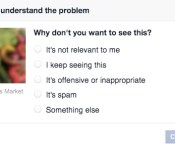
Facebook wants to know why you don’t like its ads

Advertising comes hand-in-hand with almost any free service on the internet, but those ads are only useful to companies if you actually look at that them. Facebook has been trying to filter out unwanted ads for awhile, but now it’s taking a direct approach: it’s simply asking users what they don’t like. From now on, whenever users select “I don’t want to see this” on an item in their newsfeed, Facebook will ask why: is it offensive? Is it spam? Have you seen this ad before? In all, the social network will give users five options to chose from and use the data to adjust ad distribution accordingly. In tests the feature showed a significant reduction in ads reported as inappropriate. Check out the company’s official announcement at the source link below.
Via: TechCrunch
Source: Facebook
.CPlase_panel display:none;

Facebook test lets users schedule when a post will be deleted

It’s certainly nothing new for Facebook to test new features amongst a limited number of users before a widespread rollout, or killing them entirely (it did ask for willing participants, after all). With its latest trial, the social network is trying out an option in its iOS app that allows you to schedule when a post will delete. Taking a cue from its own ephemeral offering Slingshot, the feature will sort the erasing after a period ranging from one hour up to a week. As The Next Web points out, it’s likely that deleted posts will remain on Facebook servers rather than being permanently deleted, but that’s a point we’ll be looking to clarify if the tool gets officially added in the future.
Filed under: Internet, Software, Facebook
Source: The Next Web
.CPlase_panel display:none;

Trading ‘presence’ for untethered virtual reality: Gear VR versus Oculus Rift

Standing up and moving around with a virtual reality headset is risky. What if you walk into a table? Or step on your dog? Or bash your face into the wall? Standing up and moving around while wearing Samsung and Oculus VR’s Gear VR headset isn’t suggested. But when you put it on, seated, and turn your whole body around to look behind your virtual self, and no cords get in the way, that’s a magical experience. “There are going to be different categories of VR,” Oculus VR CEO Brendan Iribe told Engadget in an interview last week at IFA 2014 in Berlin, Germany.
On one side, there’s a tethered experience like Oculus Rift, where, “There’s going to be this bigger, more expensive experience … that has a much bigger sense of ‘presence’ right now all attached to a computer where you have power plugged into the back,” he said. That’s the concept of being transported to another world and actually being there: a sense of “presence.” On the other side, there’s mobile VR: untethered, intended for mainstream accessibility and able to use your existing devices (such, as, say, your cellphone). “It’s untethered, but there’s now limitations and restrictions around the GPU/CPU,” Iribe said.
Virtual reality, right now, is all about trade-offs. This discrepancy between mobile and tethered VR is the biggest trade-off there is: Do you want convenience, or do you want “presence”?
If you answered, “I want both,” we’re right there with you. Sadly, that’s not a reality just yet. Iribe explained:
“There are certainly trade-offs. We don’t know how long it’ll take to get to the magic VR sunglasses that are untethered. It’s a dream. We all believe in that future of a mobile, VR pair of sunglasses, but that’s pretty far away.”
Gear VR is a staging ground for mainstream virtual reality. It uses the Note 4. It’s focused on media consumption. It’s light and pretty. Heck, when it launches this October alongside the Note 4, everything you can do on it will be free experiences. That’s part of the plan of pushing virtual reality into the mainstream. Hook ‘em with casual VR, then show off the big guns with tethered, interactive virtual reality.
Having spent a lot of time with Oculus VR’s second development kit, I was skeptical of the experience being offered with Gear VR. The graphical fidelity is, of course, nowhere near that of a dedicated PC. There’s no depth-tracking, so if you move your head forward, the scene remains static. These are major barriers to delivering on “presence,” the concept of feeling as though you’re physically there while wearing a VR headset. “Presence” is at the core of VR: It’s what distinguishes virtual reality headsets from head-mounted displays.
Oculus VR CTO John Carmack agreed, and said that his team is hard at work on taking those next, necessary steps to make mobile VR more capable:
“We are absolutely tackling position tracking, multi-user experiences, better gaming — all these things — in the coming year. It’s an exciting train we’re hitched onto with Samsung here, because there technology ticks twice a year. And that’s a treadmill that we’ve chosen to get on, and we’re going to do our very best to stay on that and continue innovating at that pace.”
After Gear VR, Carmack expects the competition from other electronics giants will step up tremendously. “This is good enough that it’s going to attract competition from the other significant players,” he said. And that competition is good for us, the VR users, as it means rapid innovation. Video passthrough on Gear VR is a perfect example: If Oculus’ Rift doesn’t ship with some form of video passthrough — what Carmack calls his “Diet Coke button” — that would be tremendously surprising.
Characteristically, Oculus co-founder Palmer Luckey doesn’t see video passthrough as just the ability to interact with reality while wearing a VR headset. He wants more, like augmented reality. “It’s one thing to have a convenience window,” he told us. “It’s another to try and make something where that’s a core feature of the device like AR. That’s a much harder problem to solve.”
Despite the trade-offs, Gear VR offers Oculus a chance to get its name out there on a virtual reality product and to set a foundation for software on the first consumer version of the Rift. The basics — the dashboard and store UI, for instance — will be familiar on the Rift. “Our dashboard, the basic interface, platform and store: Expect it to be similar between the two,” Carmack said.
It also enables VR developers to start making some money. Beyond just helping push VR into the mainstream, Gear VR enables virtual reality developers to start building a financial foundation for future projects. “The critical thing, from the developer standpoint, is we’re actually going to have a market where they can sell and get checks from Oculus with this sooner than on the PC front,” Carmack noted.
In the long-term, mobile virtual reality and tethered virtual reality won’t be separate entities. Carmack foresees a not-so-distant future where the Rift has a dedicated processor that enables both tethered and untethered VR. That’s always been the end goal, really. How soon it’s coming is up for debate.
“I have my vision for where this goes for Oculus,” Carmack said, “Where Oculus starts building systems that might as well include systems-on-a-chip (SOCs), graphics renderers and things inside ours. Not state-of-the-art necessarily, something that will boost the cost all that far up. But then Oculus version three or five or whatever it ends up being is something that can be use unplugged — we’d have our own Android stuff and all that — but you could plug it into the PC and use that.” An interesting vision of the future indeed. Here’s hoping it’s even sooner than we expect.
Filed under: Cellphones, Gaming, Peripherals, Wearables, Software, HD, Mobile, Samsung, Facebook
.CPlase_panel display:none;

Facebook tackles YouTube with video counter, hits a billion plays per day

Though it’s still far from YouTube, Facebook fired a shot across its competitor’s bow by saying it now serves up a billion native video views per day. In addition, its latest update (rolling out soon) has a YouTube-like view counter for public videos, making it easier to find popular selections or see how your own uploads are doing. Facebook said two-thirds of video views were from mobile devices, a stat no doubt helped significantly by the new auto-playing feature that’s on by default. A recent video ranking change also gives frequent video watchers more options. But as the NY Times pointed out, Facebook’s social nature can also send a video viral quickly. Beyoncé, for instance, garnered 2.4 million Facebook pageviews for a VMA video in four hours, while YouTube only chalked up a few thousand in the same time. Facebook also touted improved metrics for publishers, and is clearly interested in generating more video revenue — it recently purchased a video ad firm called LiveRail.
Filed under: Software, Mobile, Facebook
Via: TechCrunch
Source: Facebook
.CPlase_panel display:none;

Feedback Loop: Online security, the Note Edge, fitness trackers and more!

Happy Saturday, and welcome to another edition of Feedback Loop! With all the talk of online data breaches this week, we’re discussing ways to better protect your data stored in the cloud. After you’re done auditing your passwords, let us know what you think of Samsung’s new curved Galaxy Note Edge and find out how much fitness trackers are helping your fellow readers. Make yourself comfy and join us after the break for some in-depth tech talk.
How are you keeping yourself safe online?
In light of the recent iCloud security issue, I’m curious to find out how you protect yourself online. Obviously, strong credentials are the way to go, but are you using password managers? Do you go the extra mile by also enabling two-factor authentication? Come join the discussion and share your tips for staying safe in the cloud.
Who is the Galaxy Note Edge for?
Samsung likes to get a little crazy with mobile devices, and at IFA this week, the Galaxy Note Edge captured everyone’s attention. The curved screen has TgD asking just who is the Note Edge made for? Check out Brad’s hands-on first, and then head to the forums to share your own theories.
Facebook Messenger: Give in, or say goodbye
Decoupling apps is all the rage right now. Foursquare kicked things off with Swarm and Facebook finally spun out Messenger for good. John isn’t thrilled with this move; he doesn’t understand why we need multiple apps for a single service. Is this the final straw for Facebook on your phone?
Are fitness trackers improving your health?
Even though fitness analytics are showing up in phones and smartwatches, the dedicated tracker market is still kicking. They’re coming in the form of bracelets, watches (the non-smart kind) and more. The age-old question still remains though: Do they actually work? A few of our readers have already shared their success stories, so come join the discussion and let us know if all that data-tracking is working for you.
Other discussions you may also like:
- Recommendations for headphones priced under $200
- What IFA announcements have you most excited?
- Operation Finish all the games!
That’s all this week. Want to talk about your favorite gadget or have a burning question about technology? Register for an Engadget account today, visit the Engadget forums and start a new discussion!
.CPlase_panel display:none;

Facebook Messenger’s new trick brings doodles to your photos

Still looking for a reason to use Facebook’s now-unbundled Messenger app? A new feature learns from competition including Snapchat and Facebook’s own Slingshot by adding easy annotation on shared photos. Just click the picture icon like you normally do, then hit the edit button instead of send, and you can doodle with your finger (remember Draw Something? Is anyone still playing that?) or just type in some text before sending. Right now the tweak is Android-only, and should already be live if you’re running the most recent version of the app.
Filed under: Internet, Mobile, Facebook
Source: Facebook Messenger (Google Play)
.CPlase_panel display:none;
 AIVAnet