



Vienna gallery to auction off alleged Apollo 15 camera used on the lunar surface

If you happen to be in Austria in March and have, oh, around $270,000 just lying around, you can get a memento from the Apollo 15 mission. To be precise, that amount might win you a 70-millimeter Hasselblad Electric Data Camera at a WestLicht Gallery auction in Vienna — one that James Irwin supposedly used when he walked on the moon in 1971. While NASA hasn’t confirmed its authenticity, gallery officials insist that the number 38 printed inside the camera is all the proof they need, as the images Irwin took were all labeled with the same number.
According to CollectSpace, though, the camera’s serial numbers are identical to a device sold at a New Hampshire auction in 2012. While a former NASA photographer was certain that that camera was part of an Apollo mission, it was never linked to Apollo 15 or to the eighth man to walk on the moon. So, even if 200 grand’s chump change to you, it may be best to take the gallery’s claim with a pinch of salt.
Source: CollectSpace

Ricoh Theta enables 360-degree photo uploads to Google+ and Maps

Folks who shelled out $400 for Ricoh’s quirky Theta camera can now show off their 360-degree masterpieces to a larger audience. Circle-loving shutterbugs just got the option to upload their images to Google+ and Google Maps via the camera’s companion apps for Android, iOS, Windows 7/8 and Mac. While users have been able to upload to Twitter, Tumblr and Facebook for quite some time, it’s only now that the firm has made the apps compatible with Photo Sphere. As a nice plus, dedicated sphere photographers can string multiple 360-degree pictures together to create Street Views, though they’d probably look too trippy to help out a lost tourist.
Source: Ricoh, Google Play, iTunes, Windows/Mac
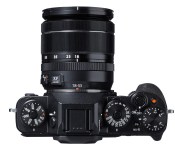
Fujifilm’s weather-resistant X-T1 camera ships next month for $1,300

Fujifilm shooters, get your wallets ready — the camera maker’s latest compact interchangeable-lens camera is about as full-featured as they come in this price range. The X-T1 is the latest X-Mount cam in the company’s lineup, which includes models such as the X-M1 and X-E2, and it’s compatible with the same suite of Fujinon XF and XC lenses. It’s set to ship next month for $1,300 body only, or $1,700 with an 18-55mm f/2.8-4 kit lens. The banner features here include a 16.3-megapixel APS-C X-Trans CMOS II sensor, a large 2.36M-dot OLED viewfinder, a refreshed UI and an EXR Processor II, which enables a half-second start-up time, 0.05-second shutter lag and a half-second shooting interval, along with an 8 fps burst mode that includes tracking autofocus.
Another significant addition, of course, is the weather-resistant build. When paired with a weather-resistant lens, the X-T1 can hold up to dust and water, and it’s freeze-proof to 14°F (-10°C), should your latest assignment bring you to the arctic tundra in the dead of winter. Additionally, the 3-inch, 1.04M-dot tilting LCD is reinforced with tempered glass, but assuming you’re using a neck strap properly, there’s no excuse for letting your X-T1 collide with the earth. Finally, it’s the first of its kind to support the new SDXC UHS-II format, which yields write speeds double that of a traditional SD card. There’s also WiFi connectivity, with instant transfers and remove shooting via the Fujifilm Camera Remote app. Three new weather-resistant lenses, including an 18-135mm f/3.5-5.6, a 16-55mm f/2.8 and a 50-140mm f/2.8, will launch as well, though we don’t have pricing and availability information to share at this point.
Filed under: Cameras
New week, new rumors for the Samsung Galaxy S5
When it comes to rumors surrounding Samsung’s flagship devices, it’s starting to feel more like rumors surrounding Apple devices — starting months in advance of release.
For example, back in November we started hearing rumors the Samsung Galaxy S5 was expected to launch in Q1 of this year. This isn’t all that surprising as it lines up nicely with previous launches of flagship Galaxy devices.
Then as time has passed us by, the rumor mill is starting to heat up and turn out more and more rumors surrounding the device, seemingly one rumor a week (give or take).
As of right now the Galaxy S5 is supposed to come with new battery tech for faster charging, a QHD screen, an aluminum unibody, revamped TouchWiz UI, and now a 20-megapixel camera, complete with an iris scanner for added security, according to a report from PhoneArena.
It’s hard to sift through all of the rumors and separate fact from fiction, but with the Samsung’s history of pushing the envelope with new features (even features that many may deem unnecessary), many of these rumors may indeed be true.
As usual, only time will tell and you can be sure we will cover the device and it’s specs once its made officially available.
Until then, be sure to tune in next week. Same rumor time, same rumor channel.
The post New week, new rumors for the Samsung Galaxy S5 appeared first on AndroidGuys.

Adafruit shows how to make your own touchscreen camera using Raspberry Pi (video)

Do you like the idea of building your own digital camera, but want something a little more sophisticated than Ikea’s cardboard cam? Adafruit will be happy to help you out. It has posted instructions for making a point-and-shoot using little more than a Raspberry Pi, its matching camera module and Adafruit’s PiTFT touchscreen. The resulting device won’t rival any modern point-and-shoot for quality, but it’s truly usable — you can even slap on a WiFi adapter to upload shots to Dropbox. Whatever your experience with DIY photography, you’ll find everything you need to know at the source link.
Filed under: Cameras
Via: Raspberry Pi
Source: Adafruit
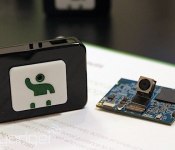
Wearable Google Helpouts streaming camera shares GoPro heritage, we go hands-on (video)

Ambarella isn’t exactly a household name, but the 10-year-old company’s silicon has long found its way into GoPro cams and other hardware thanks to its video-compression chops and low-power tech prowess. Word broke last month that Google commissioned the outfit to produce a reference design for a wearable camera that would stream to its Helpouts service, which lets folks ask experts for help over video. Here at CES, the manufacturer’s brought along a few samples of the device, and we’ve just put our paws all over one.
Inside a plastic housing the size of a chunky matchbox, Ambarella’s placed a custom chip (an A7LW, if you’re curious) that endows the package with the ability to stream 1080p video at 30fps for a minimum of one hour. The housing also comes with a mini-USB port, microphone, 500mAh battery, 8GB of flash storage, WiFi and Bluetooth connectivity, along with power and “connect” buttons up top.
Not only can the setup stream 1080p footage with just 1 Mbps of bandwidth — albeit with a varying bit rate to adjust quality — but it also pipes the video directly to Google’s servers over WiFi, removing the need to tether to another device. After a user joins a Helpouts session, the camera will become available as a video source. What’s more, the hardware can either be used by one of the pros on Mountain View’s service, or the Average Joe looking for a hand.

The camera held its own when it came to video quality, which looks like what we’ve come to expect from Google Hangouts. Although it piped footage to the cloud and down to the tablet on display, there was only about a second’s worth of lag, likely thanks to Google’s software.
When it comes to the wearable aspect of the cam, some of the models on hand sported a clip on the rear or a metal loop up top for a necklace. Having said that, form factor and features will be up to device manufacturers who buy the innards from Ambarella — that is, if Google goes forward with the idea of shooters that natively support Hangouts.
Ultimately, the draft hardware not only shows that Hangouts may score capable, tailored streaming hardware, but also that those cams might not be too far off. Details regarding pricing, release dates and manufacturers are still too early to pin down, but something tells us we can expect to hear more from Google this year.
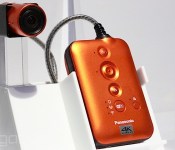
Panasonic’s first-person 4K camera debuts at CES, set for launch in late 2014

Wearable devices and 4K are two of the biggest trends at CES, and Panasonic has managed to make both collide. The outfit’s revealed a UHD camera that folks can wear on their head with the help of a plastic mount that wraps around their ears and neck. While the prototype is nearly identical to the HX-A100 cam the firm debuted at last year’s show (yes, it’s still waterproof), this Ultra High-Definition model is lined with some more powerful innards. Detailed tech specs are being kept under lock and key, but the unit on display was sending a live feed of the pixel-packed footage to a 4K display through a mini-HDMI port — a feature that will be available in the final version. Despite the hardware’s compact form, it produced sharp video free of stuttering, and caught a fairly wide field of view courtesy of its fisheye lens. While there’s no word on pricing, the first-person camera is slated for a release later this year.
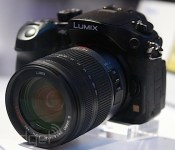
Panasonic’s next GH mirrorless camera will record 4K video, arrive late February for under $2,000

With plenty of 4K displays in Panasonic’s booth, it’s appropriate the firm’s finally shown off a camera in its GH line that records 4K video. The company’s keeping most of the hardware’s specs close to its collective vest, but a representative was able to divulge a few details. UHD content can be recorded at 200 Mbps, and output in a full live feed via a mini-HDMI port (thanks to ALL-I Intra mode) to display on a computer or record to a hard drive. Of course, the Micro-Four Thirds shooter can save footage straight to an SDXC card — a UHS Class 3 prototype variant tuned for such a task was on display — though space will run out fairly quickly.
There’s no word how many megapixels the cam totes, but it will be able to simultaneously snap photos while recording video. More details are set to arrive with the camera’s official release in late February, when it’ll arrive with a price tag of $2,000 or less. In the meantime, look out below for a glimpse of the shooter in the gallery.
Filed under: Cameras
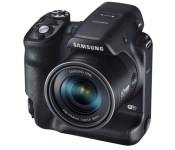
Samsung announces a batch of sharing-focused SMART cameras, including a dual-grip beast with 60x zoom

They don’t run Android, and we’re not sure if they even run Tizen OS, but a lineup of new smart cameras at CES represents Sammy’s best efforts to elevate point-and-shoots to a higher state of technological being. (Hopefully before the entire genre of the “cheap camera” is wiped out by smartphones.) We’re still lacking exact pricing and availability, alas, but the model numbers and specs hint at the essential hierarchy, starting with the huge WB2200F bridge camera with 60x zoom and going all the way down to the tiny WB35F with a 12x zoom. All the cameras come with WiFi and NFC for quick pairing to a smartphone or tablet; all deliver 16MP images as a bare minimum; and we’ll take a moment to cover each one in a little more detail after the break.
WB2200F

This bridge camera sits at the head of the table, with a Back-Side Illuminated (BSI) sensor for improved low-light performance (at least compared to the regular CCD sensors lower down the lineup), 60x zoom with optical stabilization for ridiculously detailed shots of squirrels and usefully wide 20mm focal length at the other end of the zoom range. Aside from NFC and WiFi, other connectivity options come in the form of a full-sized SD slot and HDMI output. In addition to the big 75mm LCD, a dual-grip design stands out as being unusual for this category of camera, and it makes room for a bigger battery that Samsung promises will allow users to “indulge their passion [for photography] for longer periods of time than ever before.”
WB1100F

On the face of it, this camera delivers much the same feature set as the WB2200F, but with a smaller 35x zoom that brings the weight down to 462 grams (as measured, conveniently, without the battery), instead of 608 grams. But there are other sacrifices to be made: the sensor is a non-BSI CCD, plus there’s only 720p video recording (instead of 1080p) and no HDMI output.
WB350F

This looks to be an updated (and hopefully cheaper) hybrid of last year’s Galaxy Camera and WB850F, without Android, but with the same 21x zoom, 16MP BSI sensor and max ISO of 3200 — all of which suggests that picture quality should actually be pretty decent. We’ve got the same-sized LCD as the WB220F, but now with touch sensitivity. We also have the same connectivity features, but here housed in a camera that weighs 216 grams, which suggests this could be the most mainstream offering of the lot.
WB35F and WB50F

This is the smallest of the bunch, at 144 grams and just 10 centimeters wide. Aside from the difference in form factor, with just a 12x zoom lens here, most features and specs are similar to the WB1100F. Also the SD slot is replaced by microSD, which may actually be more convenient for sharing to other mobile devices. Finally, the WB50F is billed as a “child-friendly” alternative to the WB35F, with a slightly more rugged build that slightly adds to the weight.
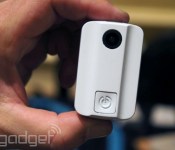
meMini’s wearable camera gives you the gift of hindsight

meMini is the brainchild of New Zealanders Samuel Lee and Ben Bodley, and the former’s snow sports background was the inspiration behind creating the hardware. While the technology is still in the fluid “late protptype” stage, Bodley’s expertise with cameras has ensured that the unit will ship with a high quality 3.1-megapixel camera with a 160-degree field of view. In terms of storage, the meMini has 16GB of non-expandable memory, with a 32GB edition mooted as a bonus for a certain class of Kickstarter backer. Which brings us round to the price: as, like any invention from the last few years, the company will be taking to Kickstarter with the hope of raising $50,000, with the standard edition setting priced at $150 for early backers, while the standard edition is expected to retail for around $200.
Dana Wollman contributed to this report.
Filed under: Cameras, Wearables
Source: Kickstarter
 AIVAnet