


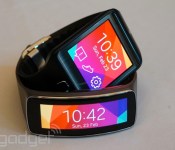
Meet Samsung’s new smartwatch family: the Gear 2, Neo and Fit

Samsung’s new crop of Gear smartwatches are no longer card-carrying members of its Android Galaxy. That’s because Tizen, the company’s open-sourced OS, has taken over the reins for the line begot by the barely five-month-old Galaxy Gear. And, in typical Samsung fashion, the company hasn’t released just one new Gear, but three with very specific areas of focus: the fashionable Gear 2, the functional Gear Neo and fitness-focused Gear Fit. The newly announced trio was on display here at Mobile World Congress in Barcelona, giving us a chance to get acquainted with their particular quirks and let you know whether or not to free up some space on your wrist.
Based on looks alone, it’s obvious the Gear 2 is Samsung’s new smartwatch flagship. The device not only surpasses its stripped down sibling, the Neo, with the inclusion of a camera just above its 1.63-inch watchface, but it also boasts an all-metal enclosure and removable leather strap. This is in contrast to the Neo’s all-over colorful, plastic design — though it, too, features a swappable strap and even designer support from the likes of Moschino and Nicholas Kirkwood. Their spec differences aside, both the Gear 2 and Neo feature 4GB of internal storage, 300mAh battery, an inbuilt IR blaster (paired with Samsung’s WatchOn app) for controlling your TV, IP67 rating for water-resistance, Bluetooth 4.0 for connecting to a portable media player and heart rate monitor (located under the watch face) to aid with fitness-tracking. That latter health-focused bit even goes as far as “coaching” users, via haptic feedback, to increase or decrease their exercise rate.
So how do these two new Gears differ cosmetically from the original Galaxy Gear that inspired them? For starters, Samsung’s done away with the exposed metal screws of the Galaxy Gear’s front face in favor of a sleeker, seamless finish that gently blends into the band. The home button has been moved to a prominent position just at the base of the touchscreen, while the camera and/or IR blaster (depending on the Gear model) reside just above the top edge. The Gear 2 and Neo also sport a bit of user customization, as both now offer a multitude of wallpaper and font options. As for their charging cradle, Samsung didn’t have any on-hand to show off, but we’ve been told they’ll be different than that of the OG Galaxy Gear’s.

Then there’s the Gear Fit. In this trio of Samsung smartwatch amigos, it’s kind of the oddball, what with its 1.84-inch curved Super AMOLED display (432 x 128) and narrow focus on health and wellness. The Fit, like its Gear siblings, also features a swappable strap, Bluetooth 4.0 and an IP67 rating for water-resistance, except its battery is rated for longer use at up to four days. Of the bunch, it’s definitely the most physically attractive Gear option and the one we could really see users embracing.
There’ll be no shortage of apps for consumers that plunk down for any of these new Gears. Samsung has stated that it now counts over 100 dedicated apps for its Gear line and with the availability of its open SDK, that number is poised to expand even further. Of course, Samsung’s offering a means of getting to these third-party Gear apps easily via its own curated app store. As for its own pre-loaded selection, Samsung’s made it so that users will have access to the same stable of apps on Samsung’s Gear 2 and Neo: Notifications, Logs, Dialler, Contacts, Pedometer, Exercise, Heart Rate, S Voice, Media Controller, WatchOn Remote, Apps and Settings. While the Fit ditches the IR blaster- and phone-focused apps for the more narrow suite of Notifications, Media Controller, Pedometer, Exercise, Heart Rate, Timer, Stopwatch and Settings.
You’re probably wondering when we can expect to see these new Gears hit retail and just how much each is going to cost. Those are both good questions we, unfortunately, don’t have the answer to right now. Samsung would only go on record to say that the Gear 2, Neo and Fit would be available sometime in April, but that still leaves a giant question mark hovering over their respective prices. While that essential bit’s currently an unknown, we’d bet that, given the breadth of this new Gear line, you can expect there’ll be a range of affordability.
Sharif Sakr contributed to this report.
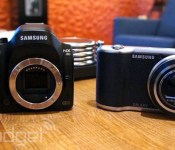
Samsung’s Android-powered Galaxy Camera 2 ships next month for $450

Looking to pick up Samsung’s much-improved Galaxy Camera 2? The 16-megapixel Android-powered shooter can be yours next month for $450. The device includes Jelly Bean under the hood, and unlike what we experienced with the original cam, this updated version felt quite snappy during our CES demo. There’s a 4.8-inch 720p display, WiFi connectivity (this model doesn’t support 3G/4G) and a boosted 2,000 mAh battery. The lens doesn’t appear to be improved, however, with a 21x zoom and an f/2.8-5.9 maximum aperture range. Samsung is also announcing pricing and availability for the NX30, which ships today for a whopping $1,000 with an 18-55mm kit lens. We think the company would benefit from a more aggressive MSRP there, given the competition in the mirrorless camera space, but if you aren’t turned off by the price, it does appear to be a solid option.

Galaxy S5: Invisible Side Touch Camera Button, 3D Tour, Aqua Shots and More
Mobile World Congress is getting much closer every day. While we sadly won’t be able to spring for the trip to Barcelona Spain, we will be here getting the info that comes from it out to you guys. All the major, and a bunch of the minor, OEMs will all be in attendance. Of course the big news that everyone is waiting on is the the Samsung Galaxy S5, which is supposedly going to be unveiled at the Unpacked 5 event on February 24th. True to tech tradition, all sorts of leaks about what the Galaxy S5 will and won’t have are circulating and a new round of treats have surfaced over at SamMobile that gives us some more to talk about.
 Shortly after their news that the Galaxy S5 will have a finger print scanner they received a flood of information that they claim is “trusted”. They are working through it all and doing lots of posts about the whole device and the obtained information. Today they let loose details on the camera aspect of the device. Here is what they have –
- 16 Megapixel sensor
- Shoots 4k UHD video at 30fps
- Shoot 1080p video at 60fps
That is cool and all, but it is the rest of the information that makes it a bit cooler. The Galaxy S5 will have a dedicated camera button. No, not one you actually push down. Instead they are referring to it as ‘Side Touch’. Apparently it will similar to capacitive buttons, but on the side of the device where a normal physical hardware camera button would be. Unfortunately they say their are limitations to its use. For instance you won’t be able to use it in Portrait Mode, Easy Mode or while recording a video.
The Galaxy S5 will also have an enormous amount of camera modes built-in at launch. The list includes ones we are all familiar with like HDR, Night, Eraser, Best Face and Best Photo. There are a number of new modes that will be added in though, like 3D Tour Shot, Focus Select and Golf. The 3D Tour Shot lets you create a interactive virtual tour of your surroundings. Sounds like photosphere to me, but I am sure it has some element of a Samsung twist to it. Focus Select is what it sounds like. It lets you draw the focus to a particular spot or focal point and and give the image the great depth of field that we all love. Golf is a cool addition where someone can take a photo video of you during your gold swing so you can play it backwards and forwards to see where your mistakes are.
There is one more camera mode that is mentioned, but no one seems to have really talked about it. SamMobile lists it, but apparently its presence doesn’t mean much. There is a Aqua mode. They say it is ”Appropriate for taking pictures underwater.” Does that mean the Galaxy S5 is also on par with the Xperia Z line and is water resistant to a point? I am not sure. That leads me to think that either the Galaxy S5, or one of its planned variants, will be submersible on purpose. Samsung didn’t have much luck with Galaxy S4 Active and water damage. It could simply be a mode that is specifically set up to take images of water too. For instance lakes, waterfalls and rivers where the blues and whites and reflective surface properties would be handled automatically. That is what I am more inclined to lean towards, but a Galaxy S5 Active style device is also weighing heavy on my mind.
They go on to talk about various camera effects to spice up your images also. With so many apps like instagram, Snapseed and even Photoshop express, all the additional effects seem like extra fluff. While the list of effects is rather large, Samsung will also be allowing you to download even more custom effects when you want. Again, sounds like they are taking the direction of Sony with the Xperia Z lines new camera.
Source: SamMobile

Microsoft intros monthly storage plans for OneDrive, Android app now does automatic camera backups

Nope, not SkyDrive — OneDrive. In case you haven’t heard, Microsoft’s cloud storage service is going by a new name, and it’s finally going into effect today; you should see in the upper-left corner the next time you log in. But that’s not all that’s new: the company also updated its Android app with automatic camera backups, so that any photos or video you take on your device will automatically be sent to OneDrive. If you recall, this is a feature you’ll already find on the company’s iOS app — for whatever reason, it just took a bit longer to make its way to Android. As ever, you can opt to have OneDrive upload on WiFi only, ensuring you don’t exceed your monthly data cap. You can also put limits on image sizes if you want to make the most of your 7GB of free storage space.
Additionally, the company introduced monthly storage plans, starting at $4.49 a month for 50GB and going up to $11.49 a month for 200GB. Simple math tells us that’s more expensive than buying the same amount of storage on a yearly basis, but hey, some of you might be commitment phobes, and we get that. Lastly, you’ll want to keep an eye on Microsoft’s new OneDrive Twitter account today: the company will be giving away 100GB of free storage for a year, with freebies going to the first 100,000 people who log in at a designated time. The catch: Microsoft hasn’t said yet what time folks will need to log into their accounts, so if you want a chance of winning, you’ll just need to watch OneDrive’s Twitter feed. Sneaky, but them’s the breaks.

[OP-ED] Smartphone Focus 2014: The race for the best camera on Android Begins

Original image courtesy of Android3DVideos
With the biggest week of the smartphone calendar still to come at MWC 2014 in just a week’s time, we’ve already had a taste of things to come this year with the launch of the LG G Pro 2 with its 4K capable camera. It’s clear that in the early going in 2014, manufacturers are going to be trying to keep up with each other in the video recording domain, aiming for that elusive 4K status. However, I don’t think this is where the real battle will be waged, nor will this necessarily win over us consumers either. While it will be influenced by video recording capabilities, I think the real battle between smartphones in 2014 will be determined by who can produce the best quality photos.
 This was especially telling at the end of 2013 with the release of two of the best budget devices we’ve ever seen. The LG-manufactured, Google-mandated Nexus 5 was fantastic value for flagship level performance with none of the premium cost, and Motorola’s last hurrah under Google, the Moto G, brought surprising performance and a very impressive screen in a package that may as well have costed pocket change. However, one resounding criticism of both these phones is that the camera performance was less than stellar. To be sure, other flagship devices like the Galaxy Note 3 and Xperia Z1 have much better cameras, but despite even the Xperia Z1 having a monstrous 20.7MP camera, there hasn’t quite been an outpouring of love for its abilities.
Across the figurative pond, we have the Apple iPhone 5S and the Nokia 1020, both with their share of toys. The iPhone of course has its 8MP camera, but perhaps crucially, that camera has an aperture of 2.2 which gives it some incredible light sensitivity, and is the source of many determined photographers to show off exactly how special the iPhone’s camera is.

Courtesy of Austin Mann
There is, of course, also the Nokia 1020 with its insanely impressive 41MP PureView camera which gives it unprecedented quality and zoom capabilities that aren’t available in any other phone. Likewise, the Nokia 1020 has its staunch supporters who continually show their approval of the phone through projects which highlight exactly how brilliant the camera is.

Courtesy of ArtPhotoFeature
Several professional photographers have asserted that they would replace their secondary cameras, normally of the point-and-shoot variety, with either of these phones, some even going as far to say replacing their DSLR as a primary photography device. While certainly, some photographers may prefer Android devices for their cameras as well, they are far and few between and from what I’ve seen, produce far less impressive results. Perhaps it does not matter to the average joe, but the fact that it is widely understood that despite the fact the iPhone has “less megapixels”, but still results in superior photo quality should be most telling. Android manufacturers take note: those ever-inflating camera numbers are fooling no one.
 There are, of course, examples of Android manufacturers making an effort to subvert this fruitless pursuit of ever-increasing megapixel count: HTC is of course the prime exponent of this with their UltraPixel technology which in my opinion took canyon-sized steps to narrowing the divide between Android and its platform competitors. HTC is rumoured to be taking their improvements to the next level in their next flagship device, the ethereal HTC M8, which allegedly utilizes a dual-sensor camera configuration to give it unprecedented photo quality capabilities; for exactly why this dual-sensor camera is going to rock, check out our explanation here.
I think that Android manufacturers need to follow HTC’s lead and really invest in developing new and innovative ways to improve camera quality because I think that we’ve already seen what we’ve needed to see performance-wise in 2014. Of course, we’re going to see new processors that push the limits of what should be possible from a device that fits in your hand, and batteries will continue to increase in capacity despite staying the same size, but through all these advancements, the progression of camera and photo quality has stagnated. However, with the increasing popularity of image based social networks like Instagram, Snapchat, and Pinterest, Android can’t just concede all these users to Apple and Nokia while they bicker within the Android market; they need to compete in a meaningful way.
Furthermore, I predict that by mid-2014, or even the end of 2014, pretty well all Android flagship smartphones will be rocking a Qualcomm Snapdragon 800 or 805, 3GB RAM, and a 2K display; so what will the differentiating factor be then? I say it will be the camera, and not some novel ability to film 4K videos that you aren’t able to output to its full potential on your non-4K TV or device; it will be the ability to take pictures that rival the abilities of the iPhone, Nokia 1020, maybe commercial cameras, and definitely its Android competitors. That will, and should be, the race that Android manufacturers strive to win in 2014.
Source: Austin Mann, ArtPhotoFeature

Mirrorless cameras, pricey point-and-shoots shine at Japan’s CP+

While Japan’s prominence continues to wane when it comes to consumer electronics in general, the country remains enormously relevant in the digital imaging space. Canon and Nikon dominate the market, alongside other mainstream players like Sony and Panasonic. Manufacturers like Casio, Fujifilm, Olympus, Sigma and Ricoh continue to release compelling models, too — your own camera probably got its start in an office tower near Tokyo, as other shooters will for years to come. Each year, Japanese consumers gather at CP+ in Yokohama, a four-day trade show that’s served as a venue for camera makers to show off their new products to local audiences for more than 50 years. Following the final PMA show in 2010, CP+ has been an important event for us as well — CES hasn’t caught on with the camera industry, and with Photokina held only once every two years, this February photo fest is the place to be.
This year, manufacturers opted for practical improvements over headline-grabbing features like absurdly small designs, gigantic LCDs or Android-powered UIs. But that doesn’t mean 2014′s lot skimps when it comes to innovation. Much to our surprise, Casio offered up one of the most interesting models. The EX-100, which is currently only expected to hit stores in Japan, includes a unique bracketing mode that varies not only exposure, but also white balance, focus and other settings in order to capture the perfect shot without a lot of photo know-how or prep. Sigma’s dp Quattro was another showstopper, with its unusually wide body, highly capable sensor and a trio of fixed lenses. We were also very impressed with Canon’s PowerShot G1 X Mark II, which delivers DSLR-like image quality in a package that’s smaller than most mirrorless cams.

There was also a bit of innovation on the storage front. SanDisk’s new U3 SDXC card is fast enough to capture high-bitrate 4K video. You’ll need one of these to capture 4K clips with Panasonic’s new GH4, or to take full advantage of the Fujifilm X-T1, which caught our eye with a weather-resistant housing, speedy performance and a bounty of dedicated dials. Olympus, meanwhile, caught us off guard with its Stylus SP-100, a 50x superzoom that includes a unique gun sight — a laser-projected bulls-eye helps you aim the camera quickly when you’re targeting a fast-moving subject way off in the distance. On the other side of the hall, Sony’s Alpha 6000 was one of our favorites in the mirrorless category, with super-fast focusing performance and a full suite of features, such as a bright OLED viewfinder and WiFi (the latter of which could be found on just about every camera at CP+). It was a fantastic show all around — and we’re already counting the days until Photokina, which kicks off this September in Cologne, Germany.
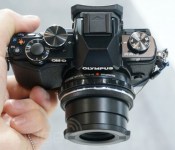
Olympus’ small and mighty E-M10 is priced to sell (hands-on)

It’s been more than two years since Olympus unveiled its OM-D E-M5, but that camera’s retro-inspired design is clearly here to stay. The latest model in the series, the E-M10, is priced more like a step-up camera than a flagship, but it hardly skimps on features, with the same 16-megapixel Micro Four Thirds sensor and classic good looks as 2012′s flavor. There’s also a very nice collapsable 14-42mm f/3.5-5.6 kit lens with an integrated cap, a sharp 3-inch tilting touchscreen, an integrated 1.44-megapixel EVF and built-in WiFi with a unique QR-code interface for easy pairing with the Olympus Image Share companion app. You also get an 8 fps (single autofocus) burst mode, 1080/30p video shooting, a 25,600 top ISO and 3-axis sensor-shift image stabilization (down from the 5-axis version included with the E-M5).
We had quite a bit of fun shooting at Olympus’ CP+ booth, where models and large floral displays joined forces to pose for a dozen or so E-M10s. The camera’s control layout and functionality is very similar to what we experienced with the E-M5, and the device performed well, with the speedy focusing we’ve come to expect from Olympus. We especially liked the collapsable power-zoom lens, which nearly triples in size once you power on the camera to provide a healthy zoom range with quick and consistent performance. The E-M10 seems like a great option for photographers that don’t already own on OM-D, but with specs similar to the E-M5, there’s not much incentive to upgrade. Additionally, we’d suggest considering the Sony A6000 as well, which is priced identically at $800 with a lens, yet offers a larger, high-resolution sensor and generally higher specifications. The E-M10 will arrive within a week or two, however, while the Alpha will ship in April, so if you need a new camera now, that’s worth noting, too.

Filed under: Cameras

Aiming Olympus’ Stylus SP-100, the 50x superzoom camera with a gun sight (hands-on)

There are bigger superzooms out there, but Olympus’ new Stylus SP-100 is trying to make you a better long-distance shooter alongside its 50x zoom functionality. A see-thru viewfinder window with a laser-projected bulls-eye right in the middle jumps out from the top of the camera when you press the appropriate button. Then, while you’re at a high level of zoom, the window acts as a short-cut way of ensuring you’re on-target without zooming out to reassess. Olympus even set up a faux flying bird right in the middle of the CP+ show floor in Japan, hanging from the ceiling supports to draw our full-zoom fire. It’s a clever shortcut to assist with framing — it seems pitched at beginner photographers, rather than those already used to telephoto lenses and DSLRs. It’s not perfect, you’ll still need to ensure your shutter speed is up to scratch to grab a decent image, but it’s certainly a good way of adding some extra guidance.
The 16MP Stylus SP-100 feels lighter than an entry-level DSLR and there’s still a built-in flash above that new framing assist system. Alongside that, this superzoom is also capable of up to 7 fps burst shooting (up to six frames) which should also help up the chances of getting the right actual shot. You’ll be able to test it out for yourself next month, when it lands in the US priced at $400.
Filed under: Cameras
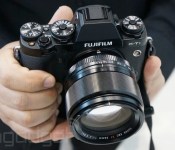
Fujifilm’s dial-filled X-T1 is a manual shooter’s dream (hands-on)

On paper, the most significant addition to Fujifilm’s X-T1 is its weather-resistant housing. But you’ll need one of three as-of-yet-unreleased weather-sealed lenses in order to take advantage — the 18-55mm f/2.8-4 kit optic isn’t up to snuff when it comes to keeping out water, sand and snow, so if you opt for the $1,700 bundle, you’ll be out of luck. Instead, we’re quite taken with the camera’s comprehensive control layout, which includes dedicated dials for exposure compensation, shutter speed and ISO (!) mounted up top. Some lenses also include an integrated exposure dial, so you can set the full exposure manually without any need to dig through menus. There’s also a 16.3-megapixel APS-C X-Trans CMOS II sensor and an EXR Processor II, along with a 3-inch, 1.04M-dot tilting LCD and a really nice 2.36M-dot OLED viewfinder for framing shots.
We spent a few minutes shooting with the X-T1 at CP+ just outside Tokyo this week, and the camera performed phenomenally. The focusing system was speedy and accurate, and the optional extended grip and vertical grip accessory made shooting in either orientation quite comfortable. The UI also felt like an improvement — even reviewing images on the built-in LCD, a process which can often be unnecessarily cumbersome, was a breeze. The X-T1 is one of the only current models to be compatible with the new SDXC UHS-II format (SanDisk announced its first U3 card just this week), so images you shoot in the 8 fps burst mode should make their way off the camera’s buffer very quickly.
Overall, we’re smitten with the X-T1, and depending on where pricing falls for the weather-resistant 18-135mm f/3.5-5.6, 16-55mm f/2.8 and 50-140mm f/2.8 lenses, this may turn out to be one of the most attractive mirrorless combos on the market. Those optics may be a few months out, but if you’re willing to stick with dry conditions for the time being, you should be able to pick this camera up within a week or two for $1,300 body only or $1,700 with the 18-55mm f/2.8-4 kit lens.

Filed under: Cameras
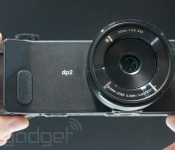
Sigma’s CEO wants you to focus on the dp2 Quattro’s new sensor, not its peculiar design

This was a bit of a shocker to us as well: Kazuto Yamaki, Sigma’s chief executive and lead design guru, doesn’t want you to be distracted by the dp Quattro’s strange shape. The extra-wide footprint is of course what first turned us on to this high-end camera, but the takeaway here should be the shooter’s 29-megapixel Foveon X3 CMOS direct image sensor, which Yamaki says enables a reduced file size and better high-ISO performance. That refreshed chip operates similarly to traditional color film, using multiple layers to capture enhanced detail. That, along with a new processor, should produce sharper, more realistic images with vibrant colors — something Sigma describes as “full-bodied image quality.” Without an opportunity to review full-resolution samples, we can’t really speak to the dp Quattro’s performance, but there’s no question that company reps are very excited about this new device.
The unusual design is what captured our attention, and judging by the long queue at Sigma’s CP+ booth in Yokohama, Japan today, consumers are quite curious as well. Our first thought was that the company widened the body to accommodate a larger display, but the 920k-dot, 3-inch LCD is shockingly ordinary. The model seen here is the dp2, which features a fixed 28mm f/2.8 lens, but Sigma is also releasing the dp1, which includes a 45mm f/2.8 optic and the dp3, which sports a 75mm equivalent lens (yes, you’ll need three cameras to take advantage of all three focal lengths). Since there’s a lot of real estate to work with, the buttons and control dials have plenty of room to stretch out — it literally couldn’t feel less cramped, so if you’re often accidentally tapping more than one button, you’ll love what Sigma’s done here. There’s also a hot shoe, and once you attach a full-size flash, the dp may feel better balanced.

We liked the design overall, though we’re still a bit puzzled, especially considering Sigma’s plea to look past the extra-wide housing. It’s also unclear how much each camera will retail for, or when they’ll hit stores, but our money’s on a price tag north of one grand. As for the internal design, Yamaki brings a bit of clarity in our video interview, embedded below.
Mat Smith contributed to this report.
Filed under: Cameras
 AIVAnet