



HTC explains how the ‘Duo Camera’ brings depth-sensing to the new One

Finally, we have an official explanation for the two round holes in the back of the new HTC One. The main camera, which sits in the regular spot, houses a 4MP “Ultrapixel” camera much like on last year’s handset. The smaller lens, which is positioned directly above — or to the side when you hold the phone in landscape mode to grab a shot — contains half the resolution (i.e., 2MP), but it doesn’t actually capture images. It merely offers a level of depth perception, allowing the camera to “understand objects in physical space.” A key benefit of this, according to HTC, is a quicker autofocus time of around 300ms, because the camera can use actual depth measurements to focus on objects. Other benefits come when you edit a photo, thanks to a range of effects (such as blurring) that can be selectively applied to foreground or backgrounds subjects. HTC has also just announced an SDK that will allow third-party app makers to make use of the Duo Camera’s depth map, which is stored as metadata within JPEG files. For more, including sample images, check out our full review of the HTC One.
Filed under: Cellphones, Cameras, Mobile

Mirama hopes to replace your smartphone with a headset, your camera button with a finger gesture

Mirama wants do away with the the camera button on your smartphone. In fact, don’t even get the smartphone out to begin with. Its prototype headset lets you frame and take a picture using your hands and its built-in camera. No buttons, no vocal cues, not even a wink. Other gestures, registered by the camera sensor, add the ability to confirm or cancel (thumbs up and down, respectively) while you can even attempt a hand-written message … if you have the right level of motor control. (Our own gestured penmanship during a quick demo proved we didn’t.) The cameras on the left and right, meanwhile, offer a constant stream of what you’d be looking at if you weren’t wearing the headset. Gestures (well, your hands) then appear in bright cyan on top of the video feed.
The plan is for a head-based wearable to replace the smartphone, at least when it comes to the interface. As Senior Engineer Johannes Lundberg suggests, the hardware needs to get a lot lighter and a whole lot smaller for this to happen — the biggest barrier here (and why the company uses a PC to run its most recent prototype), is a matter of battery power. That’s another issue that needs to get tackled before Mirama becomes a more realistic prospect for most of us.

In a slightly unusual twist for a show all about wearables, Mirama’s prototype is more about the operating system than it is about the hardware itself. The company is already offering a bundle that include a set of glasses and laptop with the Mirama OS pre-installed and access to IDE and SDKs for app development, priced at 3 million yen. However, if you’ve got the skills and are looking ot build your own gesture system, BrilliantService is willing to sell you all the parts that make up their eyewear for 200,000 yen. And that name? Mirama comes from combining the words”miru’, which means ‘look’ in Japanese, and ‘amaze’, which means… yep, you’ve got it.
Filed under: Cellphones, Peripherals, Wearables, Science
Source: Mirama
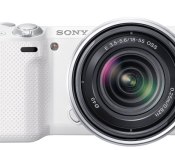
How would you change’s Sony’s NEX-5R?

Most camera geeks agree that Sony needed to make up for the NEX-F3, and that it did so with style by producing the NEX-5R. When we placed this in the hands of our in-house camera guru, he was “thrilled.” In fact, he described it as one of the best compact ILCs of 2012-2013, and that people should keep it in their mind the next time it came time to buy a camera. The question that needs to be asked, however, is did our man Honig get it right? If you’re a shutterbug who put one of these through its paces, then share with us your impressions and feelings over on the forum.
Source: Engadget Product Forums

Sony A7 and A7R firmware update brings boosted performance, improved image quality

Sony’s flagship duo of mirrorless cameras scored a few improvements today. After updating to firmware version 1.2, A7 and A7R owners will be able to take advantage of boosted image quality, new applications and faster start-up times when the camera is turned on immediately after being powered off. On the IQ front, Sony’s managed to reduce color noise in speed priority continuous mode. You may also notice reduced color artifacts at object edges in bright scenes while shooting video. As for the Play Memories Camera apps, firmware 1.2 adds in new Live-view Grading and Smooth Reflection tools. There’s also better AE tracking in the Timelapse app. Finally, the update enables compatibility with the new 70-200mm full-frame lens.
Source: A7 (Windows), A7 (Mac), A7R (Windows), A7R (Mac)

Camera deals of the week: 03.19.14

Now is as good a time as any to hone that photography hobby. What’s that? You don’t have a camera? Well then, a handful of discounted models await on the other side of the jump that could have you eager to dive in. There’s a point-and-shoot, a retro design and a pair of pro-grade DSLRs to cover a range of snapshooting abilities.
If there are other photo wares you’re after that we haven’t included here — join us and add them to your “Want” list. Every time there’s a price cut in the future, you’ll get an email alert!
Nikon D800 (body-only)

Price: $2,180
Regular Price: $2,800
Engadget Global Score: 88
Buy: Fumfie
The D800 made its debut back in 2012 and has been shooting crisp 36-megapixel images ever since. Our 90-day Price History tool indicates that the current going rate is equal to the three-month low for the DSLR that also packs HD video chops and snappy autofocus.
Canon EOS 5D Mark II (body-only)

Price: $2,000
Regular Price: $2,699
Engadget Global Score: 89
Buy: 42nd Street Photo
We don’t usually like to include discontinued tech in these roundups. However, if you’re willing to take a chance on a DSLR with some age on it, the EOS 5D Mark II is also seeing its lowest price in the last 90 days. The camera packs a full-frame, 21-megapixel sensor that’s well-equipped to tackle low-light snapshots when the need arises.
Fujifilm X100S

Price: $940
Regular Price: $1,299
Engadget Global Score: 83
Buy: Fumfie
Prefer your photo hobby to sport a bit of retro flair? If so, Fuji knows a thing or two about classic styling, and its Fujifilm X100S is being sold at a three-month low price. It isn’t just a pretty face either, as reviewers have noted image quality and robust features as key selling points.

Nikon Coolpix S9500

Price: $220
Regular Price: $230
Engadget Global Score: 81
Buy: Amazon
If you don’t mind your point-and-shoot cloaked in red, the Coolpix S9500 is now marked at $130 below its original $350 asking price. Both WiFi and GPS features make the S9500 a solid travel companion when you don’t have room to pack in a full DSLR and all of its requisite accessories.
Filed under: Cameras

Samsung’s interchangeable-lens NX mini sports 1-inch sensor, fits in your pocket (hands-on)

Hey “style-conscious” men and women in your 20s and 30s, Samsung’s got a new camera just for you. The electronics giant is touting its NX mini as the world’s thinnest and lightest interchangeable-lens camera, and while it technically falls at the low end of the company’s NX line, this new cam comes along with a 1-inch (smaller) sensor and a scaled-down lens mount, which means new lenses, though you can use larger NX glass with a $150 adapter. Without a lens, the camera weighs 158 grams (5.6 ounces), making it lighter than “some bananas” (the fruit), as Samsung demonstrated with a PowerPoint slide during a presentation earlier today. There’s a 20.5-megapixel BSI CMOS sensor, WiFi, NFC, a 1/16,000 max shutter speed, 25,600 top ISO, 6 fps burst mode, 1080/30p video, a battery that can capture up to 650 shots with a full charge and a 3-inch HVGA flip-up touchscreen.
We spent a few minutes poking around the mini’s menu system and taking some sample shots (which we were required to leave behind). The camera performed well, with speedy focusing and accurate exposure (based on reviewing images on the LCD). It’s hardly the fastest mirrorless ILC on the market, but Samsung’s making no such claim — performance was what we’d expect from an entry-level model. Both the 9mm (24.3mm equivalent) f/3.5 pancake lens and 9-27mm (24.3-72.9mm) f/3.5-5.6 zoom are incredibly compact and lightweight. With the prime lens attached, the mini will fit in a jacket pocket. There’s also a 17mm (45.9mm) f/1.8 lens in the works, which should ship in July. The camera, meanwhile, will be available black, white, brown, green and pink sometime next month. A 17mm kit will retail for $450 while a version with the zoom lens instead (that also includes a tiny external flash) will be available for $550. Both pairings ship with a free copy of Adobe Lightroom 5.
Skype version 4.7 for Android brings significant battery savings
“Imagine being able to leave Skype running on your phone all day without having to worry about your battery life.”
That’s how Skype are promoting their latest version of the popular app, promising to rid the battery woes that has plagued the app for sometime.
Version 4.7 of Skype sees improvements that aggressively tackle the issue of battery usage, to a point where Skype claim leaving the application running in the background all day will go unnoticed by users when it comes to battery used.
To achieve such drastic improvements, Skype have had to make some fundamental under-the-hood changes including turning off instant notification of messages in group chats. They advise:
- In the near future, you will be able to receive group chat messages instantly without additional battery impact.
- If you can’t wait for that to happen, we’ve added a new setting to let you keep group chat notifications. Go to Settings > Notifications > check the “Sync group messages in the background” box.
In addition, version 4.7 of Skype includes a workaround for a KitKat bug which caused a ‘runaway’ process when the camera was synced in the background (fantastic news), as well as a fix for audio and video calling on tablets that do not have Bluetooth.
The update is live in the Google Play Store right now.
The post Skype version 4.7 for Android brings significant battery savings appeared first on AndroidGuys.

Samsung Galaxy S5 ISOCELL camera is suffering some production issues; delay Imminent?
 The story of early 2013 was the titanic battle between the Samsung Galaxy S4 and the HTC One for the Android smartphone crown, however, the conflict was marred by debilitating supply issues that befell HTC. The issues stemmed from a lack of HTC One camera modules which would eventually go on to severely impact HTC’s bottom line in the weeks after its release. While Samsung won that battle in terms of handsets sold, the tables have turned on Samsung in 2014 as the Samsung Galaxy S5 ISOCELL camera that was shown off earlier this week is apparently suffering from production issues.
This time, it’s not the camera sensor itself which is the problem; it’s Samsung’s new six-element lens which is constructed in an extremely complex and intricate process in which “even the slightest flaw results in a considerable optical distortion”. While the results of a successfully assembled lens are likely phenomenal, the current production yield of these lens is approximately 20-30%, even with Samsung outsourcing the assembly to a third party lens supplier. That’s definitely not a good sign, particularly with the April launch date looming, but hopefully some breakthroughs will happen in the near future to help Samsung meet its supply targets instead of delaying the Galaxy S5′s release in some regions.
What do you think about these new reports of delays for the Samsung Galaxy S5? Has Samsung bitten off more than it can chew with this new ISOCELL camera, and opened the door for HTC? Let us know your opinion in the comments.
Source: ETNews via Phone Arena

Esurance video appraisal lets a rep use your smartphone’s camera to assess damage remotely

This is one cool tool we hope to never use. Esurance’s new video appraisal feature for the insurer’s Android and iOS apps helps speed up the post-accident process significantly. Typically, you’re required to get a vehicle inspection after an accident before the insurance company can send out an estimate for repairs. With the refreshed app, however, an appraiser can use your smartphone’s camera to assess the damage while also communicating with customers and the repair shop. You’ll still need to set up an appointment (through the Esurance app), but since the agent won’t need to travel, you’ll be on your way much more quickly. Video appraisal requires a smartphone running Android 4.0+ or iOS 7, a front and rear camera with autofocus and a WiFi or LTE connection. Tablet compatibility is in the works. It’s available today in the latest version of the Esurance app.

Plex adds adds free Chromecast support for all, media shuffling and camera uploads to iOS

If paying for beta access to new features isn’t your bag, the folks at Plex have some good news for you. The media outfit’s announced that not only is beaming your content to Google’s HDMI dongle free now (if you’ve purchased the app), but iOS fans can join the music and photo party too. But wait, there’s more: the update also lets web users and iDevice owners shuffle, reorder, remove and add content to a media queue with some pretty neat filtering options. There isn’t an ETA for availability on other platforms, however.
Plex Pass subscribers have a new toy too: iOS camera uploads. The feature is pretty self-explanatory (photos are background-uploaded from your device to the Plex servers), but, if you don’t have an Apple TV, it’s likely one of the easier ways to put your pictures on the living room flat-screen. Can you hear that? It’s the sound of the Chromecast-app floodgates creaking open — on Apple’s mobile OS, even.
Filed under: Home Entertainment, Tablets, HD, Mobile
 AIVAnet