


DJI brings its smooth video tech to the ground with Ronin camera gimbal

DJI’s best known for its versatile photography drones, but the company’s bringing its stabilization technology to ground-based shoots with the Ronin camera gimbal. The compact device, which appears to be a more consumer-friendly version of last year’s Movi Freefly, is designed to work with a variety of compact cameras, from DSLRs to a Red Epic. The handheld gimbal is based on the firm’s ZenMuse tech, which you’ll find in select camera copters. A single videographer can control the rig, or you can have a second operator manage pan and tilt wirelessly. Ronin can be configured in less than five minutes using a companion smartphone app, which enables auto calibration after balancing the camera. We’re not clear on pricing just yet, but DJI says to expect the device to ship later this quarter.
Filed under: Cameras
Sony announces full-frame Alpha A7s with 4K video output

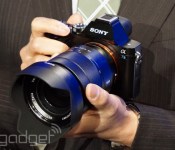
It wouldn’t be NAB without a major 4K announcement from Sony, and that’s exactly what we’ve got here. The company introduced the Alpha A7s at its Las Vegas press event today, bringing 4K video to the popular full-frame mirrorless camera line. The “s” in the new camera’s name stands for sensitivity, and to that end it supports an ISO range of 50 to 409,600. The 12.2-megapixel full-frame sensor limits downscaling with 3,840 x 2,160 (QFHD) 4K video, ultimately resulting in higher quality footage. While you can store 1080p video internally, you’ll need to use an external recorder to capture 4K video, which the camera outputs with 4:2:2 color sampling via HDMI.
You can store XAVC S-format video with a class 10 or higher SDXC card. When in 1080p mode, you can also opt to shoot with APS-C cropping, while 120 fps capture is supported when you jump down to 720p. The A7s can snap still images, of course, but it really shines when it comes to capturing 4K and HD video. The camera supports S-Log2 gamma, expanding the dynamic range to 1300 percent, resulting in reduced shadow and highlight clipping.
Physically, the A7s looks identical to its Alpha siblings, with a solid design and feel. It also sports WiFi and NFC, for wireless transfers to a smartphone or tablet. Also, like the other Alpha 7 cams, the A7s includes a Multi Interface Shoe, so you can add in Sony’s XLR mic adapter kit, the XLR-K1M. Pricing has not yet been announced, but Sony executives say to expect it in stores this summer, just a few month’s after Panasonic’s GH4. Check it out in our video below.
Sarah Silbert contributed to this report.
Contour returns to the action camera market with some familiar gear

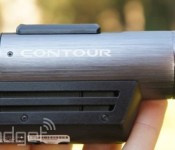
Contour quietly shut down last year, leaving outdoor explorers little choice but to pick up action cameras from GoPro and other rivals. The company found new ownership during that downtime, however, and it’s back in business this week with a renewed sense of purpose. For now, the firm is only selling the cameras it had before the lights went out. You can buy the entry-level ROAM2 camera for $200, while the flagship Contour+2 is available for $300. The firm won’t lean on its past glories for long, mind you — it’s promising new models later this year. It’s too early to say whether Contour can reclaim its place in the point-of-view camera industry that it helped create, but it’s good to see renewed competition in a field where the choices have been rapidly shrinking.
Filed under: Cameras, Wearables
Source: Contour (Pitchengine)
Lifelogging camera Autographer reaches out to Android users

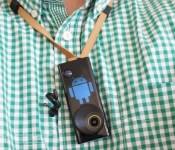
Having a photojournalist follow us around all day could work out to be pretty expensive, which is why we liked the idea of Autographer’s neck-worn lifelogging camera – even if we didn’t appreciate the low-fi picture quality. In any case, the device’s creators are continuing to improve the product, releasing a companion app on Google Play that opens it up to Android users. The company can’t fix the camera’s weak sensor, but at least there’s an identical set of features to what’s on the iOS counterpart.
Filed under: Cameras
Source: Google Play

Stock Android Camera app Could Soon Find its Way to the Play Store
Sources are claiming that Google is in the process of bringing the stock Android camera app, the one found on Nexus devices, to the Play Store. Adding it to the list of standalone apps that Google has already pulled out like Gmail. The Engadget source claims that testing is already underway and that it will eventually make its way out of the Android OS stock software found on Nexus devices and become available for any device running Android 4.4+.
 The move isn’t terribly surprising really. Over the last year or so we have seen more and more manufacturers take their apps out of devices and make them available as standalone apps. Samsung, Sony, Motorola and others are in that list. The Play Store offers up the control to ensure the app can only be installed to a supporting device and it also allows them to update the app independently versus having to release an entire OS update. With carriers needing to test out full on OS updates, Play Store app versions speed up the process at which they can release fixes, patches and new features to one aspect of a device.
Along with the news that the app will become stand alone soon, there is also talks of new modes like one that will help mimic a shallow depth of field to create blurry backgrounds without the need to do so through alternative apps like snapseed. The Xperia Z2 and HTC One (M8) have this ability already.
If that isn’t cool enough, they are reportedly going to be opening up the camera software to third-party developers. I imagine this would be for add-on apps that can be downloaded to create different effects and such.
I for one am pretty excited to see what Google has done to make the stock camera app even better. With third-party developer access, we should see a flood of great add-ons that can help unleash the create beast hidden inside.
Source: Engadget
Img: Gizmag
//<![CDATA[
ord = window.ord || Math.floor(Math.random()*1E16);
document.write('’);
//]]>

Google to focus on portrait shots and effects with improved camera app

We know that Google has been looking to bring more advanced photo features to Android for a while, but it may soon be ready to show off what it’s been working on. Sources aware of Google’s plans have confirmed to us that the search giant is currently testing a new version of its camera app that will sport a refreshed UI, a background-blurring effect for portrait shots, and improved panorama and Photo Sphere modes. As part of its overhaul, we’re told that Google has finally fixed issues with the default camera’s photo framing, allowing users to snap images with a new 100-percent no-crop viewfinder. That means you’ll see exactly what your Android device will capture before you hit the shutter button, with no unwanted objects creeping in at the edges.
The company is also said to be making the camera app more extensible, by opening support for third-party filters. This will allow developers (and Android enthusiasts) to create and import custom effects inside the stock camera app. The camera app’s portrait skills may see some improvements too, with the addition a new lens blur mode that will take photos with a shallower depth of field, mimicking the effects you’d typically see in Nokia’s Refocus app and HTC’s new One. New high-resolution panorama and Photo Sphere modes have also been added, improving the quality of your sweeping shots.
While many are awaiting the release of Android 4.4.3, the latest version of KitKat, Google is set to make these camera improvements available to users by way of a standalone update. Our sources indicate that the app will exist separately so that non-Nexus owners running Android 4.4 and above will be able to take advantage of the improvements, without having to wait for an OTA update from their device maker or carrier.
Filed under: Cellphones, Software, Mobile, Google
Ultrakam lets your iPhone capture higher resolution film-like video clips

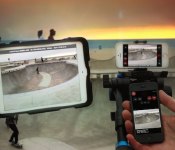
While Sony and Samsung are busy making phones with 4K recording capabilities, one developer has worked its pixel magic to get more from iPhone cameras. Ultrakam is the first iOS app capable of recording “2K” resolution with a film-like 24p frame rate, letting iPhone 5s owners shoot 2240 x 1672 pixel video (around 75 percent more pixels than regular HD) to output higher-quality footage than the default camera app. There’s support for the iPhone 5 and 5c, as well as the the iPad mini, iPad Air and iPad with Retina display, but the app is limited to high-definition and “2K” at 20fps on “older” devices.
Including an array of settings and various shooting modes that allow you to record higher bit-rate video and audio, with a minute of footage consuming up to 3GB of storage on max settings (expect that 64GB iPhone 5s to fill up fast), Ultrakam is primarily aimed at filmmakers. However, there’s plenty of neat features for regular users to show off their talent. It offers slow motion video, but again the iPhone 5s has all the fun, as it supports slow motion capture at 120fps over the iPhone 5′s 60fps. You can slow down your recordings by up to 10x if you choose the lowest preset. The app also supports timelapse shooting, offering custom configurations that will snap high resolution photos at set intervals, combining them to output a high-quality landscape. Once you’ve shot your footage, Ultrakam’s built-in player and editing tools let you play video, generate stills, color correct and share them with ease. Ultrakam is available on the App Store for $6.99 — a little more costly than your regular camera app, but the extra quality and advanced features may justify the price.
Filed under: Cellphones, Software, Mobile
Via: The Next Web
Source: Ultrakam, (App Store)

Olympus Stylus Tough TG-3 ships with WiFi and f/2 lens for $350, dead fish sold separately

We question Olympus‘ decision to photograph its latest ruggedized cam next to a dead fish, then send that image out to reporters. But puzzling marketing practices aside, this is one impressive point-and-shoot. The Stylus TG-3 hails from the company’s Tough line, which means it’s waterproof (to 50 feet), freeze-proof (to 14°F), shockproof (from seven-foot drops) and crushproof (to 220 pounds). Unlike many other ruggedized cams, however, the TG-3 is equally impressive when it comes to traditional capabilities. There’s a 16-megapixel CMOS sensor, an f/2-4.9, 25-100mm optical zoom lens, a 3-inch 460k-dot LCD, 1080p video, GPS and WiFi. A new microscope mode lets you snap macro shots just 10mm from your subject and a ring light accessory (perhaps our favorite feature) mounts atop the camera’s built-in LED to provide even light with small subjects positioned just in front of the lens. The TG-3′s expected to ship this June for $350 in black and red.
Filed under: Cameras
Olympus brings five-axis image stabilization to the point-and-shoot with $400 Stylus SH-1

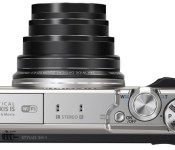
Olympus introduced its five-axis image stabilization in 2012 with the OM-D E-M5. That $1,000 camera was mighty powerful for its day, but the new IS tech was perhaps its most impressive feature, enabling sharp stills and steady handheld video. It’s very exciting, then, that Olympus is bringing that same stabilization to its point-and-shoot line with the Stylus SH-1. This compact cam has plenty of other tricks up its sleeve, too. Take the f/3-6.9, 25-600mm 24x optical zoom lens, for example, or the 16-megapixel BSI CMOS sensor and TruePic VII processor (the same found in the OM-D series). There’s also a 3-inch 460k-dot LCD, 1080/60p video, an 11fps burst mode and integrated WiFi. The SH-1 is expected in stores this May in black, white and silver. It’ll retail for $400, which, considering the optics and the five-axis image stabilization on board, is a pretty solid deal.
Filed under: Cameras

This system can tell if workers are lying by looking at their eyes

Eye-based lie detection has long been the stuff of research and science fiction, but it’s about to become a practical reality in the office. Converus is releasing EyeDetect, a hardware and software combo that helps companies find out if their workers are on the level. The system revolves around an SMI-made camera that monitors pupil dilation as well as the positions of the eyes and head. If you look shifty when answering questions, your supervisors will likely know within minutes. It’s not a perfect system; Converus claims 85 percent accuracy, which could allow for occasional false positives. We’ll know EyeDetect’s real-world usefulness very soon, though, as it’s launching in Mexico this April.
Filed under: Peripherals, Software
 AIVAnet